Category Archives: Decontamination Microbial

Research – Yersiniosis – Annual Epidemiological Report for 2021

ECDC

For 2021, 6 876 confirmed cases of yersiniosis (caused by Yersinia enterocolitica and Y. pseudotuberculosis) were reported by 28 EU/EEA countries with an overall rate of 1.9 cases per 100 000 population. This represented an increase of 11.8% on 2020 and the pre-pandemic period (2017−2019). As in previous years, Germany accounted for the highest number of cases, followed by France. These two countries accounted for 49% of all confirmed yersiniosis cases in the EU/EEA. Denmark had the highest notification rate of 7.8 cases per 100 000 population, followed by Finland, Lithuania and Czechia (Table 1, Figure 1).
Thirty-three percent of 1 649 yersiniosis cases with known information were hospitalised. No deaths were reported among the 3 659 cases with known outcome.

Click to access AER%20yersiniosis%20-%202021.pdf

Research – Strategies for Controlling the Sporulation in Fusarium spp

MDPI

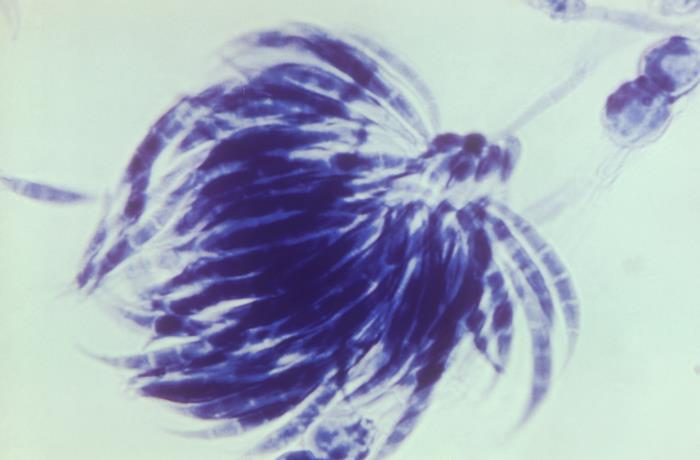
Fusarium species are the most destructive phytopathogenic and toxin-producing fungi, causing serious diseases in almost all economically important plants. Sporulation is an essential part of the life cycle of FusariumFusarium most frequently produces three different types of asexual spores, i.e., macroconidia, chlamydospores, and microconidia. It also produces meiotic spores, but fewer than 20% of Fusaria have a known sexual cycle. Therefore, the asexual spores of the Fusarium species play an important role in their propagation and infection. This review places special emphasis on current developments in artificial anti-sporulation techniques as well as features of Fusarium’s asexual sporulation regulation, such as temperature, light, pH, host tissue, and nutrients. This description of sporulation regulation aspects and artificial anti-sporulation strategies will help to shed light on the ways to effectively control Fusarium diseases by inhibiting the production of spores, which eventually improves the production of food plants.

Research – Control measures for Shiga toxin-producing Escherichia coli (‎STEC)‎ associated with meat and dairy products: meeting report

WHO

Overview

Although Shiga toxin-producing Escherichia coli (STEC) have been isolated from a variety of food production animals, they are most commonly associated with ruminants from which we derive meat and milk. Because of the widespread and diverse nature of ruminant-derived food production, coupled with the near ubiquity of STEC worldwide, there is no single definitive solution for controlling STEC that will work alone or in all situations. Instead, the introduction of multiple interventions applied in sequence, as a “multiple-hurdle scheme” at several points throughout the food chain (including processing, transport and handling) will be most effective.

This report summarizes the review and evaluation of interventions applied for the control of STEC in cattle, raw beef and raw milk and raw milk cheese manufactured from cows’ milk, and also evaluates available evidence for other small ruminants, swine and other animals. The information is presented from primary production, to the end of processing, providing the reader with information on the currently available interventions based on the latest scientific evidence.

This work was undertaken to support the development of guidelines for the control of STEC in beef, raw milk and cheese produced from raw milk by the Codex Committee on Food Hygiene (CCFH).

Report


Research – Salmonellosis – Annual Epidemiological Report for 2021

ECDC

In 2021, 30 EU/EEA countries reported data on salmonellosis. Twenty-six countries reported data using either the 2008, 2012 or 2018 EU case definitions for salmonellosis. Compared with the 2008 and 2012 EU case definitions, the 2018 EU case definition allows nucleic acid determination for laboratory confirmation, and includes a requirement for antimicrobial susceptibility testing and reporting of results. Four countries used another case definition, which was not specified.

Click to access SALM_AER_2021.pdf

Research – STEC infection – Annual Epidemiological Report for 2021

ECDC

For 2021, 6 534 confirmed cases of STEC infection were reported by 30 EU/EEA countries (Table 1). Twenty-seven countries reported at least two confirmed cases, and three countries reported no cases. The EU/EEA notification rate was 2.2 cases per 100 000 population, representing a 37.5% increase compared with the previous year.

Click to access AER%20STEC%20-%202021.pdf

Research – Shigellosis – Annual Epidemiological Report for 2019

ECDC

Shigellosis is a relatively uncommon disease in the EU/EEA, but remains of concern in some countries and certain population groups. For 2019, 30 EU/EEA countries reported 8 448 confirmed shigellosis cases.

The overall notification rate was 2.2 cases per 100 000 population, slightly higher than in 2018. The highest notification rate was observed in children below five years of age, followed by male adults aged 25–44 years. Sexual transmission of shigellosis among men who have sex with men (MSM) is thought to have contributed to the gender imbalance characterising the disease.

Click to access shigellosis-annual-epidemiological-report-2019.pdf

Research – Lowest number of recorded Hepatitis A cases, five other food and waterborne diseases rising towards pre-pandemic levels

ECDC

Hepatitis A cases in 2021 were at their lowest levels since EU-level hepatitis A surveillance began in 2007, while five other food and waterborne diseases are rising towards pre-pandemic levels. The information is revealed in the Annual Epidemiological Report 2021, of which six chapters are published today by ECDC.

The chapters cover diseases causing  the highest number of  food- and waterborne infections in the EU/EEA, namely campylobacteriosis, salmonellosis, yersiniosis, shigatoxigenic Escherichia coli infection, listeriosis, and hepatitis A.  

In the EU/EEA, the hepatitis A notification rate was exceptionally low in 2021, with 0.92 cases per 100 000 population, compared to 2.2 in 2019. This can be attributed primarily to the COVID-19 pandemic and restrictions, including reduced international travel.  

However, a sharp decline in the trend of hepatitis A cases has also been evident in the EU/EEA over the last five years. Additional factors contributing to this may be the heightened awareness of hepatitis A transmission, increased preventive measures such as practising good hygiene and increased vaccine uptake among at-risk groups. Increased natural immunity in at-risk groups following a large multi-country outbreak occurring in 2017 and 2018 may also be of importance.  

In 2020, the number of cases of campylobacteriosis and salmonellosis, the two most commonly reported gastrointestinal infections in the EU/EEA, decreased notably due to the COVID-19 pandemic. Unlike hepatitis A, these appeared to increase in 2021, but the levels are still well below those of the pre-pandemic years. This could partly be an effect of reduced travel as travel-related infections were at their lowest in 2021. 

Listeriosis, shigatoxigenic Escherichia coli infections and yersiniosis trends decreased less notably in 2020 and the number of cases returned to the pre-pandemic levels in 2021. This might be due to the more severe symptoms caused particularly by listeriosis and shigatoxigenic Escherichia coli infections, which are then more likely to be diagnosed and reported. Additionally, many of the cases are acquired  within the EU/EEA, and the numbers are not as affected by international travel restrictions.  

In 2021, although the COVID-19 pandemic was still ongoing, the gradual reduction of COVID-19 restriction measures, along with the return to normal daily life (social events, doctor’s visits, travel), the reopening of bars, restaurants and catering facilities (i.e. schools, workplaces), may explain the increase in cases of the five food- and waterborne diseases.   

Research – Campylobacteriosis – Annual Epidemiological Report for 2021

ECDC

The notification of campylobacteriosis is mandatory in 22 EU Member States, Iceland, Liechtenstein, and Norway. In five EU Member States (Belgium, France, Greece, Italy, and the Netherlands) notification is voluntary. The surveillance systems for campylobacteriosis have full national coverage in all EU Member States except four (France, Italy, the Netherlands, and Spain). The coverage of the surveillance system in 2021 is estimated to be 20% in France and 64% in the Netherlands. These proportions were used when calculating notification rates for these two EU Member States. No estimate of population coverage in Italy and Spain was provided, so notification rates were not calculated for these two countries. The drop in cases in Luxembourg in 2019 is a surveillance artefact caused by a change to non-culture-based methods (PCR) in private laboratories, resulting in a reduced number of isolates sent to the national reference laboratory. From 2020, laboratory confirmation with PCR is included in the notification system which, along with a new electronic laboratory notification system, is expected to result in an increase in Campylobacter notifications. Greece has reported data on laboratory-confirmed cases collected from public hospitals from 2018 onwards. For 2020 and 2021, Spain has not yet received data from all regions normally reporting and the case numbers are therefore lower than expected. All countries reported case-based data except Belgium, Bulgaria, and Greece, which report aggregated data. Both reporting formats were included to calculate numbers of cases, notification rates, disease trends, and age and gender distributions.

Click to access campylobacteriosis-annual-epidemiological-report-2021.pdf

Research – A Comprehensive Review of Variability in The Thermal Resistance (D-Values) of Food-Borne Pathogens—A Challenge for Thermal Validation Trials

MDPI

Abstract

The thermal processing of food relies heavily on determining the right time and temperature regime required to inactivate bacterial contaminants to an acceptable limit. To design a thermal processing regime with an accurate time and temperature combination, the D-values of targeted microorganisms are either referred to or estimated. The D-value is the time required at a given temperature to reduce the bacterial population by 90%. The D-value can vary depending on various factors such as the food matrix, the bacterial strain, and the conditions it has previously been exposed to; the intrinsic properties of the food (moisture, water activity, fat content, and pH); the method used to expose the microorganism to the thermal treatment either at the laboratory or commercial scale; the approach used to estimate the number of survivors; and the statistical model used for the analysis of the data. This review focused on Bacillus cereus, Cronobacter sakazakii, Escherichia coli, Listeria monocytogenes, and Clostridium perfringens owing to their pathogenicity and the availability of publications on their thermal resistance. The literature indicates a significant variation in D-values reported for the same strain, and it is concluded that when designing thermal processing regimes, the impact of multiple factors on the D-values of a specific microorganism needs to be considered. Further, owing to the complexity of the interactions involved, the effectiveness of regimes derived laboratory data must be confirmed within industrial food processing settings.


Research – Prevent Illness From C. perfringens

CDC

CDC Clost perf

Clostridium perfringens bacteria are one of the most common causes of food poisoning. CDC estimates that the bacterium causes nearly 1 million foodborne illnesses in the United States every year.

C. perfringens makes spores, which are inactive forms of the bacterium that help it survive heat, dryness, and other environmental conditions. Under certain conditions, such as when food is kept at an unsafe temperature (between 40°F and 140°F), C. perfringens spores can transform into active bacteria, which multiply in the food. After someone eats food containing C. perfringens, it can produce a toxin (poison) that causes diarrhea.

Foods cooked in large batches and held at unsafe temperatures are typically involved in outbreaks of C. perfringens food poisoning. Specific foods commonly linked to C. perfringens food poisoning include

  • Poultry, such as turkey and chicken
  • Meat, such as beef and pork
  • Gravy

Outbreaks of C. perfringens food poisoning tend to happen in settings where large groups of people are served and keeping food at proper temperatures may be difficult—for example, hospitals, school cafeterias, prisons, nursing homes, and large events with catered food.

Most of these outbreaks happen in November and December. Many of them have been linked to popular holiday foods, such as turkey and roast beef.