Category Archives: Decontamination Microbial

India – 135 people hospitalised in Malappuram after showing symptoms of food poisoning

The Hindu

As many as 135 people who attended a wedding at Kalady near Tavanur in Malappuram district on Wednesday were hospitalised after they developed symptoms of food poisoning.

Many of them are children. They were admitted to different hospitals at Edappal and neighbouring places with diarrhea, vomiting, and fever. Health officials said none was critical.

While 69 people from Thuruvanam island near Maranchery, who accompanied the bride to the party at the groom’s house at Kalady, fell sick, 66 of those who suffered food poisoning were from Kalady panchayat.

Health officials examined the premises where food poisoning was suspected and said it could have been caused by the water used during the function.

USA – Missoula County Health Officials issue warning about raw milk following possible Coxiella burnetii exposure

Food Poison Journal

Following potential exposure to bacteria from unpasteurized milk sold at a farmers’ market in Missoula County, the Missoula City-County Health Department is warning residents of the dangers of consuming unpasteurized, or “raw,” milk.

Milk that was recently sold at a local farmers market came from a herd where two cows tested positive for Coxiella burnetii, which is the bacteria that causes Q fever. While one of those cows had not yet produced milk, the other produced about 10% of the farmer’s yield.

“We don’t know if the cow was shedding the bacteria at the time it was milked, or if that cow’s milk was sold at the farmers market,” said Environmental Health Director Shannon Therriault. “So, we can’t say for sure whether anyone was exposed. However, what we do know is that unpasteurized milk can contain harmful bacteria that can make you and your loved ones sick.”

Unpasteurized milk products have been linked to outbreaks of E. coli, campylobacter, salmonella, brucella, listeria and cryptosporidium. In the case of Q fever, symptoms can take two or three weeks to present following exposure. According to the Centers for Disease Control and Prevention, symptoms of Q fever include fever, chills, fatigue, headache, muscle aches, nausea, vomiting, diarrhea, chest pain, stomach pain, weight loss and a non-productive cough.

USA – Boston Restaurant, Los Amigos Taqueria, Linked to Salmonella Outbreak

Outbreak News Today

kswfoodworld salmonella

According to the local media, a local restaurant chain has been shut down by the local health department due to “a slew of health violations” and “unsanitary working conditions that appear to be linked to a Salmonella outbreak in the area.”

The health department recommends that customers of the “Los Amigos Taqueria Brighton location between May 12 and May 18 to monitor themselves for symptoms of Salmonella infection, including fever, diarrhea, and abdominal pain, and to contact a healthcare provider for an evaluation and testing if appropriate.”

Health agents’ report said that “multiple rodent droppings” were also found on pineapple cans, bags of pinto beans, single-use beverage holders, and storage tables.

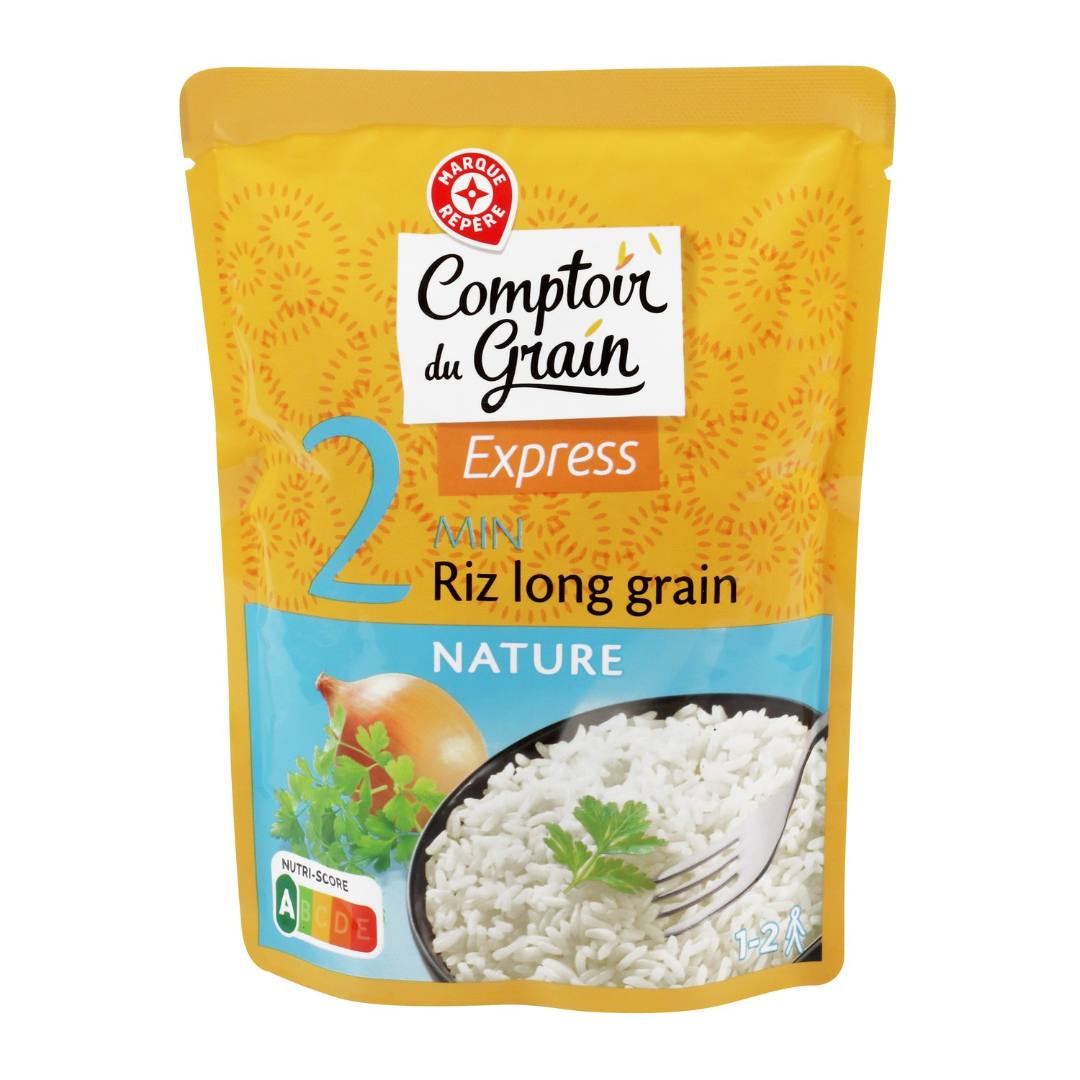
France – LONG GRAIN RICE NATURE EXPRESS 2MIN 250G – Risk of Microbial Contamination

Gov france

entification information of the recalled product

  • Product category Feed
  • Product subcategory Cereals and baked goods
  • Product brand name GRAIN COUNTER
  • Model names or references LONG GRAIN RICE NATURE EXPRESS 2MIN 250G
  • Identification of products
    GTIN Batch Date
    3564700873304 M102-3 Date of minimum durability 04/12/2024
  • Products Lis tPoster_reminder_Riz_long_grain_nature_Express_250g_Comptoir_du_Grain.pdfAttachment
  • Packaging DOY PACK 250G
  • Marketing start/end date From 04/21/2023 to 05/17/2023
  • Storage temperature Product to be stored at room temperature
  • Geographic area of ​​sale Whole France
  • Distributors E.LECLERC

Research – U.S. heads up Codex ciguatera efforts

Food Safety News

The United States is to lead work on a document covering the prevention or reduction of ciguatera poisoning.

The plan was given the go-ahead at a recent Codex Committee on Contaminants in Foods meeting.

An electronic working group, chaired by the U.S. and co-chaired by France, Spain, and Panama, will work on a proposed code of practice or guidelines for consideration at the next meeting of the committee in 2024.

In 2022, the committee established a working group chaired by the U.S. and co-chaired by the European Union to prepare a discussion paper on the topic.

Generally, codes of practice provide practical guidance or measures to reduce or prevent a hazard in food, while a guideline gives higher-level principles and approaches to addressing a particular issue.

Research – Whole-Genome Sequencing of Shiga Toxin-Producing Escherichia coli for Characterization and Outbreak Investigation

MDPI

Abstract

Shiga toxin-producing Escherichia coli (STEC) causes high frequencies of foodborne infections worldwide and has been linked to numerous outbreaks each year. Pulsed-field gel electrophoresis (PFGE) has been the gold standard for surveillance until the recent transition to whole-genome sequencing (WGS). To further understand the genetic diversity and relatedness of outbreak isolates, a retrospective analysis of 510 clinical STEC isolates was conducted. Among the 34 STEC serogroups represented, most (59.6%) belonged to the predominant six non-O157 serogroups. Core genome single nucleotide polymorphism (SNP) analysis differentiated clusters of isolates with similar PFGE patterns and multilocus sequence types (STs). One serogroup O26 outbreak strain and another non-typeable (NT) strain, for instance, were identical by PFGE and clustered together by MLST; however, both were distantly related in the SNP analysis. In contrast, six outbreak-associated serogroup O5 strains clustered with five ST-175 serogroup O5 isolates, which were not part of the same outbreak as determined by PFGE. The use of high-quality SNP analyses enhanced the discrimination of these O5 outbreak strains into a single cluster. In all, this study demonstrates how public health laboratories can more rapidly use WGS and phylogenetics to identify related strains during outbreak investigations while simultaneously uncovering important genetic attributes that can inform treatment practices.

Research – Natural Antimicrobials for Listeria monocytogenes in Ready-to-Eat Meats: Current Challenges and Future Prospects

MDPI

Abstract

Listeria monocytogenes, an intra-cellular, Gram-positive, pathogenic bacterium, is one of the leading agents of foodborne illnesses. The morbidity of human listeriosis is low, but it has a high mortality rate of approximately 20% to 30%. L. monocytogenes is a psychotropic organism, making it a significant threat to ready-to-eat (RTE) meat product food safety. Listeria contamination is associated with the food processing environment or post-cooking cross-contamination events. The potential use of antimicrobials in packaging can reduce foodborne disease risk and spoilage. Novel antimicrobials can be advantageous for limiting Listeria and improving the shelf life of RTE meat. This review will discuss the Listeria occurrence in RTE meat products and potential natural antimicrobial additives for controlling Listeria.

Research – Multistate Outbreak of Salmonella Thompson Infections Linked to Seafood Exposure — United States, 2021

CDC

In July 2021, the Colorado Department of Public Health and Environment (CDPHE) laboratory identified a cluster of five Salmonella enterica serotype Thompson isolates related to one another within one allele difference, using whole genome multilocus sequence typing (wgMLST). These five isolates, submitted to the public health laboratory as is routine process for confirmatory testing of Salmonella, were highly related to those identified in a 2020 multistate investigation, during which traceback was conducted for sushi-grade tuna and salmon; a common supplier was not identified. The 2021 investigation commenced on August 5, 2021, with five patients living in Colorado, and one each in Missouri, Washington, and Wisconsin. During August–December 2021, CDC, CDPHE, public health and regulatory officials in several states, and the Food and Drug Administration (FDA) conducted epidemiologic, environmental, and laboratory investigations of this multistate outbreak of Salmonella Thompson. Isolates were genetically related to one another and to 2020 isolates within zero to one allele difference. Implicated seafood products were traced to a single seafood distributor, in which the outbreak strain was identified through environmental sampling, and in which inspection identified inadequate sanitization and opportunities for cross-contamination of raw fish. The distributor issued a voluntary recall of 16 seafood items with high potential for contamination and completed remediation actions. This outbreak illustrated the importance of effective cleaning and sanitizing procedures and implementation of controls. When multiple products are recalled during an outbreak investigation, collaboration between public health agencies and implicated facilities can help provide food safety information to restaurants, retailers, and consumers, and to ensure disposal of all recalled products.

Hong Kong – Food Safety Focus – Bacteria in Raw Meat vs Cooked Meat

CFS

Recently, bacterial contamination of meat has attracted public attention. According to the World Health Organization, contamination of food by microbiological agents is a worldwide public health concern; and most countries have documented significant increases over the past few decades in the incidence of diseases caused by microorganisms in food. In this article, we will introduce some factors that determine the growth of bacteria in food, and discuss the different food safety considerations for bacteria in raw meat and cooked meat and the measures to reduce risks of food poisoning caused by bacteria.

Factors Determining the Growth of Bacteria in Food

Bacteria grow best when intrinsic and extrinsic properties are optimal for their growth. Intrinsic properties are the properties that are inherent parts of the food, such as pH and water activity, while extrinsic properties are the properties of the environment in which the food is stored, such as temperature. Water activity is not the same as the moisture content of the food but is a measure, ranging from 0 to 1, of the availability of water in food which determines the growth and survival of bacteria. By controlling these factors (e.g. controlling the storage temperature of the food), bacterial overgrowth can be prevented.

USA – Cyclospora outbreak in Georgia prompts public health alert

Food Safety News

Officials in Georgia are investigating an outbreak of cyclospora infections in the northwest part of the state.

The Georgia Department of Public Health Northwest Health District has not released any numbers, but it is urging people with symptoms of cyclospora infection to seek medical treatment and report any confirmed infections to local public health officials.

Georgia public health officials say their investigation is ongoing and the number of cases is expected to increase.

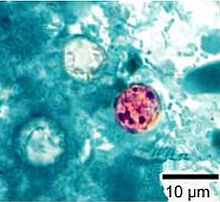
Cyclosporiasis causes an illness that can result in prolonged gastrointestinal distress, including watery diarrhea with frequent, sometimes explosive, bowel movements that can last for weeks. In severe cases, cyclospora infection can require hospitalization.220px-Cyclospora_cayetanensis_stained