Category Archives: Contaminated water

Research – Bacterial Antagonistic Species of the Pathogenic Genus Legionella Isolated from Cooling Tower

MDPI

Legionella pneumophila is the causative agent of Legionnaires’ disease, a severe pneumonia. Cooling towers are a major source of large outbreaks of the disease. The growth of L. pneumophila in these habitats is influenced by the resident microbiota. Consequently, the aim of this study was to isolate and characterize bacterial species from cooling towers capable of inhibiting several strains of L. pneumophila and one strain of L. quinlivanii. Two cooling towers were sampled to isolate inhibiting bacterial species. Seven inhibitory isolates were isolated, through serial dilution plating and streaking on agar plates, belonging to seven distinct species. The genomes of these isolates were sequenced to identify potential genetic elements that could explain the inhibitory effect. The results showed that the bacterial isolates were taxonomically diverse and that one of the isolates may be a novel species. Genome analysis showed a high diversity of antimicrobial gene products identified in the genomes of the bacterial isolates. Finally, testing different strains of Legionella demonstrated varying degrees of susceptibility to the antimicrobial activity of the antagonistic species. This may be due to genetic variability between the Legionella strains. The results demonstrate that though cooling towers are breeding grounds for L. pneumophila, the bacteria must contend with various antagonistic species. Potentially, these species could be used to create an inhospitable environment for L. pneumophila, and thus decrease the probability of outbreaks occurring. View Full-Text
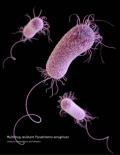
UK – Water quality – Risk assessments for Pseudomonas aeruginosa and other waterborne pathogens. Code of practice

BSI

CDC Pseudomonas

Overview

What is BS 8580-2 – Risk assessments for Pseudomonas aeruginosa about?

Our experts identified a lack of guidance on how to conduct risk assessments for Pseudomonas aeruginosa (PA) and other opportunistic waterborne pathogens other than Legionella. To fill that gap, BS 8580-2 is a new British Standard recommending a PA risk assessment process and supplying information and support on how to understand microbial hazards, prioritize actions and minimize risks.

Who is BS 8580-2 – Risk assessments for Pseudomonas aeruginosa for?

BS 8580-2 on risk assessments for pseudomonas aeruginosa applies in all types of healthcare provision, including hospitals, and care, nursing and residential homes, together with other settings where water systems and associated equipment can pose a risk. This can include in the educational, travel, industrial, leisure and beauty sectors, including health spas, nail bars and tattoo parlours.

Users of BS 8580-2 will be building and design engineers and architects; providers of fittings, outlets and components for water systems; installers and commissioners; risk assessors; regulatory bodies; building services engineers; water treatment consultants; travel, leisure and other relevant buildings owners and operators; and those responsible for the safe management of water systems, especially within leisure centres, schools, swimming pools, passenger vessels, spa pools, hot tubs etc.

BS 8580-2 will also interest clinicians, microbiologists, augmented care specialists and infection controllers in healthcare.

What does BS 8580-2 – Risk assessments for Pseudomonas aeruginosa cover?

BS 8580-2 gives recommendations and guidance on how to carry out risk assessments for pseudomonas aeruginosa (PA) and other waterborne pathogens whose natural habitat is within constructed water systems and the aqueous environment (autochthonous), rather than those present as a result of a contamination event. It includes those pathogens that can colonize and grow within water systems and the associated environment.

BS 8580-2 also covers risk assessments of distributed water systems and associated equipment, system components and fittings as well as above ground drainage systems. It covers PA risk assessment reviews and reassessments where a previous assessment has been undertaken and risk factors identified. It takes account of all relevant environmental and clinical factors and aspects of human behaviour leading to contamination events. It considers risk factors within the associated environment leading to conditions which can encourage the colonization and growth of waterborne pathogens and transfer of antibiotic resistance.

NOTE: BS 8580-2 does not cover risk assessments for Legionella spp.; these are covered in BS 8580-1, or risk assessments for enteric microorganisms derived from human or animal faecal contamination or sewage ingress.

Why should you use BS 8580-2 – Risk assessments for Pseudomonas aeruginosa?

You should use BS 8580-2 on risk assessments for pseudomonas aeruginosa because:

  • It plugs an information gap in relation to pseudomonas aeruginosa (PA) risk assessments, taking its unique additional considerations into account
  • It codifies the latest and most efficient approach to multidisciplinary PA risk assessments
  • Its recommended processes can be applied to other opportunistic waterborne pathogens
  • It can help healthcare providers demonstrate compliant risk management in respect of Dept of Health Guidance
  • It can help leisure sector organizations maintain compliance with their legal health and safety obligations
  • It can help users develop their expertise in risk assessment and strengthen organizational risk management

BS 8580-2 contributes to UN Sustainable Development Goal 3 on good health and well-being and Goal 6 on clean water and sanitation.

Research – Legionellosis: Diagnosis and Control in the Genomic Era

CDC

CDC legionella

Hundreds of books and textbook chapters, and thousands of journal review articles, have been published on Legionnaires’ disease and Legionella spp. bacteria over the past 45 years, making it important to decide whether this new and quite expensive compilation of reviews is worth acquiring (Figure). The field has become so specialized that even those who know one aspect of it may need a good review of other aspects to easily catch up on recent trends. The book contains chapters on the freshwater ecology of the bacterium; molecular and pathogenic aspects of virulence-associated bacterial secretion systems; very selected aspects of epidemiology; clinical aspects and treatment; laboratory diagnosis; and strain typing methods from serologic to whole-genome sequencing. Some chapters are more current than others. The most recent references for several chapters were published in 2016, and only 1 chapter cites references published in 2020. The book is lightly edited; some of the chapters contain overlapping material, but overall it has few typographical or spelling errors. Not all of the figures are properly labeled; for example, the figure legends in chapter 6 are reversed, and not all of the figure legends in chapter 3 fully explain the meanings of different colors and abbreviations.

I found that several of the chapters contained quite useful information that would be hard to find elsewhere, including a thorough review of L. pneumophila virulence secretory systems, as well as a review of the freshwater ecology of the bacterium, the clinical microbiology and clinical significance of Legionella spp. other than L. pneumophila, and regulatory and risk management strategies for control of the disease. Other readers, depending on their fields of interest and expertise, will find other chapters of particular interest. The chapter on non–whole-genome sequencing methods for strain typing for epidemiologic investigation is well done and could be of interest for those trying to dissect the older literature. Missing from the book, presumably by design, are a chapter reviewing in detail the ecology of the bacterium in the built environment, practical guidance on outbreak investigation, advanced techniques in epidemiologic source investigation, molecular and cellular pathogenesis other than secretion systems, and the molecular evolution of the bacterium, all of which can be found in other sources.

Is this book good value for money? Perhaps not for those who have a narrow interest in a specific field, because there are more up-to-date reviews on many of the topics in journal articles and some textbooks. For those who want to gain an overview of the topics covered in the book, some of which are more comprehensive than those found in textbooks or recent reviews, this may be a useful addition to their libraries.

Research -Surveillance of berries sold on the Norwegian market for parasite contamination using molecular methods

Science Direct

water contamination

The risk of foodborne parasite infection linked to the consumption of contaminated fresh produce has long been known. However, despite epidemiological links between the outbreaks and contaminated berries, few studies have assessed the magnitude of parasite contamination on fresh produce sold in Europe. The present study was aimed to address the knowledge gap on parasite contamination of berries sold in Norway. Samples of blueberries, strawberries, and raspberries were analysed by multiplex qPCR for detection of Echinococcus multilocularisToxoplasma gondii, and Cyclospora cayetanensis. In addition, a simplex qPCR method was employed for detecting contamination of the berries with Cryptosporidium spp. A total of 820 samples of berries, each of around 30 g (274 samples of blueberries, 276 samples of raspberries, and 270 samples of strawberries), were analysed. We found an overall occurrence of 2.9%, 6.6%, and 8.3% for T. gondii, C. cayetanensis, and Cryptosporidium spp., respectively, whereas E. multilocularis was not detected from any of the samples investigated. Strawberries and raspberries were most often contaminated with Cryptosporidium spp., whereas blueberries were contaminated mostly with C. cayetanensis. Detection of parasite contaminants on fresh berries indicates the need for a system to ensure the parasitological safety of fresh berries.

Research – Modelling the Potential Risk of Infection Associated with Listeria monocytogenes in Irrigation Water and Agricultural Soil in Two District Municipalities in South Africa

MDPI

Listeria monocytogenes (L. monocytogenes) is the etiologic agent of listeriosis which significantly affects immunocompromised individuals. The potential risk of infection attributed to L. monocytogenes in irrigation water and agricultural soil, which are key transmission pathways of microbial hazards to the human population, was evaluated using the quantitative microbial risk assessment modelling. A Monte Carlo simulation with 10,000 iterations was used to characterize the risks. High counts of L. monocytogenes in irrigation water (mean: 11.96 × 10² CFU/100 mL; range: 0.00 to 56.67 × 10² CFU/100 mL) and agricultural soil samples (mean: 19.64 × 10² CFU/g; range: 1.33 × 10² to 62.33 × 10² CFU/g) were documented. Consequently, a high annual infection risk of 5.50 × 10⁻² (0.00 to 48.30 × 10⁻²), 54.50 × 10⁻² (9.10 × 10⁻³ to 1.00) and 70.50 × 10⁻² (3.60 × 10⁻² to 1.00) was observed for adults exposed to contaminated irrigation water, adults exposed to contaminated agricultural soil and children exposed to agricultural soil, respectively. This study, therefore, documents a huge public health threat attributed to the high probability of infection in humans exposed to L. monocytogenes in irrigation water and agricultural soil in Amathole and Chris Hani District Municipalities in the Eastern Cape province of South Africa. View Full-Text

CPS – Funded Research Projects 2022 – Cyclospora

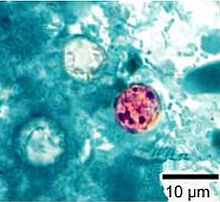
220px-Cyclospora_cayetanensis_stained

CPS

Cyclospora cayetanensis monitoring in agricultural water

The parasite Cyclospora Cayetanensis is producing illness in people consuming infected produce. Because this pathogen is in very low concentrations on actual produce, which makes it close to impossible to detect, and for prevention reasons, it is more effective to check for its presence in irrigation water, from where it is typically transferred on produce. However, even in water, this parasite is very difficult to detect. It only can be detected by lengthy molecular laboratory procedures such as PCR. One major problem for scientists to develop better and faster detection methods is the fact that there is no antibody or other recognition molecule that would be able to bind to the surface of this intact parasite.

We propose to design and synthesize, for the first time, aptamers, molecules that will be able to bind to intact Cyclospora Cayetanensis oocysts, and use them to design simple paper based colorimetric tests that can detect it in the field without the need of sample preparation or specialized laboratories. The paper based test will turn from pink to purple to indicate the water sample being tested is positive for this parasite, making this a very simple and easy to use detection method for Cyclospora Cayetanensis.

CPS

AFECCT: Assessing filtration efficacy for Cyclospora control

The reputation of growers and the health of consumers suffer when people contract foodborne illness from fresh produce contaminated with Cyclospora cayetanensis. Because filtration has been established as effective in concentrating parasites for environmental surveillance, we propose to establish how effectively filters remove such parasites from irrigation water. To achieve this, we will first conduct a series of filtration experiments using abundant parasites (of chickens) that pose no risk to the study team. We’ll then assess how well these filters reduce water contamination with Cyclospora. We will also determine whether any parasites surviving filtration are harmed in the process. We hope these findings will directly benefit growers seeking tools to mitigate risk, and hasten future research progress by validating a needed surrogate system for studying other interventions against this dangerous and enigmatic human parasite.


Research – Tracking down the origin of cholera pandemics

Science Direct

Food Illness

The bacterium Vibrio cholerae is the causative agent of the diarrheal disease cholera and is responsible for seven known pandemics. The seventh cholera pandemic began in 1961 and is still active. Unlike previous pandemics, it is caused by cholera strains of a slightly different type. How did the modified cholera strains develop and spread, and what might have contributed to their success? Scientists from the Max Planck Institute for Evolutionary Biology in Plön, Germany, and CAU Kiel, in an international team with colleagues from City College New York and the University of Texas Rio Grande Valley, have now gained new insights into a molecular mechanism that provides insight into the interactions between cholera bacteria and may have played a role in the emergence of the seventh pandemic.

In their natural environment, bacteria are subject to competition with other bacteria for space and nutrients. In this process, molecular mechanisms help them to hold their own. One such mechanism is the so-called “type 6 secretion system” (T6SS), with which a bacterium transports toxic proteins into a neighboring bacterium and thereby kills it. Thus, cholera bacteria of the seventh pandemic use their T6SS to keep other bacteria in check and presumably more easily cause infection.

Researchers now had the special opportunity to study the T6SS of cholera bacteria from previous pandemics. For this purpose, among other things, the T6SS genome sequence of cholera bacteria from the 2nd pandemic was reconstructed from a museum specimen from the 19th century in a complex procedure and recreated in the laboratory.

In the process, the scientists were able to show that 2nd and 6th pandemic cholera bacteria lack a functional T6SS. As a result, the bacteria of earlier pandemics not only lack the ability to attack other bacteria, they are themselves killed by bacterial strains of the seventh pandemic. This may have been one of the reasons that older cholera strains were displaced by modified cholera strains of the seventh pandemic and are now hard to find.

Data from new lab

Daniel Unterweger, one of the study’s authors and a group leader at the Max Planck Institute in Plön, Germany, says: “With these findings, we support the theory that microbial competition between bacteria is very important for understanding pathogens and bacterial pandemics. Our research on the cholera bacterium was made possible by an S2 laboratory newly established at the institute. Here, we can conduct experiments with bacterial pathogens under the necessary safety precautions. The study contains some of the first data from the new laboratory.”

Link to Article

RASFF Alert – Vibrio cholerae – Frozen Prawns

RASFF

Vibrio cholerae (presence /25g) in frozen prawns (Litopenaeus vannamei) from Ecuador in Spain

RASFF Alert- Pseudomonas aeruginosa – Natural Mineral Water

RASFF

Presence of Pseudomonas aeruginosa in Alcalia Natural Mineral Water from Bulgaria in Ireland and Poland

Research – Prevalence of E. coliO157:H7 in water sources: an overview on associated diseases, outbreaks and detection methods

Elsevier

Escherichia coli O157:H7 is a zoonotic pathogen with its ability to cause human illness ranging from diarrheal dis-ease to fatal hemolytic uremic syndrome. E. coli O157:H7 had been associated with waterborne outbreaks resulting in high morbidity and mortality worldwide. Therefore, it is important to investigate the prevalence of E. coli O157:H7 in water sources especially used for drinking and to develop the diagnostic methods for its early detection. The review describes traditional cultural methods, immunological techniques, and polymerase chain reaction (PCR)–based methods for detection of this bacterium in water sources. The current PCR-based techniques such as real-time PCR are more specific and sensitive and require less detection time (b3 hours).These methods can be applied for regular water monitoring and proper management of water sources to prevent waterborne diseases due to E. coli O157:H7.