Category Archives: Campylobacter

Norway – 2 dead, 2,000 sick from Campylobacter in water in Norway

Barfblog

A 1-year-old child from the island died last week of an infection in the digestive tract, but it was not clear whether the death was linked to the water contamination.

About 2,000 people have fallen sick. Since June 6, 64 have been hospitalized.

Hospital tests have shown that Campylobacter was found in at least three dozen cases.

Local newspaper Askoeyvaeringen reported that there had been been safety issues with the waterworks in the Askoey municipality, and faeces was recently found near a reservoir that supplied part of the area’s drinking water.

UK – Major retailers publish Campylobacter results

FSA


The top nine retailers across the UK have today published their latest testing results on Campylobacter contamination in UK-produced fresh whole chickens (covering samples tested from January to March 2019).

The latest figures show that on average, across the major retailers, 3.5% of chickens tested positive for the highest level of contamination. These are the chickens carrying more than 1,000 colony forming units per gram (cfu/g) of Campylobacter.

Rebecca Sudworth, Director of Policy at the Food Standards Agency, said:

‘Campylobacter levels have remained steady and are below our target of 7% at the highest level of contamination. Nevertheless, we will continue to work closely with retailers to bring levels down to as low as reasonably achievable.

Our advice to consumers remains the same: take care when handling raw chicken, do not wash it, and ensure it is cooked thoroughly before serving.’

Results

Contamination levels April-June 2018 July-September 2018 October-December 2018 January-March 2019
cfu/g less than 10 60.6% 58.8% 63.1% 55.4%
cfu/g 10-99 23.3% 26.7% 22.3% 25.3%
cfu/g 100-1000 12.5% 11% 11.4% 15.8%
cfu/g over 1000 3.7% 3.5% 3.1% 3.5%

Norway – Norway officials trying to ID water contamination source – Campylobacter

NF Chronicle

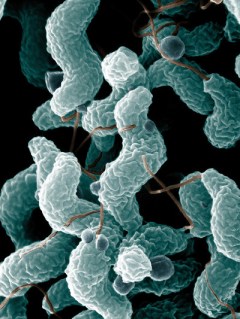
Campylobacter

Image CDC

COPENHAGEN, Denmark (AP) — Norwegian authorities said Tuesday they were trying to identify the source of water contamination that has sent dozens of people in southern Norway to the hospital.

Since Thursday, 55 people — including 13 children — from Askoey, an island north of Bergen, have been hospitalized following the contamination. All have been discharged. Norwegian news agency NTB reported that in all, some 2,000 people had fallen sick.

A 1-year-old child on the island died last week of an infection in the digestive tract, but it was not clear whether it was linked to the contamination.

He said tests showed that the bacteria Campylobacter has been found in 36 cases.

RASFF Alert- Campylobacter – Frozen Raw Chicken

RASFF-Logo

RASFF – Campylobacter jejuni (present /10g) in frozen raw chicken from Belgium, via the Netherlands in Austria

UK – Dad almost lost use of his legs after he contracted E.coli on ‘holiday from hell’

Metro

A retired fireman is learning to walk again after falling seriously ill during a nightmare holiday. Charles Jackson, 66, almost lost the use of his legs after he contracted E.coli and campylobacter during a trip to Cyprus at the start of December last year. He started to suffer with diarrhoea and fatigue a few days into his trip with wife Julie, 65. On his return to the UK, the father-of-two saw his GP after the symptoms persisted.


Research – Neutral pH sodium chlorite decreases recovery of Campylobacter in neutralizing buffered peptone water from simulated broiler carcass rinses

Wiley Online Campylobacter kswfoodworld

ABSTRACT

The goal of this study was to evaluate factors causing low recovery of Campylobacterduring regulatory sampling following acidified sodium chlorite (ASC) treatment of broiler carcasses and subsequent carry‐over into neutralizing buffered peptone water (nBPW) rinses. Solution alkalinity was shown to positively correlate with the presence of un‐reduced chlorite anion in the recovery broth, implying that low recovery of Campylobacterfrom rinses may be due to residual chlorite, an oxidizing agent. To demonstrate the susceptibility of Campylobacter to residual chlorite, three strains were inoculated into pH = 7.5 nBPW with or without addition of sodium chlorite and stored for 24 hr at 4 °C prior to culturing. Microbial counts from the solutions indicated that residual chlorite can decrease recovery by up to 4 log CFU/mL relative to controls. Acceptable recovery of Campylobacter from nBPW rinses containing residual chlorite may require development of a suitable neutralizing agent in the nBPW recovery medium.

Practical applications

Recovery of viable Campylobacter spp. from broiler carcasses following antimicrobial treatment with acidified sodium chlorite may potentially be compromised when using nBPW as the recovery medium. At neutral or slightly alkaline pH, residual sodium chlorite, an oxidizing species, is not reduced by thiosulfate present in nBPW, and demonstrates antimicrobial effects on Campylobacter. Development of a suitable alternative to thiosulfate as a reducing agent in the recovery medium may be required in to provide optimal conditions for recovery of Campylobacter.

Information – Campylobacteriosis – Annual Epidemiological Report for 2017

ECDC

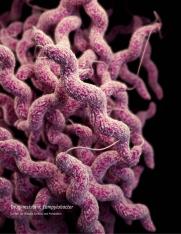
campy2

Image CDC

Campylobacteriosis is the most commonly reported gastrointestinal disease in the EU/EEA.  In 2017, 29 EU/EEA countries reported 250 161 confirmed cases of campylobacteriosis.

Information – Advice CDC – Do not rinse chicken!

CDC

Americans eat more chicken every year than any other meat. Chicken can be a nutritious choice, but raw chicken is often contaminated with Campylobacter bacteria and sometimes with Salmonella and Clostridium perfringens bacteria. If you eat undercooked chicken or other foods or beverages contaminated by raw chicken or its juices, you can get a foodborne illness, which is also called food poisoning.

That’s why it’s important to take special care when handling and preparing chicken.


USA – Chicken and Eggs Top List of Causes for Foodborne Outbreaks

Healthline


Chicken, eggs, and produce are most likely to carry bacteria responsible for the vast majority of foodborne illness in the United States.

The bacteria most likely to make you sick year after year: Campylobacter and Salmonella. Less common pathogens also include ShigellaCyclospora, and Listeria.

Foodborne illness is still a major health problem in the United States, according to a report released last week from the Centers for Disease Control and Prevention (CDC).

The agency identified more than 25,000 foodborne infections through various surveillance sites in 2018. Nearly 6,000 of those cases resulted in hospitalizations, and 120 people died as a result of foodborne illness.

The report is part of annual surveillance by the CDC that tracks the pathogens responsible for foodborne illness.

Research – High levels of potentially harmful bacteria found in raw meat dog food products: study

Science Daily 260px-YellowLabradorLooking_new

Many raw meat dog food products contain high levels of bacteria that pose potential health risks to both animals and people, finds research published online in Vet Record.

This is a particular issue for infants, the elderly, and those with poor immunity, warn the researchers.

A raw meat-based diet has become increasingly popular for dogs in recent years, because it is seen as a ‘healthier’ and more ‘natural alternative’ to widely available commercial products.

But, unlike commercial feeds, raw meat products are not heat treated or freeze dried to pasteurise their content.

To try and gauge the levels of bacteria in these products, the researchers took samples from 60 packs of raw meat products, bought from a range of stores within a 200 km radius of their laboratory between March and September 2017.

The products, which were all intended for dogs, contained at least one of: uncooked meat; and edible bones and/or organs from cattle, chicken, lamb, turkeys, pigs, ducks, reindeer or salmon. Some of the products also included vegetables, vegetable fibre, and minerals.

All the products, made by 10 different manufacturers, originated from Sweden, Norway, Finland, Germany or England.

The samples were analysed for bacteria that could potentially pose a health risk to animals and people: Enterobacteriaceae species; Clostridium perfringens, Salmonella and Campylobacter species.

All 60 samples contained Enterobacteriaceae species, which are indicators of faecal contamination and hygiene standards.

Levels varied widely among the different manufacturers, and in some cases, among the different products from the same manufacturer.

But 31 (52%) of the samples contained levels that exceeded the maximum threshold set by European Union (EU) regulations of 5000 bacteria per gram.

Most of the species identified are not known to cause infection, apart from E coli, which was found in about a third of the samples.

C perfringens, another marker of faecal contamination and hygiene standards, was found in 18 samples (30%); two of the samples exceeded the maximum limits set by Swedish guidelines.

Salmonella and Campylobacter are zoonotic species of bacteria-capable of passing from animals to people and causing infection. EU regulations don’t permit Salmonella in any animal feed.

Salmonella species were found in 4 (7%) of the 60 samples, while Campylobacter species were found in three samples from three different manufacturers. This is a relatively low level, but possibly because Campylobacter species are very sensitive to freezing, say the researchers.

“It is most likely that Campylobacter was present in more samples before freezing, and that those samples in which Campylobacter was isolated contained very high levels of Campylobacter species before the freezing process, as some managed to survive the freezer,” they write.

The findings prompt the researchers to highlight the importance of careful storage, handling, and feeding of raw meat dog food products because of the potential health risks they pose.

They make several recommendations, designed to curb the risk of infection and antibiotic resistance. Raw meat dog food should be:

    • Kept frozen until use, and thawed at 10 degrees C

Kept separate from other food

Handled with separate kitchen equipment or with equipment that is washed thoroughly after use

Good hygiene is essential, they emphasise: bacteria in the juices from raw meat dog food can splash and spread to other foods and surfaces, and dogs can transfer potentially harmful and/or antibiotic resistant bacteria by ‘kissing’ faces immediately after eating.

Dogs shouldn’t be fed raw meat products while being treated with antibiotics as this could increase the risk of antibiotic resistance, they say.

“Dogs in families with infants, elderly people or immunocompromised individuals should also not be fed [raw meat products], as these groups are more susceptible to infections,” they warn.

British Veterinary Association Junior Vice President Daniella Dos Santos commented: “This research offers further compelling evidence to support vets’ concerns about the potential animal and public health risks associated with feeding pets a raw meat-based diet.

“Bacteria such as E coli and Salmonella can cause significant gastrointestinal disease in animals. Pets can also shed potentially harmful pathogens present in raw food into their environment, so there is a risk to owners both in handling the food and coming into contact with the animal. Pet owners who choose to feed a raw food diet should be aware of the potential health risks and take full precautions while storing and handling the food.

“BVA would also not recommend making a raw food diet at home without veterinary guidance due to the potential for nutritional deficiencies in homemade diets.

“We would advise any owner wanting to try a raw meat-based diet for their pet to first consult a veterinary surgeon.”

Story Source:

Materials provided by BMJNote: Content may be edited for style and length.


Journal Reference:

  1. Josefin Hellgren, Lovisa Staaf Hästö, Camilla Wikström, Lise-Lotte Fernström, Ingrid Hansson. Occurrence of Salmonella, Campylobacter, Clostridium and Enterobacteriaceae in raw meat-based diets for dogsVeterinary Record, 2019; vetrec-2018-105199 DOI: 10.1136/vr.105199