Category Archives: Campylobacter

USA – State orders another recall of raw milk sold from dairy farm west of Modesto -Campylobacter

Modbee

Campylobacter kswfoodworld

The state has ordered a recall of raw goat milk sold from a dairy farm west of Modesto.

Routing sampling found campylobacter jejuni bacteria, but no illnesses have been reported, the California Department of Food and Agriculture announced Monday.

The product came from Valley Milk Simply Bottled, a small operation along Maze Boulevard west of Hart Road. The same farm has had two recalls of cow milk because of the same bacteria since 2019, again with no illnesses reported.

Sweden – Campylobacter (Sweden, August 2021-)

Folkhalsomyndigheten

2021-08-23

In recent weeks, the number of people who have contracted campylobacter infection has been higher than in previous weeks. The increase has been seen throughout the country and in all age groups. The period has been preceded by an increased proportion of broiler flocks carried on campylobacter (Swedish Veterinary Institute (SVA). Previous studies have shown that cases of disease are often linked to raw chicken meat, which makes it likely that increased prevalence of campylobacter in chicken flocks is the cause. In the next few weeks, the Swedish Public Health Agency will collect samples from the disease cases for analysis and typing as part of the microbiological monitoring program in order to identify the presence of common sources of infection.

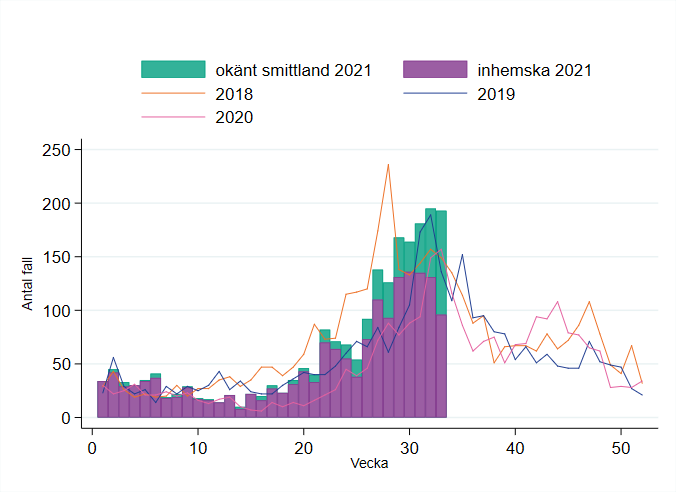
Figure. The number of reported cases of campylobacter infection per week during 2021 to week 33 (until 2021-08-23, week 33 is incomplete) and for the years 2018-2020, for cases infected in Sweden and cases with unknown country of infection.

The graph shows the number of reported cases per week in 2021 that are stacked.  During weeks 29-33, the number of cases has been higher than before with 150-200 cases, earlier this year the number of cases was below 50 to up to 100 cases a week.  The pattern follows previous years, 2018-2020 with more cases during the late summer, these years are shown as lines in the graph.

Research – Antimicrobial Efficacy and Spectrum of Phosphorous-Fluorine Co-Doped TiO2 Nanoparticles on the Foodborne Pathogenic Bacteria Campylobacter jejuni, Salmonella Typhimurium, Enterohaemorrhagic E. coli, Yersinia enterocolitica, Shewanella putrefaciens, Listeria monocytogenes and Staphylococcus aureus

MDPI

Contamination of meats and meat products with foodborne pathogenic bacteria raises serious safety issues in the food industry. The antibacterial activities of phosphorous-fluorine co-doped TiO2 nanoparticles (PF-TiO2) were investigated against seven foodborne pathogenic bacteria: Campylobacter jejuniSalmonella Typhimurium, Enterohaemorrhagic E. coliYersinia enterocoliticaShewanella putrefaciensListeria monocytogenes and Staphylococcus aureus. PF-TiO2 NPs were synthesized hydrothermally at 250 °C for 1, 3, 6 or 12 h, and then tested at three different concentrations (500 μg/mL, 100 μg/mL, 20 μg/mL) for the inactivation of foodborne bacteria under UVA irradiation, daylight exposure or dark conditions. The antibacterial efficacies were compared after 30 min of exposure to light. Distinct differences in the antibacterial activities of the PF-TiO2 NPs, and the susceptibilities of tested foodborne pathogenic bacterium species were found. PF-TiO2/3 h and PF-TiO2/6 h showed the highest antibacterial activity by decreasing the living bacterial cell number from ~106 by ~5 log (L. monocytogenes), ~4 log (EHEC), ~3 log (Y. enterolcolitcaS. putrefaciens) and ~2.5 log (S. aureus), along with complete eradication of C. jejuni and S. Typhimurium. Efficacy of PF-TiO2/1 h and PF-TiO2/12 h NPs was lower, typically causing a ~2–4 log decrease in colony forming units depending on the tested bacterium while the effect of PF-TiO2/0 h was comparable to P25 TiO2, a commercial TiO2 with high photocatalytic activity. Our results show that PF-co-doping of TiO2 NPs enhanced the antibacterial action against foodborne pathogenic bacteria and are potential candidates for use in the food industry as active surface components, potentially contributing to the production of meats that are safe for consumption. View Full-Text

Australia Research – Monitoring the incidence and causes of diseases potentially transmitted by food in Australia: Annual report of the OzFoodNet network, 2013–2015

Au Gov

This report summarises the incidence of diseases potentially transmitted by food in Australia, and details outbreaks associated with food that occurred during 2013–2015.
OzFoodNet sites reported an increasing number of notifications of 12 diseases or conditions that may be transmitted by food (botulism; campylobacteriosis; cholera; hepatitis A; hepatitis E; haemolytic uraemic syndrome (HUS); listeriosis; Salmonella Paratyphi (paratyphoid fever) infection; salmonellosis; shigellosis; Shiga toxin-producing Escherichia coli(STEC) infection; and Salmonella Typhi (typhoid fever) infection), with a total of 28,676 notifications received in 2013; 37,958 in 2014; and 41,226 in 2015.
The most commonly-notified conditions were campylobacteriosis (a mean of 19,061 notifications per year over 2013–2015) and salmonellosis (a mean of 15,336 notifications per year over 2013–2015). Over these three years, OzFoodNet sites also reported 512 outbreaks of gastrointestinal illness caused by foodborne, animal-to-person or waterborne disease, affecting 7,877 people, and resulting in 735 hospitalisations and 18 associated deaths.
The majority of outbreaks (452/512; 88%) were due to foodborne or suspected foodborne transmission. The remaining 12% of outbreaks were due to waterborne or suspected waterborne transmission (57 outbreaks) and animal-to-human trans-mission (three outbreaks). Foodborne and suspected foodborne outbreaks affected 7,361 people, resulting in 705 hospitalisations and 18 deaths.
Salmonella was the most common aetiological agent identified in foodborne outbreaks (239/452; 53%), and restaurants were the most frequently-reported food preparation setting (211/452; 47%). There were 213 foodborne outbreaks (47%) attributed to a single food commodity during 2013–2015, with 58% (124/213) associated with the consumption of eggs and egg-based dishes.

UK – Report into the sources of human Campylobacter infection published

FSA

The Food Standards Agency has today published a study to further determine the principal sources of this foodborne disease.

A report published by the FSA confirms that chickens are the source of the majority of human cases of Campylobacter, followed by other animals such as sheep, pigs and cows. This infection may have been passed to people directly through food, but could also be via environmental and water contamination.

The Campylobacter Source Attribution Study, launched in 2015 as part of the FSA’s wider and ongoing Campylobacter Reduction Programme, also reveals an increase in antimicrobial resistance within Campylobacter strains between 1997 and 2018. Work is continuing in this area to determine the full impact.

FSA Head of science, evidence and research, Rick Mumford, said:

“We will use these findings to better understand the causes of Campylobacter infection, and to inform further work on foodborne transmission. This will also help to identify further research areas to explore as we seek to reduce the overall burden of Campylobacter infection in the UK.”

Around 300,000 human cases of Campylobacter are estimated to be acquired from food each year in the UK, out of a total of around 630,000 cases. Campylobacter lives in the intestinal tracts of a wide range of mammals, birds and even insects.

Researchers embarked on this project to determine the key reservoirs of human Campylobacter infections and help identify potentially effective risk management strategies. The project assessed patient samples from two locations – a representative urban site in North Tyneside and rural site in Oxfordshire – alongside foods sampled from retail in York, Salisbury and London.

With regards to antimicrobial resistance, the study revealed a rise in fluoroquinolone and tetracycline resistance in C.jejuni isolates from human infections between 1997 and 2018. Fluoroquinolone resistance was more frequent in C.jejuni isolates from  chicken than from other animals, whilst tetracycline resistance was more frequent in poultry and pig isolates than ruminants. Resistance to macrolides and aminoglycosides remain low.

The majority of people who are infected with Campylobacter recover fully and quickly, but it can cause long-term and severe health problems in some, including young children and the elderly.

You can help keep your family safe by cooking your food correctly, and avoiding cross-contamination through ensuring good personal hygiene.

Read the full report here. As part of the project, a data storyboard (Opens in a new window)was created and can be viewed online.

Image

INFOSAN Research

New Zealand – Lindsay Farm brand Organic Raw Milk (unpasteurised) – Campylobacter

MPI

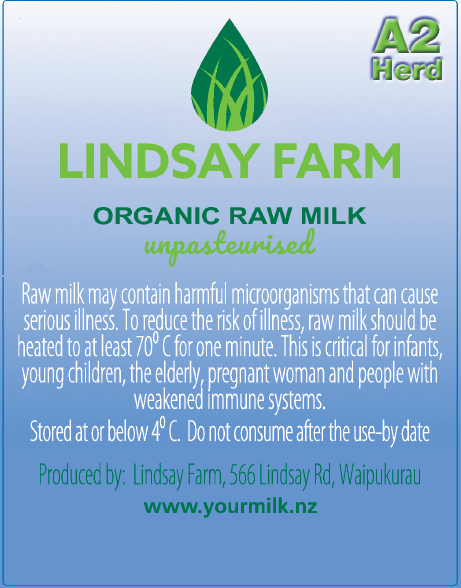
Lindsay Farm brand Organic Raw Milk (unpasteurised)

27 July 2021: Lindsay Farm is recalling specific batches of Lindsay Farm brand Organic Raw Milk (unpasteurised) as the product may contain Campylobacter.

Lindsay Farm brand Organic Raw Milk (unpasteurised) 2L
Product identification
Product type  Raw (unpasteurised) drinking milk
Name of product (size) Lindsay Farm brand Organic Raw Milk (unpasteurised) 2L
Batch marking Lot numbers: 2107, 2307, 2407, 2507 and 2607
Date marking Batches with a Use by date of  25.07.21, 27.07.21, 28.07.21, 29.07.21, and 30.07.21
Package size and description The product is sold in a 2L plastic bottle.
Distribution The product is sold in the Hawke’s Bay region via home deliveries and the following registered depots:

Betta Electrical, 46 – 48 Ruatainwha Street, Waipukurau

Chantal Shop, 45 Hastings Street, Napier

Cornucopia – The Organic Shop, 221 Heretaunga Street East, Hastings

Dawnacres Florist, 208 Havelock Road, Akina, Hastings

Healthnuts, 4 Barraud Street, Dannevirke

Nature’s Nurture – The Organic Grocer, 100 High Street, Waipawa

Tangaroa Seafoods, 7 Tangaroa Street, Ahuriri, Napier

Unichem Taradale Pharmacy, 288 Gloucester Street, Taradale, Napier.

Notes This recall does not affect any other batches of Lindsay Farm brand Organic Raw Milk (unpasteurised).

Consumer advice

Customers are asked to check the lot number and use by date printed on the product.

If you have purchased any of the affected product listed on this notice, do not consume it. Customers should return the product to their retailer for a full refund. Alternatively, consume after heating to 70°C and holding at this temperature for one minute. If you don’t have a thermometer, heat the milk until it nearly reaches a boil (or scald the milk) before drinking it.

There have been no reports of associated illness in New Zealand. If you have consumed any of this product and have any concerns about your health, seek medical advice.

How to reduce the risk of illness if you drink raw unpasteurised milk

Campylobacter infection: symptoms and advice

Who to contact

If you have questions, contact Lindsay Farm:

  • Phone: 06 858 5333
  • Address: Lindsay Road, Waipukurau, Central Hawke’s Bay.
Image

INFOSAN – Research

Research – Bacteriophage Therapy to Reduce Colonization ofCampylobacter jejuniin Broiler Chickens before Slaughter

Click to access viruses-13-01428.pdf

Research Australia – Campylobacter, Salmonella at record highs in Australia

Food Safety News

Record levels of Campylobacter and Salmonella have been recorded in Australia, according to the annual surveillance report of notifiable diseases for 2016.

The data comes from a study published in the most recent edition of the Communicable Diseases Intelligence journal that also found E. coli, Listeria and Cryptosporidium infections had risen.

The role of disease surveillance includes identifying national trends, providing guidance for policy development and resource allocation and informing the response to outbreaks, according to the researchers.

In 2016, gastrointestinal diseases made up 15 percent of total reports for communicable diseases. Notified cases increased by 10 percent to 49,885 in 2016 compared to 2015.