Category Archives: Campylobacter jejuni

Sweden – Increase in cases of illness with Campylobacter infection

Folkhalsomyndigheten

Campylobacter kswfoodworld

In recent weeks, there has been an increase in the number of people who have contracted campylobacter infection. The rise in the number of cases is preceded by an increase in campylobacter in broiler flocks. Good hygiene when handling raw chicken reduces the risk of becoming infected.

There has been an increase in the number of people who have been infected by the intestinal bacteria campylobacter in recent weeks. During week 26, the number of reported cases increased further compared to previous weeks and the increase looks set to continue.

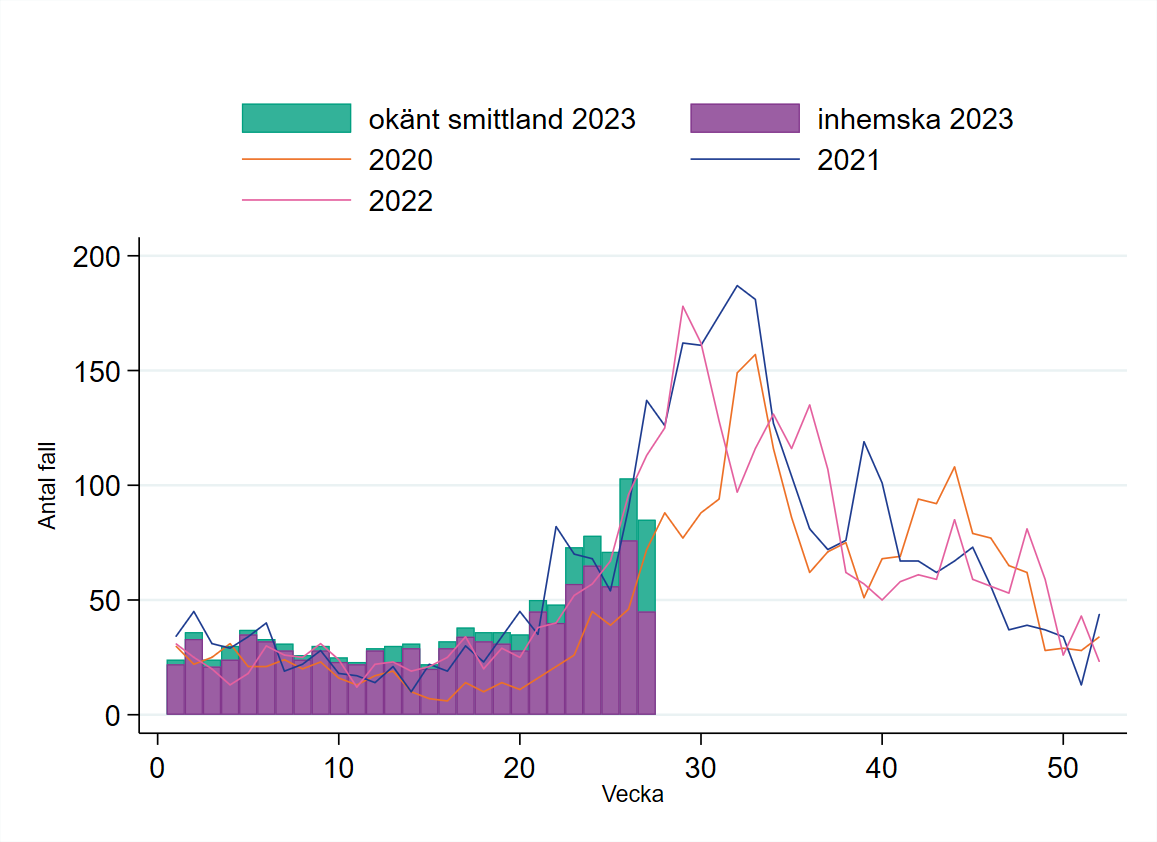
Figure: The number of reported cases of campylobacter per week infected in Sweden or with an unknown country of infection (230706). Week 27 is not yet complete.

The number of sick people increased from week 21 to 60 cases per week from 30 cases.  In week 26, the cases increased further, a similar increase is seen in 2020-2022.

From mid-June, an increase in the occurrence of campylobacter in Swedish broiler flocks has also been observed. Previous studies have shown a connection between campylobacter infection and the consumption of fresh chicken, where around a third of those who have contracted the disease have been linked to fresh chicken. Campylobacter infection in humans is more common in summer as is the presence of campylobacter in broiler flocks.

Sweden sees another rise in illnesses for 2022


Food Safety News

Most foodborne infections rose in Sweden in 2022 compared to the year before, according to the latest figures.

A report by the National Veterinary Institute (SVA), Folkhälsomyndigheten (the Public Health Agency of Sweden), Livsmedelsverket (the Swedish Food Agency) and Jordbruksverket (Swedish Board of Agriculture) showed a rise for Campylobacter, Salmonella, Listeria, and E. coli infections. Some of this was because of increased travel and more people being infected abroad.

A total of 5,165 cases of campylobacteriosis were reported in 2022 and 57 percent of these were domestic. This is up on more than 4,000 cases in 2021. For domestic infections in 2022, the median age was 51 with a range of 0 to 101. More men, 54 percent, than women were sick.

A correlation between human cases and Campylobacter-positive broiler batches underscores the need for further preventive measures, said the report.

UK retailers share Campylobacter in chicken results

Food Safety News

Supermarkets in the United Kingdom have reported their Campylobacter in chicken results for late 2022.

The Food Standards Agency (FSA) maximum target level is up to 7 percent of birds with more than 1,000 colony-forming units per gram (CFU/g) of Campylobacter.

Data from the retailers covers October to December 2022 on high findings of Campylobacter in fresh, shop-bought, UK-produced chickens.

Results at Waitrose, Morrisons and Lidl went up while Marks and Spencer, Aldi, Asda, and Sainsbury’s recorded lower levels of contamination than the previous quarter. Figures for Co-op stayed the same.

Campylobacter is the most common cause of bacterial food poisoning in the UK and the dose needed to make people sick can be as low as a few hundred cells.

Tesco has stopped publishing data as it has changed the way it monitors the pathogen in chicken so findings are not comparable with other retailers.

New Zealand – Lindsay Farm brand Organic Raw Milk (unpasteurised) – Campylobacter

MPI

28 June 2023: Lindsay Farm HB Ltd is recalling specific batches of its Lindsay Farm brand Organic Raw Milk (unpasteurised) as the product may contain Campylobacter.

Product identification
Product type Raw (unpasteurised) drinking milk
Name of product (size) Lindsay Farm brand Organic Raw Milk (unpasteurised) 2L
Batch marking Lot Numbers : 0806, 0906,1006, 1106,1206, 1306, 1406, 1506, 1606, 1906, 2006, 2106, 2206, 2306, 2406, 2506, 2606, 2706
Date marking Use by date between 12.06.2023 and up to and including 01.07.2023.
Package size and description The product is sold in a plastic 2L bottle.
Distribution The product is sold in the Hawke’s Bay region via home deliveries and the following registered depots:

  • Betta Electrical, 46 – 48 Ruatainwha Street, Waipukurau
  • Chantal Shop, 45 Hastings Street, Napier
  • Cornucopia – The Organic Shop, 221 Heretaunga Street East, Hastings
  • Dawnacres Florist, 208 Havelock Road, Akina, Hastings
  • Nature’s Nurture – The Organic Grocer, 100 High Street, Waipawa
  • Tangaroa Seafoods, 7 Tangaroa Street, Ahuriri, Napier
  • Unichem Taradale Pharmacy, 288 Gloucester Street, Taradale, Napier.

The product has not been exported.

Notes This recall does not affect any other batches of Lindsay Farm brand Organic Raw Milk (unpasteurised) or any batches of Lindsay Farm brand Organic Pasteurised Whole Milk.

Point of sale notice for retailers

If you are a retailer of the products in this recall, download a copy of the point of sale notice. You need to display it in your store for one month.

Point of sale notice [PDF, 68.4KB]

Consumer advice

Customers are asked to check the lot number and Use by date printed on the bottle.

If you have purchased any of the affected product listed on this notice, do not consume it. Customers should return the product to their retailer for a full refund. Alternatively, consume after heating to 70°C and holding at this temperature for one minute. If you don’t have a thermometer, heat the milk until it nearly reaches a boil (or scald the milk) before drinking it.

There have been no reports of associated illness in New Zealand. If you have consumed any of this product and have any concerns about your health, seek medical advice.

Customers should return the product to their retailer for a full refund.

How to reduce the risk of illness if you drink raw unpasteurised milk

Campylobacter infection: symptoms and advice

Who to contact

If you have questions, contact Lindsay Farms HB Ltd:

  • Phone: 06 858 5333
  • Address: Lindsay Road, Waipukurau, Central Hawke’s Bay.

Researchers estimate Campylobacter costs in Germany

Food Safety News

Campylobacter infection and related illness is associated with a substantial economic burden in Germany, according to a study.

Researchers analyzed the use of health care and direct and indirect costs of Campylobacter and care-intensive long-lasting health issues of patients from health insurance data with 26 million members in Germany.

Claims data of insurants with at least one Campylobacter diagnosis in 2017 were provided, of which 9,945 were included in the analysis published in the journal Plos One.

This showed a lower rate of Campylobacter diagnoses than German surveillance data for 2017 but with similar age, gender, and regional distribution. According to both the surveillance and claims data, rates were lowest in the 5 to 14 age group and highest for females aged 20 to 24.

Some people developed post-infectious reactive arthritis, Guillain-Barré syndrome (GBS), inflammatory bowel disease (IBD), and/or irritable bowel syndrome (IBS).

USA – Raw Farm Raw Milk Recalled in California For Campylobacter

Food Poisoning Bulletin

Raw Farm raw milk is being recalled in California for possible Campylobacter contamination. The milk is produced and packaged by Raw Farm, LLC of Fresno County, California. No illnesses have been reported to date in connection with the consumption of this unpasteurized milk. The farm is located at 7221 South Jameson Avenue in Fresno.

The recall and quarantine order was announced by California State Veterinarian Dr. Annette Jones after Campylobacter was found in the farm’s packaged whole raw milk. The milk was sampled and tested by the California Department of Food and Agriculture. Routine sampling conducted at the farm found the pathogen.

The recalled product is Raw Farm Whole Raw Milk that is packaged in half gallon (64 ounce) and gallon (128 ounce) plastic jugs. The code date that is marked on the container is BEST BY 05/05/2023.

Research – A foodborne outbreak of Campylobacteriosis at a wedding – Melbourne, Australia, 2022

1 Health

Abstract

Campylobacter is the most common bacterial cause of foodborne gastroenteritis in Australia; how-ever, outbreaks caused by the pathogen are relatively uncommon. In March 2022, the Victorian Department of Health was notified of a gastrointestinal illness in 20 guests following attendance at a wedding reception.

Two of these individuals were notified with laboratory-confirmed campylobacteriosis, and an investigation was undertaken to identify the source of the infection and implement strategies to prevent further illness. A case-control study was conducted to determine the likely source of infection. Cases were defined as attendees of the wedding reception, with onset of diarrhoea and/or abdominal cramping 1–10 days after attending the function. Controls were randomly selected from the remaining list of non-ill guests. Cases and controls were interviewed using a standardised, menu-based questionnaire.

Food preparation processes were documented, and food samples collected.

A total of 29 wedding guests met the case definition. Cases reported onset of illness 2–5 days fol-lowing the wedding and major symptoms included abdominal cramping (100%), diarrhoea (90%), headache (79%), and fever (62%). Two cases were hospitalised, one with ongoing secondary neu-rological sequelae.

Illness was significantly associated with consumption of a duck breast brioche canapé containing duck liver parfait (odds ratio = 2.85; 95% confidence interval: 1.03–7.86). No leftover food samples were available for testing.The investigation found that the duck canapé was the likely vehicle of infection. Consistent with the literature on Campylobacter transmission, it is likely that inadequate cooking of the duck liver for the parfait was the contributing factor that led to illness. This highlights the risks posed by undercooked poultry dishes, and shows that education of food handlers remains a priority.

Research – Report of the Scientific Committee of the Spanish Agency for Food Safety and Nutrition (AESAN) on the prospection of biological ha-zards of interest in food safety in Spain (2)

AESAN

This report addresses the prospection of biological hazards for some types of food that may pose a risk to the population and that are not currently included in the official control programs in Spain.

It completes and updates the 2018 report by the Scientific Committee of the Spanish Agency for Food Safety and Nutrition (AESAN, 2018). A number of bacteria that are significant contributors to nosocomial infections due to the increase in the number of multi-resistant strains of Acinetobacter spp. ,Klebsiella pneumoniae and Pseudomonas aeruginosa are listed first.

It is also addressed the study of the prevalence and possible control of Bacillus cereus and Cronobacter spp. presence in cereal flours and others, the revision of Campylobacter jejuni and/or Campylobacter coli in meats other than poultry, as well as the study of Shigatoxin-producing Escherichia coli. These latter two biological agents are much better known from the food control perspective, although there are control measures for Campylobacter spp. in poultry meat and not in other types of meat such as beef or pork and in the case of E. coli, producers of Shiga toxins, the control of this particular type of pathogenic strains in food has not been specifically addressed either.

Finally, tick-borne viral encephalitis, which can be transmitted to humans through the consumption of raw milk or raw dairy products, has been indicated as a viral hazard. The prospective study shows the need to determine the prevalence of multi-resistant bacteria of Acinetobacter baumannii, K. pneumoniae and P. aeruginosa in foods in Spain, especially in ready-to-eat foods such as salads and fresh plant-based foods. This is especially important due to the lack of data on the prevalence of these bacteria in foods in Spain. However, food research is carried out in neighbouring countries.

It is also necessary to include C. jejuni and/or C. coli in the investigations of beef and pork, since the incidence of these foodborne pathogens in humans is not explained solely by the presence of these agents in poultry meat, being their presence in other animals for slaughter also evident. Similarly, outbreaks of Shiga toxin-producing E. coli have been reported in Spain over the last 25 years, which makes it advisable to control them in beef, raw milk and leafy vegetables.

With regard to Cronobacter spp. and B. cereus, the importance of these agents can be demonstrated given their survival in powdery materials such as flours of different origins, including cereals, although the reported outbreaks do not seem to indicate a high prevalence. As regards the only viral hazard mentioned, it should be noted that the wide dispersion of the ticks that can transmit this virus, together with the potential consumption of raw milk, makes it advisable to investigate it in raw milk products.

However, the study of the actual infective capacity of this virus is not easy to establish with simple analytical methods. With this last exception, research for controlling all these biological hazards in food is possible, with classical or advanced methodologies that are robust enough, available for each case.


Research – Joint FAO/WHO Expert Meeting on the pre-and post-harvest control of Campylobacter spp. in poultry meat

FAO

The Joint FAO/WHO Expert Meeting on Microbial Risk Assessment (JEMRA) on the pre-and post-harvest control of Campylobacter spp. in poultry meat was convened to review recent data and evidence on the topic and to provide scientific advice on control measures for thermotolerant Campylobacter species C. jejuni and C. coli in the broiler production chain. This  document summarizes the  conclusions  of  the  meeting  on  the  pre-and  post-harvest  control  of Campylobacter spp.  in  poultry  meat  and  is being made  available  to facilitate the  deliberations  of  the upcoming Codex Committee on Food Hygiene (CCFH). The full report will be published as part of the Food and Agriculture Organization   (FAO)and World   Health Organization(WHO)Microbiological   Risk Assessment (MRA) Series.

Research – High winds can worsen pathogen spread at outdoor chicken farms – Campylobacter

Science Daily

A study of chicken farms in the West found that high winds increased the prevalence of Campylobacter in outdoor flocks, a bacterial pathogen in poultry that is the largest single cause of foodborne illness in the U.S. Researchers found that about 26% of individual chickens had the pathogen at the ‘open environment’ farms in the study, which included organic and free-range chicken farms. High winds the week prior to sampling and the farms’ location in more intensive agricultural settings were linked to a greater prevalence of Campylobacter.