Category Archives: Aflatoxin B1

RASFF Alerts – Aflatoxin – Pistachios – Dried Figs – Hazelnuts- Groundnuts – Peanuts – Mixture of Millet, Maize and Baobab Juice

RASFF

Aflatoxins in pistachios from USA via Turkey in Romania and Belgium

RASFF

Aflatoxins in pistachios from USA via Turkey in Romania and Belgium

RASFF

Aflatoxins in mixture of millet, maize and baobab juice from Senegal, via the Netherlands in Austria, Croatia, France, Germany, Luxembourg, Netherlands, Poland and Sweden.

RASFF

AFLATOXINS IN DRIED FIGS FROM TURKEY in Germany and Bulgaria

RASFF

AFLATOXINS IN HAZELNUT KERNELS FROM Azerbaijan in Bulgaria, Germany and Slovakia

RASFF

Aflatoxins in Argentine peanuts in the Netherlands and Switzerland

RASFF

Aflatoxin in Egyptian groundnuts in the Netherlands

RASFF

Aflatoxins in hazelnuts from Georgia in Germany and Bulgaria

Belgium – Fine brown rice cakes (130g) from the Lima brand – Aflatoxin

AFSCA

Recall of Lima Bio Food BV
Product: Fine brown rice cakes (130g) from the Lima brand.
Problem: too high aflatoxin B1 content.


In agreement with the FASFC, Lima Bio Food BV is withdrawing the “Thin brown rice pancakes” (130g) of the Lima brand from sale and recalling them from consumers because of an excessively high content of aflatoxin B1. Lima Bio Food BV asks its customers not to consume this product and to return it to the point of sale where it was purchased, where it will be reimbursed.

Product description

– Product name: Fine brown rice cakes
– Brand: Lima
– Expiry date (BDD) (“Best before (or end)”): 02/07/2023
– Batch number: R22182B
– Sales period: from 09/14/2022 to 10/18/2022
– Type of packaging: plastic film
– Weight: 130g

The product was distributed through various points of sale, including Bio-Planet stores.

For any additional information , contact:

Mrs. Nathalie Feys, +32 50 72 86 86 or nathalie.feys@hain-celestial.eu .

Research – Straw Can Pose Mycotoxin Risk in Dairy Heifer Diets

Dairy Herd

Straw is a common, high-fiber, low-energy ingredient in U.S. dairy heifer rations. While we normally monitor grain quality to watch for harmful mycotoxins, it turns out straw can carry its own mycotoxin risk, according to a recent feed quality evaluation by Alltech, Inc.

Each year, Alltech conducts comprehensive mycotoxin testing programs in the U.S., Canada, and Europe to assess the mycotoxin risk in newly harvested grain crops. For the first time this year, wheat and barley straw were added to the sampling in Europe.

Danish farmers were worried about the damaging effects of wet weather both pre- and post-harvest. Because excessive moisture delayed straw harvest, the crops lay in the field for extended periods, damaging quality and fueling mold contamination.

A total of 70 straw samples from Denmark were evaluated. Deoxynivalenol (DON) was identified in 84% of samples, and emerging mycotoxins were found in 70% of samples. All told, 95% of samples contained some form of mycotoxin, with 50% containing two or more.

According a bulletin on mycotoxins in forage shared by the University of Wisconsin, DON may be a marker for other mycotoxins in contaminated feeds. When young dairy animals consume mycotoxins, they can be at risk for feed refusals, diarrhea, and immunosuppression. Additionally, mycotoxin-induced outcomes may be vague, and include unthriftiness, rough haircoat, poor body condition, and reproductive problems.

Alltech technical advisor and veterinarian, Dr. Radka Boutova, DVM, suggested adding straw to the list of feedstuffs that are screened for mycotoxins if it is a commonly used ingredient in a young stock ration. This is particularly important if the straw crop was stressed and/or delayed in the field due to unfavorable weather conditions, or for any straw that shows visible signs of mold.

RASFF Alerts – Aflatoxin – Groundnuts – Dried Figs

RASFF

Aflatoxin in Argentine groundnuts in the Netherlands

RASFF

Aflatoxins B1 in organic dried figs from Turkey in Germany

RASFF

Aflatoxins IN DRIED FIGS GARLAND FROM TURKEY in Bulgaria and Hungary

RASFF Alerts – Aflatoxin –

RASFF

Aflatoxin in Pakistan Chapli Kabab in the Netherlands

RASFF

Aflatoxin in USA groundnuts in the Netherlands

RASFF

Aflatoxin in Argentine groundnuts in the Netherlands

RASFF

Aflatoxins in groundnuts from Nigeria in Belgium

RASFF

Aflatoxin B1 in peanuts from United States in Spain

RASFF

Aflatoxins in apricot kernels from Turkey in the Netherlands and Germany

RASFF

Aflatoxins in almond meal from Spain, via Germany in Austria

Research – Protecting businesses and consumers from Mycotoxin contamination.- Infographic

Waters

Research – Underreported Human Exposure to Mycotoxins: The Case of South Africa

MDPI

South Africa (SA) is a leading exporter of maize in Africa. The commercial maize farming sector contributes to about 85% of the overall maize produced. More than 33% of South Africa’s population live in rural settlements, and their livelihoods depend entirely on subsistence farming. The subsistence farming system promotes fungal growth and mycotoxin production. This review aims to investigate the exposure levels of the rural population of South Africa to dietary mycotoxins contrary to several reports issued concerning the safety of South African maize. A systematic search was conducted using Google Scholar. Maize is a staple food in South Africa and consumption rates in rural and urban communities are different, for instance, intake may be 1–2 kg/person/day and 400 g/person/day, respectively. Commercial and subsistence maize farming techniques are different. There exist differences influencing the composition of mycotoxins in food commodities from both sectors. Depending on the levels of contamination, dietary exposure of South Africans to mycotoxins is evident in the high levels of fumonisins (FBs) that have been detected in SA home-grown maize. Other potential sources of exposure to mycotoxins, such as carryover effects from animal products and processed foods, were reviewed. The combined effects between FBs and aflatoxins (AFs) have been reported in humans/animals and should not be ignored, as sporadic breakouts of aflatoxicosis have been reported in South Africa. These reports are not a true representation of the entire country as reports from the subsistence-farming rural communities show high incidence of maize contaminated with both AFs and FBs. While commercial farmers and exporters have all the resources needed to perform laboratory analyses of maize products, the greater challenge in combatting mycotoxin exposure is encountered in rural communities with predominantly subsistence farming systems, where conventional food surveillance is lacking.

Research – Aflatoxins Contamination in Raw and Roasted Cashew nuts in Mtwara, Tanzania

AJMR

The aim of this work was to determine the contamination levels of raw and roasted cashew nuts sold in Masasi and Newala districts of Mtwara region in Tanzania. A total of 60 samples including 40 roasted (24 samples from Newala and 16 from Masasi) and 20 raw samples (12 from Newala and 8 from Masasi) were collected. Determination of total aflatoxins levels in raw and roasted cashew nuts samples was carried out by immune affinity high performance liquid chromatography (HPLC). The levels of contamination ranged from not detected (less than Limit of Quantification) to 3.29 µg/kg for both aflatoxin B1 and total aflatoxin in the cashew nuts samples. None of the samples had total aflatoxins contamination greater than the recommended maximum residues of 4 µg/kg set by European Commission (2010) or 10 µg/kg set by FAO and WHO (1995). About a quarter (38%) of the samples had total aflatoxins less than limit of quantification. All roasted cashew nut samples were found to have total aflatoxins less than 3 µg/kg while about 86% of raw cashew nut samples had total aflatoxins less than 3 µg/kg.

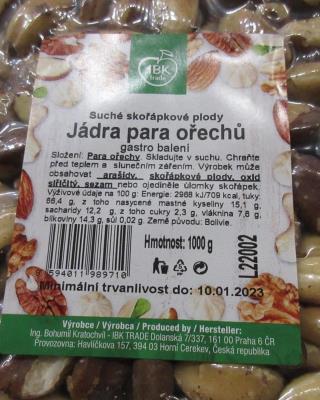
Czech Republic – Brazil Nuts – kernels – Aflatoxin B1

Potravinynapranyri

Illustrative photo #1

Place of inspection:
Horní Cerekev ( Havlíčkova 157, 394 03 Horní Cerekev )
ID: 07361092
Food group: Nuts Nuts

Brazil nuts – kernels
Category: Dangerous foods
Invalid parameter:

aflatoxin B1

In Brazil nuts, the limit for the content of contaminating substances – aflatoxins – was exceeded twice.

Aflatoxins are classified as mycotoxins. 

Batch: L74-22
Best before date: 30/3/2023
Packaging: plastic bag 20 kg
Quantity of the product in the package: 20 kg
Distributor: Supplier: CATZ INTERNATIONAL BV, BLAKEBURG build, Blaak 22, ROTTERDAM
Country of origin:  Bolivia
Date of sample collection: 5/3/2022
Reference number: 22-000336-SZPI-CZ
The sample was detected by the official control of the State Agricultural and Food Inspection.

RASFF Alerts – Aflatoxin – Pistachios – Peanuts

RASFF

Aflatoxins B1 and total over the limits allowed in Pistachio in shell from Iran in Italy and Germany

RASFF

Aflatoxins in peanuts in shell from Egypt in Germany