Monthly Archives: June 2021

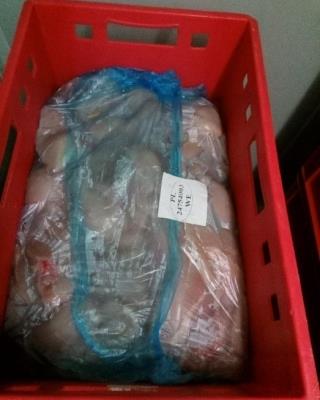
Czech Republic – Chilled chicken breast fillet – Salmonella

Potravinynapranyri

Illustration photo no. 1

Place of inspection:
Cesky Tesin ( Hrabinska 1930 / 28b, 73701 Cesky Tesin )
Company ID: 02179440
Food group: Meat and meat products Unpacked: meat, minced meat, meat preparations

Chilled chicken breast fillet
Category: Dangerous food
Unsatisfactory parameter:

Salmonella enterica serum. Enteritidis

The pathogenic bacterium Salmonella enterica serum was detected in chilled chicken breasts Enteritidis , which can cause a condition called salmonellosis.

Expiration date: 5/23/2021
Producer: PPHU Pawel Kaczorek Zaklad Rozbioru Drobiu, 42-500 Bedzin, Zawale 22, PL 24754003
Distributor: Kama trade CZ – re-dispatch meat warehouse
Country of origin:  Poland
Date of sampling: May 20, 2021
Reference number: 21-000019-SVS-CZ
The sample was found by official inspection of the State Veterinary Administration

UK – Almost half the adults (46%) who cook coated frozen chicken products do not always check cooking instructions on packaging before cooking

FSA

The Food Standards Agency (FSA), Food Standards Scotland (FSS) with Ipsos MORI have published a survey of consumer practices relating to coated frozen chicken products.

This survey identifies behaviours which could increase people’s risk to foodborne disease. It was commissioned as a result of a Salmonella incident linked to frozen chicken products such as nuggets, goujons, dippers, poppers and kievs. While these products may appear cooked on the outside, they often contain raw chicken and so they must be cooked thoroughly to help kill Salmonella bacteria.

Findings show that two thirds of adults aged 16-75 (67%) say they have recently cooked or eaten coated frozen chicken products at home. These products are particularly popular with younger adults, with 88% of those aged 16-24 having recently consumed them or cooked them at home. Participants were also more likely to have cooked or eaten these products if they have children aged 15 or under in their household (86%).

The survey also included questions on the storage and handling of these products pre and post-cooking:

  • Almost two thirds of those who cook these products (62%) say uncooked coated frozen chicken products at least sometimes come into contact with other surfaces such as worktops and plates
  • Over half of those who cook these products (58%) say they always wash their hands after handling coated frozen chicken products
  • Almost a quarter of consumers who personally cook products say they defrost them before cooking (23%), 62% say they do not. Among those who defrost products, half say they leave them at room temperature (53%)

Most participants who use an oven to cook coated frozen chicken products say they sometimes cook them together with other products, such as chips or vegetables (84%). Cooking these chicken products at a lower temperature or for a shorter time than advised may mean they are not thoroughly cooked before serving.

Narriman Looch, Head of Animal Feed and Foodborne Disease Control Branch said: ‘It’s important to understand that frozen chicken products often contain raw chicken, even though they may look pre-cooked on the outside. While additional measures have been put in place by food businesses to improve the safety of these products, consumers need to handle these products as they should other raw meat products. Cooking food at the right temperature and for the right amount of time will kill any Salmonella bacteria that may be in food. Therefore, we are urging consumers to follow cooking instructions for these products to protect themselves and their families.’

Food safety tips for frozen breaded chicken products:

  • Treat these products as raw chicken, ensuring they are steaming hot after cooking and surfaces they have touched are cleaned to avoid the spread of bacteria
  • Make sure the oven is up to temperature before cooking
  • Check the instructions on packaging and cook at the correct temperature and for the time stated
  • Wash your hands, utensils and clean surfaces after handling these products
  • If products require defrosting, follow the storage instructions on packaging and always defrost in the fridge

About this poll

The FSA and FSS commissioned an online survey via three waves of Ipsos MORI’s online omnibus of 5,599 adults (aged 16-75) living in the UK. Of these 3,740 had cooked or eaten coated frozen chicken products recently and went on to complete the full survey. The data was weighted to be representative of the UK adult population aged 16 – 75.

The full report is available in the research section of our website.

About the outbreak

FSA and FSS are continuing to work with Public Health England (PHE) and devolved public health authorities as well as our international food safety partners, via the United Nations’ World Health Organization, (WHO) and the Food and Agriculture Organization’s (FAO’s) International Food Safety Network (INFOSAN), to address the causes of the outbreak at source to prevent further cases of Salmonella Enteritidis.

Between January 2020 and May 2021 there have been 511 cases of Salmonellosis in the UK caused by two strains of Salmonella Enteritidis and linked to consumption of frozen, raw, breaded chicken products.

Authorities in Poland and UK retailers have taken action to reduce the risk from these products. Where non-compliant or unsafe food has been identified by the UK, action has been taken to protect consumers.

Italy – Genoese pesto without garlic – Listeria monocytogenes

Salute

Brand : Pastificio Novella Sas

Name : Genoese pesto without garlic

Reason for reporting : Recall due to microbiological risk

Publication date : 22 June 2021

Documentation

Documentation

USA – After U.S. recall, firm initiates nationwide Canadian recall of cat food because of Salmonella concerns

Food Safety News

Natural Balance Pet Foods Inc. is recalling certain cat food products in Canada because of possible Salmonella contamination, which can be dangerous to pets and people who handle the food.

The company reported that 378 units of the affected product were sold in Canada from February to April 2021.

As of June 2, the company had not received any reports of illness, complaints or injuries in Canada.

The products are the same that were recalled in the United States in May.

In the U.S. the issue was found by the Minnesota Department of Agriculture during a routine state surveillance sample.

UK – UK patient count in Salmonella melon outbreak doubles.

Food Safety News

The number of people sick in the United Kingdom in an outbreak linked to melons has almost doubled.

The Food Standards Agency (FSA) and Public Health England (PHE) are investigating the incident with 99 people sick since April. It was previously known that 52 people were ill in the UK.

Those more than 70 and less than 9 years old are the age groups mostly affected. Investigations are focusing on the supply chain of galia, cantaloupe and honeydew melons from Honduras and Costa Rica.

FSA is working with trade associations and retail businesses to get information relevant to the outbreak. A quick rise in confirmed infections occurred in the week commencing May 24.

Research – Prevalence of Listeria species and Listeria monocytogenes on Raw Produce Arriving at Frozen Food Manufacturing Facilities

Journal of Food Protection

Ubiquity of Listeria monocytogenes in the environment impacts the food industry and presents concerns for frozen food facilities. This study determined the prevalence and numbers of Listeria species and L. monocytogenes on raw produce arriving at frozen food facilities. Raw produce was collected using multi-level blinding protocols to ensure anonymity of participants and avoid traceback. Five raw vegetables were selected: corn, carrots, green beans, peas, and spinach. Raw products were collected after arrival at the facilities but before any cleaning or other pre-processing steps that are typically performed inside the facility. The FDA BAM method for detection of Listeria spp. and L. monocytogenes was followed, with PCR screening followed by selective plating methods. Listeria numbers were estimated from positive samples using MPN methodology. A total of 290 samples were collected, with 96 and 17 samples positive for Listeria spp. (33.1%) and L. monocytogenes (5.9%), respectively. Enumeration data for the 96 Listeria spp. samples indicated 82 samples had greater than 100 MPN Listeria spp./g and 14 samples less than 100 MPN Listeria spp./g. The prevalence of Listeria spp. varied by commodity: spinach (66.7%), peas (50%), corn (32.2%), green beans (22.2%), and carrots (13%). L. monocytogenes prevalence was determined in corn (13.6%), peas (6.3%), and green beans (4.2%) arriving at processing facilities. Such data was previously unavailable to frozen vegetable processors and is valuable in implementing process control standards. The prevalence and pathogen concentration data from raw commodities found in this study can provide the industry information to conduct more accurate quantitative risk assessments and provide a baseline to model and target appropriate pathogen reduction steps during processing.

New Zealand – Real Milk Timaru brand raw (unpasteurised) drinking milk – Listeria monocytogenes

MPI

Product identification
Product type Raw (unpasteurised) drinking milk
Name of product (size) Real Milk Timaru brand raw (unpasteurised) drinking milk (1L)
Date marking Use by date: 17/06/21, 18/06/21 and 19/06/21
Batch marking Purchased on and between 13 and 15 June 2021.

Lot numbers: 210613, 210614 and 210615

Package size and description The product is sold in a 1L glass bottle.
Distribution The product was sold via a vending machine at 22 Fairview Road, Timaru. The product was also available via home deliveries in the South Canterbury area and online at:

The product has not been exported.

Notes This recall does not affect any other batches of Real Milk Timaru brand raw (unpasteurised) drinking milk.

Consumer advice

Customers are asked to check the lot number, use by date written on the product and date of purchase.

If you have purchased any of the affected product listed on this notice, do not consume it. Customers should return the product to Real Milk Timaru for a full refund. Alternatively, consume after heating to 70°C and holding at this temperature for one minute. If you don’t have a thermometer, heat the milk until it nearly reaches a boil (or scald the milk) before drinking it.

There have been no reports of associated illness in New Zealand. If you have consumed any of this product and have any concerns about your health, seek medical advice.

MPI’s advice on how to reduce the risk of illness if you drink raw unpasteurised milk

More information on Listeria

Who to contact

If you have questions, contact Real Milk Timaru:

  • Phone: ​027 221 4552
  • Address: 22 Fairview Road, Timaru.

Belgium – “Seafood” brand 150g Zeelandia’s garnalen – Listeria monocytogenes

AFSCA

Recall Levenstond NV Seafood
Product: “Seafood” brand 150g Zeelandia’s garnalen.
Problem: possible presence of Listeria monocytogenes.


In consultation with the AFSCA Levenstond Seafood NV has decided to withdraw the Seafood (150g) of the brand “Zeelandia’s garnalen” from the sale.

This following a press release from the supplier of this product, in which he informed us of the possible presence of Listeria monocytogenes.

This product is being withdrawn from sale and is being recalled from consumers.

Levenstond Seafood NV asks consumers not to use the product and to return it to the point of sale.

Product description:

Name: Zeevruchtenmix, Fruits de Mer, Meeresfrüchte Lot
numbers – expiry dates (
BBD ): lot 260521 –
06/16/2021
lot 010621 – 06/22/2021 lot 040621 – 06/25/2021
Weight: 150 g

This product has been distributed by the following points of sale in Belgium:

De Vis Factorij Riemst – Allewijstraat 1, 3770 Riemst
Agora Culinair Seafood – Atealaan 21, 2200 Herentals
Carrefour market Diepenbeek – Wijkstraat 37, 3590 Diepenbeek
Carrefour market Houthalen – Weg naar Zwartberg 75 , 3530 Houthalen-Helchteren
Carrefour market Terbiest – Hasseltsesteenweg 39, 3800 Sint-Truiden

For more information , you can contact the contact point of Levenstond Seafood NV (012 / 42.01.10, marieke@levenstondseafood.be ).

USA – Yogurt E. coli Outbreak: What is a Secondary Food Poisoning Infection?

Food Poisoning Bulletin

In the Pure Eire yogurt E. coli outbreak that has sickened at least 16 people in Washington and Arizona, some of the patients have contracted secondary food poisoning infections. This term may not be familiar to everyone. So what is this type of infection?

A secondary food poisoning infection occurs when someone gets sick from contact with another person, not by eating contaminated food or drinking contaminated water. Many pathogens can be spread person-to-person, by direct contact and common contact with fomites (surfaces), both through the fecal-oral route.

Ireland – Boil water notice issued for Clare Island public water supply

Con-telegraph

crypto

FOLLOWING advice from the Health Service Executive, Irish Water and Mayo County Council have issued a boil water notice for the area supplied by the Clare Island public water supply to protect approximately 165 people following a recent drinking water quality test.

The notice has been put in place due to the detection of cryptosporidium in the Clare Island public water supply.

Cryptosporidium is a tiny parasite found in human and animal waste. If it is swallowed (ingested), it can cause a disease called cryptosporidiosis. The symptoms of cryptosporidiosis include fever, stomach upset, weight loss and diarrhoea.

Cryptosporidium may be found in water if it has been contaminated or if there has been a problem with water treatment.