Monthly Archives: March 2021

Taiwan – 164 hospitalized in southern Taiwan with suspected food poisoning

Taiwan News

At least 164 students have been taken to hospitals in Pingtung County since Thursday evening (March 11) after developing symptoms of food poisoning.

Students from Donggang Senior High School began to display symptoms associated with food poisoning — including stomach cramps, vomiting, and diarrhea — after arriving home from school on Thursday. The school said it began to receive calls from parents at 11 p.m. and that a total of 231 students had called in sick on Friday.

As of press time, 121 of the 164 students who sought treatment at Fooyin University Hospital and Antai Hospital had been discharged, leaving 43 still hospitalized for further observation. Since all the patients had eaten food sourced from the same supplier, the authorities suspect the outbreak is a case of mass food poisoning and have sent samples of the school lunch to a medical laboratory for analysis.

Belgium – Rund Menu frozen sausage (dog food) – Salmonella

AFSCA

Recall of Canis Purus
Product: Rund Menu frozen sausage (dog food).
Problem: presence of Salmonella.


In agreement with the AFSCA, Canis Purus is withdrawing from sale the product Rund Menu (frozen sausage – dog food) and is recalling it to consumers because of the presence of Salmonella.

Canis Purus asks its customers not to give this product to their pets and to return it to the point of sale, ANIMALS (Toleikstraat 13, 3960 Bree) where it was purchased. They will be reimbursed.

Product description

– Product name: Rund Menu
– Brand: Canis Purus
– Date of minimum durability (DDM) (“
Best before (or end)”): 01/12/2021 – Batch number: 201201
– Sales period: from 12/01/2020 to 02/19/2021
– Type of packaging: Frozen sausage
– Weight: 500 g / 1000 g

The product was sold via ANIMALS (Toleikstraat 13, 3960 Bree)

For any further information , contact:

Paredis Stef
0032 479 692 721
stef@animaux-bree.be

Singapore – Recall of eggs from Lay Hong Berhad Layer Farm Jeram (Malaysia)due to presence of Salmonella Enteritidis

Click to access sfa-media-release_120321_recall-of-eggs-from-lay-hong-berhad-layer-farm-jerame3e2294028dc42c980dbc111d1baad50.pdf

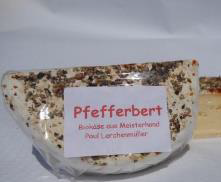
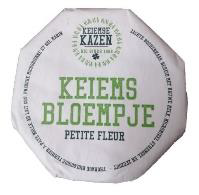
Germany – Petit Fleur Camembert, Pfefferbert, Kreitaberti, 250 g- Listeria monocytogenes

LMW

Warning type:Food
Date of first publication:03/12/2021
Product name:Petit Fleur Camembert, Pfefferbert, Kreitaberti, 250 g
Product pictures:

Product image1.png
Product image2.png
Product picture3.png
Manufacturer (distributor):Cheese wholesaler Paul Lerchenmüller
Reason for warning:

Listeria

Packaging Unit:see attached press release
Durability:see attached press release
Production date:see attached press release
Lot identification:see attached press release
Further information:

Reference is made to the attached press release from the food company.

Contact to the responsible authorities:

Baden-Württemberg:poststelle@mlr.bwl.de

Bavaria:poststelle@lgl.bayern.de
Hesse:Schnellwarnung@rpda.hessen.de
Press releases and information
title Attachment or web link
Press release

Germany – CAMEMBERT GRAINDORGE – STEC E.coli

steLMW

Warning type:Food
Date of first publication:03/13/2021
Product name:CAMEMBERT GRAINDORGE
Product pictures:

4813_Camembert LC_1.jpg
Manufacturer (distributor):MUNICH fromage GmbH & Co. KG
Reason for warning:

Detection of verotoxin-producing E. coli

Packaging Unit:250 g
Durability:04/07/2021
Lot identification:270121LI13
Further information:For more information, please refer to the attached press release.
Contact to the responsible authorities:

Baden-Württemberg:poststelle@mlr.bwl.de

Bavaria:poststelle@lgl.bayern.de
Hamburg:poststelle@justiz.hamburg.de
Hesse:Schnellwarnung@rpda.hessen.de
Lower Saxony:poststelle@ml.niedersachsen.de
North Rhine-Westphalia:poststelle@mulnv.nrw.de
Press releases and information
title Attachment or web link
Press release MÜNNICH fromage GmbH & Co. KG

USA – Legionnaires’ Disease cluster reported in north New Jersey

Outbreak News Today

CDC legionella

Image CDC

The New Jersey Department of Health (NJDOH) is investigating a cluster of Legionnaires’ disease cases in Union County. The Department is aware of 14 confirmed cases of Legionnaires’ disease, including one death, among individuals who live in or spend time in the county.

The cases were reported to the Department between February 3 and February 26, 2021. The Department is working with the local health departments in Union County to investigate this cluster. The individual who died was a male resident of Union County in his late 60s.

“This is a continuing investigation. The risk to anyone who lives in Union County is very small,” said New Jersey Health Commissioner Judith Persichilli.  “Out of an abundance of caution, the Department recommends that individuals who live in Union County who become ill with pneumonia-like/respiratory symptoms, such as fever, chills, cough, shortness of breath, muscle aches, and headache visit their healthcare provider.”

Research – Efficacy of Bacteriophage Cocktail to Control E. coli O157:H7 Contamination on Baby Spinach Leaves in the Presence or Absence of Organic Load

MDPI

Fruits and vegetables are high in nutrients that are essential for a healthy lifestyle. However, they also harbor an extensive array of microorganisms such as bacteria, which can be beneficial, neutral, or pathogenic. Foodborne pathogens can contaminate produce at any stage from the farm to the consumer’s table. Appropriate washing techniques using sanitizers can reduce the risk of pathogen contamination. Issues related to maintaining concentration, efficacy, and other problems have been a challenge for the food industry and, when left unresolved, have led to different outbreaks of foodborne illnesses. In this study, the efficacy of a lytic bacteriophage cocktail was examined for its ability to infect and reduce the contamination of Escherichia coli O157:H7 (E. coli O157:H7), in media with a high organic load, using a microplate technique. The study was conducted for 3 h to determine if the bacteriophage cocktail could reduce the pathogen in the presence of a high organic load. A significant (p < 0.05) reduction in the population of E. coli O157:H7 was observed, representing a 99.99% pathogen reduction at the end of 3 h. Fresh spinach leaves were washed in sterile potable or organic water (~9000 ppm organic load) containing E. coli O157:H7 and a bacteriophage cocktail to study the effectiveness of bacteriophages against the foodborne pathogen. Results indicated that the bacteriophage significantly (p < 0.05) reduced the contamination of E. coli O157:H7 in both situations. The study also demonstrated the bacteriophages’ ability to infect and reduce the pathogen in an organic-rich environment. This characteristic differs from commercially available sanitizers that have demonstrated a tendency to bind with the available organic load. Thus, these studies highlight the advantage of employing bacteriophages during produce wash to eliminate foodborne pathogen contamination on fruits and vegetables. View Full-Text

Research – Scientists working on better testing for leafy greens, other fresh produce

Food Safety News

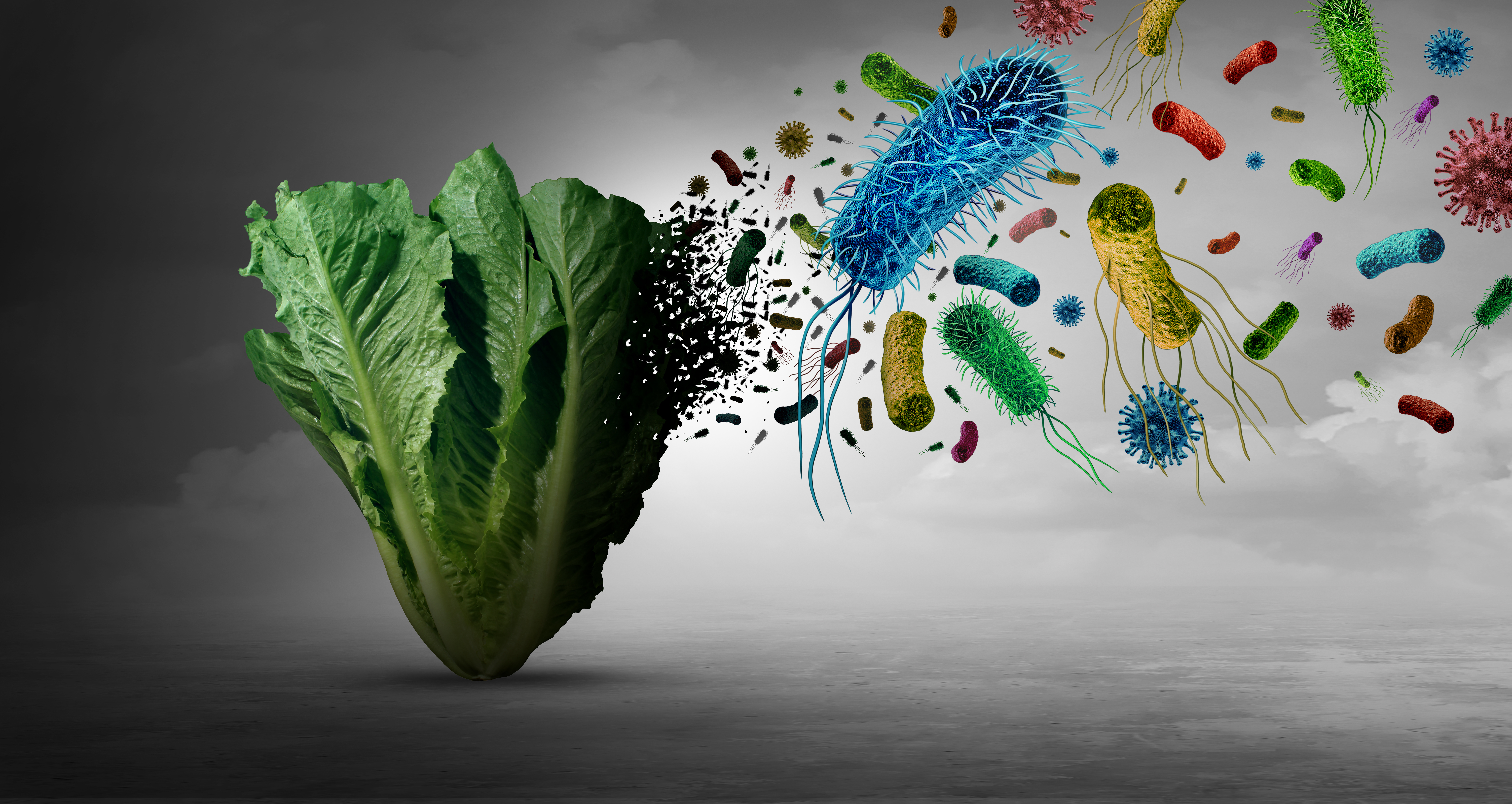
Vegetable Bacteria Danger

Vegetable bacteria and germs on vegetables and the health risk of ingesting contaminated green food including romaine lettuce as a produce contamination and safety concept with 3D render elements.

Researchers seeking to develop better food safety testing for fresh produce, with a particular focus on lettuce, have received a boost in the form of a USDA grant.

The U.S. Department of Agriculture’s National Institute of Food and Agriculture (NIFA) recently announced the grant of more than $348,000 to support the work at the University of Illinois. 

Matt Stasiewicz, assistant professor of applied food safety at the university is heading the project. The study involves swabbing many plants in the field to capture potential pathogens, then passing those aggregate swabs to a single microbiological test.

“Safety testing is important for a ready-to-eat product that isn’t cooked before consumption. We want to ensure we find contamination if it occurs so we can remove it from the product stream,” Stasiewicz said in the announcement. “The goal of this USDA grant is to introduce transformative change into how preharvest testing works.”

“The main foodborne pathogen leafy green growers are worried about is toxin-producing E. coli; those have been responsible for outbreaks the last couple of years. We know risk factors are animal intrusion, relatively recent rainfall events, and untreated or otherwise contaminated irrigation water.”

Research – Campylobacter Contamination of UK-Produced Halal Chicken at Retail

Journal of Food Protection

CDC Campy

Campylobacter is the leading cause of human bacterial diarrhoeal disease worldwide, with poultry meat products accounting for the majority of human cases. Recent surveys by the Food Standards Agency estimate the Campylobacter prevalence in fresh UK retail chicken to be 41.2%. However, such surveys have not distinguished between broiler chickens produced for different consumer demographics, such as the Halal market. Campylobacter colonisation of broilers is difficult to prevent, especially during routine partial depopulation of flocks. Broilers produced for the Halal market may undergo multiple depopulation events, which may increase the risk of colonisation and subsequent Campylobacter contamination of chicken meat. This project aimed to determine the prevalence and levels of Campylobacter contamination of chicken meat produced for the UK Halal market. Campylobacter was identified and enumerated from the neck skin and outer packaging of 405 Halal chickens. Following culture, isolates were assigned to species via PCR and disc diffusion antimicrobial susceptibility tests determined. Logistic regression analysis assessed risk factors for Campylobacter isolation, the level of Campylobacter contamination among positive carcasses and antimicrobial resistance outcomes. Campylobacter spp. were confirmed in 65.4% of neck skin samples and 17.1% of packaging samples. 13.8% of neck skin samples had the highest level of contamination (>1000 cfu/g). Large birds had a significantly higher number of samples with >1000 cfu/g (p<0.001) and as chicken carcass weight increased, birds were more likely to be Campylobacter-positive (p<0.05). A high prevalence of resistance was seen to ciprofloxacin (42.0%) and 38.5% of samples contained at least one multi-drug resistant Campylobacter isolate. This study demonstrates that Halal chicken has a higher Campylobacter prevalence than non-Halal chicken. Interventions should be introduced to reduce this increased public health risk to consumers.

Research – Environmental Management of Legionella in Domestic Water Systems: Consolidated and Innovative Approaches for Disinfection Methods and Risk Assessment

MDPI

Legionella_Plate_01

Legionella is able to remain in water as free-living planktonic bacteria or to grow within biofilms that adhere to the pipes. It is also able to enter amoebas or to switch into a viable but not culturable (VBNC) state, which contributes to its resistance to harsh conditions and hinders its detection in water. Factors regulating Legionella growth, such as environmental conditions, type and concentration of available organic and inorganic nutrients, presence of protozoa, spatial location of microorganisms, metal plumbing components, and associated corrosion products are important for Legionella survival and growth. Finally, water treatment and distribution conditions may affect each of these factors. A deeper comprehension of Legionella interactions in water distribution systems with the environmental conditions is needed for better control of the colonization. To this purpose, the implementation of water management plans is the main prevention measure against Legionella. A water management program requires coordination among building managers, health care providers, and Public Health professionals. The review reports a comprehensive view of the state of the art and the promising perspectives of both monitoring and disinfection methods against Legionella in water, focusing on the main current challenges concerning the Public Health sector.