Monthly Archives: March 2020

Research -Microbiological reduction strategies of irrigation water for fresh produce

JFP

Irrigation water can be a source of pathogenic contamination of fresh produce. The quality of the water used during primary production is important to control to ensure food safety and protect human health. Several measures to control the microbiological quality of irrigation water are available for growers, including preventative and mitigation strategies. However, clear guidance for growers on which strategies could be used to reduce microbiological contamination is needed. This study evaluates pathogenic microorganisms of concern in fresh produce and water, the microbiological criteria of water intended for agricultural purposes, as well as preventative and mitigative microbial reduction strategies. This article provides suggestions for control measures that growers can take during primary production to reduce foodborne pathogenic contamination coming from irrigation water. Results show that controlling the water source, regime, and timing of irrigation may help to reduce the potential exposure of fresh produce to contamination. Moreover, mitigation strategies like electrolysis, ozone, UV, and photocatalysts hold promise either as a single treatment, with pretreatments that remove suspended material, or as combined treatments with another chemical or physical treatment(s). Based on the literature data, a decision tree was developed for growers, which describes preventative and mitigation strategies for irrigation water disinfection based on the fecal coliform load of the irrigation water and water turbidity. It helps guide growers when trying to evaluate possible control measures given the quality of the irrigation water available. Overall, the strategies available to control irrigation water used for fresh produce should be evaluated on a case-by-case basis as one strategy or technology does not apply to all scenarios.
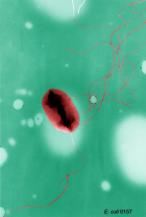
Research – Inactivation of Shiga Toxin-Producing Escherichia coli and Listeria monocytogenes Within Plant Versus Beef Burgers in Response to High Pressure Processing

JFP

kswfoodworld E.coli O157

Image CDC

We evaluated high pressure processing to lower levels of Shiga toxin-producing Escherichia coli (STEC) and Listeria monocytogenes inoculated into samples of plant or beef burgers. Multi-strain cocktails of STEC and L. monocytogenes were separately inoculated (ca. 7.0 log CFU/g) into plant burgers or ground beef. Refrigerated (i.e., 4°C) or frozen (i.e., -20°C) samples (25-g each) were subsequently exposed to 350 MPa for up to 9 or 18 min or 600 MPa for up to 4.5 or 12 min, respectively. When refrigerated plant or beef burger samples were treated at 350 MPa for up to 9 min, levels of STEC were reduced by ca. 0.7 to 1.3 log CFU/g. However, when refrigerated plant or beef burger samples were treated at 350 MPa for up to 9 min, levels of L. monocytogenes remained relatively unchanged (ca. ≤0.3 log CFU/g decrease) in plant burger samples, but were reduced by ca. 0.3 to 2.0 log CFU/g in ground beef. When refrigerated plant or beef burger samples were treated at 600 MPa for up to 4.5 min, levels of STEC and L. monocytogenes were reduced by ca. 0.7 to 4.1 and ca. 0.3 to 5.6 log CFU/g, respectively. Similarly, when frozen plant and beef burger samples were treated at 350 MPa up to 18 min, reductions of ca. 1.7 to 3.6 and ca. 0.6 to 3.6 log CFU/g in STEC and L. monocytogenes numbers, respectively, were observed. Exposure of frozen plant or beef burger samples to 600 MPa for up to 12 min resulted in reductions of ca. 2.4 to 4.4 log and ca. 1.8 to 3.4 log CFU/g in levels of STEC and L. monocytogenes, respectively. Via empirical observation, pressurization did not adversely affect the color of plant burger samples, whereas appreciable changes in color were observed in pressurized ground beef. These data confirm that time and pressure levels already validated for control of STEC and L. monocytogenes in ground beef will likely be equally effective towards these same pathogens in plant burgers without causing untoward effects on product color.

Research – Some E. coli Strains May Be Linked to Development of Bowel Cancer

Food Poisoning Bulletin

CDC E.coli

Image CDC

According to a new study in the journal Nature, E. coli infections may be linked to bowel cancer. Some species of the intestinal microbiota, which is the collection of bacteria and viruses that live in the human gut, have been associated with colorectal cancer, but a direct role hasn’t been proven.

As it turns out, E. coli bacteria carry what is called a pathogenicity island pks, that creates enzymes that synthesize a compound called colibactin. Colibactin causes double-strand breaks in cultured cells. This damage can lead to cancer over time. Colibactin is found more often in fecal samples of people who do have bowel cancer than healthy people.

Research – The Growth and Aflatoxin B1, B2, G1 and G2 Production by Aspergillus flavus and A. parasiticus on Ground Flax Seeds (Linum usitatissimum)

JFP

Flax seed has become an increasingly popular food ingredient because of its nutrient richness as well as potential health benefits.  Flax seeds are often ground before consumption and flax seed cakes are used as animal feed.  Aflatoxin production may occur subsequently when the ground seeds are stored in an environment supporting fungal growth. The objectives of this study were to determine the growth of two  toxigenic fungi, Aspergillus flavus and A. parasiticus , and to quantify the concentrations of four major aflatoxins (AFB1, AFG1, AGB2, and AFG2) produced by the two fungi on ground flax seeds with 0.82, 0.86, 0.90, 0.94 and 0.98 a w incubated for 30 days at 20, 27 and 35°C. Results of the study showed that A. flavus was able to grow on ground seeds with 0.86-0.98 a w at all three temperatures, and the most rapid growth occurred at 0.90 and 0.94 a w at 27°C. Whereas A. parasiticus grew on seeds with 0.86-0.98 a w at 27 and 35°C as well as on seeds with 0.86-0.90 a w at 20°C, and the most favorable growth condition was 0.90-0.94 a w at 35°C. Aspergillus flavus produced aflatoxins on seeds with 0.90-0.94 a w at 27°C as wells as on seeds with 0.86-0.98 a w at 35°C and the maximum total aflatoxin (298 µg/kg), AFB1 (247 µg/kg) and AFG1 (51 µg/kg) were found on seeds with 0.90 a w at 35°C. Whereas, A. parasiticus produced aflatoxins under a wider range of conditions which included 0.86 a w at 27 and 35°C, 0.90 a w at 20 and 27°C, 0.94 a w at 27°C, and 0.98 a w at 35°C.  The maximum total aflatoxin (364 µg/kg) and maximum AFB1 (324 µg/kg) along with 34 µg/kg AFG1 and 6 µg/kg AFB2 were produced by A. parasiticus on seeds with 0.98 a w incubated at 35°C for 30 days. Linear regression models also indicated that high incubation temperature (35°C) was optimal for overall fungal growth as well as formation of high levels of aflatoxin by both fungi. Future studies should also address aflatoxin contamination in flax seed oil.

Research – Exposure Assessment of Multi-Mycotoxins in Black and White Sesame Seed Consumed in Thailand

JFP

This study was conducted to determine the occurrence of 16 well recognized and emerging mycotoxins in black and white sesame seed samples being commercialized in Thailand, and to evaluate health risk assessment in consumers. Samples were extracted and cleaned up by a modified QuEChERS based procedure. Multi-mycotoxins in sesame seed samples were analyzed using a validated liquid chromatography-tandem mass spectrometry (LC-MS/MS) method. Additionally, the risk of mycotoxin exposure via dietary intake of sesame was evaluated using hazard quotient, margin of exposure (MOE) and quantitative liver cancer risk approaches established by EFSA and FAO/WHO, respectively. The results show that 21.5 % of total samples (n = 200) were contaminated with mycotoxins. 19.5 % of total samples (n = 200) were contaminated with a single mycotoxin and 2 % of total samples were contaminated with multiple mycotoxins. 9 % of total samples were contaminated with aflatoxins (AFs), however only one black and one white sesame seed sample was above the regulatory limits of the European Union (2 µg / kg). The MOE values derived from consumption of black and white sesame were generally below 10,000 especially in the heavily consuming group. The number of liver cancer cases over a life time associated with AFB 1 exposure based on upper bound values at high level of black and white sesame consumption (97.5th percentile) is estimated to be more than 1 liver cancer case per million persons. Therefore, a potential risk to consumer health exists through the dietary consumption of black and white sesame and subsequent exposure to AFB 1 . However, further evaluation using larger sample sizes is necessary for more accurate calculation. In addition, continuous monitoring of mycotoxin contamination of sesame with risk assessment is recommended.

Research -Towards a better understanding of listeriosis risk among older adults in the United States: Characterizing dietary patterns and the sociodemographic and economic attributes of consumers with these patterns

JFP

Older adults are at higher risk of invasive listeriosis compared with the general population.  Some foods are more likely than others to be contaminated with or contain high levels of Listeria monocytogenes . The objectives of this study were to, 1) determine dietary consumption patterns, among older adults in the United States; 2) evaluate sociodemographic and economic characteristics of older adults associated with each pattern; 3) determine intake of foods associated with larger relative risk of listeriosis within these patterns; and 4) rank these patterns based on risk. Data of older adults, age 60 and older, participating in the cross-sectional National Health and Nutrition Examination Surveys (NHANES) 2009-2010, 2011-2012, and 2013-2014 (n=4,967) were included in these analyses. Cluster analysis was used to define dietary patterns based on day 1 and day 2 24-hour dietary recalls. Mean intake of foods associated with higher risk of listeriosis were examined within each pattern, and ANOVA with Dunnett’s method of adjustment was used to evaluate significant differences in mean intake of foods. Patterns were ranked based on relative risk of listeriosis using outbreak illness attribution data. Five distinct dietary patterns were identified. Patterns ranked at highest relative risk of listeriosis, based on US outbreak illness attribution data, were characterized by relatively higher intakes of, (1) fruits, vegetables, and cheeses (~13% respondents) or (2) cereal, milk, and yogurt (~14% respondents).  Individuals consuming these dietary patterns differed in sex, race, food security, self-rated diet quality, and self-rated health. Cluster analysis, despite methodological limitations, provides new information on consumption, sociodemographic, and economic characteristics of subgroups within susceptible populations that may be used to target educational messages .


RASFF Alerts – Aflatoxin – Curry powder – Chilli Powder – Groudnut Kernels – Almond Kernels

RASFF-Logo

RASFF – aflatoxins (B1 = 7.6; Tot. = 9.3 µg/kg – ppb) in curry powder from Malaysia, via the United Kingdom in Switzerland

RASFF – aflatoxins (B1 = 9.2 µg/kg – ppb) in chili powder from India in Hungary

RASFF – aflatoxins (B1 = 14; Tot. = 16 / B1 = 32; Tot. = 36 µg/kg – ppb) in groundnut kernels from India in the Netherlands

RASFF – aflatoxins (B1 = 2.9; Tot. = 19) in almond kernels from the United States in the Netherlands

RASFF – aflatoxins (B1 = 19; Tot. = 22 µg/kg – ppb) in groundnut kernels from India in the Netherlands

RASFF – aflatoxins (B1 = 49; Tot. = 55 µg/kg – ppb) in groundnut kernels from India in the Netherlands

RASFF – aflatoxins (B1 = 2.2; Tot. = 2.2 µg/kg – ppb) in groundnuts from Argentina in the Netherlands

RASFF Alerts – Salmonella – Raw Chicken – Chicken Legs – Pork Diaphragm – Camel Burger – Sesame Seeds – Chicken Cordon Bleu – Chicken Thighs – Minced Veal – Minced Beef – Frozen Kebab- Frozen Pork – Black Chia Seeds – Chicken Breast – Chicken Fillet – Turkey Meat

RASFF-Logo

RASFF – Salmonella enterica ser. Typhimurium (presence /25g) in chilled raw chicken from France in Norway

RASFF – Salmonella enterica ser. Kottbus (presence /25g) in frozen chicken leg quarters from Poland in Bulgaria

RASFF – Salmonella (in 1 out 5 samples /25g) in frozen pork diaphragm from the United Kingdom in the Czech Republic

RASFF – Salmonella (presence /10g) in frozen camel burger from Belgium in Belgium

RASFF – Salmonella enterica ser. Herston (presence /25g) in sesame seeds from Sudan, dispatched from the United Arab Emirates in Greece

RASFF – Salmonella enterica ser. Nessa (presence /25g), Salmonella enterica ser. salamae (presence /25g) and Salmonella enterica ser. Salford (presence /25g) in sesame seeds from Sudan in Greece

RASFF – Salmonella (in 1 out of 3 samples /25g) in chilled chicken cordon bleu from the Netherlands in the Netherlands

RASFF – Salmonella enterica ser. Enteritidis (presence /25g) in frozen chicken thighs from Poland, via Lithuania in Estonia

RASFF – Salmonella enterica ser. Enteritidis (in 2 out of 5 samples /25g) in chilled chicken broiler thigh meat from Poland in Lithuania

RASFF – Salmonella (presence /25g) in frozen minced veal from the Netherlands in the Netherlands

RASFF – Salmonella (presence /25g) in minced beef from Denmark, via Germany in Sweden

RASFF – Salmonella enterica ser. Typhimurium (presence /25g) in frozen chicken broiler thighs from Poland in Lithuania

RASFF – Salmonella enterica ser. Infantis (in 1 out of 5 samples /25g) in chicken broiler quarters from Lithuania, with raw material from Poland in Lithuania

RASFF – Salmonella enterica ser. Bredeney (presence /25g) and Salmonella enterica ser. Infantis (presence /25g) in frozen kebab from Slovenia in Italy

RASFF -Salmonella (presence /25g) in frozen pork from Germany in Sweden

RASFF – Salmonella enterica ser. Bredeney (presence /25g) in black chia seeds from Bolivia in Romania

RASFF – Salmonella enterica ser. Aberdeen (presence /25g) in sesame seeds from Sudan, via the United Arab Emirates in Greece

RASFF – Salmonella enterica ser. Enteritidis (in 3 out of 5 samples /25g) in chilled chicken breast fillets from Poland in the Czech Republic

RASFF – Salmonella (presence /25g) in frozen chicken breast fillets from Poland in Italy

RASFF – Salmonella enterica ser. Infantis (presence /25g) in frozen chicken fillet from Hungary in Lithuania

RASFF – Salmonella enterica ser. Typhimurium monophasic (1 ,4, [5], 12:i:-) (present /25g) in various chilled turkey meat from France in France

RASFF Alert – Ochratoxin A – Raisins

RASFF-Logo

RASFF – ochratoxin A (33.8 µg/kg – ppb) in raisins from South Africa, via Germany in Switzerland

RASFF Alerts – E.coli – Chilled Cheese – Live Mussels

RASFF-Logo

RASFF – too high count of Escherichia coli (110000 CFU/g) in chilled cheese from France in France

RASFF – high count of Escherichia coli (up to 1100 MPN/100g) in live mussels (Mytilus galloprovincialis) from Italy, with raw material from Spain in Italy