Monthly Archives: August 2019

Research – Assessment of the bioprotective potential of lactic acid bacteria against Listeria monocytogenes on vacuum-packed cold-smoked salmon stored at 8 °C.

Science Direct

Abstract

Smoked salmon is a highly appreciated delicatessen product. Nevertheless, this ready-to-eat (RTE) product is considered at risk for Listeria monocytogenes, due to both the prevalence and growth potential of this bacteria on the product. Biopreservation may be considered a mild and natural effective strategy for minimizing this risk. In this study, we evaluated the following three potential bioprotective lactic acid bacterial strains against L. monocytogenes in three smoked salmon types with different physicochemical characteristics, primarily fat, moisture, phenol and acid acetic content: two bacteriocin-like producers that were isolated from smoked salmon and identified as Lactobacillus curvatus and Carnobacterium maltaromaticum and a recognized bioprotective bacteriocin producer from meat origin, Lactobacillus sakei CTC494. L. sakei CTC494 inhibited the growth of L. monocytogenes after 21 days of storage at 8 °C in all the products tested, whereas L. curvatus CTC1742 only limited the growth of the pathogen (<2 log increase). The effectiveness of C. maltaromaticum CTC1741 was dependent on the product type; this strain limited the growth of the pathogen in only one smoked salmon type.

These results suggest that the meat-borne starter culture, L. sakei CTC494, may potentially be used as a bioprotective culture to improve the food safety of cold-smoked salmon.
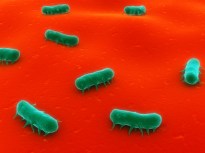
Research -Adaptation to life in cattle may be driving E. coli to develop harmful features

Science Daily

A large-scale study of the genetic differences and similarities among E. coli bacteria from cattle and humans indicates that features causing food poisoning in humans may continuously be emerging in bacteria from cattle as a means to better adapt to their environment.

While E. coli bacteria are one of the most well-known causes of food poisoning, a wide variety of E. coli strains exists, many of which are harmless, permanent residents of our intestines. However, the ingestion of harmful strains of E. coli on contaminated food can lead to severe illness, vomiting, and diarrhea.

“To develop the most effective preventive measures, we need a deep understanding of the source and living conditions of the bacteria,” says Yoshitoshi Ogura, associate professor at Kyushu University’s Department of Bacteriology, who led the research.

“Although cattle have long been thought to be a main source of E. coli that cause food poisoning, why dangerous forms would keep appearing in cattle has been unclear.”

Ogura’s group, in collaboration with researchers across Japan and in France, Belgium, and the United States, set out to help answer this question by investigating the genetics of E. coli bacteria collected from cattle and humans in 21 countries spanning six continents.

“To date, there have been only a limited number of reports of the genome sequences of E. coli from cattle, so we needed to fill that gap,” comments Yoko Arimizu, first author on the paper in Genome Research announcing the new results.

While the largest number of samples was from Japan, strains from other regions exhibited characteristics that were well distributed among those from Japan, indicating a good diversity of the set of samples.

Based on the genetic features of the bacteria, the researchers could generally separate the different strains of E. coli into two groups, with one primarily consisting of bacteria collected from humans and the other of those from cattle.

Applying the same analysis to clinically obtained E. coli that are known to cause illness, the researchers found that most of the strains causing intestinal problems belonged to the group associated with cattle.

Furthermore, many of the samples from cattle exhibited features similar to those causing food poisoning, such as the production of Shiga toxin. While these features generally appear not to cause illness in cattle, their prevalence in the investigated samples suggests that such characteristics are beneficial for life in a cattle’s intestine.

“As long as there is pressure to maintain or strengthen these illness-producing characteristics to better adapt to living in a cattle’s intestine, new variants of E. coli that cause food poisoning are likely to continue appearing,” states Ogura.

The researchers speculate that these characteristics may help E. coli protect itself from bacteria-eating organisms present in cattle intestines, but more work is needed to identify the exact reason.

USA – Human Salmonella Illnesses linked to Pig Ears hits 143 in 25 States

Food Poison Journal kswfoodworld salmonella

As of August 26, 2019, a total of 143 people infected with the outbreak strains of Salmonella have been reported from 35 states. A list of the states and the number of cases in each can be found on the Map of Reported Cases page.

Illnesses started on dates ranging from June 10, 2015 to July 30, 2019. Ill people range in age from less than 1 year to 90 years, with a median age of 39 years. Sixty (46%) ill people are female. Of 110 ill people with information available, 33 (30%) have been hospitalized. No deaths have been reported.

USA – Listeria Warning: Consumers Advised to Avoid Unsealed Food from We Share Hope

Food Poison Journal

The Rhode Island Department of Health (RIDOH) is advising consumers to avoid eating food products that are not commercially sealed from We Share Hope of Warren and East Providence, RI because it has the potential to be contaminated with Listeria monocytogenes.

Various food products were distributed to soup kitchens and food pantries in Rhode Island and possibly other states or may have been purchased at the We Share Hope facility at 624 Main Street, Warren. No one should purchase or obtain food from the Warren or East Providence facilities until further notice. These products were distributed from a facility that previously had environmental samples that tested positive for Listeria monocytogenes. At this time, there have not been any reports of illnesses associated with these products.

USA – “Cyclosporapocalypse” sickens 1,696 in 33 States in 2019

Food Poison Journal Cyclospora_LifeCycle201

The number of reported cases of domestically acquired cyclosporiasis has increased from the previous month and remains elevated in the United States since May 1, 2019.

As of August 28, 2019, 1,696 laboratory-confirmed cases of cyclosporiasis were reported to CDC by 33 states, District of Columbia and New York City in people who became ill since May 1, 2019 and who had no history of international travel during the 14-day period before illness onset.

USA – Hepatitis A Again!

Food Poison Journal

The Southern Nevada Health District has identified a person with hepatitis A that worked at a 7-Eleven convenience store located at 2910 S. Maryland Parkway, Las Vegas, NV 89109 (Maryland Parkway and Vegas Valley Drive) while they were potentially infectious to others. Although transmission of hepatitis A from food handlers to patrons is rare, the Health District is informing customers who purchased non-prepackaged foods such as hot dogs or hot deli items between Friday, July 26 and Friday, Aug. 7, 2019, at this 7-Eleven location that they may have been exposed to the virus.

Food Poison Journal

The Saginaw County Health Department (SCHD) has confirmed a case of hepatitis A (HAV) in a foodservice worker at the Cracker Barrel Restaurant and Old Country Store located at 6450 Dixie Highway in Bridgeport, Michigan.

The facility is working with the SCHD during the investigation.

Anyone who visited the Cracker Barrel from August 25-28, 2019 may have been exposed. These individuals are advised to receive the hepatitis A vaccine by September 8, 2019.

Cruise ship outbreaks down in 2019

Outbreak News Today

As we near the end of August, it is quite noticeable that the number of cruise ship outbreaks investigated by the Centers for Disease Control and Prevention’s (CDC) Vessel Sanitation Program (VSP) is less than recent previous years.

Thus far in 2019, CDC-VSP officials investigated five outbreaks- all before early April, nothing since. The most recent outbreak being Oceania Cruises, Oceania Marina 3/18 to 4/5 voyage.

While the year is not over, it is a slower season.

This compares to 11 outbreaks investigated in all of 2018, 11 in 2017 and 13 in 2016.

Of the 40 outbreaks reported by VSP, 27 were due to norovirus, 2 were Enterotoxigenic E. coli(ETEC), one each of Clostridium perfringens, rotavirus, norovirus and Campylobacter and norovirus and ETEC.

RASFF Alerts – Listeria monocytogenes – VP Cooked Shrimps – Gouda Cheese – Serrano Ham – Stuffed Veal Cod Cuts

RASFF-Logo

RASFF – Listeria monocytogenes (570 CFU/g) in vacuum packed cooked shrimps from France in France

RASFF – Listeria monocytogenes (presence /25g) in gouda cheese from Poland in Poland

RASFF – Listeria monocytogenes (<10 CFU/g) in serrano ham from Spain in France

RASFF – Listeria monocytogenes (in 2 out of 5 samples /25g) in chilled stuffed veal cold cuts (“cima”) from Italy in Italy

RASFF Alert – Foodborne Outbreak suspected (Salmonella)

RASFF-Logo

RASFF –   to be caused by and Salmonella (present /25g) in eggs from Spain in the Netherlands

RASFF Alert – Mould – Baguettes

RASFF-Logo

RASFF – baguettes from France infested with moulds (visible) in Denmark