Category Archives: Uncategorized

USA – FDA Investigation of a Multistate Outbreak of Cyclospora Illnesses Linked to Fresh Express Salad Mix Served at McDonald’s Ends

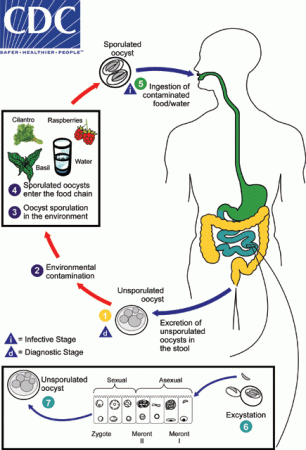
FDA Cyclospora_LifeCycle201

The FDA, CDC, along with state and local officials investigated a multi-state outbreak of cyclosporiasis illnesses likely linked to salads from McDonald’s restaurants.

Update – September 12, 2018

As of September 11, 2018, this outbreak appears to be over. A total of 511 laboratory-confirmed cases of Cyclospora infection were reported in people who consumed salads from McDonald’s restaurants; the cases were reported by 15 states and New York City.

The FDA investigated distribution and supplier information for romaine and carrots but did not identify a single source or potential point of contamination for this outbreak.

Recommendations

Consumers who have symptoms of cyclosporiasis should contact their health care provider to report their symptoms and receive care.


RASFF Alerts – Moulds -Sweet and Hot Peppers – Chocolate Cakes with Coconut Topping

RASFF-Logo

RASFF-sweet and hot peppers from Egypt infested with moulds in Slovenia

RASFF-chocolate cakes with coconut topping from Sweden infested with moulds in Denmark

RASFF Alerts – Aflatoxin – Almonds – Groundnuts – Pistachios

RASFF-Logo

RASFF-aflatoxins (B1 = 15.7; Tot. = 17.6 µg/kg – ppb) in almonds from the United States in Spain

RASFF-aflatoxins (B1 = 4.0 µg/kg – ppb) in groundnut kernels from Argentina in the Netherlands

RASFF-aflatoxins (B1 = 13; Tot. = 15 µg/kg – ppb) in groundnuts from Argentina in the Netherlands

RASFF-aflatoxins (B1 = 7.2 µg/kg – ppb) in groundnut kernels from Argentina in the Netherlands

RASFF-aflatoxins (B1 = 2.8 µg/kg – ppb) in groundnut kernels from Argentina in the Netherlands

RASFF-aflatoxins (B1 = 25; Tot. = 62 µg/kg – ppb) in groundnuts from Argentina in the Netherlands

RASFF-aflatoxins (B1 = 25; Tot. = 28 µg/kg – ppb) in groundnut kernels from Argentina in the Netherlands

RASFF-aflatoxins (B1 = 86.5; Tot. = 93 µg/kg – ppb) in pistachios in shell from Iran in Greece

RASFF-aflatoxins (B1 = 4.1; Tot. = 4.4 µg/kg – ppb) in groundnut kernels from Argentina in the Netherlands

RASFF-aflatoxins (B1 = 2,8 µg/kg – ppb) in shelled groundnuts from Sudan in Greece


Research – Prevalence and Molecular Characteristics of Clostridium difficile in Retail Meats, Food-Producing and Companion Animals, and Humans in Minnesota

Journal of Food Protection

Community-associated Clostridium difficile infection (CA-CDI) now accounts for approximately 50% of CDI cases in central Minnesota; animals and meat products are potential sources. From November 2011 to July 2013, we cultured retail meat products and fecal samples from food-producing and companion animals in central Minnesota for C. difficile by using standard methods. The resulting 51 C. difficile isolates, plus 30 archived local veterinary C. difficile isolates and 208 human CA-CDI case isolates from central Minnesota (from 2012) from the Minnesota Department of Health, were characterized molecularly, and source groups were compared using discriminant analysis. C. difficile was recovered from 0 (0%) of 342 retail meat samples and 51 (9%) of 559 animal fecal samples. Overall, the 81 animal source isolates and 208 human source isolates were highly diverse genetically. Molecular traits segregated extensively in relation to animal versus human origin. Discriminant analysis classified 95% of isolates correctly by source group; only five (2.5%) human source isolates were classified as animal source. These data do not support meat products or food-producing and companion animals as important sources of CA-CDI in the central Minnesota study region.

Zimbabwe – 20 dead, 2,300 suspected cases as Zimbabwe cholera outbreak spreads

Outbreak News Today 

CDC Vibrio

The Zimbabwean Ministry of Health and Child care has declared the ongoing cholera outbreak in the capital Harare a state of national emergency as the death toll rose to 20.

Over 2,300 suspected cases have been reported in Harare since the outbreak was confirmed on September 1. The number of infected is expected to rise countrywide following the confirmation of several new cases and at least one death in four other provinces outside the capital.

Health and Child Care Minister Dr Obadiah Moyo said all the new cases reported in Masvingo, Manicaland, Midlands and Mashonaland Central provinces have been traced back to the outbreak in Harare.

“We are declaring a cholera emergency for Harare. This will enable us to contain cholera and typhoid in the city as quickly as possible. We do not want further deaths, and if we do not create this disaster emergency situation, we will continue losing lives,” he said.

Dr Moyo blamed the Harare City Council for triggering the cholera outbreak by neglecting burst sewerage reticulation pipes over the past two months, leading to faecal contamination of underground water sources.

USA – Bravo Packing recalls Performance Dog raw pet food because of Salmonella

Food Safety News 


Bravo Packing Inc. has recalled all of its Performance Dog frozen raw pet food products because of potential Salmonella contamination.

Bravo initiated the recall after the U.S. Food and Drug Administration found Salmonella in a sample of Performance Dog. Officials collected the sample during an inspection of the company’s manufacturing facility. Pet foods that are contaminated with Salmonella pose a risk to pet owners and others in their households. People can cross contaminate their hands, kitchen counters, utensils, pet bowls and other surfaces.

The recalled frozen dog food is packaged in 2- and 5-pound plastic sleeves. The unlabeled sleeves are packed in cardboard boxes labeled with the manufacture date code of 071418. Tefco distributed the implicated dog food to retail stores and directly to consumers.

Dogs infected with Salmonella may develop lethargy, abdominal pain, reduced appetite, fever, vomiting and diarrhea, which may or may not be bloody. Infected animals can shed Salmonella into the environment even when not exhibiting symptoms of an active infection, putting handlers and household members at risk of infection.

No human or animal illnesses have been reported to date in relation to this recall.

UK – Egypt – E. coli ’caused Egypt hotel couple’s deaths’

BBC News

E. coli caused the deaths of a British couple who died after falling ill at a holiday resort in Egypt, the country’s authorities have said.

John Cooper, 69, and his wife Susan, 63, from Burnley, died in the Red Sea city of Hurghada on 21 August .

In an official statement, the Egyptian general prosecutor said post-mortem examinations showed E. coli bacteria was a factor in both deaths.

But the couple’s daughter described the findings as “absolute rubbish”.

Kelly Ormerod, who was at the Steigenberger Aqua Magic hotel with her parents, told the BBC she did not believe the symptoms her parents showed were consistent with E. coli infection .

She added further post-mortem examinations of her parents’ bodies would be carried out in the UK, on direction from the Home Office.

Research – Recall of Pure Water and Baby Pure Water Due to Insufficient Controls at the Production Site

FSAI fsai

Summary
Category 2: For Information
Alert Notification: 2018.37
Product: Pure Water and Baby Pure Water; pack size: All pack sizes
Batch Code: All batch codes
Country Of Origin: Ireland

Message:

All batches of the above listed products manufactured by Baby Pure Water Ltd. operating at Ardbraccan, Navan, Co. Meath are subject to recall due to insufficient controls at the production site. A Closure Order, under S.I. No. 117/2010 EC (Official Control of Foodstuffs) Regulation 2010, was served by the Health Service Executive (HSE) on the food business operator of the Ardbraccan Navan Co. Meath site, for non-compliances with food legislation. A Prohibition Order was also issued by the HSE in respect of all bottled water produced to date by Baby Pure Ltd. at Ardbraccan, Navan, Co Meath.

Ukraine – Ukraine reports 8th botulism death of 2018 – Clostridium botulinum

Outbreak News Today 

CDC Clost Spore

The Ukraine Ministry of Health reported an additional botulism death in a man from the Kherson region, the eighth botulism fatality of the year.

The probable cause of botulism is smoked homemade fish, which he and his wife eaten the day before. The woman is currently hospitalized for her illness in a severe resuscitation unit.

The Ministry of Health once again emphasizes that with the slightest suspicion of botulism, urgent medical attention should be sought. The success of treatment depends on early diagnosis and proper treatment, which in most cases is accompanied by the introduction of botulinum antitoxin.

Research – Salmonella enterica Serotype Newport Infections in the United States, 2004–2013: Increased Incidence Investigated Through Four Surveillance Systems

Mary Ann Liebert Salm2

Newport is the third most common Salmonella enterica serotype identified among the estimated 1.2 million human salmonellosis infections occurring annually in the United States. Risk factors for infection and food items implicated in outbreaks vary by antimicrobial resistance pattern. We conducted a descriptive analysis of data from four enteric disease surveillance systems capturing information on incidence, demographics, seasonality, geographic distribution, outbreaks, and antimicrobial resistance of Newport infections over a 10-year period from 2004 through 2013. Incidence increased through 2010, then declined to rates similar to those in the early years of the study. Incidence was highest in the South and among children <5 years old. Among isolates submitted for antimicrobial susceptibility testing, 88% were susceptible to all antimicrobials tested (pansusceptible) and 8% were resistant to at least seven agents, including ceftriaxone. Rates of pansusceptible isolates were also highest in the South and among young children, particularly in 2010. Pansusceptible strains of Newport have been associated with produce items and environmental sources, such as creek water and sediment. However, the role of environmental transmission of Newport in human illness is unclear. Efforts to reduce produce contamination through targeted legislation, as well as collaborative efforts to identify sources of contamination in agricultural regions, are underway.