Category Archives: Uncategorized

USA -Outbreak of Salmonella Infections Linked to Pet Hedgehogs

CDC 

  • Eleven people infected with the outbreak strain of Salmonella Typhimurium have been reported from eight states.
    • One person has been hospitalised and no deaths have been reported.
  • Epidemiologic and laboratory evidence indicate that contact with pet hedgehogs is the likely source of this outbreak.
    • In interviews, 10 (91%) of 11 ill people reported contact with a hedgehog.
    • A common supplier of hedgehogs in this outbreak has not been identified.
  • The outbreak strain making people sick was identified in samples collected from three hedgehogs in two ill patients’ homes in Minnesota.

Australia – Doctors issue warning after 20 cases of food poisoning – Salmonella

QT

DOCTORS have warned residents to be extra vigilant when preparing food, with the current heatwave leading to a spike in the number of food poisoning cases.

In the past week, House Call Doctor has responded to 20 people suffering food poisoning, including two from Ipswich.

Doctor Ryan Harvey said with extreme weather conditions forecast to stay, it was imperative people considered how their food was stored and prepared.

Canada – Food Recall Warning – Crisp & Delicious brand Chicken Breast Nuggets recalled due to Salmonella

CFIA CIFA

Recall details

Ottawa, January 25, 2019 – Sofina Foods Inc. is recalling Crisp & Delicious brand Chicken Breast Nuggets from the marketplace due to possible Salmonella contamination. Consumers should not consume the recalled product described below.

Recalled products

Brand Name Common Name Size Code(s) on Product UPC
Crisp & Delicious Chicken Breast Nuggets – Uncooked Seasoned Breaded Chicken Cutlettes 1.6 kg 2019 JL 19 0 69299 11703 5
  • Currently, there are 54 cases of illness in ten provinces linked to this outbreak: British Columbia (4), Alberta (11), Saskatchewan (1), Manitoba (3), Ontario (20), Quebec (4), New Brunswick (2), Nova Scotia (5), Prince Edward Island (3) and Newfoundland and Labrador (1). None of the ill individuals have been hospitalised. No deaths have been reported. Frozen raw breaded chicken products have been identified as a source of this outbreak.

Ireland -Salmonella infection in Ireland, 2017

HPSC

The 414 cases notified in 2017 were the highest number of salmonellosis cases reported
in Ireland since 2008
 International travel is a large contributor to the overall burden of salmonellosis in Ireland (40%), in particular in summer months
 The most common serotypes reported in Ireland and internationally are S. Enteritidis and S. Typhimurium, with S. Typhimurium the more prevalent among cases acquired in
Ireland
 The highest reported incidence was in children under five years, with this effect being
more pronounced among cases acquired in Ireland
 A large outbreak of S. Brandenburg in HSE-E resulted in this serotype being the third
most common serotype in Ireland this year. This highlights the continued potential for
foodborne outbreaks of salmonellosis
 The introduction of WGS at the NSSLRL has contributed to confirmation of suspected
outbreaks and to the identification of outbreaks which may not have been recognised on
epidemiological grounds alone
 WGS has also enabled a small cluster of cases in Ireland to be recognised as being part
of a much larger EU incident

Research – The effect of silver nanocomposite packaging based on melt mixing and sol–gel methods on shelf life extension of fresh chicken stored at 4 °C

Online Library

Abstract

In the present study, seven types of films were produced using different proportions of polyethylene containing silver, clay, and titanium dioxide nanoparticles. Following the determination of the minimum inhibitory concentration of the films in the eradication of Staphylococcus aureus and Escherichia coli, the film containing 5% silver nanoparticles and 5% titanium dioxide nanoparticles was found to have the highest antimicrobial property and was determined to be an ideal cover for food products. The antibacterial effect of the films on the shelf life extension and quality of the chicken stored at 4 °C in the Days 1, 3, and 5 of the experiment was checked. The structure and morphology of the nanoparticles and the selected films were evaluated using a field emission scanning electron microscope, scanning electron microscope, transmission electron microscope, Fourier‐transform infrared spectroscopy, and dynamic light scattering. The analysis of the results indicated that the most appropriate inhibition growth was observed with S. aureus and E. coli in nutrient agar and the largest diameter of the radial inhibition zone occurred with S. aureus. Moreover, the analysis of variance showed that the effect of different concentrations of silver and titanium dioxide nanoparticles was significant (p < .05). The results of this study showed that the produced nanocomposite was used to preserve chicken meat for 5 days at 4 °C inhibited the growth of both types of bacteria.

Practical applications

Nowadays production of active packaging is increasing worldwide as they were proved to have numerous effects on inhibiting of microbial growth and even bactericidal effects. Therefore, a wide variety of food producers in different sections namely agriculture, dairy, and meat industries have applied nanopackaging using different nanoparticles. Thus, more research on different physicochemical and antimicrobial effects are needed.


Research – The Rise of Cyclospora

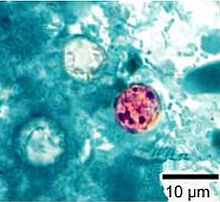
The Food Poisoning Bulletin 220px-Cyclospora_cayetanensis_stained

The parasite Cyclospora was first described by Dr. Ashford, a British parasitologist, in 1979. He found the parasite in stool samples from sickened people in Papua New Guinea in 1977 and 1978. In the 1990s, Cyclospora garnered increasing interest from the scientific and public health communities after it was identified as the cause of outbreaks of diarrheal illness in the United States. Since then, scientific understanding of Cyclospora’s source and infectious process has grown substantially.

Humans contract Cyclosporainfections from eating food or drinking water contaminated with Cyclospora.  Contamination of food often occurs when produce is irrigated or washed in water contaminated with human feces. Cyclospora uses the human body to complete part of its reproductive life cycle.

Cyclospora is not endemic to the United States. The illness is most common in tropical and subtropical regions, and it is more common in summer months. Numerous previous outbreaks of Cyclosporain the United States have been associated with consumption of fecally-contaminated fruits and vegetables, including raspberries, mesclun, basil, lettuce, and cilantro.

Research – Anti-adhesion of probiotic Enterococcus faecium WEFA23 against five pathogens and the beneficial effect of its S-layer proteins against Listeria monocytogenes

Canadian Journal of Microbiology

Enterococcus faecium WEFA23 is a potential probiotic strain isolated from Chinese infant feces. In this study, the antagonistic activity of E. faecium WEFA23 on adhesion to pathogens was investigated. Enterococcus faecium WEFA23 was able to compete, exclude, and displace the adhesion of Escherichia coli O157:H7, Salmonella Typhimurium ATCC 13311, Listeria monocytogenes CMCC54007, Staphylococcus aureus CMCC26003, and Shigella sonnei ATCC 25931 to Caco-2 cells. Among them, L. monocytogenes achieved the strongest inhibition rate in both competition and displacement assays. Those anti-adhesion capacities were related to the bacterial physicochemical properties (hydrophobicity, auto-aggregation, and co-aggregation) of the bacterial surface. For L. monocytogenes, the anti-adhesion capacity was affected by the heat treatment, cell density, and growth phase of E. faecium WEFA23; 108 colony-forming units of viable cells per millilitre at the stationary phase exhibited the strongest anti-adhesion activity. In addition, removal of S-layer proteins of E. faecium WEFA23 by treatment with 5 mol/L LiCl significantly decreased its adhesion capacity, and those S-layer proteins were able to compete, displace, and exclude L. monocytogenes at different levels. Both cells and S-layer proteins of E. faecium WEFA23 significantly reduced the apoptosis of Caco-2 cells induced by L. monocytogenes, which was mediated by caspase-3 activation. This study might be helpful in understanding the anti-adhesion mechanism of probiotics against pathogens.

Research – New bacteria strain isolated to reduce Zearalenone – Mycotoxin – Lysinibacillus sp

All About Feed

Several physical and chemical technologies are used for inactivation or elimination of the mycotoxin zearalenone. A new bacteria strain that can reduce this mycotoxin has now been added to the list.

Zearalenone (ZEA) is produced by various strains of the genus Fusarium, most notably Fusarium graminearum, Fusarium culmorum and Fusarium cerealis. The growth of Fusarium is affected by various factors (temperature, moisture content of grains, microbial interactions, etc.), and a large amount of ZEA can accumulate in mouldy crops and cereal-derived food products, which frequently leads to reproductive abnormalities of domestic animals and occasionally in hyperoestrogenism in humans.

Research – Effect of Atmospheric Pressure Plasma on Listeria monocytogenes Attached to Abiotic Surfaces

Journal of Food Protection

Listeria monocytogenes can be introduced into food processing plants via raw material of animal or plant origin and can establish endemic populations through formation of biofilms. Biofilms are a continuous source of contamination for food products, and L. monocytogenes cells in biofilms are more resistant to stress and sanitizing agents than are planktonic cells. The use of gas-discharge plasmas may offer a feasible alternative to conventional sanitization methods. Plasmas are a mixture of charged particles, chemically reactive species, and UV radiation and can be used to destroy microorganisms. The purpose of this study was to measure the effectiveness of cold atmospheric pressure plasma (APP) treatments against bacteria attached to a solid surface and to evaluate the individual susceptibility of various L. monocytogenes strains. Attention was focused on the state of the cells after treatment, combining detection by viable counts and quantitative PCR (qPCR). Most of the culturable cells were inactivated after APP treatment, but the qPCR assay targeting the 16S rRNA revealed the presence of injured cells or their entrance into the viable but nonculturable state. These results were at least partly confirmed by a resuscitation experiment. After APP treatment, L. monocytogenes cell suspensions were incubated in brain heart infusion broth; some cells grew in the medium and therefore had survived the treatment. An understanding of the effects of APP on L. monocytogenes can inform the development of sanitation programs incorporating APP for pathogen removal. Methods other than those based of the culturability of the cells should be used to monitor pathogens in food processing plants because cultivation alone may underestimate the actual microbial load.

Research – Growth of Salmonella on Inoculated Inhull Pistachios during Postharvest Handling

Journal of Food Protection Salmonella

Salmonella has been isolated from dried pistachios in both postharvest and retail surveys. The source of Salmonella in pistachios is unknown, but introduction is possible at points during production, harvest, and postharvest activities. To examine the behavior of Salmonella on pistachios during simulated postharvest conditions, early-, mid-, and late-season inhull pistachios were collected from two commercial processors over five different harvests. Pistachios were inoculated with cocktails of nalidixic acid– or rifampin-resistant Salmonella at 0.64 to 1.59 log CFU/g (low) or 2.73 to 3.27 or 4.29 to 4.31 log CFU/g (high) and were incubated for up to 30 h under commercially relevant conditions (23, 35, or 37°C and 50 or 90% relative humidity [RH]). Populations of Salmonella were measured by plating onto tryptic soy agar and CHROMagar Salmonella with added nalidixic acid or rifampin. Individual growth curves at the same temperature and RH differed significantly among different lots of pistachios. Except for a single late-season lot in which no significant growth was observed, Salmonella multiplied under all storage conditions. In the first 3 h after inoculation, insignificant (most cases) to small (0.41 to 0.67 log CFU/g) but significant (P < 0.05) mean increases in Salmonella populations were measured; the mean predicted time to achieve maximum populations (5 to 8 log CFU/g) was 16 ± 4 h. In paired samples, longer lag phases, lower growth rates, and lower maximum increases were observed with inoculated inhull pistachios incubated at 23°C and 50% RH compared with 35 or 37°C and 90% RH. Similar growth curves were observed at the low and high inoculum levels; throughout the 30 h of incubation, Salmonella populations were consistently ∼1 to 2 log CFU/g lower on pistachios inoculated at the low inoculum level. Managing the time between harvesting and hulling will reduce the potential for growth of Salmonella on pistachios during postharvest handling.