Category Archives: STEC E.coli

USA – Dangerous E. Coli O157 Found in Ground Beef Sold at Kroger and Fred Meyer Supermarkets

Consumer Reports

Kroger-brand ground beef purchased at a Fred Meyer supermarket in Seattle and tested by Consumer Reports was found to have a deadly strain of E. coli called O157:H7. The tested package of 93 percent lean ground beef is marked with an “Establishment” (EST) number of 965, representing the plant where the meat was processed, and a “use or freeze by date” of 1/11/2022. (See the product label below.)

At this time, there is no recall of this ground beef, and no illnesses have been linked to the product. But CR’s food-safety experts warn consumers who might have purchased Kroger-branded 93 percent lean ground beef from any Kroger-owned grocery store to check their packages and to throw away the product if it contains that establishment number and “use or freeze by” date. Those stores include Fred Meyer, Harris Teeter, Ralphs, Dillons, and several other supermarkets. (See a complete list of Kroger-owned grocery stores.) Consumers also should not buy ground beef with those markings from any of those stores.

Research – Prevalence and patterns of fecal shedding of Shiga toxin–producing Escherichia coli by cattle at a commercial feedlot in South Africa

Wiley Online

Healthy colonized cattle are the major reservoir of Shiga toxin–producing Escherichia coli (STEC) and play a key role in the entry point of the pathogen into the beef chain. Excretion rates and the concentration of the pathogen in feces influence the epidemiology and transmission of the pathogen within herds and to humans. This study evaluated the prevalence and dynamics of fecal shedding of STEC by cattle in a commercial feedlot in Gauteng, South Africa. An initial cross-sectional survey was conducted; fecal samples were obtained from 106 randomly selected weaned beef calves on arrival at the feedlot using polymerase chain reaction (PCR) to screen by detecting stx1 and stx2 genes. Subsequently, a longitudinal study was conducted, and 15 STEC-positive and 11 STEC-negative cattle were sampled monthly and followed to slaughter. STEC O157 and non-O157 were enumerated in samples using commercial chromogenic agar. Initial prevalence of STEC shedding was 27% (29/106; 95% CI [19, 37%]). All 26 cattle shed STEC intermittently or continuously during the study period, all except one were super-shedders (≥4 log10 CFU/g) at one or more samplings, and 19 (73%) were persistent or intermittent super-shedders. Of the 38 STEC isolates recovered, 15 (39%) were serotypeable, representing 11 non-O157 serogroups, including O101, O168, O178, and O68. The most frequent virulence combination profile was stx1 + eaeA + ehxA (n = 12; 32%). This study confirms the occurrence and variability of STEC super-shedding in feedlot cattle and highlights that super-shedding is not limited to STEC O157. It also shows their public health significance.

USA – Alaska hit with 2 E. coli illnesses linked to Simple Truth Organic Power Greens and Nature’s Basket Organic Power Greens – E.coli O157

Food Poison Journal

As of December 29, 2021, 13 people infected with the outbreak strain of E. coli O157:H7 have been reported from six states. Illnesses started on dates ranging from November 27, 2021, to December 9, 2021.

Sick people range in age from 4 to 79 years, with a median age of 54, and 92% are female. Of 12 people with information available, four have been hospitalized and one person developed a type of kidney failure called hemolytic uremic syndrome (HUS). No deaths have been reported.

State and local public health officials are interviewing people about the foods they ate in the week before they got sick. Of 12 people interviewed, all reported eating packaged salads. Of 10 people who provided brand information, 6 ate or bought Simple Truth Organic Power Greens and 1 ate Nature’s Basket Organic Power Greens. Both Organic Power Greens salads have the same mix of leafy greens: organic spinach, mizuna, kale, and chard. Several sick people reported using these salads in smoothies.

USA – Seven sickened by Simple Truth Organic Power Greens from QFC and Fred Meyer stores in Washington – E.coli O157

Food Poison Journal

The Washington State Department of Health (DOH) confirmed today that the state is part of an E. coli outbreak affecting six states. The seven cases of E. coli O157:H7 found so far in Washington are likely linked to Simple Truth Organic Power Greens purchased at QFC and Fred Meyer stores in Washington state. Consumers with Simple Truth Organic Power Greens with best-by dates through December 20, 2021, should discard them to prevent further illnesses.

RASFF Alert – STEC E.coli – New Zealand Lamb Pucks

RASFF

Shigatoxin-producing Escherichia coli in frozen lamb plucks from New Zealand in Bulgaria

Hong Kong – CFS urges public not to consume several kinds of cheese from France with possible Shiga toxin-producing E. coli contamination

CFS

Centre for Food Safety

The Centre for Food Safety (CFS) of the Food and Environmental Hygiene Department today (December 20) urged the public not to consume three kinds of cheese imported from France due to possible contamination with Shiga toxin-producing Escherichia coli (STEC). The trade should stop using or selling the affected batches of products immediately if they possess them.

Details of the products are as follows:

Product name:  (1) FRERES MARCHAND – CANTAL ENTRE DEUX AOP
(2) TRADITIONAL SELECTION 1KG – 4 CHEESES
(3) TRADITIONAL SELECTION 2KG – 6 CHEESES
Brand: Les Frères Marchand
Place of origin: France
Importer: Classic Fine Foods (Hong Kong) Limited
Lot: LOT 21-45

A spokesman for the CFS said, “The CFS received a notification from the Rapid Alert System for Food and Feed (RASFF) of the European Commission that the above-mentioned products might have been contaminated with STEC and are being recalled. According to the information provided by the RASFF, the affected batches of products have been imported into Hong Kong. Upon learning of the incident, the CFS immediately contacted the local importer concerned for follow-up.”

A preliminary investigation found that the importer, Classic Fine Foods (Hong Kong) Limited, had imported some of the affected batches of products into Hong Kong. The importer concerned has initiated a recall according to the CFS’ instructions. Enquiries about the recall can be made to the hotlines at 2612 2066 during office hours.

“People will contract STEC-causing gastro-intestinal disease through consumption of contaminated water or undercooked and contaminated foods. Intestinal bleeding and serious complications such as hemolytic uraemic syndrome may also develop in some people,” the spokesman said.

The spokesman urged consumers not to consume the affected batches of the products if they have bought any. The trade should also stop using or selling the affected batches of products concerned immediately if they possess them.

The CFS will alert the trade to the incident, continue to follow up and take appropriate action. An investigation is ongoing.

Ends/Monday, December 20, 2021

RASFF Alert – STEC E.coli – Raw Milk Cheese

RASFF

Shigatoxin-producing Escherichia coli (O26 H11 stx, eae+ /25g) in raw milk cheese from France in Belgium, Austria, France, Germany, Macao, UAE and Hong Kong

Research – An outbreak of food poisoning due to Escherichia coli serotype O7:H4 carrying astA for enteroaggregative E. coli heat-stable enterotoxin1 (EAST1) – Seaweed

Cambridge Org

In June 2020, a large-scale food poisoning outbreak involving about 3000 elementary and junior high school students occurred in Yashio, Saitama, Japan. A school lunch was the only food stuff ingested by all of the patients. Escherichia coli serotype O7:H4 carrying the astA gene for enteroaggregative E. coli (EAggEC) heat-stable enterotoxin 1 (EAST1) was detected in faecal specimens from the patients, and sample inspection revealed its presence in a seaweed salad and red seaweed (Gigartina tenella) as one of the raw materials. Analysis of the antibiotic sensitivity of the isolates revealed resistance to ampicillin and cefotaxime. All isolates were confirmed to be of the same origin by pulsed-field gel electrophoresis after digestion with the restriction enzyme XbaI, and single nucleotide polymorphism analysis using whole genome sequencing. To our knowledge, this is the first report of a large-scale food poisoning caused by E. coli O7:H4, which lacks well-characterized virulence genes other than astA.

Research – Desiccation survival in Salmonella enterica, Escherichia coli and Enterococcus faecium related to initial cell concentration and cellular components

Journal of Food Protection

Salmonella enterica is well-known for its ability to survive and persist in low-moisture environments.  Previous studies have indicated a link between the initial cell concentration and the population of Salmonella that survive upon desiccation and subsequent storage; however, how the initial cell concentration affects survival is unknown.  This study examined the basis of this phenomena and whether it occurred in other microorganisms, specifically Shiga toxigenic Escherichia coli (STEC), and Enterococcus faecium . Salmonella, STEC, and E. faecium were grown as lawns on TSAYE and harvested using buffered peptone water (BPW). To determine recovery at different initial cell levels, cultures were diluted to 9, 7, and 5 log CFU/mL and applied to filters.  Filters were dried for 24 h, then stored for 28 d at 25°C/33% RH. During storage, cells were recovered from filters using BPW and cultivated on TSAYE.  Both Salmonella and E. coli , but not E. faecium , showed non-proportional recovery. Less viability remained with lower initial starting population after 24 h desiccation such that ≥10 log CFU/mL were recovered when 11 log CFU/mL was desiccated, but ❤ log CFU/mL were recovered when 5 log CFU/mL was desiccated. Once dried, persistence did not appear affected by initial cell concentration. When dead cells (heat-treated) were added to the diluent, recovery of Salmonella was proportional with respect to the initial cell concentration. To further examine the response on desiccation, Salmonella was diluted in BPW containing one of 11 different test cell components related to quorum sensing or known to affect desiccation resistance to assess recovery and persistence. Of the 11 additions only cell debris fractions, cell-free extract, and peptidoglycan improved recovery of Salmonella . Desiccation survival appears related to cell wall components, however, the exact mechanism affecting survival remains unknown.

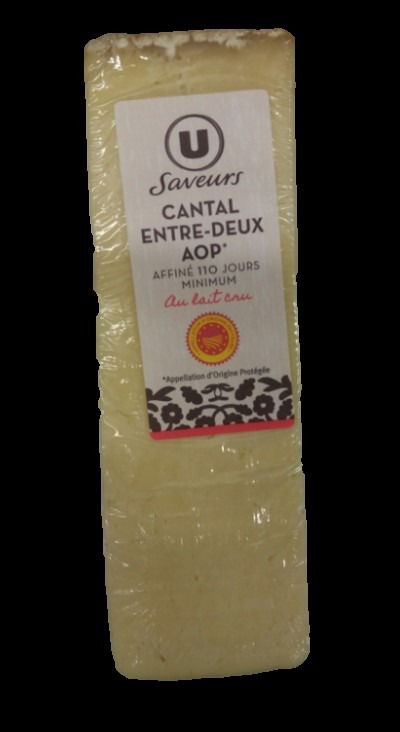
France – Cantal Entre Deux AOP with raw milk – STEC E.coli O26

Gov france

Identifying information for the recalled product

  • Product category Food
  • Product sub-category Milk and dairy products
  • Product brand name U FLAVORS
  • Names of models or references Cantal Entre Deux AOP with raw milk U FLAVORS (220g)
  • Product identification
    GTIN Lot Dated
    3368952539939 16821443 Use-by date 12/07/2021
    3368952539939 16821452 Use-by date 12/12/2021
  • Packaging under film
  • Start date / End of marketing From 08/11/2021 to 12/09/2021
  • Storage temperature Product to be stored in the refrigerator
  • Health mark FR 63 113 081 CE
  • Geographical sales area Whole France
  • Distributors ALL STORES IN THE SOUTH WEST AND EAST REGIONS

Practical information regarding the recall

  • Reason for recall Following the detection of STEC O26: H11 strains
  • Risks incurred by the consumer Toxinogenic Escherichia coli shiga (STEC)