Category Archives: Salmonella

RASFF Alert – Animal Feed -Salmonella – Toasted Soya Beans

RASFF-Logo

RASFF – Salmonella enterica ser. Agona (present /25g) in toasted soy beans from Belgium in Belgium

UK – Happy Hounds recalls frozen raw dog food products due to the presence of Salmonella

FSA


Happy Hounds is recalling certain types of frozen raw dog food because salmonella has been found in the products.

Product details

Frozen Chicken & Beef Sleeve Dog Food

Pack size 1kg
Batch code 1205
Best before 3 September 2020
Frozen Chicken Mince Sleeve Dog Food

Pack size 1kg
Batch code 1205
Best before 3 September 2020
Frozen Chicken Mince Dog Food

Pack size 2.5kg (bag of 4)
Batch code 1205
Best before 3 September 2020

Risk statement

The presence of salmonella in the products listed above. Salmonella is a bacterium that can cause illness in humans and animals. The product could therefore carry a potential risk because of the presence of salmonella, either through direct handling of the pet food, or indirectly, for example from pet feeding bowls, utensils or contact with the faeces of animals.

In humans, symptoms caused by salmonella usually include fever, diarrhoea and abdominal cramps. Infected animals may not necessarily display signs of illness, but symptoms can include diarrhoea.

Action taken by the company

Happy Hounds is recalling the above products. Point of sale notices will be displayed in all retail stores that are selling these products. These notices explain to customers why the products are being recalled and tell them what to do if they have bought the product.

Our advice to consumers

Our advice to pet owners: If you have bought any of the above products do not use them. Instead, return them to the store from where they were bought for a full refund. When handling and serving raw pet food it is always advised to clean utensils and feeding bowls thoroughly after use. Consumers should wash hands thoroughly after handling raw pet food, bowls, utensils or after contact with the faeces of animals. Raw pet food should be stored separately from any food (especially ready to eat foods). Care should be taken when defrosting to avoid cross contamination of foods and surfaces.

Canada- Food Recall Warning – Alkanater brand Tahina recalled due to Salmonella

CFIA

Recall details

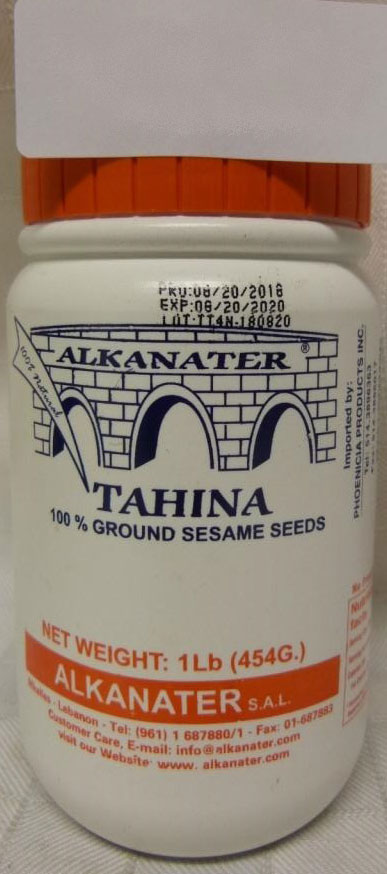
Ottawa, January 14, 2020 – Phoenicia Group Inc. is recalling Alkanater brand Tahina from the marketplace due to possible Salmonella contamination. Consumers should not consume the recalled product described below.

The following product has been sold in Quebec and Ontario and may have been distributed in other provinces and territories.

Recalled product

Brand Product Size UPC Codes
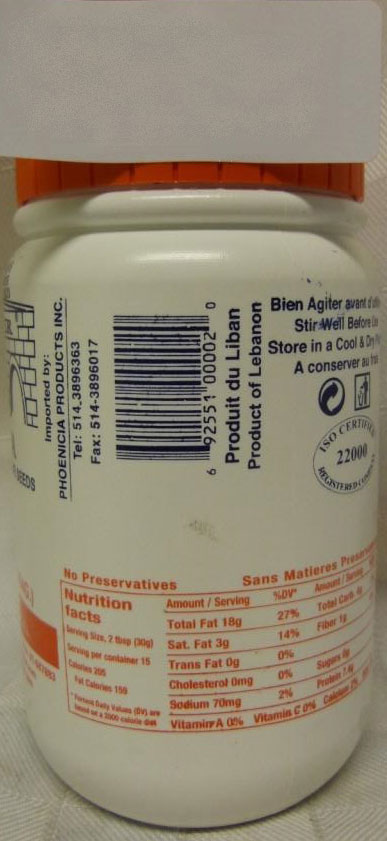
Alkanater Tahina 454 g 6 92551 00002 0 PRO: 08/20/2018
EXP: 08/20/2020
LOT: TT4N-180820

What you should do

If you think you became sick from consuming a recalled product, call your doctor.

Check to see if you have the recalled product in your home. Recalled products should be thrown out or returned to the store where they were purchased.

Food contaminated with Salmonella may not look or smell spoiled but can still make you sick. Young children, pregnant women, the elderly and people with weakened immune systems may contract serious and sometimes deadly infections. Healthy people may experience short-term symptoms such as fever, headache, vomiting, nausea, abdominal cramps and diarrhea. Long-term complications may include severe arthritis.

Background

p>This recall was triggered by Canadian Food Inspection Agency (CFIA) test results. The CFIA is conducting a food safety investigation, which may lead to the recall of other products. If other high-risk products are recalled, the CFIA will notify the public through updated Food Recall Warnings.The CFIA is verifying that industry is removing the recalled product from the marketplace.

Illnesses

There have been no reported illnesses associated with the consumption of this product.

Product photos

Printer ready version of photos

  • Alkanater - Tahina - 454 g - front
  • Alkanater - Tahina - 454 g - back

Research – Prevalence of Salmonella in cucumbers, antibiotic and acid resistances and description of the kinetic behavior with dynamic model during storage

Wiley Online

This study isolated Salmonella from cucumbers, analyzed the antibiotic resistance and acid resistance for the isolates and developed a dynamic model. Salmonella prevalence in cucumbers and their resistances were determined. To describe the kinetic behavior of Salmonella isolates, the isolates were inoculated into cucumbers, and Salmonella cell counts were enumerated during storage at 10–30°C. The Baranyi model was fitted to the cell count data to calculate kinetic parameters (lag phase duration [LPD] and maximum specific growth rate (μmax)], and a polynomial model was fitted to the kinetic parameters as a function of temperature. The model performance was evaluated with root mean square error (RMSE). Using these models, a dynamic model was developed. Salmonella were detected in 3 of 24 cucumbers, all of which were multidrug‐resistant and one was acid‐resistant. As storage temperature increased, LPD decreased and μmax increased. These models were appropriate with 0.367 of RMSE. These results suggest that cross‐contaminated Salmonella could increase during transportation, and it may lead to human infection.

Argentina -More than 50 sick in Argentinian city due to Salmonella

Food Safety News

An emergency committee to control the sale of food has been created in a city in northwest Argentina after a spike in Salmonella cases in early 2020.

There have been 51 confirmed cases of Salmonella in Salta so far this year. At least five people have been hospitalized but recovered after treatment.

The committee will be responsible for controlling food sold on public roads at street stalls and at commercial premises. It includes experts from the National University of Salta (UNSA) and Catholic University of Salta (Ucasal).

Officials hope by increasing controls they can bring the rise in infections under control and minimize the risk to the public.

Research – Treatment of fresh produce with a Salmonella‐targeted bacteriophage cocktail is compatible with chlorine or peracetic acid and more consistently preserves the microbial community on produce

Wiley Online

Diets rich in minimally processed foods are associated with numerous health benefits, in part, due to their diverse, natural microbiota. However, antimicrobials, such as chlorine and peracetic acid (PAA), that are used to address food safety concerns may damage the natural microflora of fresh produce. One promising approach for targeting pathogenic bacteria in foods without impacting the normal food microbiota are bacteriophages. In this study, we observed that combinational treatment of conventional antimicrobials (PAA and chlorine) and bacteriophages, specifically the Salmonella‐targeted preparation SalmoFresh, retained the bactericidal effectiveness of individual interventions, and in some cases, achieved substantially increased efficacy. Additionally, the bacterial microbiomes of farm fresh and organic produce were less affected after phage treatment compared to PAA and chlorine. Finally, our study revealed that resistance rates against SalmoFresh were relatively minor and unaffected by the stresses introduced after chemical washes and/or bacteriophage treatment.

Research-Nisin-Based Organic Acid Inactivation of Salmonella on Grape Tomatoes: Efficacy of Treatment with Bioluminescence ATP Assay

Journal of Food Protection

ABSTRACT

The antimicrobial activity of a new nisin-based organic acid sanitizer (NOAS), developed in our laboratory, was tested against viable aerobic mesophilic bacteria and Salmonella populations inoculated on produce surfaces. The activity of NOAS was compared with 200 ppm of chlorinated wash water and a bioluminescence ATP technique to determine the efficacy of treatments compared with plate count methods. The activity of the 10% final concentration of NOAS against viable populations of 109 CFU/mL Salmonella in phosphate-buffered saline (PBS), sterile deionized distilled water, and buffered peptone water was tested in vitro and on grape tomatoes inoculated with Salmonella at 2.5 log CFU/g. A similar batch of inoculated tomatoes were treated with 200 ppm of total available chlorinated water. All treatments for inactivation of viable Salmonella in vitro was tested up to 30 min and 5 min for the attached populations on tomatoes. Inactivation of viable Salmonella at 109 log CFU/mL by 10% the NOAS solution averaged >107 log CFU/mL in PBS, sterile deionized distilled water, and buffered peptone water. Similarly, Salmonella bacteria inactivated on tomato surfaces by the NOAS solution was significantly (P < 0.05) greater than numbers on chlorinated washed tomatoes, and surviving bacterial populations on NOAS and chlorine-treated tomatoes were <1 and 4 CFU/g, respectively. A significant linear correlation coefficient (r2 = 0.99) between the bioluminescence ATP assay and aerobic plate counts of inoculated and untreated grape tomatoes were recorded but not with NOAS and chlorine-treated tomatoes, as bacterial populations were less than the minimum baseline for determination. Also, the results indicated that the NOAS solution is a better alternative antimicrobial wash solution than 200 ppm of chlorinated water.

HIGHLIGHTS
  • The antimicrobial activity of NOAS was compared with chlorinated water.

  • Salmonella bacteria were more susceptible to NOAS than chlorinated water.

  • Assay correlated with aerobic plate count of inoculated and untreated tomatoes, not treated ones.

  • NOAS is an excellent alternative antimicrobial wash solution compared with chlorinated wash water.

Research- Survival Evaluation of Salmonella and Listeria monocytogenes on Selective and Nonselective Media in Ground Chicken Meat Subjected to High Hydrostatic Pressure and Carvacrol

Journal of Food Protection

ABSTRACT

High pressure processing (HPP) and treatment with the essential oil extract carvacrol had synergistic inactivation effects on Salmonella and Listeria monocytogenes in fresh ground chicken meat. Seven days after HPP treatment at 350 MPa for 10 min, Salmonella treated with 0.75% carvacrol was reduced to below the detection limit (1 log CFU/g) at 4°C and was reduced by ca. 6 log CFU at 10°C. L. monocytogenes was more sensitive to these imposed stressors, remaining below the detection limit during storage at both 4 and 10°C after HPP treatment at 350 MPa for 10 min following treatment with 0.45% carvacrol. However, pressure-injured bacterial cells may recover and lead to an overestimation of process lethality when a selective medium is used without proper justification. For HPP-stressed Salmonella, a 1- to 2-log difference was found between viable counts on xylose lysine Tergitol 4 agar and aerobic plate counts, but no significant difference was found for HPP-stressed L. monocytogenes between polymyxin–acriflavine–lithium chloride–ceftazidime–esculin–mannitol (PALCAM) agar and aerobic plate counts. HPP-induced bacterial injury and its recovery have been investigated by comparing selective and nonselective agar plate counts; however, few investigations have addressed this issue in the presence of essential oil extracts, taking into account the effect of high pressure and natural antimicrobial compounds (e.g., carvacrol) on bacterial survival in various growth media. Use of selective media may overestimate the efficacy of bacterial inactivation in food processing evaluation and validation studies, and the effects of various media should be systematically investigated.

HIGHLIGHTS
  • HPP and carvacrol had synergistic pathogen inactivation effects in ground chicken meat.

  • HPP at 350 MPa for 10 min with 0.60% carvacrol treatment resulted in a >5-log pathogen reduction.

  • A 1- to 2-log difference was found for counts of HPP-treated Salmonella on two growth media.

  • Counts of HPP-treated L. monocytogenes were similar on selective and nonselective media.

  • Carvacrol suppressed the growth and recovery of the HPP-treated bacterial cells.

Information USA – What Are the Symptoms of Common Foodborne Pathogens?

CDC

Burden of Foodborne Illness: Findings

CDC estimates that each year roughly 1 in 6 Americans (or 48 million people) gets sick, 128,000 are hospitalized, and 3,000 die of foodborne diseases.


These estimates provide the most accurate estimates yet of which known foodborne pathogens (bacteria, viruses, and parasites) are causing the most illnesses in the United States, and how many foodborne illnesses are caused by unspecified agents. The estimates also show that much work remains to be done—specifically in focusing efforts on the top known pathogens and identifying the additional causes of foodborne illness and death.

CDC provides estimates for two major groups of foodborne illnesses

Known foodborne pathogens — 31 pathogens known to cause foodborne illness. Many of these pathogens are tracked by public health systems that track diseases and outbreaks. Read the report >

Unspecified agents — Agents with insufficient data to estimate agent-specific burden; known agents not yet identified as causing foodborne illness; microbes, chemicals, or other substances known to be in food whose ability to cause illness is unproven; and agents not yet identified. Because you can’t “track” what isn’t yet identified, estimates for this group of agents started with the health effects or symptoms that they are most likely to cause, such as acute gastroenteritis. Read the report >


Total number of foodborne illnesses each year

CDC estimated the number of illnesses, hospitalizations, and deaths caused by both known and unspecified agents. CDC then estimated what proportion of each were foodborne. The first table below provides estimates for domestically acquired foodborne illnesses, and the second table provides estimates for domestically acquired illnesses caused by all transmission routes (foodborne, waterborne, person-to-person contact, animal contact, environmental contamination, and others).

Estimated annual number of domestically acquired, foodborne illnesses, hospitalizations, and deaths due to 31 pathogens and the unspecified agents transmitted through food, United States
Foodborne agents Estimated annual number of illnesses Estimated annual number of hospitalizations Estimated annual number of deaths
Number (90% credible interval) % Number (90% credible interval) % Number (90% credible interval) %
31 known pathogens 9.4 million
(6.6–12.7 million)
20 55,961
(39,534–75,741)
44 1,351
(712–2,268)
44
Unspecified agents 38.4 million
(19.8–61.2 million)
80 71,878
(9,924–157,340)
56 1,686
(369–3,338)
56
Total 47.8 million
(28.7–71.1 million)
100 127,839
(62,529–215,562)
100 3,037
(1,492–4,983)
100
Estimated annual number of illnesses, hospitalizations, and deaths due to 31 pathogens and the unspecified agents, United States
Foodborne agents Estimated annual number of illnesses Estimated annual number of hospitalizations Estimated annual number of deaths
Number (90% credible interval) % Number (90% credible interval) % Number (90% credible interval) %
31 known pathogens 37.2 million
(28.4–47.6 million)
21 228,744
(188,326–275,601)
47 2,612
(1,723–3,819)
42
Unspecified agents 141.8 million 79 258,033 53 3,574 58
Total 179 million 100 486,777 100 6,186 100


Pathogens causing the most foodborne illnesses, hospitalizations, and deaths each year

Top five pathogens contributing to domestically acquired foodborne illnesses
Pathogen Estimated number of illnesses 90% credible interval %
Norovirus 5,461,731 3,227,078–8,309,480 58
Salmonella, nontyphoidal 1,027,561 644,786–1,679,667 11
Clostridium perfringens 965,958 192,316–2,483,309 10
Campylobacter spp. 845,024 337,031–1,611,083 9
Staphylococcus aureus 241,148 72,341–529,417 3
Subtotal 91

 Top of Page

Top five pathogens contributing to domestically acquired foodborne illnesses resulting in hospitalization
Pathogen Estimated number of hospitalizations 90% credible interval %
Salmonella, nontyphoidal 19,336 8,545–37,490 35
Norovirus 14,663 8,097–23,323 26
Campylobacter spp. 8,463 4,300–15,227 15
Toxoplasma gondii 4,428 2,634–6,674 8
E. coli (STEC) O157 2,138 549–4,614 4
Subtotal 88
Top five pathogens contributing to domestically acquired foodborne illnesses resulting in death
Pathogen Estimated number of deaths 90% credible interval %
Salmonella, nontyphoidal 378 0–1,011 28
Toxoplasma gondii 327 200–482 24
Listeria monocytogenes 255 0–733 19
Norovirus 149 84–237 11
Campylobacter spp. 76 0–332 6
Subtotal 88

Spain – Food poisoning mystery continues in Murcia – Salmonella ?

Euroweekly News

HEALTH officials are trying to find the cause of a food poisoning outbreak that left 44 people ill after a New Year’s Eve party in Molina de Segura. Although left unwell no one needed to be hospitalised in what is thought to have been a case of salmonella.