Category Archives: Salmonella

RASFF Alerts – Animal Feed – Salmonella – Raw Petfoods – Dog Chews – Complementary Feed for Puppies- Horse Meal Mix

RASFF-Logo

RASFF – Salmonella enterica ser. Typhimurium (presence /25g) and too high count of Enterobacteriaceae (>30000 CFU/g) in raw petfood from the Netherlands in Belgium

RASFF – Salmonella (presence /25g) in dog chews (dried boar ears) from Poland in Poland

RASFF – Salmonella (presence /25g) in complementary feed for dog puppies from Germany in Germany

RASFF – Salmonella (presence /25g) in horse meal mix from Mexico in the Netherlands

Information -Food safety law firm asks USDA to ban 31 Salmonella strains

Food Dive

Marler Clark, a Seattle-based food safety law firm, has petitioned the USDA’s Food Safety and Inspection Service to ban 31 salmonella strains on meat and poultry. The 60-page citizen petition was submitted Jan. 19 on behalf of two individuals and one family sickened by salmonella, plus three nonprofit organizations active in food safety issues — Food & Water Watch, Consumer Federation of America and Consumer Reports.

Research – Novel composite antimicrobial film could take a bite out of foodborne illnesses

Science Daily

A novel composite film — created by the bonding of an antimicrobial layer to conventional, clear polyethylene plastic typically used to vacuum-package foods such as meat and fish — could help to decrease foodborne illness outbreaks, according to researchers in Penn State’s College of Agricultural Sciences.

The antimicrobial lining of the film is comprised of a pullulan-based biopolymer produced from starch syrup during a fermentation process, which is already approved for use in foods. Pullulan, a water-soluble “polysaccharide,” is essentially a chain of sugar, glycerin and cellulose molecules linked together. To kill pathogens such as SalmonellaListeria and pathogenic E. coli, researchers infused the pullulan with Lauric arginate, made from naturally occurring substances and already approved for use in foods.

Development of the composite antimicrobial film is important because 76 million cases of foodborne illnesses occur each year in the U.S. alone, resulting in 300,000 hospitalizations and 5,000 deaths, according to the U.S. Centers for Disease Control and Prevention. In light of this problem and the commercial potential of this discovery, Penn State has applied for a provisional patent on the composite antimicrobial film.


USA -Five Star Food brand Sham Gardens Tahina recalled for Salmonella contamination

Food Safety News Salmonella kswfoodworld

Michigan’s Northern Fish Five Star Food Inc., located in Garden City, has recalled  100 cases of Excellent Tahina 800 g and 100 cases of Excellent Tahina 400 g in containers because it has the potential to be contaminated with Salmonella.

No illnesses are yet associated with the Sham Gardens Tahini recall. The Michigan Department of Agriculture and Rural Development discovered potential contamination by random sampling.  Final laboratory reports are pending, but  Five Star Foods opted to recall the following products as listed by product code.

Product Code Product Description UPC Expiration
TAH806SG Excellent Tahina 800 g 6214002717420 Best By Nov 2020
TAH400SG Excellent Tahina 400 g 6214002717413 Best By Nov 2020

The recalled product was distributed in states of Michigan, Ohio, New York, Florida, North Dakota, Virginia, Pennsylvania, and Texas and is sold in 800 grams (1.76 lb) and in 400 grams (14.1 oz).

Expiration dates (Best By Nov 2020) are printed on the lid of the container.


Information – Salmonella from Geckos

Worms and Germs

This is a smaller outbreak than the puppy outbreak from the previous post, probably in large part because fewer people have contact with geckos, but… Contact with reptiles such as geckos has been a known risk factor for human salmonellosis for years. That’s a big part of the reason for recommending that high risk people (i.e. those less than 5 years of age, over 65 years of age, pregnant, or immunocompromised) have no contact (direct or indirect) with reptiles.

In this outbreak (Koski et al, Zoonoses and Public Health 2019), Salmonella Fluntern was the cause of infection in 12 people in 4 US states (Oregon, California, Iowa and New York). The median age of those affected was 5 years, with a range from less than 1 to 58 years of age (so much for the “keep young kids away from reptiles” recommendation). No one died, but 3 people (25%) were hospitalized. Most people reported contact with leopard geckos, and the same bacterium was isolated from a gecko owned by one affected person.


Research – Microbial contamination of grocery shopping trolleys and baskets in west Texas, 2020

Barf Blog

Indicator microorganisms evaluated were those detected by aerobic plate count (APC), yeast and molds (YM), Enterobacteriaceae (EB). Environmental listeria (EL), coliforms (CF), and E. coli (EC).  In addition, listeria monocytogenes, staphylococcus aureus, Escherichia coli O157 and salmonella sp. Were tested for.  Trolley grills (n=36) had 2.7 x 10CFU/cm2.  Trolley handles (n=36) had 2.7 x 10of CF and 5.2 CFU/cm2 of YM.  The bottom of handheld baskets (n=25) had 3.5 x 10⁵ CFU/cm2 of CF and 5.07 CFU/cmof EC.  S. aureus was found on 96% of the baskets, 50% of the trolley handles (18 out of 36 samples), and 42% of the trolleys’ grills.  E. coli O157 was identified on 17% of baskets, 3% on trolley grills, and 3% on handles.  Salmonella sp. was detected on 16% of baskets and 8% of trolley grills.  L. monocytogenes was detected on 17% of the bottoms of handheld baskets but on none of the other samples. 

Research -Evaluation of the Efficacy of Three Direct Fed Microbial Cocktails To Reduce Fecal Shedding of Escherichia coli O157:H7 in Naturally Colonized Cattle and Fecal Shedding and Peripheral Lymph Node Carriage of Salmonella in Experimentally Infected Cattle

Journal of Food Protection

ABSTRACT

Two experiments were conducted to evaluate the feeding of direct fed microbials (DFMs) on fecal shedding of Escherichia coli O157:H7 in naturally infected cattle (experiment I) and on Salmonella in the feces and peripheral lymph nodes (PLNs) of experimentally infected cattle (experiment II). Thirty cattle, 10 per treatment, were used in each experiment. Treatments in experiment I consisted of a control (lactose carrier only); DFM1, a 1:1 ratio of Enterococcus faecium and Lactobacillus animalis; and DFM2, a 1:1 ratio of Lactobacillus acidophilus and Pediococcus acidilactici. In Experiment II, DFM1 was replaced with DFM3, a 1:2 ratio of Lactobacillus reuteri and other Lactobacillus strains. Additives were mixed in water and applied as a top-dressing to each pen’s daily ration for 50 days. Approximately half-way through each experiment, the DFM concentration was doubled for the remainder of the study. Fecal samples were collected throughout experiment I and cultured for E. coli O157:H7. Cattle in experiment II were inoculated intradermally with Salmonella Montevideo on days 32, 37, and 42 and then necropsied on days 49 and 50 (five cattle per treatment on each day). Innate immune function was assessed on days 29, 49, and 50. In experiment I, fecal concentration and prevalence of E. coli O157:H7 were not different (P > 0.10) nor was there an effect (P = 0.95) on the percentage of super shedders (cattle shedding ≥3.0 log CFU/g of feces). In experiment II, no treatment differences (P > 0.05) were observed for Salmonella in the PLNs except for the inguinal nodes, which had a significantly lower Salmonella prevalence in DFM-supplemented cattle than in the controls. Immune function, as measured by monocyte nitric oxide production and neutrophil oxidative burst, was decreased (P < 0.05) in the DFM treatment groups. Although results of this research indicate little to no effect of these DFMs on E. coli O157:H7 or Salmonella in cattle, an increase in the duration of administration to that similar to what is used for commercial cattle might elicit treatment differences.

HIGHLIGHTS
  • Direct fed microbials were evaluated for pathogen mitigation in cattle.

  • No treatment effects on fecal shedding of E. coli O157:H7 were observed.

  • DFM treatment reduced Salmonella in only one the four lymph node types examined.

  • Under these experimental conditions, short-term feeding of DFMs failed to mitigate pathogens.


Research – Thermal and Chemical Treatments To Reduce Salmonella on Alfalfa (Medicago sativa) and Broccoli (Brassica oleracea var. italica) Seeds before and during the Sprouting Process: A Hurdle Approach

Journal of Food Protection

ABSTRACT

Sprouts are vehicles of foodborne diseases caused by pathogens such as Salmonella. The aim of this study was to evaluate thermal and chemical treatments applied as a hurdle approach to reduce Salmonella in alfalfa (Medicago sativa) and broccoli (Brassica oleracea var. italica) seeds before and during their germination. Seeds, inoculated and then dried at 55°C for 48 h, were subjected to a chemical treatment and a thermal shock with (i) 75 mM caprylic acid at 70°C for 5 s, (ii) 0.04% CaO at 70°C for 5 s, or (iii) 1% H2O2 at 70°C for 5 s. After each treatment, seeds were immersed in water at 3°C for 5 s. Next, the imbibition process was carried out with 0.016% H2O2 at pH 3.0. Finally, the seeds were transferred to a rotary drum-type germinator and were sprayed with the same chemical solution that was applied before the imbibition process, for 20 s at intervals of 5 min for 40 min at 3 rpm. All chemical treatments reduced Salmonella at least 5 log CFU/g on both seeds. Germination rates between 90 and 93% were obtained after application of thermal and chemical treatments. Salmonella was not detected after the imbibition stage when caprylic acid and H2O2 treatments were applied. However, during the germination process of both seeds, Salmonella counts of >6 log CFU/g were obtained despite all treatments being applied at different stages of the sprouting process. These results demonstrated that thermal and chemical treatments used as a hurdle approach to control Salmonella on alfalfa and broccoli seeds significantly reduced the pathogen concentration on seeds >5 log but were ineffective to eliminate Salmonella and to control its growth during the sprouting process. The production of safe sprouts continues to be a major challenge for industry.

HIGHLIGHTS
  • A hurdle approach reduces Salmonella concentration >5 log on alfalfa and broccoli seeds.

  • Germination rates over 90% were reached on alfalfa and broccoli seeds after sequential treatments.

  • Salmonella counts increase during germination, despite the efficacy of previous treatments on seeds.

  • Production of safe sprouts continues to be a major challenge for industry.

USA – Pig ears still a Salmonella risk despite interventions

AVMA

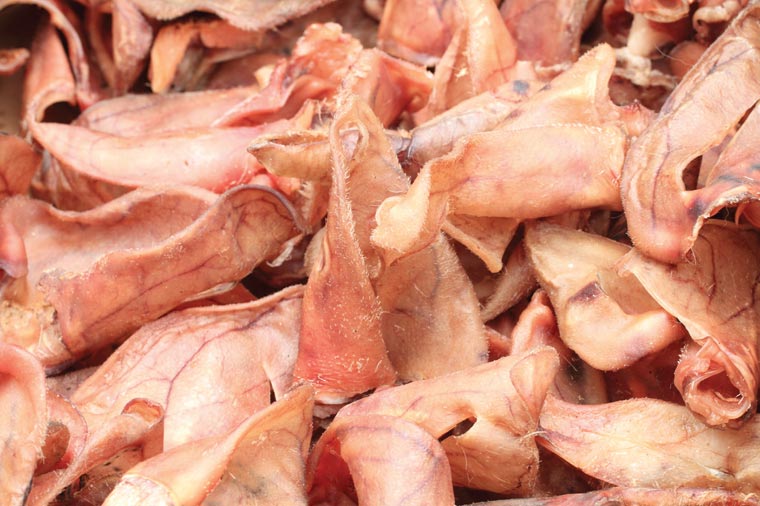
Pig ear treats remain a source of Salmonella after decades of illnesses.

The most recent outbreaks linked with pig ears ended in October 2019 after at least 154 illnesses with 35 people hospitalized. Companies recalled treats imported from Argentina, Brazil, and Columbia.

Pig ear treats have been linked with illness outbreaks since at least 1999, when epidemiologists said the products likely sickened at least 30 people in Canada. U.S. authorities blocked entry of the implicated products.

Pig ear treats

Image AVMA

RASFF Alerts – Salmonella – Breaded Alaskan Pollock Fillets – Chicken Quarters – Chilled Turkey Breast Fillets – Processed Fish Maws

RASFF-Logo

RASFF – Salmonella (present /25g) in chilled breaded Alaska pollock fillets (Theragra chalcogramma) from the Netherlands in Germany

RASFF – Salmonella enterica ser. Enteritidis (4 out of 5 samples /25g) in back chicken quarters from Poland in Poland

RASFF – Salmonella enterica ser. Typhimurium monophasic (1 ,4, [5], 12:i:-) (presence /25g) in chilled turkey breast fillet from Poland, via Denmark in Finland

RASFF – Salmonella enterica ser. Kentucky (presence /25g) and Salmonella enterica ser. Senftenberg (presence /25g) in processed fish maws from the Gambia in the UK