Category Archives: Salmonella

USA – New York firm recalls organic flour from Spain because of Salmonella concerns

Food Safety News

After receiving a notice from its supplier in Spain, a New York company is recalling certain boxes of Tiger Nuts brand flour because of possible Salmonella contamination.

Tiger Nuts Inc. of Newburgh, NY, sold the implicated flour to retailers in Oregon and Missouri and three online bakers, according to the company’s recall notice posted by the U.S. Food and Drug Administration.

“Tiger Nuts Inc. was notified by their Spanish growers Tiger Nuts S.L. in Valencia, Spain, that a customer in Germany had reported Salmonella content in their Tiger Nuts extra fine flour,” according to the recall notice.

“The supplier Tiger Nuts S.L. and the German customer are continuing to investigate the occurrence and are keeping us (the New York company) updated. The specific (flour) we received in November 2020 was completely sold through by January 2021.”

France – Product recall: SELECTION DU MONDE brand crocodile fillet

Oulah

Product recall: SELECTION DU MONDE brand crocodile fillet

ENCOUNTERED PROBLEM

Presence of salmonella

PROPOSED SOLUTION

People who may have this product are asked not to consume it and to return it to the point of sale where it was purchased.

Foodborne illness caused by salmonella results in gastrointestinal disturbances, diarrhea, vomiting and abdominal pain, often accompanied by fever; these symptoms may be more severe in young children, immunocompromised individuals and the elderly. The incubation period can range from 6 to 72 hours.
People who have consumed the products mentioned below and who have these symptoms are invited to consult their doctor, notifying him of this consumption.

FURTHER INFORMATION

▸ Names of models or references
CROCODILE NET 2 x 125 gr black skinpack


▸ Barcode
22979820


▸ Lot
• 2501195
• 2500504
• 2090003


▸ DLC – DDM
06/02/2021


▸ Packaging
Black plastic container under transparent vacuum revealing the product.


▸ Start date / End of marketing
From 05/20/2021 to 05/31/2021


▸ Geographical sales area
REUNION (974)


Carrefour distributors


▸ Consumer service contact
0692726400


▸ Source
JACARANDA DISTRIBUTION

UK – FSA issues precautionary safety advice for specific melons

FSA

There have been some recent salmonella cases of illness in the UK, the possible source is thought to be whole honeydew, cantaloupe and galia melons originating from Costa Rica, Honduras or Brazil bought on or before 28 May 2021.

Consumers may be able to identify the country of origin from a sticker on the fruit. If consumers are not sure about the country of origin of their galia, cantaloupe or honeydew melon, they are advised to dispose of the fruit as a precaution.

We are aware that a large number of UK retailers may have stocked the affected melons, which have now been removed from sale.

Tina Potter, Head of Incidents for the Food Standards Agency said:

‘As a precaution we are advising people not to eat these melons and to dispose of them. It is important that consumers wash their hands and any surfaces that have been in contact with the melons thoroughly. This will help avoid the risk of cross contamination and the risk of illness.’

Professor Saheer Gharbia, Head of Gastrointestinal Pathogens Unit at Public Health England, said:

‘Symptoms of salmonellosis typically resolve themselves and include diarrhoea, stomach cramps, nausea, vomiting and fever. However, symptoms can be more severe and lead to hospitalisation, especially in the very young and those with weakened immune systems. Anybody with concerns that they have symptoms of salmonellosis should contact their GP or out of hours service.’

Anyone who is concerned about symptoms should contact their GP or out of hours service in the first instance.

Only the melons listed above are affected. We are working with Public Health England, Food Standards Scotland and other UK health protection and food safety colleagues to continue investigations.

RASFF Alerts – Foodborne outbreak -Salmonella Dublin in chilled raw milk cheese

RASFF

Foodborne outbreak suspected to be caused by Salmonella Dublin in chilled raw milk cheese from France

RASFF Alerts – Salmonella – Polish Chicken and Turkey – Sesame Seeds – BBQ Pork Ribs – Shatavari Powder – Frozen Blanched Shrimps

RASFF

Salmonella spp. in chilled chicken meat from Poland in Germany and the UK

RASFF

Salmonella enterica ser. Enteritidis in frozen chicken elements from Poland in Belgium, France, Hungary, Latvia, Lithuania, UK, Netherlands, Slovakia and Poland

RASFF

Salmonella spp. in sesame from Nigeria in Germany

RASFF

Salmonella spp. in chilled chicken meat from Poland in Poland, Germany , Netherlands and UK

RASFF

Salmonella Enteritidis in chicken in Germany and Poland

RASFF

Salmonella spp. in fresh chicken broiler meat thighs meat, boneless, skinless from Poland in Lithuania

RASFF

Salmonella spp. in fresh chicken broiler drumsticks from Poland in Lithuania

RASFF

Salmonella spp. in chilled marinated in BBQ sauce pork ribs from Poland in Lithuania

RASFF

Salmonella in frozen chicken meat preparations from Belgium in the Netherlands

RASFF

Salmonella O:4 (B) in turkey meat from Poland in the UK

RASFF

Salmonella Enteritidis detected in chicken neck skins, chickens originating from Hungary, slaughtered in Poland” in Poland

RASFF

Carcasses and poultry cuts salmonella enteritidis from Poland in the UK, Ireland and Netherlands

RASFF

Salmonella spp. in organic shatavari powder from India in Austria, Finland, Germany, Italy , Netherlands, Poland, Portugal. Slovenia, Spain, Switzerland and the UK

RASFF

Salmonella Enteritidis in chicken neck skins from Poland in Lithuania

RASFF

Salmonella in gambero indopacifico/salmonella in frozen blanched shrimps (Parapenaeopsis stylifera) from India in Italy

RASFF

Salmonella Enteritidis in chilled chicken elements from Poland in Romania, Ukraine and the UK

RASFF

Presence of Salmonella in hulled sesame seeds from Nigeria in Greece

RASFF

Presence of Salmonella in sesame seeds from Nigeria in Greece


RASFF Alerts – Animal Feed – Salmonella – Feed Material – Rapeseed Cake

RASFF

Salmonella O:7 in feed material from the Ukraine in Poland

RASFF

Salmonella enterica ser. Agona (present /25g) in rapeseed cake from Belgium in France

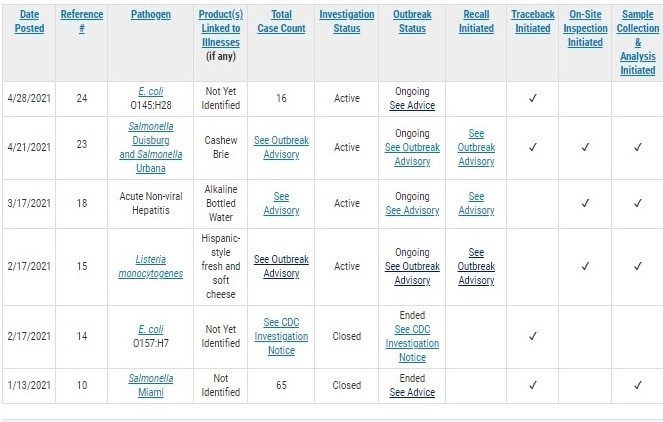
USA – FDA Core Investigation Table Update

FDA

0a

New Zealand – Food Safety has taken precautionary action following the detection of Salmonella Enteritidis at an Auckland poultry farm.

MPI

kswfoodworld Salmonella

New Zealand Food Safety has taken precautionary action following the detection of Salmonella Enteritidis at an Auckland poultry farm.

This is a timely reminder to take the usual precautions around food safety at home, says director of food regulation Paul Dansted.

“There has been an increase in human cases caused by the same strain of salmonella found in our investigation, which we are tracking alongside the Ministry of Health.

“The cause of the human cases is still being investigated. However, to reduce the possibility of getting ill through food, we’d like to remind people to follow the 3Cs of food safety at home.

“In other words, clean food preparation surfaces, cook raw chicken meat to an internal temperature of 75°C, and chill cooked chicken meat in the fridge.

“Symptoms of Salmonella illness include abdominal cramps, diarrhoea, fever, headache, nausea and vomiting. It can be serious in people with reduced immunity, older people, children, and pregnant women.”

A New Zealand Food Safety audit and follow-up testing has found the bacterium at an Auckland supplier of hatching eggs and day-old chicks to industry.

“That facility has taken a number of steps to prevent further infection, including sanitising affected sheds, culling potentially affected chickens, and increased testing.

“These actions, as well as our tracing work, and wider industry testing, have prevented any contaminated eggs from reaching consumers.

“People’s safety is our number one priority here. Our testing and tracing work over the past few months has been focussed on ensuring the risk remains low, and to assist industry to eradicate the bacterium from commercial chicken flocks.”

Actions to date include:

  • Tracing product from the facility to 64 farms, which have all been tested. Two of these farms tested positive and have been required to hold product before it goes to market. The farms must take a number of actions before being allowed to continue trading. Results from a further 2 facilities are due in the next few days, and the remaining 60 farms returned negative tests.
  • Four facilities which earlier tested positive for the bacterium have already been sanitised and the affected flocks have been culled.
  • Significantly increased industry testing for Salmonella, above and beyond normal requirements, across the supply chain.

“For context, the Salmonella Enteritidis bacterium is present in the poultry industries of many countries and is managed by a variety of regulatory controls. However, it does occasionally cause outbreaks of food poisoning, and can be serious.

“We continue to monitor the situation with the Ministry of Health and are working closely with the poultry sector to ensure any risk is identified and dealt with.”

Salmonellosis can spread in a variety of ways outside of food, including contact with infected animals, material, or surfaces.

Research -Salmonella use intestinal epithelial cells to colonize the gut

Science Daily

kswfoodworld salmonella

The immune system’s attempt to eliminate Salmonella bacteria from the gastrointestinal (GI) tract instead facilitates colonization of the intestinal tract and fecal shedding, according to National Institutes of Health scientists. The study, published in Cell Host & Microbe, was conducted by National Institute of Allergy and Infectious Diseases (NIAID) scientists at Rocky Mountain Laboratories in Hamilton, Montana.

Salmonella Typhimurium bacteria (hereafter Salmonella) live in the gut and often cause gastroenteritis in people. The Centers for Disease Control and Prevention estimates Salmonella bacteria cause about 1.35 million infections, 26,500 hospitalizations and 420 deaths in the United States every year. Contaminated food is the source for most of these illnesses. Most people who get ill from Salmonella have diarrhea, fever and stomach cramps but recover without specific treatment. Antibiotics typically are used only to treat people who have severe illness or who are at risk for it.

Salmonella bacteria also can infect a wide variety of animals, including cattle, pigs and chickens. Although clinical disease usually resolves within a few days, the bacteria can persist in the GI tract for much longer. Fecal shedding of the bacteria facilitates transmission to new hosts, especially by so-called “super shedders” that release high numbers of bacteria in their feces.

NIAID scientists are studying how Salmonella bacteria establish and maintain a foothold in the GI tract of mammals. One of the first lines of defense in the GI tract is the physical barrier provided by a single layer of intestinal epithelial cells. These specialized cells absorb nutrients and are a critical barrier that prevent pathogens from spreading to deeper tissues. When bacteria invade these cells, the cells are ejected into the gut lumen — the hollow portion of the intestines. However, in previous studies, NIAID scientists had observed that some Salmonella replicate rapidly in the cytosol — the fluid portion — of intestinal epithelial cells. That prompted them to ask: does ejecting the infected cell amplify rather than eliminate the bacteria?

To address this question, the scientists genetically engineered Salmonella bacteria that self-destruct when exposed to the cytosol of epithelial cells but grow normally in other environments, including the lumen of the intestine. Then they infected laboratory mice with the self-destructing Salmonella bacteria and found that replication in the cytosol of mouse intestinal epithelial cells is important for colonization of the GI tract and fuels fecal shedding. The scientists hypothesize that, by hijacking the epithelial cell response, Salmonella amplify their ability to invade neighboring cells and seed the intestine for fecal shedding.

The researchers say this is an example of how the pressure exerted by the host immune response can drive the evolution of a pathogen, and vice versa. The new insights offer new avenues for developing novel interventions to reduce the burden of this important pathogen.

USA – Salmonella Outbreaks Linked to Backyard Poultry

CDC

Fast Facts
  • Illnesses: 163
  • Hospitalizations: 34
  • Deaths: 0
  • States: 43
  • Recall: No
  • Investigation status: Active
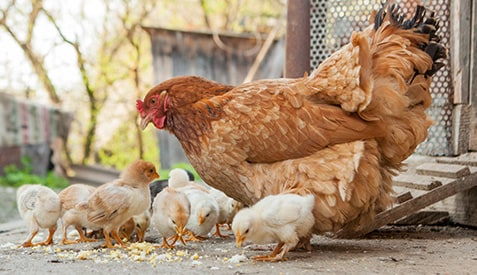
Backyard poultry with chickens eating

Backyard Poultry and Salmonella

Backyard poultry, like chicken and ducks, can carry Salmonella germs even if they look healthy and clean. These germs can easily spread to anything in the areas where they live and roam.

You can get sick from touching your backyard poultry or anything in their environment and then touching your mouth or food, and swallowing Salmonella germs.

What Backyard Flock Owners Should Do
  • Wash your hands
    • Always wash your hands with soap and water immediately after touching backyard poultry, their eggs, or anything in the area where they live and roam.
    • Use hand sanitizer if soap and water are not readily available. Consider having hand sanitizer at your coop.
  • Be safe around backyard flocks
    • Don’t kiss or snuggle backyard poultry, and don’t eat or drink around them. This can spread Salmonella germs to your mouth and make you sick.
    • Keep your backyard flock and supplies you use to care for them (like feed containers and shoes you wear in the coop) outside of the house. You should also clean the supplies outside the house.
  • Supervise kids around flocks
    • Always supervise children around backyard poultry and make sure they wash their hands properly afterward.
    • Don’t let children younger than 5 years touch chicks, ducklings, or other backyard poultry. Young children are more likely to get sick from germs like Salmonella.
  • Handle eggs safely
    • Collect eggs often. Eggs that sit in the nest can become dirty or break.
    • Throw away cracked eggs. Germs on the shell can more easily enter the egg though a cracked shell.
    • Rub off dirt on eggs with fine sandpaper, a brush, or a cloth. Don’t wash them because colder water can pull germs into the egg.
    • Refrigerate eggs to keep them fresh and slow the growth of germs.
    • Cook eggs until both the yolk and white are firm, and cook egg dishes to an internal temperature of 160°F to kill all germs.

Call your healthcare provider right away if you have any of these severe symptoms:

  • Diarrhea and a fever higher than 102°F
  • Diarrhea for more than 3 days that is not improving
  • Bloody diarrhea
  • So much vomiting that you cannot keep liquids down
  • Signs of dehydration, such as:
    • Not urinating (peeing) much
    • Dry mouth and throat
    • Feeling dizzy when standing up