Category Archives: Salmonella

RASFF Alerts – Salmonella – Polish Chicken Products – Black Pepper – Dried Mexican Pimento – Chicken Drumsticks – Chicken Inner Fillets – Rubbed Spearmint Leaves – Halva with Pistachios – Poultry Burger – Hare Meat

RASFF

Presence of Salmonella spp. in black pepper from Brazil in Poland

RASFF

Salmonella (presence /25g) in dried Mexican pimento from Mexico in Poland

RASFF

Salmonella enterica ser. Enteritidis in chilled chicken drumsticks from Bosnia and Herzegovina in Croatia

RASFF

S.enteritids in frozen chicken inner fillets from Slovakia in France

RASFF

Salmonella Enteritidis in chicken filets from Poland in Slovakia

RASFF

Salmonella enterica ser. Enteritidis in chilled poultry meat from Poland in Slovakia

RASFF

Salmonella (presence /25g) in frozen chicken from Poland in Romania

RASFF

Salmonella Enteritidis in chicken from Poland in Poland and Hungary

RASFF

Salmonella spp. in spearmint leaves rubbed from Egypt in the Czech Republic, Denmark, Germany, Poland and Ukraine

RASFF

Salmonella spp. in halva with pistachios from Turkey in the Czech Republic, Germany and Poland

RASFF

Presence of Salmonella in poultry burger from Greece in Germany

RASFF

Presence of E.Coli Stec and Salmonella Typhimurium in hare meat from Uruguay in Italy

RASFF Alerts – Animal Feed – Salmonella – Rapeseed Expeller

RASFF

Salmonella spp. in organic rapeseed expeller from Italy in Germany

RASFF

Salmonella Havana in rapeseed expeller from Germany in Denmark

EU – Salmonellosis outbreak linked to imported sesame-based products

EFSA

Five European countries have reported salmonellosis infections linked to the consumption of sesame-based products such as tahini and halva imported from Syria.

Up to 121 people have been affected since January 2019 in Denmark, Germany, the Netherlands, Norway, and Sweden. Several types of Salmonella are linked to the outbreak – S. Mbandaka, S. Havana, S. Orion, S. Amsterdam, S. Senftenberg, and S. Kintambo.

The products are sealed and ready to be consumed, which suggests that contamination occurred before they reached the European market.

Control measures on the involved batches have been implemented since August 2020. Nevertheless, cases were still being reported as recently as September 2021. This could be because the products have a long shelf life and are being stored in people’s homes.

EFSA and ECDC scientists concluded that there is still a risk of new Salmonella infections related to these products in the EU/EEA.

Israel – Palm Tahini Products – Salmonella

Palm Grinding Company recalls various Palm tahini products due to Salmonella contamination. 

The recall notice link is below

Click to access RCL_13102021.pdf

New Zealand – Managing Salmonella Enteritidis in commercial chicken flocks

MPI

Salmonella Enteritidis is a serious disease affecting people. Infection can occur from eating eggs and poultry meat. To help eliminate Salmonella Enteritidis, commercial chicken operators need to meet extra requirements from October 2021.

Commercial chicken operators must meet extra rules

From 6 October 2021, commercial chicken operators must comply with an emergency control scheme (ECS). The rules are to:

  • identify, monitor, and evaluate the risks around producing and selling chicken products
  • better manage the risks to public health from Salmonella Enteritidis (SE).

The Ministry for Primary Industries (MPI) consulted with the poultry industry about the ECS.

How to comply with the SE Emergency Control Scheme Order [PDF, 1001 KB]

Animal Products Order: Emergency Control Scheme – Managing SE in Commercial Chicken Flocks [PDF, 609 KB]

The rules apply to all those in the chicken supply chain

Specific chicken products must be produced and sold under the ECS. The rules apply to all operators within the chicken supply chain, including:

  • breeders, hatcheries, and rearers
  • egg laying and broiler farms
  • processing sites of chicken meat and eggs.

USA – Outbreak Investigation of Salmonella Thompson – Seafood (October 2021) – Do not eat, sell, or serve recalled seafood sold in Colorado

FDA

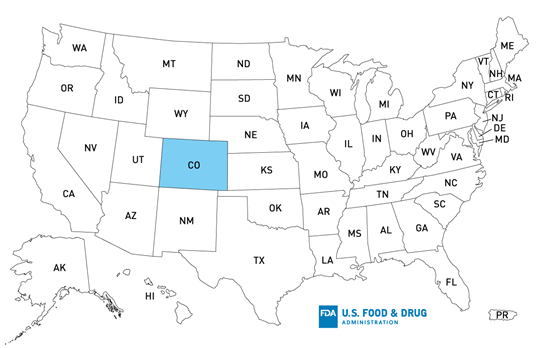
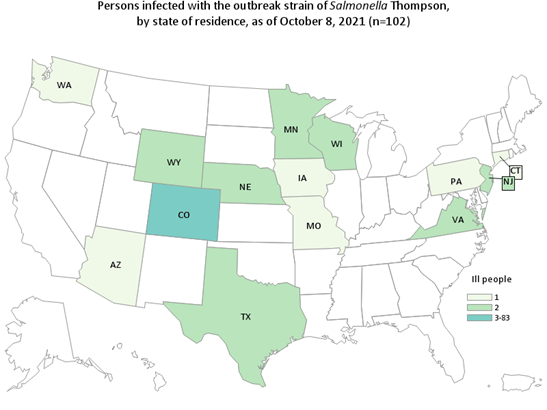
The FDA, along with CDC and state and local partners, are investigating a multistate outbreak of Salmonella Thompson infections linked to seafood manufactured or processed by Northeast Seafood Products, Inc. of Denver, CO. According to CDC, the majority of sick people are either Colorado residents or reported traveling to Colorado during the week they got sick. Only two people did not report traveling to Colorado during the week they got sick.

CDC’s analysis of epidemiological information indicates that seafood is the leading hypothesis for the cause of illnesses linked to this outbreak. FDA’s traceback investigation identified Northeast Seafood Products, Inc. as a common distributor among illness subclusters. As part of this outbreak investigation, environmental samples were collected from Northeast Seafood Products, Inc. On 10/7/2021, environmental samples collected from Northeast Seafood Products, Inc. were reported positive for Salmonella Thompson and were determined to be a match to the outbreak strain through whole genome sequencing.

On 10/8/2021, Northeast Seafood Products, Inc. recalled Haddock, Monkfish, Bone-in Trout, Grouper, Red Snapper, Red Rock Cod, Ocean Perch, Pacific Cod, Halibut, Coho Salmon, Atlantic Salmon Portions, Lane Snapper, Tilapia, All Natural Salmon Fillet, Pacific Sole, and Farm Raised Striped Bass. These products were sold to restaurant and Albertsons, Safeway, and Sprouts supermarkets in Colorado.  The Pacific Cod sold through Sprouts is not being recalled. A full list of recalled products is available on FDA’s website. At this time, Northeast Seafood Products, Inc. has temporarily shut down production.

Recommendation

Consumers, restaurants, and retailers should not eat, sell, or serve any recalled seafood. FDA recommends that anyone who might have purchased or received recalled product, check their refrigerators and freezers and throw away recalled product.

A full list of recalled products is available on FDA’s website.


Map of U.S. Distribution of Recalled Northeast Seafood Products

 Outbreak Investigation of Salmonella Thompson – Seafood - Map of U.S. Distribution of Recalled Products (October 8, 2021)

Case Count Map Provided by CDC

Outbreak Investigation of Salmonella Thompson – Seafood - CDC Case Count Map (October 8, 2021)

Case Counts

Total Illnesses: 102
Hospitalizations: 19
Deaths: 0
Last Illness Onset: September 7, 2021
States with Cases: AZ (1), CO (82), CT (1), IA (1), MN (2), MO (1), NE (2), NJ (2), PA (1), TX (2), VA (2), WA (2), WI (2), WY (2)
Product Distribution*: CO
*States with confirmed distribution; product could have been distributed further

France- Box of 6 organic eggs & loose eggs code 0FREOU01 – Salmonella

Gov france

Identifying information for the recalled product

  • Product category Food
  • Product sub-category Eggs and egg products
  • Product brand name Coteaux de la Saâne
  • Names of models or references Egg code: 0FREOU01
  • Product identification
    Lot Dated
    Box 6 eggs & bulk Recommended consumption date 10/30/2021
    Box 6 eggs & bulk Recommended consumption date 11/01/2021
  • Products List Product_list.pdf Enclosed
  • Packaging Box of 6 bulk eggs
  • Start date / End of marketing From 05/10/2021 to 07/10/2021
  • Storage temperature Product to be stored in the refrigerator
  • Geographical sales area Regions: Île-de-France,, Normandy
  • Distributors Bruel / Café de la Gare / Coccinelle / Auchan Luneray / Rapid Market / EpiService / Café de la Place / Viveco / Lycée Pablo Neruda / Les Saveurs d’Eric / Alexandre Clet / Super U Yerville / E. Leclerc Yvetot / U Express Yvetot / Valley grocery store
  • List of points of sale Reminder_list.pdf

Practical information regarding the recall

  • Reason for recall Positive Salmonella analysis in a livestock building
  • Risks incurred by the consumer Salmonella spp (causative agent of salmonellosis)
    Intoxication

Research – A pilot-scale evaluation of using gaseous chlorine dioxide for decontamination of foodborne pathogens on produce and low-moisture foods

Wiley Online

Small-scale studies have shown that chlorine dioxide gas, ClO2(g), was effective for decontamination of produce, nuts, and spices. This study conducted a pilot-scale evaluation to identify effective ClO2(g) treatment parameters for commercial-scale applications. The gas was produced by a generator utilizing sodium chlorite and chlorine gas for decontamination of Shiga toxin-producing Escherichia coli (STEC), Listeria monocytogenes, and Salmonella inoculated on tomatoes, blueberries, baby-cut carrots, almonds, and peppercorns. Inoculated samples and 45 kg tomatoes in a 1,246-L treatment chamber were exposed to various ClO2(g) concentrations (mg/L) and times 9 (hr) at 70–95% RH to determine the treatment effects on the pathogen reductions. Results showed that the treatment caused higher reductions on produce. A ClO2(g) treatment of 1 mg/L-3 hr at 70% RH reduced 4.9–6.8, 5.1–5.6, and 4.2–6.3 log CFU/g of STEC, L. monocytogenes, and Salmonella, respectively, on produce, with the highest reductions on baby-cut carrots. For almonds and peppercorns, ClO2(g) treatments under higher RH caused higher reductions. The treatment of 2 mg/L-9 hr or 3 mg/L-4 hr at 95% RH reduced >4.0 log of STEC and Salmonella on almonds, and 1 mg/L-5 hr at 85% RH achieved >5.0 log reductions on peppercorns. Applying moisture to the surfaces of almonds caused >4.0 log reductions using 1 mg/L-5 hr at 95% RH. This study identified effective ClO2(g) treatment parameters for achieving >4.0 log reductions of common pathogens on tomatoes, blueberries, baby-cut carrots, almonds, and peppercorns and showed that ClO2(g) generator is suitable for large-scale decontamination. These findings can be used for pilot-scale ClO2(g) decontamination of these products and for testing using ClO2(g) for commercial-scale decontamination trials.

Research – Inactivation of Salmonella enterica serovar Typhimurium and Staphylococcus aureus in rice by radio-frequency heating 

Journal of Food Protection

The objectives of this study were to determine the effect of the milling degree (MD) of Oryza sativa L. (Korean rice) on the heating rate, pathogen inactivation (Salmonella Typhimurium and Staphylococcus aureus), and color change resulting from radio-frequency (RF) heating. Rice samples inoculated with pathogens were placed in a polypropylene jar and subjected to RF heating for 0-75 s. The heating rate of rice with a 2% MD was the highest during RF heating, followed by those with a 0, 8, and 10% MD, and the reduction of pathogens showed the same trend. The reduction of the levels of pathogens in rice with a MD 0 and 2% was significantly higher than that observed for rice with a MD of 8 and 10% under the same treatment conditions. For example, log reductions of S. Typhimurium in rice by 55 s RF heating were 3.64, 5.19, 2.18, and 1.80 for milling degree of 0, 2, 8, and 10%, respectively. At the same treatment conditions, log reduction of S. aureus were 2.77, 5.08, 1.15, and 0.90 for milling degree of 0, 2, 8, and 10%, respectively. The color of rice measured according to L*, a*, and b* was not significantly altered after RF heating, regardless of the MD. Therefore, the MD of rice should be considered before RF heating is applied to inactivate foodborne pathogens.

Research – Transfer of Salmonella from inert food contact surfaces to wheat flour, cornmeal and NaCl.

Journal of Food Protection

Salmonella contamination in a dry processing facility frequently requires removal methods that are non-aqueous. Removal of pathogens from food processing systems with a purge of uncontaminated dry food materials has been proposed, however, little is known with the respect to efficacy. In this study, survival of Salmonella on inert contact surfaces and transfer of Salmonella from inert contact surfaces to low-moisture foods was evaluated. Six stainless steel and polymeric food contact material types, in bead form, were contaminated at 11 log CFU/mL and then stored at two temperatures, 25°C and 4°C for six months. Simultaneously, three dry food materials/ingredients were used to remove Salmonella from contaminated beads. Wheat flour, cornmeal, and NaCl (1 g each) were mechanically mixed with 3 beads of each material type. The rate of microbial transfer from contaminated beads to food materials was measured. Further experimentation using multiple transfers were applied on two representative beads types, 316 stainless steel and polypropylene, representing common surface contact materials used in processing equipment. Survival of Salmonella on beads depended on storage temperature, surviving longer at 4°C compared to 25°C (p<0.05), but was not influenced by type of bead material. Transfer of Salmonella from stainless steel beads to flour was significantly greater than from plastic (p<0.05). Transfer rates from stainless steel to wheat flour, cornmeal, and NaCl were measured as -0.5713, -0.2592, and -1.4221 Log CFU Salmonella removed/cm 2 /g clean material used. Transfer rates for polypropylene to whole wheat flour, cornmeal, and NaCl were more than 10-fold lower at -0.0156, -0.0148, and -0.0129 Log CFU Salmonella removed/cm 2 /g clean material used. These results indicate that while material type may not influence Salmonella survival during storage, Salmonella is more easily removed from stainless steel than polyethylene.