Category Archives: Salmonella

EU – Kinder Chocolate Salmonella Typhimurium Outbreak sickens over 200 in Europe – International outbreak of Salmonellosis in young children linked to the consumption of Kinder brand products. Update on April 20, 2022.

Sante Publique

Update on 20/04/22 following the recall of several products from the Kinder range manufactured in a factory in Belgium due to suspected contamination by  Salmonella Typhimurium.

Following the investigations carried out by the Belgian health authorities, together with their English, European and in particular French counterparts, the company Ferrero proceeded on April 5, 2022 to the recall of several Kinder range products manufactured in a factory in Belgium due to suspected contamination by Salmonella Typhimurium . On April 8, 2022, the recall finally affected all Kinder products from this factory, regardless of their expiry date. On April 14, 2022, an update of the recalled products, including the 2021 Christmas Advent Calendars, was released.

Case of salmonellosis in France: update on April 20, 2022

In total, as of 04/19/2022: 42 cases of salmonellosis with a strain belonging to the epidemic have been identified by the National Reference Center (CNR) for salmonella at the Institut Pasteur in France. 

The 42 cases are spread over 11 regions: Ile-De-France (7 cases), Provence-Alpes-Côte d’Azur (7 cases), Grand-Est (6 cases), Hauts-de-France (4 cases), Auvergne-Rhône-Alpes (4 cases), Nouvelle-Aquitaine (3 cases), Bourgogne-Franche-Comté (3 cases), Normandy (3 cases), Brittany (2 cases), Occitanie (2 cases), and Corsica (1 cases), with a median age of 3 years, and involved 22 boys and 20 girls.

Thirty-two cases were able to be questioned by Public Health France. All the cases report, before the onset of their symptoms (which occurred between 20/01 and 23/03/2022), the consumption of chocolates of the brand cited here.

Thirteen people were hospitalized for their salmonellosis, all discharged since. No deaths were reported. Public Health France is continuing its investigations with the families of cases recently reported by the CNR. 

The successive withdrawals and recalls of the Kinder brand products concerned, produced by the Belgian factory with its closure by the Belgian authorities, should limit the occurrence in France of new cases of salmonellosis in the coming days/weeks. 

To find out the list of products concerned by the withdrawal-recall: https://rappel.conso.gouv.fr/

People who have consumed the products mentioned above and who present symptoms (gastrointestinal disorders, fever within 72 hours of consumption), are invited to consult their doctor without delay, notifying him of this consumption.

In order to limit person-to-person transmission (especially in households with young children), it is recommended to wash your hands well with soap and water after using the toilet, after changing your child, and before to cook.

Situation internationale

See the previous points

Israel – Israel’s Strauss recalls chocolate after Salmonella found

Financial Post

Israeli foodmaker Strauss Group said on Monday it was recalling more than a dozen types of Elite brand chocolate after a routine inspection at its plant in northern Israel found traces of salmonella.

Strauss – a maker of snacks, fresh food and coffee with an Israeli market share of 12.4% – disclosed in a regulatory filing the discovery of the bacterium, which can cause intestinal disease.

Strauss recalled products made after Feb. 20 and the Nazareth-area plant has been shut to find the source of the problem, the company said, adding it was coordinating with Israel’s Health Ministry.

The products being recalled belonging to its “Elite” line of chocolate snacks include the popular Shokolad Para, Pesek Zman, Egozi and Kif Kef candy bars, Energy chocolate-coated crackers, and Bonbonniere candy boxes, among others. Strauss announced that the production of the various chocolate products in the factory was immediately halted and products manufactured in the vicinity of the discovery of salmonella were blocked from distribution.

Click to access NEWS_recalls_food_RCL_25042022_3.pdf

EU – 19 April update: Monophasic Salmonella Typhimurium outbreak

ECDC

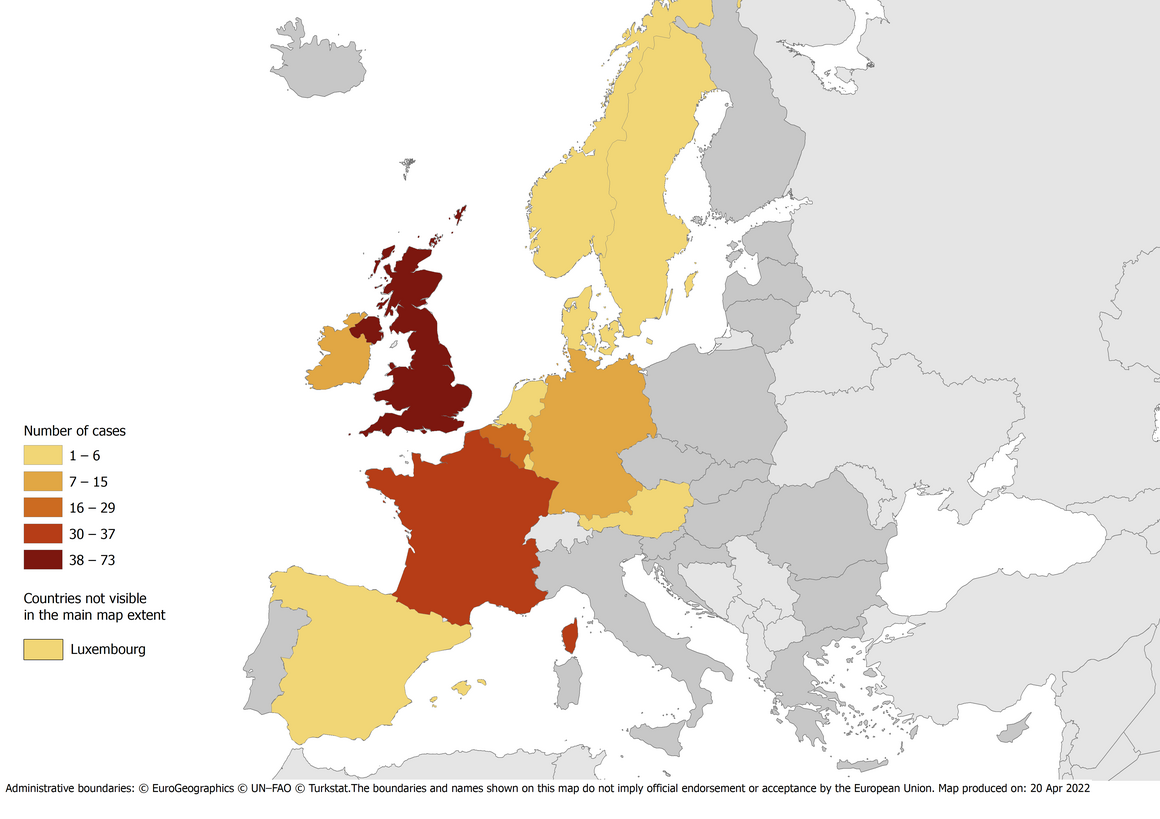
As of 19 April 2022, an outbreak of 187 confirmed and probable cases of monophasic S. Typhimurium (cluster 1) has been identified in the EU/EEA and the United Kingdom.

Number of confirmed and probable cases* with monophasic S. Typhimurium infection by country, EU/EEA and the UK, as of 19 April 2022

The outbreak is characterised by an unusually high proportion of children being hospitalised, some with severe clinical symptoms such as bloody diarrhoea. Based on interviews with patients and initial analytical epidemiological studies, specific chocolate products have been identified as the likely route of infection. Affected cases have been identified through advanced molecular typing techniques. As this method of testing is not routinely performed in all countries, some cases may be undetected.

Product recalls have been launched globally and examples of these can be found on several countries web sites including BelgiumFranceGermanyIrelandLuxembourgNetherlandsNorway, and the UK. The recalls aim to prevent the consumption of products potentially contaminated with Salmonella. Further investigations are being conducted by public health and food safety authorities in countries where cases are reported, to identify the cause and the extent of the contamination, and to ensure contaminated products are not put on the market.

ECDC and EFSA published a rapid outbreak assessment on 12 April 2022. The second strain of monophasic S. Typhimurium in non-human samples (cluster 2), which is mentioned in the published ROA, was found matching with 23 human cases from Belgium (n=5), France (n=5), Germany (n=4), Ireland (n=1), the Netherlands (n=1), and the UK (n=7).

Questions regarding ongoing product recalls should be addressed to national food safety authorities.

Number of confirmed and probable cases* with monophasic S. Typhimurium infection (cluster 1) by country, EU/EEA and the UK, as of 19 April 2022

Country Confirmed cases Probable cases Total cases
Austria 5 1 6
Belgium 7 22 29
Denmark 1 0 1
France 37 0 37
Germany 11 3 14
Ireland 15 0 15
Luxembourg 1 1 2
Netherlands 2 0 2
Norway 1 0 1
Spain 1 2 3
Sweden 4 0 4
Total EU/EEA 85 29 114
United Kingdom 73 0 73
Total 158 29 187

*According to the European outbreak case definition

UK – UKHSA update on Salmonella cases linked to confectionary products

Gov UK

Investigating an ongoing outbreak linked to certain Kinder products made by Ferrero. The majority of the cases are children under 5 years of age.

Latest

The UK Health Security Agency (UKHSA) is continuing to work with the Food Standards Agency, Food Standards Scotland, Public Health Scotland, Public Health Wales, Public Health Agency Northern Ireland – as well as international public health and food safety authorities – to investigate an ongoing outbreak of salmonella linked to certain Kinder products made in one of Ferrero’s factories, in Arlon, Belgium.

As of 20 April, there are 73 cases linked to this outbreak in the UK. The majority of the cases are children under 5 years of age.

We continue to remind people that a range of Kinder Egg products and Schoko-Bon’s should not be eaten.

Full details on the products affected and the recall can be found here.

Further information on case numbers in all affected countries can be found at the European Centre for Disease Prevention and Control (ECDC).

Previous

15 April 2022

As we enter the bank holiday weekend, the Food Standards Agency (FSA), Food Standards Scotland (FSS) and the UK Health Security Agency (UKHSA) are strongly reminding people that a range of Kinder Egg products and Schoko-Bon’s should not be eaten.

The agencies are continuing to work with Public Health Scotland, Public Health Wales, Public Health Agency Northern Ireland – as well as international public health and food safety authorities – to investigate an ongoing outbreak of salmonella linked to certain Kinder Egg product ranges and Schoko-Bons produced at one of the Ferrero company’s factories, in Arlon, Belgium.

Full details on the products affected and the recall can be found here.

As of 15 April, there are 70 cases linked to this outbreak in the UK. The majority of the cases are in children under 5 years of age.

Dame Jenny Harries, Chief Executive of UKHSA, said:

We’re reminding people of the recall this bank holiday weekend as it’s possible these products have been bought and stored as gifts, or for events such as Easter trails.

It’s crucial these products are not eaten and are discarded. Salmonella infection can be severe and many children affected in this outbreak have been very unwell and hospitalised, so anyone giving chocolate products to friends or family should take extra care to ensure their Easter gifts are not amongst those products recalled.

Thank you to parents and guardians  who worked with us and other public health authorities in the UK to tell us what their children had eaten prior to becoming unwell – this allowed us to rapidly pinpoint a potential source of infection and helped food chain investigations both in this country and in Europe. We understand this has been a worrying time for these families, and their responses have helped to prevent more children and vulnerable adults being affected.

Emily Miles, Chief Executive of the Food Standards Agency, said:

As we go into the Easter weekend, we are strongly urging consumers to follow the advice in the latest recall notice and to check any Kinder products they might have already bought against the list detailed in the notice, as they may pose a risk to health. If they do have any products on the list, they should not eat them and should discard them immediately.

We have emphasised to the business and the authorities in Belgium the importance of taking a precautionary approach to their recall and trust that they will continue to put consumers’ needs first in any action they take.

Symptoms of salmonellosis – or infection with salmonella – typically resolve themselves within a few days. However, symptoms can be more severe, especially in young children, those who are pregnant and those with weakened immune systems.

Anybody with concerns that they have symptoms of salmonellosis should contact their GP or call NHS 111. Salmonella can be spread from person to person as well as from food, so anyone affected should adhere to good hygiene practices, such as washing hands thoroughly after using the bathroom and avoiding handling food for others where possible, if you have symptoms.

The following products have been recalled and regardless of best-before date, should not be eaten.
The recall includes:

  • Kinder Surprise 20g and 3x 20g
  • Kinder Surprise 100g
  • Kinder Egg Hunt
  • Kinder Mini Eggs
  • Kinder Schoko-Bons

13 April 2022

The UK Health Security Agency (UKHSA) is continuing to work with the Food Standards Agency, Food Standards Scotland, Public Health Scotland, Public Health Wales, Public Health Agency Northern Ireland – as well as international public health and food safety authorities – to investigate an ongoing outbreak of Salmonella linked to certain Kinder products produced by the Ferrero Group.

Full details on the products affected and the recall can be found here.

As of 13 April, there are 67 cases linked to this outbreak in the UK. The majority of the cases are in children under 5 years of age.

Dr Lesley Larkin, Surveillance Lead, Gastrointestinal Pathogens and Food Safety (One Health) at UKHSA, said:

We would like to thank all the parents who worked with us and other public health authorities in the UK to tell us what their children had eaten prior to becoming unwell – they allowed us to rapidly pinpoint a potential source, which facilitated food chain investigations both in this country and in Europe. We understand this has been a worrying time for these families, and their responses have helped to prevent more children being affected.

Symptoms of salmonellosis typically resolve themselves within a few days. However, symptoms can be more severe, especially in young children, those who are pregnant and those with weakened immune systems.

Anybody with concerns that they have symptoms of salmonellosis should contact their GP or call NHS 111. Salmonella can be spread from person to person as well as from food, so anyone affected should adhere to good hygiene practices, such as washing hands thoroughly after using the bathroom and avoiding handling food for others where possible, if you have symptoms.

Belgium – Product Recall: Several Kinder chocolates – Salmonella

AFSCA

04/22/2022 (Product Recall Update 04/08/2022)
Ferrero
Product Recall: Several Kinder chocolates.
Problem: Possible presence of Salmonella.


FERRERO RECALLS THAT KINDER SCHOKOBONS SHOULD NOT BE CONSUMED. REGARDLESS OF THE EXPIRY DATE , LOT NUMBER OR PACKAGING SIZE Ferrero wishes to draw attention to the possible presence, albeit small and unlikely, of Kinder Schokobons of different sizes than those usually present

on the Belgian market, because they would be imported from foreign markets. These products, also produced in the Arlon factory, should not be consumed.

Kinder Schokobons and Kinder Happy Moments, all formats combined, were withdrawn from the market on April 8th. Since then, Ferrero and the distributors have made every effort to ensure that the products withdrawn from the market no longer circulate and are no longer available for sale, under the control of the FASFC.

However, it seems that certain formats of Schokobons, usually not distributed in Belgium, are present in minute quantities on the market and this, following import practices, not controlled by Ferrero Belgium.

The full product list is below.

Product Weight
Kinder Surprise Maxi 100g
Kinder Surprise 1 x 20g
Kinder Surprise 3 x 20g (60g)
Kinder Surprise 4 x 20g (80g)
Kinder Schokobons WHITE All weights _
Kinder Schokobons All weights _
Kinder Mix Plush 133g
Kinder Mix Advent Calendar 127g
Kinder Mini Eggs Hazelnut 100g
Kinder Mini Eggs Mix 250g
Kinder Happy Moments All weights _

We advise consumers who have purchased the products concerned by the recall, not to consume them and to return them to the store where they purchased them in order to be reimbursed. He can also contact Ferrero’s consumer service for any questions on this subject or to obtain a refund at the following address Consumer.Service.benelux@ferrero.com or on the number 0800 21042 .

We reassure our consumers that all other products in the Kinder range are perfectly safe to eat: Kinder Bueno, Kinder Chocolat, Kinder Maxi, Kinder Country, Kinder Cards, Kinder Joy, Kinder Tranche au Lait, Kinder Pingui, Kinder Choco Fresh and Kinder Délice can be consumed with confidence.

We would like to thank the distributors and the authorities for their collaboration. We take food safety very seriously and all actions we take are guided by our commitment to consumers.

Luxembourg – ALBURJ BRAND HALVA – Salmonella

SAP

The Luxembourg food safety authorities are recalling the following product:

name halvah
Brand Alburj
Unity 6x 800g
bar code 6217000020486
Date of minimum durability (MDD) 09.07.2022

Danger  : Possible presence of salmonella

Salmonella can cause symptoms such as nausea, vomiting, abdominal cramps, diarrhea, fever and headache within 6 to 72 hours after consumption. These symptoms may be aggravated in young children, immunocompromised subjects and the elderly. People who have consumed these products and have these symptoms are invited to consult a doctor and report this consumption to him.

Source of information: RASFF (Rapid Alert System for Food and Feed)

Communicated by: Government Commission for Quality, Fraud and Food Safety .

Canada – Update – Various poppy seeds recalled due to Salmonella

CFIA

Product
Various poppy seeds
Issue
Food – Microbial Contamination – Salmonella
What to do

Do not consume, use, sell, serve, or distribute the recalled products

Issue

Industry is recalling various poppy seeds from the marketplace due to possible Salmonella contamination.

The recalled products have been sold as indicated in the table.

Canada – Update – Various poppy seeds recalled due to Salmonella

CFIA

Product
Various poppy seeds
Issue
Food – Microbial Contamination – Salmonella
What to do
Do not consume, use, sell, serve, or distribute the recalled products

Industry is recalling various poppy seeds from the marketplace due to possible Salmonella contamination.

The recalled products have been sold as indicated in the table.

Research – New NARMS report shows rising resistance in Salmonella, Campylobacter

CIDRAP

The latest data from a national surveillance system that monitors foodborne bacterial pathogens for antimicrobial resistance (AMR) shows some concerning changes in resistance patterns among serotypes of Salmonella.

The findings come from the National Antimicrobial Resistance Monitoring Systems (NARMS) 2019 Integrated Summary, which combines data from the Centers for Disease Control and Prevention (CDC), the Food and Drug Administration (FDA), and the US Department of Agriculture (USDA). The report provides a snapshot of resistance patterns found in bacteria isolated from humans, animals, raw meats from retail outlets (chicken, ground turkey, ground beef, and pork chops), and meat and poultry product samples collected at slaughtering facilities.

In addition to Salmonella, which causes an estimated 1.35 million illnesses and 26,500 hospitalizations each year, the NARMS report also includes resistance data on Campylobacter (1.5 million illnesses and 19,500 hospitalizations), Escherichia coli, and Enterococcus. NARMS monitors these bacteria to detect emerging resistance patterns to the antibiotics that are most important to human medicine, multidrug resistance, and specific resistance genes.

Increase in multidrug-resistant Salmonella serotype

Overall, the NARMS report shows that more than three fourths of the Salmonella isolates (78%) from humans were not resistant to any of the antibiotics tested, and that the overall level of resistance in humans remains relatively unchanged since 2018. However, the report also found rising resistance to ciprofloxacin—one of the three antibiotics used to treat severe Salmonella infections.

From 2018 to 2019, Salmonella with decreased susceptibility to ciprofloxacin increased from 9% to 11% in humans, from 18% to 31% in retail chicken, from 20% to 30% in chicken product samples, from 26% to 32% in chicken cecal content samples, and from 0% to 14% in retail pork samples.

The increase in resistance to ciprofloxacin among poultry isolates was primarily due to the increase in Salmonella Infantis, a multidrug-resistant (MDR) serotype that emerged in 2014.

The rise in Salmonella Infantis isolates was also behind an increase in MDR isolates found in retail chicken (from 20% to 32%) and in chicken product samples (22% to 29%). Up to 10 antimicrobial resistance (AMR) genes were found in some of the Salmonella Infantis isolates.

In addition, the NARMS report shows an increase in another MDR Salmonella serotype, I 4,[5],12:i:-, which is linked to pigs and has become an increasing public health concern in Europe and the United States. The percentage of MDR isolates from humans that are of the I 4,[5],12:i:- serotype rose from 7% in 2010 to 26% in 2019, and from 7% to 35% in swine samples.

NARMS data also show rising fluoroquinolone resistance in Campylobacter isolates. In humans, the proportion of ciprofloxacin-resistant Campylobacter isolates rose from 29% in 2018 to 34% in 2019 for Campylobacter jejuni and from 41% to 45% in C coli. Ciprofloxacin-resistant C jejuni isolated from chicken cecal contents (21% in 2018 to 26% in 2019) and chicken retail samples (20% to 22%) also rose.

Analysis of E coli isolates found increases in ceftriaxone resistance in sow cecal samples (3% in 2018 to 7% in 2019) and in retail pork (4% to 7%). Whole-genome sequencing of Salmonella and E coli from animals, animal products, and retail meats found that none harbored any of the MCR-1 through MCR-8 colistin-resistance genes.

Czech Republic – Chicken skewer – Salmonella

Potravinynapranyri

Place of inspection:
Polerady ( Polerady 24, 25063 Polerady )
ID: 13280457
Food group: Meat and meat products Meat semi -finished product

Chicken skewer
Category: Dangerous food
Unsatisfactory parameter:

Salmonella Newport

The pathogenic bacterium Salmonella Newport was found in the meat preparation . This bacterium can cause a condition called salmonellosis.

Expiration date: 2/18/2022
Producer: Milan Pixa
Country of origin:  Czechia
Sampling date: Feb 16, 2022
Reference number: 22-000035-SVS-CZ
The sample was found by an official inspection of the State Veterinary Administration.