Category Archives: Pathogen

UK – Cotswold Farm – Cryptosporidium

Wilts and Glous Standard763px-Cryptosporidium_parvum_01

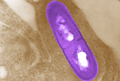
FIVE visitors to Countryfile presenter Adam Henson’s farm in the Cotswolds and one member of staff are being treated for the intestinal infection cryptosporidium.

Public Health England (PHE) is working closely with the Health and Safety Executive, Cotswold District Council, Animal Health and Veterinary Laboratories Agency (AHVLA) and Cotswold Farm Park to investigate the outbreak at Cotswold Farm Park, Guiting Power, near Bourton-on-the-Water.

Everyone affected is recovering well at home and the farm park has put in extra measures to reduce the risk of infection to visitors over the coming bank holiday Monday.

W.H.O – Report on Campylobacter

WHOCampylobacter

On 9–11 July 2012, the World Health Organization (WHO), in collaboration with the Food and Agriculture Organization of the United Nations (FAO) and the World Organisation for Animal Health (OIE), convened an Expert Consultation on The Global View of Campylobacteriosis, in Utrecht, Netherlands.

The objectives of the Consultation were:

To review the progress made in the past 10 years in understanding and controlling Campylobacteriosis, take note of successful approaches and lessons learned, and identify challenges in controlling Campylobacter from farm to table and in reducing the human health burden and attributable health consequences;

To consider cross-cutting areas, such as food- and waterborne Campylobacteriosis and antimicrobial resistance, taking into account the context of both high-income countries and low- and middleincome countries (LMIC);

To suggest how WHO, FAO and OIE could take action to reduce Campylobacter in the food chain and the burden of foodborne Campylobacteriosis.

Research – Antimicrobials – Listeria – Sampling Plans and Clustering

Science Direct

The present study investigated the efficacy of sub-inhibitory concentrations (SICs, concentrations not inhibiting bacterial growth) and bactericidal concentrations (MBCs) of four, generally recognized as safe (GRAS), plant-derived antimicrobials (PDAs) in inhibiting Listeria monocytogenes (LM) biofilm formation and inactivating mature LM biofilms, at 37, 25 and 4°C on polystyrene plates and stainless-steel coupons. In addition, the effect of SICs of PDAs on the expression of LM genes critical for biofilm synthesis was determined by real-time quantitative PCR. The PDAs and their SICs used for inhibition of biofilm were trans-cinnamaldehyde (TC 0.50, 0.75 mM), carvacrol (CR 0.50, 0.65 mM), thymol (TY 0.33, 0.50 mM), and eugenol (EG 1.8, 2.5 mM), whereas the PDA concentrations used for inactivating mature biofilms were 5.0 and 10.0 mM (TC, CR), 3.3 and 5.0 mM (TY), 18.5 and 25.0 mM (EG). All PDAs inhibited biofilm synthesis and inactivated fully formed LM biofilms on both matrices at three temperatures tested (P<0.05). Real-time quantitative PCR data revealed that all PDAs down-regulated critical LM biofilm-associated genes (P<0.05). Results suggest that TC, CR, TY, and EG could potentially be used to control LM biofilms in food processing environments, although further studies under commercial settings are necessary.

Science Direct

As in many cases, pathogenic microorganisms contaminate the food material as clusters or group of individual cells; the effectiveness of sampling plans based on mixture distributions representing bacterial agglomeration was assessed. In general, sampling plans that do not take into account such consideration lead to higher probabilities of accepting defective lots. Since quite often no scientific data are available in order to determine the degree of over-dispersion or clustering of the target microorganisms, in this theoretical study we compare the variance-to-mean ratio and the reciprocal of the exponent k of the negative binomial distribution (NB) as measures of dispersion. The mixture Poisson-logarithmic (Plog) model is proposed as a special case of the NB distribution, where the bacterial clusters are Poisson distributed while the individuals in each cluster follow a logarithmic distribution. In order to describe microbial data characterised by an excess of zero counts (1−π), we assess the zero-inflated Poisson (ZIP) and zero-inflated negative binomial (ZINB) distributions as alternative statistical models. The Operating Characteristic (OC) curves generated on the basis of the zero-inflated distributions were compared for fixed values of the variance-to-mean ratio and the parameter π at any mean level of contamination and sample weight adopted. The results show that assuming fixed 1/k and π for the NB and ZIP distributions, respectively, both models converge to a Poisson distribution at the producer’s quality level. In contrast, the consumer’s quality level is highly affected by assuming fixed values of 1/k and π since it increases. The OC curves generated for the NB and ZIP distributions assuming fixed values of the variance-to-mean ratio at any mean level of contamination and sample weight adopted, reveal that both the consumer’s and producer’s quality level are affected, as they both increase. Within the ZINB distribution, a separate investigation is conducted to determine which parameters are mostly responsible for describing microbial over-dispersion. As a general conclusion, for the design of sampling plans based on any statistical distribution, OC curves that reflect microbial agglomeration should be constructed considering that variance is not constant but dependant on the level of microbial concentration of the lot.

USA – Restaurant with Hepatitis A

Food Poisoning BulletinClose up 3d render of an influenza-like virus isolated on white

The Southeastern Idaho Public Health Department released a statement today stating that the patrons of Papa Murphy’s in Chubbuck, Idaho may have been exposed to Hepatitis A in April. An employee from the restaurant was diagnosed with the disease on May 2, 2013. There is no evidence of a Hepatitis A outbreak at this time.

RASFF Alert -Aflatoxin

RASFF – Aflatoxins (B1 = 47.6; Tot. = 52.9 µg/kg – ppb) in pistachios from Turkey in Germany

European Research – Listeria monocytogenes

DGCCRFlisteria-hp

Monitoring of food contamination by Listeria monocytogenes.

The national plan implemented by the DGCCRF is intended to monitor the contamination of food at the distribution stage. During these checks, investigators collected more than 3,600 samples

Of all the goods taken Listeria monocytogenes was found in 1.5% of cases. Only two cheeses have reached the prescribed limit (100 cfu / g) or 0.06% of the samples analysed. The analysis results indicate a low level of non-compliant products.

These results and the significant decrease in the number of establishments abnormality (38% in 2 years) shows the continuous improvement of the microbiological quality of food and hygiene conditions in the retail sector.

USA – Salmonella Sickens 80 – Las Vegas Restaurant

Food Poisoning BulletinSalmonella

The Southern Nevada Health District is investigating a Salmonella outbreak associated with Firefly Tapas Restaurant and Bar at 3900 Paradise Road in Las Vegas. Public health officials believe more than 80 people have been sickened in this outbreak. The health department closed Firefly on April 26, 2013 after reports of illness began coming into the office.

The health department has identified the cause of the outbreak as Salmonella. The symptoms of salmonellosis, the illness associated with a Salmonella infection, include diarrhea, which can be bloody, fever, abdominal cramps, headache, loss of appetite, nausea, and sometimes vomiting. People usually get sick 6 to 72 hours after infection. Investigators do not know what food is the source of the outbreak.

Canada – Whole Salted Fish – Clostridium botulinum

Health Canada

Health Canada is reminding Canadians that the consumption of certain whole salted fish products like fesikh, a traditional dish in the Egyptian community, represents an increased risk of botulism.

The fish used to make these specific salted fish dishes are not gutted before the ripening and salting process. This provides an opportunity for Clostridium botulinum bacteria that may be in the gut of the fish to grow and produce the toxins that cause botulism. These toxins are not eliminated by any smoking or drying of the end product. Refrigeration, freezing, washing, and open air or vacuum packaging will not make the fish safe. This applies to whole fish, fillets or parts.

The most recent botulism outbreak in Canada caused by the consumption of fesikh was in 2012. Internationally, the consumption of ungutted salted fish, including fesikh, has been linked to many cases of botulism.

Food contaminated with Clostridium botulinum toxin may not look or smell spoiled. Symptoms of botulism can include nausea and/or vomiting followed by one or more of: double vision, blurred vision, drooping eyelids, dry mouth, difficulty speaking, difficulty swallowing, weakness, respiratory failure and paralysis. In severe cases, death can occur. Symptoms generally begin 12 to 36 hours after eating a contaminated food, but they can occur as early as six hours or as late as 10 days after eating.

USA – USDA – Recall – Meatballs -Listeria monocytogenes

USDAUSDA

P.E. & F. Inc., a St. Louis establishment, is recalling approximately 123
pounds of frozen, ready-to-eat meatballs due to possible contamination with
Listeria monocytogenes, the U.S. Department of Agriculture’s Food
Safety and Inspection Service (FSIS) announced today.

The problem was discovered by FSIS routine sampling for Listeria
monocytogenes
. The company inadvertently did not hold the product pending
test results. FSIS and the company have received no reports of illnesses
associated with consumption of these products.

RASFF Alerts – E.coli – Raw Milk – Minced Beef

RASFF – High count of Escherichia coli (1500 000 CFU/g) in raw milk cheese from France

RASFF – Shigatoxin-producing Escherichia coli (0 26 H 11, STEC or VTEC) in minced beef meat from Italy in France