Category Archives: outbreak

USA -Cyclospora – Unwashed produce ?? – Drying May Help

Food Posioning Bulletin

Is the source of a multi-state Cyclopora outbreak restaurant lettuce salad? Health officials in at least six states are working in collaboration with the Centers for Disease Control and Prevention to divine the food source that has infected hundreds of people with a rare parasite.

The bug is so rare that it is not included in the standard parasite screening which looks for Giardia and Cryptosporidium, said David Warshauer, deputy director of communicable disease at the Wisconsin State Laboratory of Hygiene (WSLH). And once it’s confirmed with a special lab test, sub-typing is generally not performed.

With common bacterial food poisoning outbreaks, including those caused by E.coli, Salmonella, Listeria or Campylobacter, subtyping, often done with Pulsed Field Gel Electrophoresis (PFGE), is performed to find the bacteria’s “genetic fingerprint.” This allows health officials to see how many people have been sickened by the same source.

Food Poisoning Bulletin

If you’re like most people, you wash your produce before eating it. But do you dry it?  You should, according to the U.S. Food and Drug Administration (FDA).

Hundreds of people in six states; Illinois, Iowa, Kansas, Nebraska, Texas and Wisconsin have been sickened by a single-cell parasite called Cyclospora. To reduce your risk of food poisoning form fresh produce the FDA recommends the following produce-washing tips. Before you begin, wash your hands with hot, soapy water for 20 seconds, or long enough to sing Happy Birthday twice. Wash produce under cool, running water. Do not use soap or commercial washes. Scrub firm produce such as melons, cucumbers and potatoes with a brush. Dry the produce with a clean cloth or paper towel. Following these recommendations will reduce but not completely eliminate the risk of food poisoning from bacteria or parasites.

People become infected with Cyclospora when they eat or drink food or water that is contaminated with microscopic amounts of fecal matter containing the parasite. Cyclospora is most commonly found in tropical climates but imported foods including mesclun lettuce, basil, snow peas, and raspberries have been the source of a number of U.S. outbreaks in recent years.

USA – Legionella Outbreak

Food Posioning BulletinLegionella_Plate_01

Legionnaire’s outbreaks in Wisconsin and Ohio have sickened dozens of people, health authorities say. At least 20 people in Milwaukee County have  been diagnosed with the disease since June 1, 2013. Of those, 14 are from  the city of Milwaukee. Four people remain hospitalized. Wisconsin health authorities are looking for the source or sources of the outbreak

In Franklin County, Ohio, 22 illnesses have been associated with the Wesley Ridge Retirement Community in Reynoldsburg. Those sickened include visitors, residents and employees. Two of them have died. Franklin County Public Health,  the Ohio Department of Health and the Centers for Disease Control and Prevention (CDC) are working together to determine the source of the outbreak

USA – Cyclospora Outbreak Update

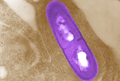
BarfBlog 220px-Cyclospora_cayetanensis_stained

Authorities suspect that fresh vegetables are the source of a rare parasite sickening dozens of Iowans.

The Iowa Department of Public Health reported this morning that 45 cyclospora infections have been confirmed in the state in the past few weeks.

That’s up from 22 cases earlier this week.

Only 10 such cases had been reported in the state in the past 20 years. The parasite is usually transmitted by tainted produce or water. It can cause weeks of severe diarrhea.

Federal experts are helping to trace the cause. Officials are urging everyone to wash their produce carefully … though they note that Cyclospora can be difficult to wash off.

Investigators who interviewed the patients believe the outbreak started in tainted vegetables, not fruit.

Food Poisoning Journal – Cyclospora What You Need to Know

The Iowa Department of Public Health, CDC and local public health agencies are investigating an outbreak of an intestinal illness caused by Cyclospora (a rare parasite). As of July 12, 45 cases of Cyclospora infections have been reported in Iowa with dozens more in Nebraska and other Midwestern states. It appears linked to eating fresh vegetables.

Ireland – Hepatitis A in Frozen Berries

ECDCecdclogo

The ongoing outbreak of Hepatitis A virus (HAV) infection that has affected travellers to Italy from Germany, the Netherlands and Poland, as well as local residents in Italy, may now be affecting Ireland.

Three cases of HAV have been reported in Ireland, although none of the three has any travel history to Italy. Nor have they had any contact with other HAV cases. Isolates of the virus from the three Irish cases reveal an identical sequence to that found in the Italian outbreak.

Onset of illness in the Irish cases was April 2013. Additional case finding activity is currently underway. Exposure of cases in both Italy and Ireland suggests that the same contaminated vehicle of infection has been available in at least these two countries. In Italy, mixed frozen berries have been indicated as the most likely vehicle of infection by epidemiological, microbiological and environmental investigations. In late May, an Italian distributor withdrew mixed frozen berries from the market following identification of a package contaminated with virus identical to the outbreak strain.

The most recent cases in the ongoing HAV infection outbreak have been reported by Italy. The onset of symptoms in these cases was recorded in June 2013. Due to the long shelf life of frozen berries and to the average length of approximately one month for incubation of HAV, more cases are expected to be reported.

While there is evidence pointing towards mixed frozen berries as the vehicle of infection, the specific berry type has not yet been identified. The point of contamination remains unknown at this time and as a result it is not yet possible to exclude the occurrence of associated cases in other EU Member States.

USA – Salmonella Outbreak at a Funeral Home

Food Safety NewsSalmonella

At least 36 people who attended a funeral in western Alabama on July 6 have fallen ill with Salmonella infections, reported the Alabama Department of Public Health Wednesday.

The funeral was held at Eastern Star Baptist Church in York, AL, and was attended by at least 100 people, according to a press release from ADPH.

Of those known to have been sickened, 30 were hospitalized in 9 different states, including Alabama, California, Florida, Georgia, Illinois, Kansas, Michigan, Missouri and Oklahoma.

The health department’s investigation into the outbreak began June 8 after a local hospital reported that 25 people had come in late on July 6 and into the following day complaining of fever, diarrhea, nausea and vomiting.

World Update – Hepatitis A in Frozen Berries

Food Safety News

Almost 600 Sick from Hepatitis A in Frozen Berries in 3 outbreaks in the USA, Northern Italy and Northern Europe

As the case count for Hepatitis A linked to Townsend Farms Organic Antioxidant Blend reaches 140, outbreaks in Northern Italy and Northern Europe have sickened 352 and 103 respectively. All linked to frozen mixed berries.

RASFF Alerts -Salmonella – Poultry – STEC – Deer Meat- Norovirus – Oysters- Ochratoxin – Raisins – Afaltoxin – Groundnuts

RASFF -Salmonella Minnesota (presence /25g) in frozen chicken meat (Gallus gallus) from Brazil in Spain

RASFF -Shigatoxin-producing Escherichia coli (E. coli  VT2 and EAE positive) in frozen deer meat from Austria in Italy

RASFF – Shigatoxin-producing Escherichia coli (VT2, EAE positive) in frozen deer meat from Austria in Italy

RASFF – Norovirus (G I) in oysters from France in Italy

RASFF – Ochratoxin A (111.65 µg/kg – ppb) in raisins from South Africa in Poland

RASFF – Aflatoxins (B1 = 5.9 µg/kg – ppb) in groundnuts from China in the Netherlands


USA – Cyclospora Outbreak

Livewell Nebraska220px-Cyclospora_cayetanensis_stained

Fourteen more cases of cyclospora infection were reported Friday to Nebraska and Iowa public health officials, adding to the 12 that had come in over the past several days.

Officials still are trying to determine the source of the Cyclospora cayetanensis parasite, which causes an intestinal infection called cyclosporiasis. They’re telling physicians to be aware of the illness and to test specifically for the parasite

The new Nebraska cases appear to be from the eastern part of the state, as did the earlier cases, according to a spokeswoman for the Nebraska Department of Health and Human Services. Most of the new Iowa cases were from central and eastern Iowa, said Dr. Patricia Quinlisk, medical director of the Iowa Department of Public Health. One case, she said, involved an Iowan who was tested in Omaha.

Cyclospora is spread by people ingesting food or water that is contaminated with feces. People living or traveling in tropical or subtropical regions of the world may be at increased risk for infection because cyclosporiasis is found in those areas. Foodborne outbreaks of the illness in the U.S. have been linked to various types of imported fresh produce, such as raspberries, basil, snow peas and mesclun lettuce.

People need to wash all fresh produce, health officials said.

The symptoms of cyclospora infection can last for weeks in otherwise healthy people. They include fatigue, lack of appetite, nausea, abdominal cramping and a low-grade fever.

People with compromised immune symptoms will have more severe and longer-lasting symptoms

What is cyclospora?

Cyclospora cayetanensis is a parasite made of one cell, too small to be seen without a microscope. This parasite causes an intestinal infection called cyclosporiasis.

How is cyclospora spread?

Cyclospora is spread by people ingesting something, such as food or water, that is contaminated with feces. Cyclospora needs days to weeks after being passed in a bowel movement to become infectious for another person. Therefore, it is unlikely that cyclospora is passed directly from one person to another.

Who is at risk for cyclospora infection?

People living or traveling in tropical or subtropical regions of the world may be at increased risk for infection because cyclosporiasis is found in some countries in the zones. In the United States, food-borne outbreaks of cyclosporiasis have been linked to various types of imported fresh produce.

What should I do if I think I might be infected with cyclospora?

See your health care provider.

Source: Centers for Disease Control and Prevention


USA – Listeria Outbreak in Cheese Updates

Food Poisoning Bulletin

The Minnesota Department of Health has released information about the multistate Listeria outbreak linked to recalled Crave Brothers soft cheeses. Two people in Minnesota have been sickened in this outbreak. Both were older adults who became ill in early June; one of them has died.

Food Poisoning Bulletin

Two Illinois restaurants served the Crave Brothers soft French cheeses that have been linked to a multistate Listeria outbreak. Girl & The Goat in Chicago, and the Hilton Hotel in Chicago sold the recalled cheese. Anyone who ate Les Frères, Petit Frère, or Petit Frère with Truffles at those restaurants may be at risk for developing listeriosis, a serious disease.

Food Poisoning Bulletin

To date, two Minnesota residents have contracted Listeria food poisoning (listeriosis) after eating Les Freres cheese produced by Crave Brothers Farmstead Cheese Company. One of Minnesota victim died. Prompted by this outbreak, Crave Brothers issued a recall of some of its cheese products, including Les Freres (LF225 2/2.5#), Petit Frère (PF88 8/8 oz) and Petit Frère with Truffles (PF88T 8/8 oz), all with a make date of 7-1-13 or earlier.

Food Poisoning Bulletin

A premier Minnesota restaurant, Butcher & The Boar, is the only restaurant in the state named by Crave Brothers Farmstead Cheese Company as a recipient of soft cheese associated with a deadly outbreak of listeriosis. Whole Foods Markets, Lunds, Byerlys, Rainbow, Kowalski’s and other grocery retailers also sold the cheese, as did restaurants in Wisconsin and Illinois. The recalled gourmet cheese has been associated with a Listeria death in Minnesota, a second Minnesota illness and individual cases of listeriosis in Illinois, Indiana and Ohio. All five people were hospitalized and one infection in a pregnant woman resulted in miscarriage.

Food Posioning Bulletin

The Centers for Disease Control and Prevention has joined the investigation by the Minnesota Department of Health into the Listeria outbreak linked to Crave Brothers Farmstead Cheeses. The company recalled three types of its cheeses on July 3, 2013 after an outbreak was announced. At least five people have been sickened in four states; one person in Minnesota has died and a woman has suffered a miscarriage.


USA – Cheese – Listeria monocytogenes – Death and Miscarriage

Listeria BlogEurofins Food Testing UK

Les Freres cheese is distributed by Crave Brothers Farmstead Classics, a Wisconsin producer.  Crave Brothers cheese is sold at some of the Midwest restaurants, including Girl and the Goat in Chicago, Wild Rice in Bayfield, Wisconsin, and Butcher and the Boar in Minneapolis. In the Twin Cities, it is also sold at grocery stores such as Lunds, Byerly’s and Kowalski’s.  The products were distributed nationwide through retail and foodservice outlets as well as by mail orders.

According to the Minnesota Department of Health (MDH), two older adults in Minnesota got sick in early June after eating the cheese, and one later died.

The outbreak has sickened at least four others in three states, according to the Food and Drug Administration (FDA).  In addition to Minnesota, the other states involved are Illinois, Indiana and Ohio.  One of the cases was a pregnant woman who suffered a miscarriage.

All of those sickened were infected with the same strain of listeriosis, the FDA said.