Category Archives: outbreak

USA – Notable Outbreaks and Recalls of 2018 – A Busy Year!

Food Safety Tech


As stated by CDC’s John Besser, Ph.D. last month at the Food Safety Consortium, “It’s been quite a year for outbreaks.” Here’s a not-so-fond look back at some of the noteworthy outbreaks and recalls of 2018.

Romaine Lettuce –E.coli O157:H7

Raw Beef Products – Salmonella

Shell Eggs – Salmonella

Pre-cut Melon – Salmonella

Vegetable Trays – Cyclospora

Salad Mix – Cyclospora

Raw Turkey – Salmonella

Honey Smacks Cereal – Salmonella

Duncan Hines Cake Mix – Salmonella

Johnston County Hams – Listeria monocytogenes

Research – Genomically Informed Strain-Specific Recovery of Shiga Toxin–Producing Escherichia coli during Foodborne Illness Outbreak Investigations

Journal of Food Protection

Next-generation sequencing plays an important role in the characterization of clinical bacterial isolates for source attribution purposes during investigations of foodborne illness outbreaks. Once an illness cluster and a suspect food vehicle have been identified, food testing is initiated for confirmation and to determine the scope of a contamination event so that the implicated lots may be removed from the marketplace. For biochemically diverse families of pathogens such as Shiga toxin–producing Escherichia coli (STEC), the ability to detect specific strains may be hampered by the lack of a universal selective enrichment approach for their recovery against high levels of background microbiota. The availability of whole genome sequence data for a given outbreak STEC strain prior to commencement of food testing may provide food microbiologists an opportunity to customize selective enrichment techniques favoring the recovery of the outbreak strain. Here we demonstrate the advantages of using the publicly available ResFinder tool in the analysis of STEC model strains belonging to serotypes O111 and O157 to determine antimicrobial resistance traits that can be used in formulating strain-specific enrichment media to enhance recovery of these strains from microbiologically complex food samples. The improved recovery from ground beef of model STEC strains with various antimicrobial resistance profiles was demonstrated using three classes of antibiotics as selective agents, suggesting the universal applicability of this new approach in supporting foodborne illness investigations.

USA – Raw Turkey Salmonella Reading Outbreak Grows to 216 Sick

Food Poisoning Bulletin

The raw turkey Salmonella Reading outbreak has grown to 216 sick, according to the Centers for Disease Control and Prevention (CDC). Eighty-four people are hospitalized and one person who lived in California has died. This outbreak has also sickened people in Canada.


Information – The International Outbreak Museum – Portland – Orgegon

Outbreak Museum

The International Outbreak Museum began in the office of Dr. Bill Keene in his early years investigating infectious disease outbreaks at the Oregon state health department. Bill realized early on that outbreak investigations are very public opportunities to teach large audiences about the kinds of foods and products that can become contaminated and cause widespread dissemination of disease. From one of the very first (and still the oldest) exhibits, an actual box of “Rely Tampons” that associated with Toxic Shock Syndrome and Staphylococcus aureus in 1978, to painstakingly reproduced products (like Sally Jackson artisanal raw milk cheese), the physical museum includes some pretty cool stuff. We’ve got bunches of restaurant menus, cans of contaminated leather spray, bottles of MRSA-contaminated tattoo ink and equipment, and packaging from many products that were recalled from the market because they caused outbreaks and made citizens sick.

The museum is part of The Northwest Center for Foodborne Outbreak Management, Epidemiology, and Surveillance (FOMES), a program that fosters the public health practice of foodborne and diarrheal disease surveillance and outbreak investigation. FOMES will be working to bring all of the physical IOM exhibits to digital life and feature them in their proper place on the web. Our hope is that Dr. Keene’s museum can be used to share the fascinating stories behind outbreak investigations. Please consider submitting information about your latest investigation (even if you didn’t find a smoking gun).

Sweden – Salmonella outbreak in Sweden with 33 ill

Food Safety News

kswfoodworld Salmonella

Swedish officials are investigating a national outbreak of Salmonella that has sickened 33 people.

Local counties, Livsmedelsverket (National Food Agency) and Folkhälsomyndigheten (Public Health Agency) are working together to investigate the illnesses and identify the source of infection.

The outbreak of Salmonella Enteritidis with multiple locus variable number of tandem repeat analysis (MLVA) type 2-10-7-3-2 was detected by Folkhälsomyndigheten’s monitoring program using Whole Genome Sequencing (WGS) in October.


USA – FDA says poor records stalled outbreak work; feedlot likely source of E. coli

Food Safety News

Federal officials won’t say definitively that contaminated canal water was behind this year’s deadly E. coli outbreak linked to romaine lettuce, but they are saying they “found no evidence in support of alternative explanations.” 

Another point made clear in an outbreak investigation report released yesterday puts the FDA firmly on record when it comes to antiquated shipping and receiving recordkeeping used by many in the leafy greens industry. Scott Gottlieb, commissioner for the Food and Drug Administration, issued a blunt statement calling for growers, processors and distributors to do the right thing.  

Gottlieb said what consumer groups and industry observers have been saying for months — traceback efforts to determine the specific romaine behind the outbreak were “challenging” because most of the necessary records were hand written and/or were not available electronically. Those out-of-date methods resulted in the FDA and CDC telling the public to avoid all romaine grown in the Yuma, AZ, area earlier this year because specific growers and shippers could not be identified. 

“We strongly encourage the leafy greens industry to adopt traceability best practices and state-of-the-art technologies to help assure quick and easy access to key data elements from farm to fork,” Gottlieb said.

Sweden/Austria – Hepatitis A outbreak linked to imported frozen strawberries by sequencing, Sweden and Austria, June to September 2018

Eurosurveillance

Hepatitis A virus is an important cause of food-borne diseases and has been associated with several European outbreaks linked to berries [14]. Here, we describe an ongoing outbreak of hepatitis A virus (HAV) in Sweden and Austria and the confirmation of frozen strawberries imported from Poland as the source of infection. The aims are to highlight the importance of sequencing in outbreak investigations and, due to the long shelf-life of the food vehicle, to increase awareness and warnings towards HAV infections related to frozen strawberries in Europe

On 14 June 2018, the Public Health Agency of Sweden (PHAS) received a notification from the Regional Office of Communicable Disease Control and Prevention of a suspected local outbreak of HAV in County A with five cases. An epidemiological investigation was initiated by county A together with PHAS and the National Food Agency (NFA).

Between 11 June and 27 July 2018, 20 confirmed and probable cases were reported from six counties

USA – Legionnaires’ disease: Lower Washington Heights cluster rises to 14

Outbreak News Today Legionella_Plate_01

In a follow-up on the Legionnaires’ disease cluster reported in Lower Washington Heights in northern Manhattan, New York City health officials report the case count has risen to 14.

The Health Department is actively investigating these cases and is sampling and testing water from all active cooling tower systems in the area of the cluster.

This is the second Legionnaires’ disease cluster reported in Lower Washington Heights this year.

Legionnaires’ disease is a type of pneumonia that is caused by the bacteria Legionella, which grows in warm water. Symptoms resemble other types of pneumonia and can include fever, chills, muscle aches, and cough. Most cases of Legionnaires’ disease can be traced to plumbing systems where conditions are favorable for Legionella growth, such as cooling towers, whirlpool spas, hot tubs, humidifiers, hot water tanks, and evaporative condensers of large air-conditioning systems.

Individuals may be infected by breathing in water vapor containing Legionella, and the disease is not transmitted from person to person. Individuals at higher risk include those ages 50 and above, cigarette smokers, and people with chronic lung disease or compromised immune systems. People living or working in the area who are experiencing these symptoms should seek medical attention with a primary care provider or seek urgent care.

USA – Notes from the Field: Multiple Cyclosporiasis Outbreaks — United States, 2018

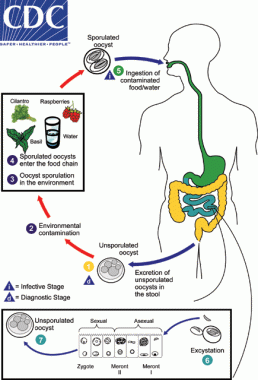
CDC Cyclospora_LifeCycle201

Cyclosporiasis is an intestinal illness caused by the parasite Cyclospora cayetanensis through ingestion of fecally contaminated food or water. Symptoms of cyclosporiasis might include watery diarrhea (most common), loss of appetite, weight loss, cramping, bloating, increased gas, nausea, and fatigue. Typically, increased numbers of cases are reported in the United States during spring and summer; since the mid-1990s, outbreaks have been identified and investigated almost every year. Past outbreaks have been associated with various types of imported fresh produce (e.g., basil, cilantro, and raspberries) (1). There are currently no validated molecular typing tools* to facilitate linking cases to each other, to food vehicles, or their sources. Therefore, cyclosporiasis outbreak investigations rely primarily on epidemiologic data.

The 2018 outbreak season is noteworthy for multiple outbreaks associated with different fresh produce items and the large number of reported cases. Two multistate outbreaks resulted in 761 laboratory-confirmed illnesses. The first outbreak, identified in June, was associated with prepackaged vegetable trays (containing broccoli, cauliflower, and carrots) sold at a convenience store chain in the Midwest; 250 laboratory-confirmed cases were reported in persons with exposures in three states (illness onset mid-May–mid-June) (2). The supplier voluntarily recalled the vegetable trays (3). The second multistate outbreak, identified in July, was associated with salads (containing carrots, romaine, and other leafy greens) sold at a fast food chain in the Midwest; 511 laboratory-confirmed cases during May–July occurred in persons with exposures in 11 states who reported consuming salads (4). The fast food chain voluntarily stopped selling salads at approximately 3,000 stores in 14 Midwest states that received the implicated salad mix from a common processing facility (5). The traceback investigation conducted by the Food and Drug Administration (FDA) did not identify a single source or potential point of contamination for either outbreak.

RASFF Alerts – Histamine -Chilled Yellowfin Tuna – Skipjack Tuna – Chilled Tuna

RASFF-Logo

RASFF-foodborne outbreak caused by histamine (1358; 1565; 1739 mg/kg – ppm) in chilled yellowfin tuna (Thunnus albacares) from Sri Lanka in Italy

RASFF-histamine (466 mg/kg – ppm) in frozen skipjack tuna (Euthynnnus pelamis) from Vietnam in Spain

RASFF-histamine (259 mg/kg – ppm) in chilled tuna from Italy in France