Public health officials in North Carolina have concluded their investigation of a foodborne illness outbreak linked to sushi, saying they were unable to determine the specific cause behind the illnesses of more than 150 people.
Only a handful of ill people who ate the suspect sushi sold at two Harris Teeter grocery stores agreed to provide samples for pathogen testing, according to the Cabarrus Health Alliance environmental health director. Officials also tested one sample of sushi.
All patient samples and the product specimen were tested for a broad range of pathogens in an attempt to identify the agent responsible for the illnesses.
The following is a list of outbreak investigations being managed by FDA’s CORE Response Teams. The investigations are in a variety of stages, meaning that some outbreaks have limited information, and others may be near completion.
An apparent salmonella outbreak at a resort in Jamaica has ruined vacations for potentially dozens of holiday travelers — and now some sickened guests are considering legal action, The Post has learned.
“It was a nightmare,” Chantel Ele of Lincoln, Nebraska, told The Post of her experience at the Grand Palladium Resort and Spa, which was echoed by other people online. “I don’t know how many people go on an all-inclusive vacation and lose weight.”
Iwaspoisoned.com, a platform that tracks food-borne illnesses, has tallied the number of guests who have allegedly become ill at the resort in December at close to 100, said the site’s founder Patrick Quade, who based the tally on reports to websites like TripAdvisor, Orbitz, Booking.com and the resort’s Facebook page.
“We have never seen an outbreak this size in the past for Jamaica,” he said.
A Yersinia outbreak in Norway has been solved and declared over just days after it was announced.
Folkehelseinstituttet (the Norwegian Institute of Public Health) said the national outbreak of Yersinia enterocolitica O3 was likely caused by a pre-mixed salad product.
Less than a week earlier, the agency had announced an investigation into a recent rise in Yersinia infections.
The outbreak started in mid-November and involved 10 confirmed patients. All of them are women aged 11 to 59 years old who became ill in mid to late November with the last case on Nov. 26. Three people live in Viken, two each in Oslo, Innlandet, and Vestland, and one in Telemark and Vestfold.
FDA’s CORE Response Teams have published information about food poisoning outbreaks for the last month or so on their CORE Investigation Table. This table lists recent outbreaks caused by E. coli, Salmonella, Listeria monocytogenes, Campylobacter, and other pathogens. This table sometimes links to actionable steps for consumers to take, but may not. At this time, there is no information about the potential food source for the new Salmonella Potsdam outbreak.
The link above is a list of outbreak investigations being managed by FDA’s CORE Response Teams. The investigations are in a variety of stages, meaning that some outbreaks have limited information, and others may be near completion.
A public health advisory will be issued for outbreak investigations that have resulted in specific, actionable steps for consumers to take to protect themselves. Please direct your attention to those pages for the most up to date information on the investigation and for consumer protection information.
The FDA, along with CDC and state and local partners, investigated a multistate outbreak of E. coli O157:H7 infections in the fall of 2020. The epidemiology and traceback investigation have determined that the outbreak was linked to leafy greens. The epidemiological and traceback investigations were not able to determine a specific type of leafy green linked to illnesses. On 12/22/2020, the CDC announced that this outbreak appears to be over. This outbreak, announced by FDA and CDC on October 28, 2020, was caused by a strain of E. coli that is genetically related to a strain linked to the fall 2019 romaine outbreak.
The FDA completed a traceback investigation of multiple types of leafy greens identified in patient interviews. Although no single ranch was identified as a common source of the leafy greens, FDA and state partners also conducted on-site investigations on farms of interest.
Teams were deployed to dozens of ranches in the region to conduct large scale environmental sampling. Additionally, no Shiga toxin-producing E. coli were found on leafy greens.
At this time, FDA’s investigational activities, including sample analysis are ongoing. A detailed report of FDA’s findings in the investigation will be released in early 2021, following the conclusion of investigational activities.
Recommendation
CDC has declared this outbreak to be over. There is no recommendation for consumers, retailers, or suppliers.
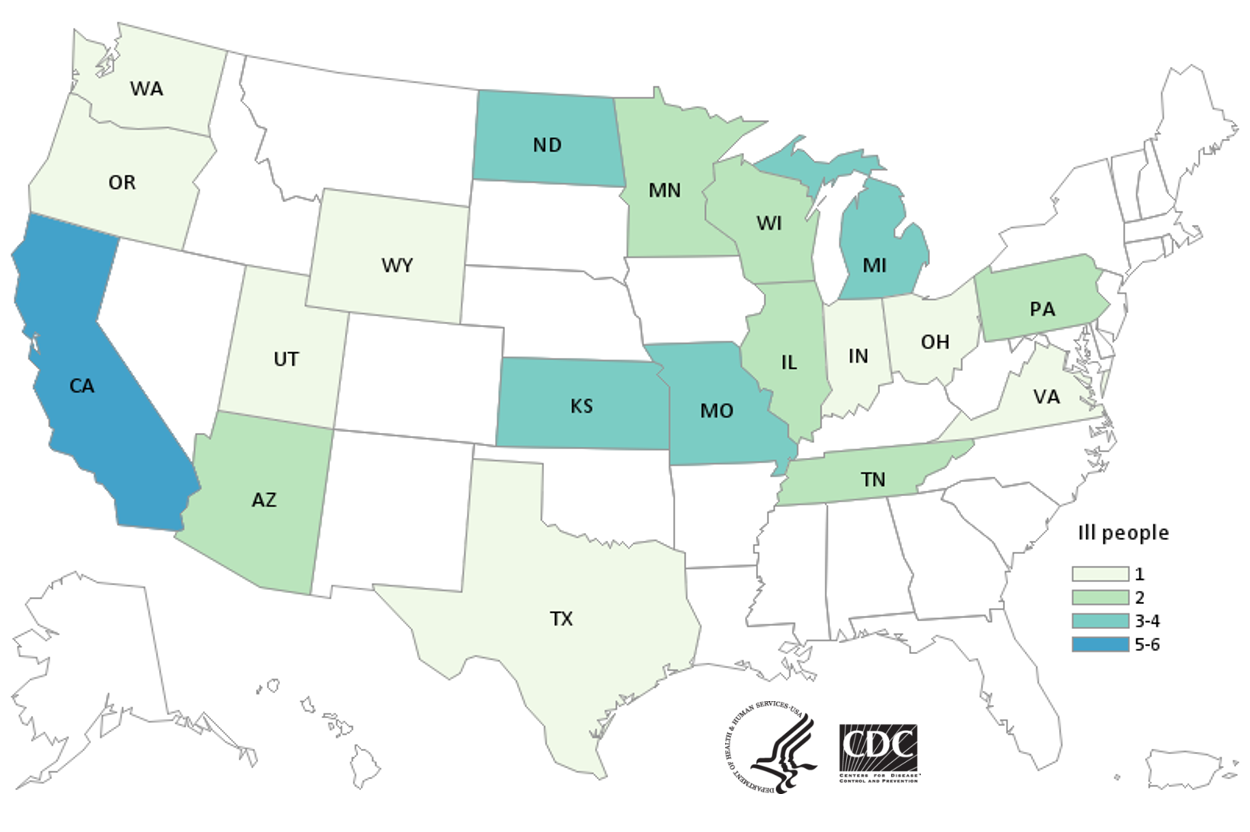
Case Count Map Provided by CDC
Case Counts
Total Illnesses: 40 Hospitalizations: 20 (4 Cases HUS) Deaths: 0 Last Illness Onset Date: October 31, 2020 States with Cases: AZ (2), CA (6), IL (2), IN (1), KS (4), MI (3), MN (2), MO (3), ND (4), OH (1), OR (1), PA (2), TN (2), TX (1), UT (1), VA (1), WA (1), WI (2), WY (1) *States with confirmed distribution; product could have been distributed further
More than 150 students and staff at a school in Belgium fell ill during an outbreak of norovirus earlier this month, according to information recently released.
The Federal Agency for the Safety of the Food Chain (FASFC) reported the food poisoning at the Atheneum Pegasus school in the city of Ostend was caused by crudités, which are mixed raw vegetables.
The FASFC, known in French as AFSCA and Dutch as FAVV, was informed in early December about the incident and started investigating with Zorg en Gezondheid (The Agency for Care and Health), and Sciensano, the national reference laboratory, to determine the source of contamination.
A total of 71 students and some staff were absent on one day and complained of vomiting, abdominal pain and fever.
The Norwegian Institute of Public Health has discovered an increased incidence of the gastrointestinal bacterium Yersinia enterocolitica O3. So far, infection has been detected in 10 people who live in several counties. Outbreak investigation has been initiated in collaboration with relevant municipal chief physicians, the Veterinary Institute and the Norwegian Food Safety Authority.
The National Institute of Public Health collaborates with the municipal health service, the Norwegian Food Safety Authority and the Norwegian Veterinary Institute to map whether patients can have a common source of infection. The patients are interviewed and the local Norwegian Food Safety Authority takes samples from food products in the homes of those who are infected, if residues are available, in order to identify the source of the outbreak if possible.