Category Archives: Norovirus

USA – Norovirus likely cause of 155 ill at Monical’s Pizza

Food Poison Journal

Norovirus Food Safety kswfoodworld

Monical’s Pizza at 6 Cherry Tree Shopping center in Washington, Illinois is currently closed due to an outbreak of an illness.

According to the Tazewell County Health Department, Monical’s was temporarily closed by the Illinois Department of Public Health (IDPH) due to an outbreak of a currently unknown foodborne illness. IDPH is currently working with the Tazewell County Health Department to identify the source.

155 people have currently reached out to the Tazewell County Health Department and reported symptoms of diarrhea and vomiting lasting 12 to 24 hours.

The health department is encouraging everyone to wash their hands and use hand sanitizer currently.

Anyone who ate at Monical’s since November 21st, and is experiencing symptoms, is encouraged to complete an online form.

RASFF Alert – Norovirus – Mussels

RASFF

Norovirus genogroup II in mussels from Spain in Portugal

Norovirus: What to do if you catch it and helping to stop the spread

UKHSA

Norovirus, commonly known as the winter vomiting bug, is a stomach bug that causes sickness and diarrhoea. Following lower levels than normal throughout the COVID-19 pandemic, we have started to see an increase in norovirus activity as we head into the winter period.

Norovirus is able to spread easily through communities and so outbreaks are common in settings where individuals have close contact such as hospitals, care homes, schools and nurseries.

For most people this is an unpleasant, short-lived illness and they make a full recovery within 2-3 days without needing any medicine. However, some groups, including young children, the elderly or those with weakened immunity, are at risk of suffering more serious and prolonged illness which may require medical treatment.

Stopping the spread

Norovirus is easily transmitted through contact with people with the infection and any surfaces or objects which have been contaminated with the virus. Symptoms include sudden onset of nausea, projectile vomiting and diarrhoea but can also include a high temperature, abdominal pain and aching limbs.

The incubation period of norovirus is 12-48 hours, which is the time between catching the virus and developing symptoms. Individuals are most infectious when symptomatic, but it is possible to pass on norovirus or shed the virus, thereby contaminating surfaces, objects or even food, both before developing symptoms and after symptoms have stopped.

Good hand hygiene is important to stop norovirus spreading. To avoid catching norovirus or passing it on to others wash your hands frequently and thoroughly with soap and warm water. This is most important following an episode of illness, after using the toilet, before eating or preparing food as well as cleaning up vomit or diarrhoea. Alcohol-based hand sanitisers are not effective against norovirus.
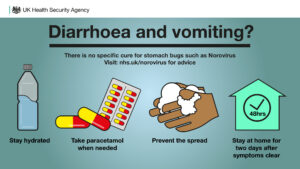
Diarrhoea and vomiting? There is no specific cure for stomach bugs such as Norovirus. Visit: nhs.uk/norovirus for advice. Icon of a water bottle. Stay hydrated. Icon of pills. Take paracetamol when needed. Icon of hands washing. Prvent the spread. Icon of a house with a clock saying 48 hours. Stay at home for two days after symptoms clear.

RASFF Alert – Norovirus – Clams

RASFF

Norovirus genogroup II in clams (Chamelea gallina) from Italy in Spain

RASFF Alerts – Norovirus – Clams

RASFF

Detection of norovirus genogroup I and II in japonica clam from Portugal in Spain

RASFF

Norovirus Genogroup I in Chamelea gallina from Italy in Spain

Research – Another drop in outbreaks was recorded in Germany for 2021

Food Safety News

The amount of foodborne outbreaks reported in Germany has continued to fall, according to the latest figures.

In 2021, the Robert Koch-Institut (RKI) and Federal Office of Consumer Protection and Food Safety (BVL) received slightly fewer reports of outbreaks with 168 compared to 193 in the previous year.

At least 1,179 cases, 196 hospitalizations, and two deaths were related to them in 2021. As in previous years, the top causes were Campylobacter and Salmonella.

Other agents involved in outbreaks were norovirus, Bacillus cereus, hepatitis A virus, Listeria monocytogenes, Clostridium perfringens, Yersinia enterocolitica, Shiga toxin-producing E. coli (STEC), Clostridium botulinum, Cronobacter sakazakii, histamine, Shigella, and Staphylococcus aureus. In seven outbreaks with 73 cases, the pathogen remained unknown.

Nineteen of the 22 outbreaks with more than five patients were caused by Salmonella.

USA – Norovirus Sickened 173 at D. C. Cobb’s Restaurant in Illinois

Food Poisoning Bulletin

Eurofins

A norovirus outbreak sickened 173 people at D. C. Cobb’s restaurant in McHenry, Illinois in August 2022, according to an investigation by the McHenry County Department of Health (MCDH). Two of those patients were hospitalized. The last time this investigation was updated was on September 16, 2022, when it was reported that 16 people were sick after eating at that restaurant. The restaurant is located at 1204 North Green Street in McHenry.

Can noroviruses be transmitted through food?

MAST

Food Borne Illness - Norovirus -CDC Photo

In winter, an increase in norovirus cases can be expected, as the infection is called the winter plague in some languages ​​(eg vinterkräksjuka in Swedish). The main symptoms of norovirus infection are malaise, vomiting, diarrhea, fever and abdominal pain.

The virus is highly contagious and only a few viruses are needed to cause infection. Noroviruses can be transmitted through food from people who are ill or have recently been ill with norovirus. There are examples of norovirus being transmitted through food in Iceland and abroad, such as frozen raspberries, oysters and food from restaurants. Such infections can cause group infections.

For example, the consumption of frozen raspberries caused a widespread norovirus infection in Denmark a few years ago. Subsequently, the Danes established rules that frozen raspberries should be heated before consumption, and such instructions can often be seen on packaging.

But how can the virus be prevented from spreading to food at home, in canteens, restaurants and other food businesses?

  • The production, cooking and serving of food should be avoided during illness and for at least 48 hours. after the symptoms are over.
  • Wash hands before handling food.
  • Wash hands before eating
  • Offer options for hand disinfection at the buffet.
  • Prevent utensil handles from coming into contact with food.
  • Food companies have clear rules regarding staff illness and their return.

The risk of norovirus being transmitted through food can be reduced if these guidelines are followed.

Advanced material:

RASFF Alert – Norovirus – French Oysters

RASFF

Norovirus in Oysters from France in the Netherlands and Finland

Australia – Outbreak of gastro at Canberra doughnut shop believed to be caused by sick worker and poor hand hygiene practices – Norovirus

ABC News

The investigation found the illness was caused by the spread of norovirus, a virus that often causes gastro and is spread through direct contact with an infected person or ingestion of faeces or vomit particles from an infected person.

It found no reports of gastro symptoms from customers in the store, making it unlikely a sick patron was the cause of the outbreak, and also noted food handlers on site did not provide stool samples for testing.

The report stated there was evidence collected on-site “suggestive of faecal contamination”, and the spread of the virus was most likely a result of a worker carrying the virus.