Category Archives: Mycotoxin

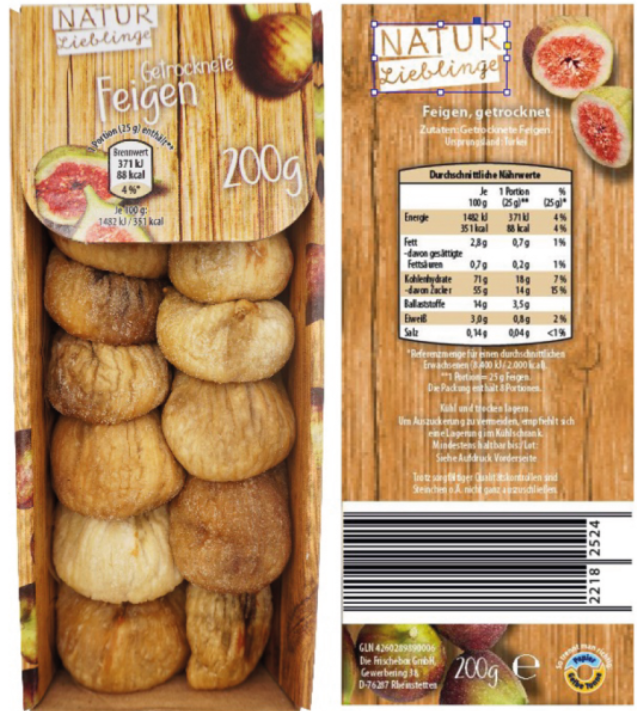
Germany – “NATUR favorites – Dried figs, 200 g” – Ochratoxin A

LMW


Warning type:Food
Date of first publication:December 21, 2020
Product name:

“NATUR favorites – Dried figs, 200 g”

Product pictures:

Unnamed.PNG

Press release

Manufacturer (distributor): Distributor: Frischebox GmbH, 76287 Rheinstetten Distribution via Aldi Süd in the federal states of Baden-Württemberg, Hesse and Rhineland-Palatinate
Reason for warning:

An increased content of ochratoxin-A (OTA) was found.

Packaging Unit: 200 g
Durability: Best before 20.06.2021
Lot identification: L4302 / 350058631-11-580
Further information:

Reference is made to the company’s consumer information sheet attached.

Contact to the responsible authorities:

Baden-Württemberg:

poststelle@mlr.bwl.de

Hesse:

Schnellwarnung@rpda.hessen.de

Rhineland-Palatinate:

Poststelle.Referat22@lua.rlp.de

India – FSSAI issues new manual for analysing aflatoxin in food

FNB News

The apex food regulator, FSSAI, has issued a revised manual for methods of analysis of mycotoxins including aflatoxin in food. FSSAI has stated that the manual shall be used by the laboratories with immediate effect and this manual shall supersede the earlier manual on mycotoxins.

According to the FSSAI all food samples suspected of being contaminated with mycotoxins must be handled with extreme care, as aflatoxins are potent carcinogenic substances.

The manual talks about personal safety precautions, precautions during analysis  and handling of glassware for aflatoxin analysis.

Currently, the regulatory limits for mycotoxins in food as defined by the FSSAI include 15 microgram per kg in cereals, and cereal products, pulses, nuts and nuts for further processing. For Aflatoxins  the limit is prescribed at 10 microgram  per kg for ready to eat products, and dried figs, while 30 microgram per kg for spices and for oilseeds for further processing, the limit is set at 15 microgram per kg.

Similarly, the limit of Aflatoxin M1 in milk is 0.5 microgram per kg, Ochratoxin A in wheat, barley and rye is at 20 microgram per kg, and for Patulin, the limit is 50mcrogram per kg in apple juice and apple juice ingredients in other beverages.

Further, the limit for Deoxynivalenol  in wheat is fixed at 1000ppm.

Mycotoxins—toxic secondary metabolites of filamentous fungi—are biological in origin. Only a few of the thousands of mycotoxins present significant food safety challenges to the farm-to-fork food continuum. The natural fungal flora associated with food safety is dominated by three genres: Aspergillus, Fusarium, and Penicillium.

Aflatoxins are highly toxic secondary metabolites and aflatoxin-producing fungi can contaminate crops in the field, at harvest, and during storage. Some of the more common crops susceptible to contamination with aflatoxins are cereals (e.g. maize, rice and wheat). The husk of these cereals are often used as animal feed.

Deoxynivalenol (DON) Deoxynivalenol (DON) also known as vomitoxin is a trichothecene mycotoxin mainly produced by Fusarium fungi (Fusarium molds). This plant pathogens can cause scab mainly in wheat and barley etc., and damages cereals the most widely by contamination in the field. The main commodities affected are cereals such as wheat, rice, barley, oats and maize etc.

Patulin is a mycotoxin that is produced by certain species of Penicillium, Apergillus, and Byssochylamys molds that may grow on a variety of foods including fruit, grains, and cheese  while Ochratoxin A (OTA) is a naturally occurring foodborne mycotoxin found in a wide variety of agricultural commodities worldwide, ranging from cereal grains to dried fruits to wine and coffee.

Denmark – Risk of Aflatoxin b1 in dried figs

Aarstiderne A / S recalls dried figs, due to risk of content of aflatoxin b1 in the product

Recalled Foods , Published: December 18, 2020

Which food
Dried figs
Net content: 1 kg
Best before date: 01.07.2021
Country of origin: Spain

Sold where The
product was sold in the period 8 November 2020 – 17 December 2020 via Aarstiderne.com, Arstiderna.com and in Aarstidernes Gårdbutik at Krogerup Avlsgaard, Krogerup 3, 3050 Humlebæk and Aarstidernes Gårdbutik on Banegaarden, Otto Busses Vej 45, 2450 København SV.

Company recalling
Aarstiderne A / S

Cause
At a random check taken by the Danish Veterinary and Food Administration, aflatoxin b1 has been found in the product.

Risk
Aflatoxin is a toxin produced by molds and can be carcinogenic.

Advice for consumers
Consumers are advised to discard the product or return it to the store where it was purchased.

RASFF Alerts – Aflatoxin – Dried Figs -Pistchios – Groundnuts- Roasted and Salted Pistachios –

European Food Alerts

RASFF

aflatoxins (B1 = 143.5; Tot. = 152.3 µg/kg – ppb) in pistachios from Turkey in Germany

RASFF

aflatoxins (B1 = 25; Tot. = 26.4 µg/kg – ppb) in pistachios in shell from Turkey in Germany

RASFF

aflatoxins (B1 = 15.3; Tot. = 16.4 µg/kg – ppb) in pistachios from Turkey in Germany

RASFF

aflatoxins (B1 = 38.1; Tot. = 44.9 µg/kg – ppb) in groundnuts from Vietnam in Finland

RASFF

aflatoxins (B1 = 37.5; Tot. = 43.2 µg/kg – ppb) in pistachios in shell from Turkey in Germany

RASFF

aflatoxins (B1 = 10.3; Tot. = 24.4 µg/kg – ppb) in dried figs from Turkey in Germany

RASFF

aflatoxins (B1 = 41.7; Tot. = 50.4 / B1 = 115; Tot. = 169.2 µg/kg – ppb) in roasted and salted pistachios in shell from Turkey in Germany

RASFF

aflatoxins (B1 = 10.3; Tot. = 42.3 µg/kg – ppb) in dried figs from Turkey in Belgium

RASFF

aflatoxins (B1 = 27; Tot. = 28.8 µg/kg – ppb) in pistachios in shell from the United States in Belgium

RASFF

aflatoxins (B1 = 26.55; Tot. = 31.44 µg/kg – ppb) in dried figs from Turkey in Germany

RASFF Alert- Mycotoxin – Ergot Alkaloids – Rye

European Food Alerts

RASFF

ergot (Claviceps purpurea) alkaloids (4948 mg/kg – ppm) in rye from Germany in Austria

RASFF Alert – Mycotoxin -Fumonsins – Organic Corn Waffles

European Food Alerts

RASFF

fumonisins (sum B1+B2: 890; 1130 µg/kg – ppb) in organic corn waffles from Slovakia in Germany

RASFF Alerts – Ochratoxin A – Pistachios

European Food Alerts

RASFF

ochratoxin A (32.8 µg/kg – ppb) in pistachios from the United States in Switzerland

RASFF Alerts -Afaltoxin – Banku Mix – Crushed Chillies – Dried Figs – Pistachios – Groundnut Kernels

European Food Alerts

RASFF

aflatoxins (B1 = 106; Tot. = 119 µg/kg – ppb) in banku mix from Ghana in the UK

RASFF

aflatoxins (B1 = 10.3; Tot. = 11.5 µg/kg – ppb) in crushed chillies from India in Italy

RASFF

aflatoxins (B1 = 13.4; Tot. = 16.7 µg/kg – ppb) in dried figs from Turkey in Italy

RASFF

aflatoxins (Tot. = 26.3 mg/kg – ppm) in pistachios from the United States, via Turkey in Germany

RASFF

aflatoxins (B1 = 132; Tot. = 147 µg/kg – ppb) in shelled pistachios from Iran in France

RASFF

aflatoxins (B1 = 7.1; Tot. = 9.5 µg/kg – ppb) in groundnut kernels from Argentina in the Netherlands

Ireland – Recall of a Batch of Castlewood Farm Organic Apple Juice due to an Elevated Level of Patulin – Mycotoxin

FSAI

Summary
Category 1: For Action
Alert Notification: 2020.95
Product: Castlewood Farm Organic Apple Juice; pack size 750ml
Batch Code: Best Before October 2021
Country Of Origin: Ireland

Message:

Castlewood Farm is recalling the above batch of its Organic Apple Juice due to an elevated level of patulin.  Patulin is a toxic contaminant produced naturally by a number of moulds found in and on fruit. Point-of-sale recall notices will be displayed in stores supplied with the implicated batch.

Nature Of Danger:

While patulin does not present an immediate risk to consumers, its presence is unacceptable and long-term consumption could cause an effect on human health. If consumed in large quantities over a period of time, patulin may cause damage to the immune system, nervous system and gastrointestinal tract.

Action Required:

Manufacturers, wholesalers, distributors, caterers & retailers:

Retailers are requested to remove the implicated batch from sale and to display a point-of-sale recall notice in stores where the affected batch was sold.

Consumers:

Consumers are advised not to consume the implicated batch.

Apple Juice Label
Apple Juice Bottle

Research – Effect of Blanching on Aflatoxin Contamination and Cross-Contamination of Almonds

Journal of Food Protection

ABSTRACT

Blanching of almonds was examined for reducing the aflatoxin content of contaminated nuts. Almonds with intact pellicles were spiked with aflatoxin B1 (AFB1) and blanched at 85°C. Following blanching, almond kernels and pellicles contained 20 and 19% of the spiked AFB1, respectively. The blanching water contained an additional 41% of the spiked AFB1. In a separate study, postblanching water was spiked with AFB1 and used for subsequent blanching of uncontaminated almonds. The resulting blanched kernels acquired 3.3% of the AFB1 from the spiked water, demonstrating a low level of cross-contamination from reused contaminated blanching water. The effect of the blanching temperature on partitioning of AFB1 from almonds to blanching water was significant at a 20-ppb spiking level, but not at 100 ppb. AFB1 levels that were unaccounted for in the mass balance of blanching components were presumed to be lost due to binding to water-solubilized almond components and were independent of pH and blanching time. Blanching reduced total aflatoxins in naturally contaminated almonds by 13 to 76%, depending on almond quality, as well as blanching time and temperature. These results indicate that the association between almond components and aflatoxin generated through mold contamination is more complex than in spiking experiments.

HIGHLIGHTS
  • Blanching and pellicle removal reduced aflatoxin in spiked almonds by up to 80%.
  • Low-level cross-contamination occurred in almonds blanched in contaminated water.
  • Aflatoxin reduction in naturally contaminated almonds by blanching was variable.