Category Archives: Mould/Mold

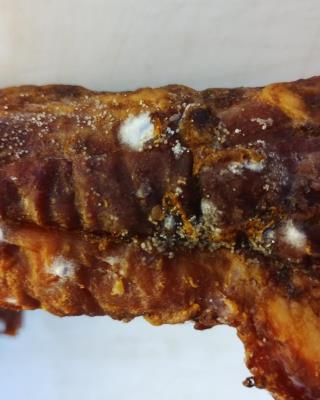
Czech Republic – Smoked ribs – Visible Mold/Mouldi

Potravinynapranyri

Illustrative photo #2

Place of inspection:
Pardubice ( Railway Regiment 2005, 530 02 Pardubice )
ID: 05457891
Invalid parameter:

fungi visible to the eye

There was white and green mold visible to the naked eye on the surface of the food. Food is not considered safe if it shows signs of spoilage.

Packaging: not packed
Quantity of the product in the package: 0.822 kg
Date of sample collection: 3/4/2024
Reference number: 24-000176-SZPI-CZ
The sample was detected by the official control of the State Agricultural and Food Inspection.

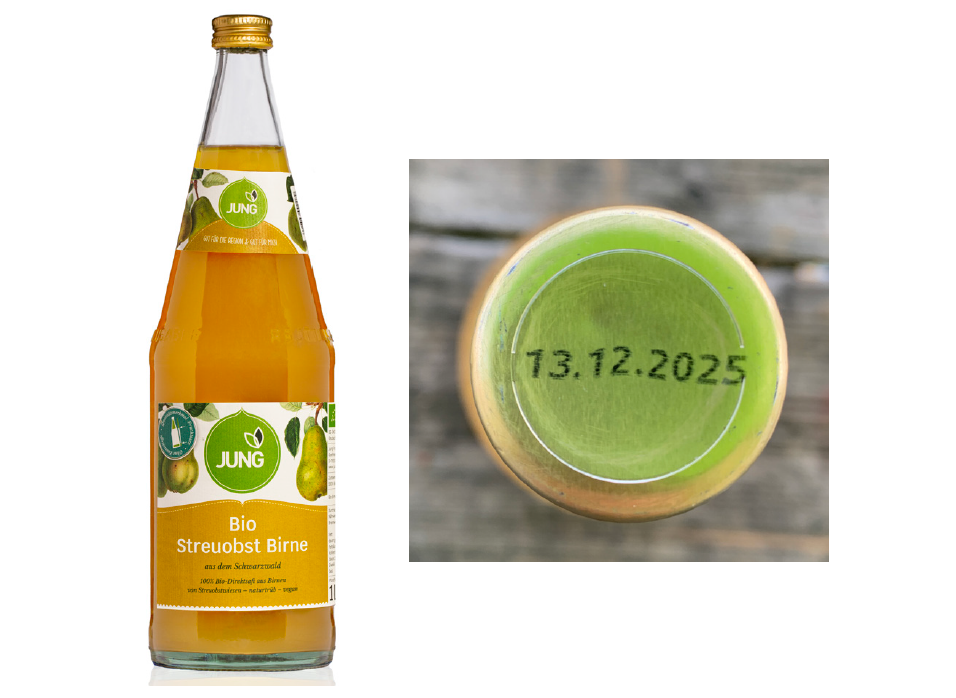
Germany – Organic orchard fruit pear juice 1 litre – Mycotoxin – Patulin

Lebensmittelwarnung

Alert type: Groceries
Date of first publication: April 26, 2024
Product name:

Organic orchard fruit pear juice 1 liter

Product images:

Image Pear Juice.PNG

customer information; Illustration of a glass bottle with a label and a bottle cap with a printed best-before date

Manufacturer (distributor):

Jung Fruit Juices GbR Goethestr. 18 79331 Teningen-Köntreiben Email: info@jung-saefte.de Telephone: 07641 96 22 02 2 Sales are limited to Baden-Württemberg.

Reason for warning:

An increased patulin content was found during an examination of an individual sample.

Packaging Unit: 1 L
Durability: 12/13/25
Lot identification: EAN 4028748000089
Additional Information:

Excerpt from the attached customer information:

The company Jung Fruchtsäfte informs that an increased patulin content was found in the product. Organic Scattered Fruit Pear Juice 1l, EAN 4028748000089
as part of an investigation on a single sample.

Only bottles with a best-before date of December 13, 2025 are affected.
The best before date can be found on the lid of the bottle.

If you have already purchased bottles of this type of juice with the stated best-before date, please return them to the market.
You will then get them exchanged. Please do not consume this product!

The JUNG FRUCHTSÄFTE company sincerely apologizes for the inconvenience caused to you.

Click to access 6323_Marktaushang_Jung_Birnensaft.pdf

RASFF Alert- Mold/Mould – Wholegrain Bread and Wheat Pita

RASFF

Mould growth in baked goods (wholegrain bread and wheat pita) from Germany, partly produced in the Netherlands in  Austria, Azerbaijan, Chile, Germany, Greece, Hong Kong, Italy, Luxembourg, Netherlands, Poland, Portugal, Switzerland.

China – Harbin Beer Found with Vomit Toxin, Company Responds

CMGM

After testing for 8 common beer mycotoxins, the results showed that one sample, “Harbin,” was found with deoxynivalenol (DON), with a detection level of 26 micrograms per kilogram. No other samples were found with mycotoxins.

Deoxynivalenol (DON), also known as vomit toxin, is mainly produced by Fusarium graminearum and Fusarium culmorum, which can be found in soil and are pathogens of cereals (especially wheat and maize).

The Joint FAO/WHO Expert Committee on Food Additives recommends a daily intake of 1 microgram per kilogram of body weight for DON, meaning that long-term exposure below this level is unlikely to pose a health risk to most people. For a 60-kilogram adult, consuming 4 cans of the sample (Harbin) detected with DON in one day would still be within safe levels.

However, the article reminds consumers that this intake level is set to protect public health, especially in cases where long-term or large amounts of DON intake may have adverse effects on health.

The article mentioned that the manufacturer of “Harbin” stated that the company has never exported tested products to Hong Kong for sale. The product has always been produced and sold only in mainland China and is not intended for sale in other regions. The entire production and sales process of the product comply with relevant laws and regulations in mainland China. The detected DON content in the samples is both compliant with and far below the relevant upper limit standards set internally, domestically, and internationally for cereal products.

Research – Comprehensive Insights into Ochratoxin A: Occurrence, Analysis, and Control Strategies

MDPI

Abstract

Ochratoxin A (OTA) is a toxic mycotoxin produced by some mold species from genera Penicillium and Aspergillus. OTA has been detected in cereals, cereal-derived products, dried fruits, wine, grape juice, beer, tea, coffee, cocoa, nuts, spices, licorice, processed meat, cheese, and other foods. OTA can induce a wide range of health effects attributable to its toxicological properties, including teratogenicity, immunotoxicity, carcinogenicity, genotoxicity, neurotoxicity, and hepatotoxicity. OTA is not only toxic to humans but also harmful to livestock like cows, goats, and poultry. This is why the European Union and various countries regulate the maximum permitted levels of OTA in foods. This review intends to summarize all the main aspects concerning OTA, starting from the chemical structure and fungi that produce it, its presence in food, its toxicity, and methods of analysis, as well as control strategies, including both fungal development and methods of inactivation of the molecule. Finally, the review provides some ideas for future approaches aimed at reducing the OTA levels in foods.

RASFF Alert- Mold/Mould – Raw Sausage

RASFF

Mould infestation and labelling deficiencies of raw sausages from Italy, via the Czech Republic in Germany and Slovakia

RASFF

Mould infestation and labelling deficiencies of raw sausage from Italy in Slovakia and Germany

RASFF Alerts – Ochratoxin A -Raisins- Mulberries

RASFF

Exceed ochratoxin A: 174 ± 42 μg/kg in Raisins from Uzbekistan in Latvia and Lithuania

RASFF

Aflatoxin and Ochratoxin A in mulberries from Turkey in the Netherlands and Belgium

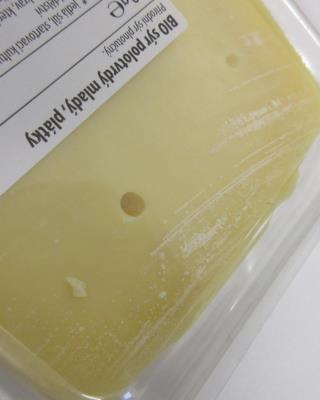
Czech Republic – Bio 50+ Goudse JONG ZACHT. BIO semi-hard young cheese, slices. – Visible Mould/Mold

Potravinynapranyri

Illustrative photo #4

Place of inspection:
Brno ( Cornovova 1066/3, 618 00 Brno )
ID: 44012373
Food group: Milk and milk products Cheese

Bio 50+ Goudse JONG ZACHT. BIO semi-hard young cheese, slices.
Category: Dangerous foods
Invalid parameter:

fungi visible to the eye

White mold was detected on the surface of the food and between the individual slices under the intact packaging in all inspected packages.

Food is not considered safe if it shows signs of spoilage. 

Unsuitable storage temperatures for this food were not detected during the inspection. The food did not have an expired minimum durability date.

Best before date: 26/02/2024
Quantity of the product in the package: 0.19 kg
Manufacturer: Seller: Albert Česká republika, sro, Radlická 520/117, 158 00 Prague 5, Czech Republic
Date of sample collection: 28/12/2023
Reference number: 24-000167-SZPI-CZ
The sample was detected by the official control of the State Agricultural and Food Inspection.

Research – Mitigation of Mycotoxins in Food—Is It Possible?

MDPI

Abstract

Among microorganisms found in food, fungi stand out because they are adaptable and competitive in a large range of water activities, temperatures, pHs, humidities and substrate types. Besides sporulating, some species are toxigenic and produce toxic metabolites, mycotoxins, under adverse biotic and abiotic variables. Microorganisms are inactivated along the food chain, but mycotoxins have stable structures and remain in ready-to-eat food. The most prevalent mycotoxins in food, which are aflatoxins, fumonisins, ochratoxin A, patulin, tenuazonic acid, trichothecenes and zearalenone, have maximum tolerable limits (MTLs) defined as ppb and ppt by official organizations. The chronic and acute toxicities of mycotoxins and their stability are different in a chemical family. This critical review aims to discuss promising scientific research that successfully mitigated levels of mycotoxins and focus the results of our research group on this issue. It highlights the application of natural antifungal compounds, combinations of management, processing parameters and emergent technologies, and their role in reducing the levels and bioaccessibility. Despite good crop management and processing practices, total decontamination is almost impossible. Experimental evidence has shown that exposure to mycotoxins may be mitigated. However, multidisciplinary efforts need to be made to improve the applicability of successful techniques in the food supply chain to avoid mycotoxins’ impact on global food insecurity.

RASFF Alerts – Mycotoxin – Ochratoxin A – Bush Mango Powder – Dried Figs – Sultanas

RASFF

Ochratoxin A and aflatoxins in bush mango powder from Togo in Switzerland

RASFF

Ochratoxin A in dried figs from Türkiye in Italy

RASFF

Ochratoxin A in organic sultanas from Turkey in  Austria, Denmark, Germany, Iceland, Italy, Portugal, Sweden, Switzerland, Türkiye, United Kingdom