Category Archives: Microbiology

USA – Elmira Legionnaires Outbreak

Outbreak News Today

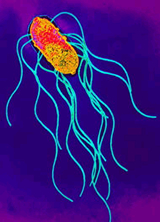
CDC legionella

Image CDC

13 Elmira residents are recovering from Legionnaires’ disease.  The Chemung County Department of Health and the New York State Department of Health are investigating the Elmira Legionnaires Outbreak.  Legionnaires disease is a serious and often deadly lung disease.  Overall, 10% of Americans who develop Legionnaires disease die.

A cooling tower at Elmira Heat Treating may be the source of this Legionnaires outbreak.  Cooling towers are a common source of Legionnaires disease outbreaks. Elmira Heat Treating has three cooling towers.  One cooling tower tested positive for Legionnaires disease.

USA – Ghnw, LLC Voluntarily Recalls Mushroom Stir Fry Blend and Stir Fry Blend Because of Possible Health Risk in Oregon and Washington States

FDA

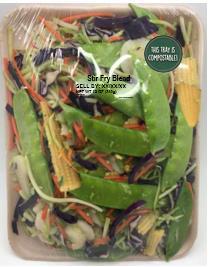
GHNW, LLC of Clackamas, OR is voluntarily recalling Mushroom Stir Fry Blend 10 oz. tray and Stir Fry Blend 16 oz. tray that were produced using Broccoli Slaw that is being recalled by Mann Packing Co., Inc. due to the potential to be contaminated with Listeria monocytogenes.

At this time, we are not aware of any illnesses linked by health officials to this recall. No other GHNW, LLC products are affected by this recall.

GHNW, LLC is issuing this recall out of an abundance of caution. The recalled products have “Sell By” dates of October 27, 2019 to November 8, 2019, which can be found printed in black ink on the front label of the product. The products affected were sold at QFC and/or Fred Meyer in Oregon and Washington State.

Consumers who believe that they are in possession of any of the products affected by this recall should dispose of the product in an appropriate waste container.

For any inquiries or comments, consumers with questions regarding this GHNW recall are welcome to call 888-449-9386, M-F, 9 am to 4 pm PST.

GHNW has notified its customers and this recall is being carried out with the knowledge of the US Food & Drug Administration.


Company Contact Information

Consumers:
 888-449-9386
Media:
Nelia Alamo
 916-208-6898

Product Photos

RASFF Alert – Animal Feed – Moulds – Sunflower Seed Meal

RASFF-Logo

RASFF – sunflower seed meal from Ukraine infested with moulds in Poland

RASFF Alert – Animal Feed – Salmonella – Fish Meal

RASFF-Logo

RASFF – Salmonella enterica ser. Montevideo (presence /25g) in fishmeal from the United States in Greece

Research – Oxidative Disinfectants Activate Different Responses in Vibrio parahaemolyticus

Journal of Food Protection

ABSTRACT

Vibrio parahaemolyticus is a prevalent seafoodborne enteropathogen that has become a global concern since the spread of its pandemic strain in 1996. This study investigates the responses of this pathogen to the oxidative disinfectants hydrogen peroxide, chlorine dioxide, and peracetic acid. Expression of the regulator genes oxyR and rpoS, determined by reverse transcription PCR, in V. parahaemolyticus wild-type, oxyR mutant, and rpoS mutant strains exhibited similar patterns in response to the tested oxidative disinfectants. The transcription of the rpoS gene was markedly enhanced in the oxyR mutant strain in the exponential phase. The expression of catalase KatE1 was tracked by using a LacZ fusion reporter in these strains. The experimental results revealed that KatE1 was a significant scavenger of hydrogen peroxide and peracetic acid in V. parahaemolyticus, and RpoS may partially compensate for the regulatory role of OxyR in the oxyR mutant strain. In contrast to its responses to hydrogen peroxide and paracetic acid, KatE1 was not the primary scavenger of chlorine dioxide in these V. parahaemolyticus strains. This study shows that these disinfectants activated a basic oxidative response in this pathogen with different features.


Research – Modeling microbial competition in food: Application to the behavior of Listeria monocytogenes and lactic acid flora in pork meat products

Science Direct

Abstract

Competition between background microflora and microbial pathogens raises questions about the application of predictive microbiology in situ, i.e., in non-sterile naturally contaminated foods. In this article, we present a review of the models developed in predictive microbiology to describe interactions between microflora in foods, with a special focus on two approaches: one based on the Jameson effect (simultaneous deceleration of all microbial populations) and one based on the Lotka–Volterra competition model. As an illustration of the potential of these models, we propose various modeling examples in estimation and in prediction of microbial growth curves, all related to the behavior of Listeria monocytogenes with lactic acid bacteria in three pork meat products (fresh pork meat and two types of diced bacon).

Research -A systematic review of source attribution of human Campylobacteriosis using multilocus sequence typing

ECDC

 gastroenteritis is a leading cause of acute bacterial gastroenteritis in high, low, and middle income countries. The number of confirmed cases has continued to increase across countries of the European Union (214,000 in 2013 to 246,000 in 2016 and 2017) [1], and over 800,000 cases are estimated to occur annually in the United States (data from 2000 to 2008) [2]. In low income countries  is increasingly implicated in growth faltering among children under 2 years of age [3].

Chicken products have been identified as an important risk factor for human infection by a variety of techniques including natural experiments, case–control studies, and increasingly by the application of genotypic methods [410]. Other infection sources identified by observational epidemiological studies include cattle, sheep, pigs, wild birds and the environment [10].

Alongside epidemiological studies there has been an increasing use of population genetic analyses to attribute human cases to likely sources. In these analyses, the genetic diversity of isolates from humans is compared with that of collections of  isolates obtained from possible sources of infection, allowing quantitative attribution to these sources.

Multilocus sequence type (MLST) data [8] have become the standard data used in such population genetic analyses, the results of which are generally consistent with the findings from epidemiological analyses [11,12]. Large collections of isolates have been sequenced at the MLST loci from a wide range of sources. The approaches provide a potential means of monitoring change in sources of human infection, for example those that occur as a consequence of public health and food chain interventions [13]. Insights obtained from seven-gene MLST analyses can also inform analyses using more extensive genomic data, as large well sampled datasets of whole genome sequenced (WGS) isolates accumulate from humans and putative sources. Other techniques such as multiplex PCR, PFGE, and comparative genomic fingerprinting have neither been taken up widely nor offer compatibility with whole genome based approaches.

Studies analysing MLST data vary in terms of both the analytical algorithm applied and the reference datasets used [1318] (‘reference’ data throughout this paper describe data from known reservoirs such as animal species that can act as sources of human infection). Here, our objectives on the use of MLST analysis to attribute infection in human populations to sources are to: (i) summarise the findings from these studies to date; (ii) describe the approaches used; and (iii) identify lessons to guide further genetic source attribution work using these data and more extensive genomic data as they become available.


Canada -Updated Food Recall Warning – Ready-to-Eat Filicetti brand Dry Cured Italian Style Sausage (Hot) recalled due to Salmonella

CFIA

Recall details

Ottawa, November 5, 2019 – The food recall warning issued on October 17, 2019 has been updated to include additional product information. This additional information was identified during the Canadian Food Inspection Agency’s (CFIA) food safety investigation.

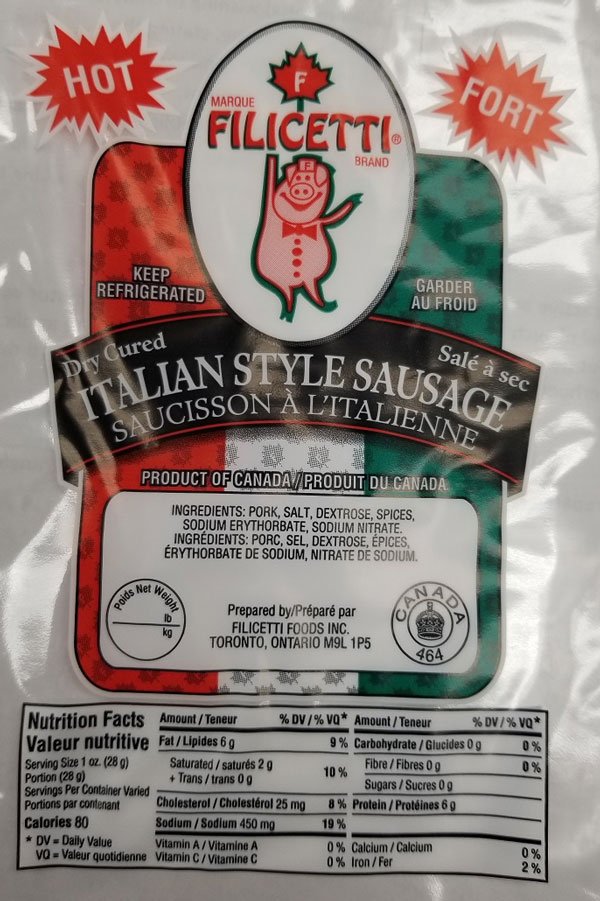
Filicetti Foods Inc. is recalling Filicetti brand Dry Cured Italian Style Sausage (hot) from the marketplace due to possible Salmonella contamination. Consumers should not consume the recalled product described below.

The following product has been sold in British Columbia, Ontario and Quebec.

Recalled product

Brand Product Size UPC Codes
Filicetti Dry Cured Italian Style Sausage (Hot ) Variable None 610

What you should do

If you think you became sick from consuming a recalled product, call your doctor.

Check to see if you have the recalled product in your home. Recalled products should be thrown out or returned to the store where they were purchased.

Food contaminated with Salmonella may not look or smell spoiled but can still make you sick. Young children, pregnant women, the elderly and people with weakened immune systems may contract serious and sometimes deadly infections. Healthy people may experience short-term symptoms such as fever, headache, vomiting, nausea, abdominal cramps and diarrhea. Long-term complications may include severe arthritis.

Background

This recall was triggered by CFIA food sampling activities following an investigation into a foodborne illness outbreak. The CFIA is conducting a food safety investigation, which may lead to the recall of other products. If other high-risk products are recalled, the CFIA will notify the public through updated Food Recall Warnings.

The CFIA is verifying that industry is removing the recalled product from the marketplace.

Illnesses

The Public Health Agency of Canada is investigating an outbreak of human illness. Please refer to the Public Health Notice for further details on this active outbreak investigation.

Product photos

Printer ready version of photos

  • Filicetti - Dry Cured Italian Style Sausage (Hot)

Research – Effect of Vacuum Packaging on Histamine Production in Japanese Spanish Mackerel (Scomberomorus niphonius) Stored at Various Temperatures

Journal of Food Protection

ABSTRACT

The effect of polyethylene packaging (PEP) in air cushion and vacuum packaging (VP) on histamine related to the quality of Japanese Spanish mackerel (JS mackerel) was studied with samples stored at −20, 4, 15, and 25°C. The aerobic plate count (APC), total volatile basic nitrogen (TVBN), and histamine concentrations of the PEP and VP samples stored at 25°C increased as the storage time continued. The PEP and VP samples stored at temperatures below 15°C showed lower levels of APC, TVBN, and histamine, with VP samples having considerably lower levels of APC, TVBN, and histamine than PEP samples. For the frozen JS mackerel stored at −20°C for 2 months and then thawed and stored at 25°C, the VP treatment delayed the increases of TVBN and histamine longer than did the PEP treatment. Thus, the storage of VP JS mackerel at temperatures below 4°C could prevent quality deterioration and extend shelf life.

HIGHLIGHTS
  • Lower APC, TVBN, and histamine were found in VP samples than PEP samples.

  • VP delayed TVBN, and histamine increased at 25°C in thawed JS mackerel.

  • VP JS mackerel below 4°C prevented quality deterioration and extended shelf life.

Research- Effect of natural microbiota on growth of Salmonella spp. in fresh pork – A predictive microbiology approach

Science Direct Salmonella kswfoodworld

Abstract

This study was undertaken to model and predict growth of Salmonella and the dominating natural microbiota, and their interaction in ground pork. Growth of Salmonella in sterile ground pork at constant temperatures between 4 °C and 38 °C was quantified and used for developing predictive models for lag time, max. specific growth rate and max. population density. Data from literature were used to develop growth models for the natural pork microbiota. Challenge tests at temperatures from 9.4 to 24.1 °C and with Salmonella inoculated in ground pork were used for evaluation of interaction models. The existing Jameson-effect and Lotka–Volterra species interaction models and a new expanded Jameson-effect model were evaluated. F-test indicated lack-of-fit for the classical Jameson-effect model at all of the tested temperatures and at 14.1–20.2 °C this was caused by continued growth of Salmonella after the natural microbiota had reached their max. population density. The new expanded Jameson-effect model and the Lotka–Volterra model performed better and appropriately described the continued but reduced growth of Salmonella after the natural microbiota had reached their max. population density. The expanded Jameson-effect model is a new and simple species interaction model, which performed as well as the more complex Lotka–Volterra model.

Highlights

► High concentrations of natural microbiota in raw pork reduced growth of Salmonella. ► This growth reducing effect was temperature dependent. ► A new expanded Jameson-effect model was introduced for description of this effect.