Category Archives: Microbiology Risk

Research – Hepatitis A outbreak in Australia linked to imported Medjool dates, June–September 202

Gov Au

Abstract

Imported, minimally processed food products have been historically associated with several hepati-tis A outbreaks in Australia. Here, we report the first known hepatitis A outbreak in Australia linked to consumption of imported fresh Medjool dates. Between June and September 2021, six genetically identical hepatitis A cases were notified in New South Wales and the Australian Capital Territory. All cases reported date consumption during their exposure period. The implicated dates were positive for hepatitis A virus (HAV) by reverse transcription polymerase chain reaction. Rapid detection of this outbreak and the swift implementation of control measures was facilitated by two key factors. Firstly, Australian international border closures implemented in response to the COVID-19 pan-demic meant that a common locally-acquired, as opposed to travel-acquired, source for cases was strongly suspected. Secondly, prompt awareness of a hepatitis A outbreak in the United Kingdom (which was found to be associated with date consumption) allowed for early hypothesis generation and investigation. This paper details the epidemiological and microbiological factors involved in this outbreak investigation and the actions taken to mitigate public health risk.

Research – Asymptomatic Carriage of Listeria monocytogenes by Animals and Humans and Its Impact on the Food Chain

MDPI

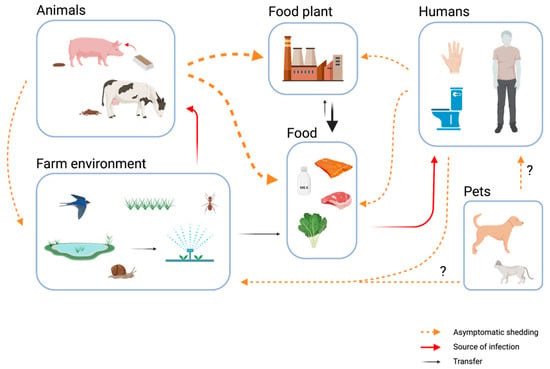
Humans and animals can become asymptomatic carriers of Listeria monocytogenes and introduce the pathogen into their environment with their feces. In turn, this environmental contamination can become the source of food- and feed-borne illnesses in humans and animals, with the food production chain representing a continuum between the farm environment and human populations that are susceptible to listeriosis. Here, we update a review from 2012 and summarize the current knowledge on the asymptomatic carrier statuses in humans and animals. The data on fecal shedding by species with an impact on the food chain are summarized, and the ways by which asymptomatic carriers contribute to the risk of listeriosis in humans and animals are reviewed. View Full-Text

Vietnam reports more food poisoning deaths in 10 months in 2022

English News

HANOI, Nov. 7 (Xinhua) — A total of 581 people in Vietnam suffered from food poisoning in the first 10 months of 2022, of whom 11 died, according to the country’s Preventive Health Department on Monday.

In the same period last year, as many as 1,519 people were affected by food poisoning, of whom five died.

CDC – Annual Reports on Foodborne Illness Source Attribution Estimates – 2020

CDC

Executive Summary

Each year in the United States, an estimated 9 million people get sick, 56,000 are hospitalized, and 1,300 die of foodborne disease caused by known pathogens. These estimates help us understand the scope of this public health problem. However, to develop effective prevention measures, we need to understand the types of foods contributing to the problem. The Interagency Food Safety Analytics Collaboration (IFSAC) is a tri-agency group created by the Centers for Disease Control and Prevention (CDC), the U.S. Food and Drug Administration (FDA), and the U.S. Department of Agriculture’s Food Safety and Inspection Service (USDA-FSIS). IFSAC developed a method to estimate the percentages of foodborne illness attributed to certain sources using outbreak data from 1998 through the most recent year for IFSAC’s priority pathogens: Salmonella, Escherichia coli O157, Listeria monocytogenes, and Campylobacter. IFSAC described this method and the estimates for 2012 in a report, in a peer-reviewed journal article, and at a public meeting. Unlike in prior IFSAC Annual Reports, attribution estimates for Campylobacter are not presented in this year’s report. Evidence suggests the sources of Campylobacter outbreaks likely differ considerably from the sources of non-outbreak-associated illnesses caused by this pathogen. IFSAC is exploring alternative approaches for estimating the sources ofCampylobacter illnesses.IFSAC derived the estimates for 2020 using the same method used for the previous estimates, with some modifications. The data came from 1,287 foodborne disease outbreaks that occurred from 1998 through 2020 and for which each confirmed or suspected implicated food was assigned to a single food category. The method relies most heavily on the most recent five years of outbreak data (2016 – 2020).

Foods are categorized using a scheme IFSAC created to classify foods into 17 categories that closely align with the U.S. food regulatory agencies’ classification needs.

Salmonella illnesses came from a wide variety of foods. More than 75% of Salmonella illnesses were attributed to seven food categories: Chicken, Fruits, Pork, Seeded Vegetables (such as tomatoes), Other Produce (such as fungi, herbs, nuts, and root vegetables), Beef, and Turkey.

E. coli O157illnesseswere most often linked to Vegetable Row Crops (such as leafy greens) and Beef. More than 80% of illnesses were linked to these two categories.

Listeria monocytogenes illnesses were most often linked to Dairy products, Fruits, and Vegetable Row Crops. More than 75% of illnesses were attributed to these three categories, but the rarity of Listeria monocytogenes outbreaks makes these estimates less reliable than those for other pathogens.

Click to access P19-2020-report-TriAgency-508.pdf

ILSI releases comprehensive new book on food safety 

Food Safety News

International Life Sciences Institute (ILSI) has announced its release of a new book, “Present Knowledge in Food Safety: A Risk-Based Approach Through the Food Chain,” which presents approaches for exposure-led risk assessment and management of food contamination at key stages of production. 

“The ILSI Federation is excited to support everyone — from students to experts — in these important fields to enhance their work and research for the public benefit,” said Stéphane Vidry, Ph.D., ILSI’s global executive director. “Bolstering food safety and public health is one of ILSI’s key values, and it’s alive and well in the publication of this new book.” 

The book aims to improve the reliability, predictability, and relevance of food safety assessments, as well as their communication challenges, to protect public health.

The book includes 72 chapters contributed by more than 110 authors. Conceptually modeled after ILSI’s book, “Present Knowledge in Nutrition,” this book provides coverage of new and emerging science in the risk assessment paradigm as applied to chemical, physical and microbiological safety issues. 

India- 16 IIIT-Srikakulam students fall sick, food poisoning suspected

New Indian Express

SRIKAKULAM: A large number of students, mostly girls, at IIIT-Srikakulam in Etcherla Mandal of the district were taken ill, reportedly due to food poisoning.

Though the incident had happened on Thursday night, it came the light on Saturday, after officials visited the campus. Immediately, 16 students, who needed better medical attention were shifted to RIMS Hospital in Srikakulam town.

District Collector Shrikesh B Latkar visited the IIIT campus on Saturday upon learning about the incident and ordered a probe into the incident.  Though the exact reason for the student’s illness was not ascertained, the students said that they fell ill after consuming half-cooked chapati and potato curry.

The campus officials have reportedly downplayed the incident, but the issue became public on Saturday when more and more students started falling ill and visited the health centre on the campus. Meanwhile, the health department organised a special medical camp on the IIIT campus and doctors will stay there for the next five days to monitor the situation.

Speaking to the TNIE, DMHO Dr BMeenakshi said, “Special medical team will stay on the campus for the next five days.  We have inspected the mess and collected the samples to ascertain the reason for the illness.”

Indai – 20 students fall ill due to food poisoning in Narayankhed

The Hans India

Narayankhed: In yet another case of food poisoning in the State government-run schools, around 20 students reportedly fell ill at a girls residential school located at Narayankhed on Saturday. The students are being treated at a government hospital in Narayankhed.


Philippines – One student dies, several others hospitalized due to food poisoning in Iloilo

MB

ILOILO CITY – One student died while several others were hospitalized due to food poisoning in Ajuy town in Iloilo province on Friday, Nov. 4.

Mayor Jett Rojas confirmed to the Manila Bulletin in a phone interview on Sunday, Nov. 6, the news on the death of a student and several others who were hospitalized allegedly after drinking spoiled buko juice during a school party on Friday, Nov. 4.

“We can now confirm this is food poisoning,” said Mayor Rojas in an interview with the Manila Bulletin.


Research – Ciguatera in Europe project granted follow-up

Food Safety News

A project looking at the surveillance and control of ciguatera poisoning in Europe has been given a second edition.

A launch meeting for EuroCigua II was attended this past week by representatives of 11 organizations involved in food safety and public health from five European countries.

Partners include the Spanish Institute of Agrifood Research and Technology (IRTA), Canary Islands Health Service (SCS), the French Agency for Food, Environmental and Occupational Health and Safety (ANSES), German Federal Institute for Risk Assessment (BfR), Portuguese Economic and Food Safety Authority (ASAE), and Dutch National Institute for Public Health and the Environment (RIVM).

Also participating in the three-year effort are the European Food Safety Authority (EFSA), the European Center for Disease Prevention and Control (ECDC), European Environment Agency of the European Commission, the United Nations Food and Agriculture Organization (FAO) and experts from research groups in the United States and Japan.

Research – Virulence Potential and Antibiotic Susceptibility of S. aureus Strains Isolated from Food Handlers

MDPI

Staphylococcus spp. are common members of the normal human flora. However, some Staphylococcus species are recognised as human pathogens due to the production of several virulence factors and enterotoxins that are particularly worrisome in food poisoning. Since many of Staphylococcal food poisoning outbreaks are typically associated with cross-contamination, the detection of S. aureus on food handlers was performed. Hand swabs from 167 food handlers were analysed for the presence of S. aureus. More than 11% of the samples were positive for S. aureus. All S. aureus strains were isolated and analysed for the presence of virulence and enterotoxin genes, namely, seasebsecsedsegseitsst-1 and pvl. The same strains were phenotypically characterised in terms of antibiotic susceptibility using the disc diffusion method and antimicrobial agents from 12 different classes. A low prevalence of antibiotic-resistant strains was found, with 55.6% of the strains being sensitive to all of the antimicrobial agents tested. However, a high prevalence of resistance to macrolides was found, with 44.4% of the strains showing resistance to erythromycin. At least one of the virulence or toxin genes was detected in 61.1% of the strains, and seg was the most prevalent toxin gene, being detected in 44.4% of the strains.