Category Archives: Microbiology Investigations

Research – Legionella pneumophila Risk from Air–Water Cooling Units Regarding Pipe Material and Type of Water

MDPI

Legionella A

Abstract

Legionellosis is a respiratory disease related to environmental health. There have been manifold studies of pipe materials, risk installations and legionellosis without considering the type of transferred water. The objective of this study was to determine the potential development of the causative agent Legionella pneumophila regarding air–water cooling units, legislative compliance, pipe material and type of water. Forty-four hotel units in Andalusia (Spain) were analysed with respect to compliance with Spanish health legislation for the prevention of legionellosis. The chi-square test was used to explain the relationship between material–water and legislative compliance, and a biplot of the first two factors was generated. Multiple correspondence analysis (MCA) was performed on the type of equipment, legislative compliance, pipe material and type of water, and graphs of cases were constructed by adding confidence ellipses by categories of the variables. Pipe material–type of water (p value = 0.29; p < 0.05) and legislative compliance were not associated (p value = 0.15; p < 0.05). Iron, stainless steel, and recycled and well water contributed the most to the biplot. MCA showed a global pattern in which lead, iron and polyethylene were well represented. Confidence ellipses around categories indicated significant differences among categories. Compliance with Spanish health legislation regarding the prevention and control of legionellosis linked to pipe material and type of water was not observed.
USA – FDA Core Outbreak Table – Update

FDA

What’s New

  • A new outbreak of hepatitis A virus infections (ref # 1143) linked to a not yet identified product has been added to the table. FDA has initiated traceback.
  • For the outbreak of Listeria monocytogenes (ref # 1123), FDA has initiated an onsite inspection, sample collection, and analysis. This investigation is ongoing and additional information will be provided as it become available.
  • The outbreak of Salmonella Typhimurium (ref # 1137) linked to alfalfa sprouts has ended and the FDA investigation is closed.

USA – Persistent Strain of E. coli O157:H7 (REPEXH01) Linked to Multiple Sources

CDC

REPEXH01

REPEXH01 is a persistent strain of Shiga toxin-producing E. coli O157:H7 bacteria that has caused illnesses and outbreaks in the United States.

Illness caused by this strain was first reported to PulseNet in 2017. Illnesses caused by this strain occur year-round but are less common in winter.

In the past, the REPEXH01 strain has spread to people through contaminated food and contaminated recreational water.

This strain is relatively diverse genetically. Bacteria in this strain are within 21 allele differences of one another by whole genome sequencing, which is more diverse than typical multistate foodborne outbreaks where bacteria generally fall within 10 allele differences of one another.

Identified outbreak sources*

*Confirmed sources were implicated by epidemiologic
plus traceback or laboratory data. Suspected sources
were implicated by epidemiologic data only. More info

  • Recreational water (confirmed): 1 outbreak
  • Romaine lettuce (confirmed): 1 outbreak
  • Leafy greens (suspected): 1 outbreak
  • Ground beef (suspected): 2 outbreaks

USA – Salmonella Outbreak Linked to Alfalfa Sprouts – Outbreak is Over

CDC

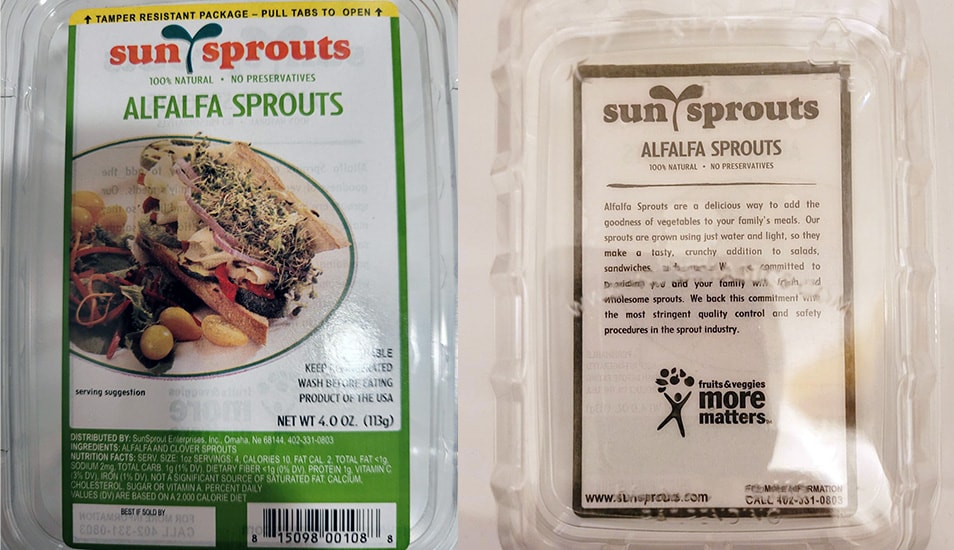
Front and back packaging of alfalfa sprouts in this outbreak

Fast Facts
  • Illnesses: 63
  • Hospitalizations: 10
  • Deaths: 0
  • States: 8
  • Recall: Yes
  • Investigation status: Closed
Outbreak Investigation Summary

Data showed that alfalfa sprouts made people in this outbreak sick.

  • Of the 50 people interviewed, 35 (70%) reported eating alfalfa sprouts.
  • Eight of the people who got sick in this outbreak confirmed they had purchased Sun Sprouts brand alfalfa sprouts from their local grocery store.

On December 29, 2022, SunSprout Enterprises recalled four lots of raw alfalfa sprouts.

USA – Florida – Salmonella Outbreak linked to Oysters

Food Poison Journal

The Florida Department of Health (DOH) and the state health departments of Georgia and Alabama have detected a Salmonella outbreak associated with the consumption of raw oysters harvested from shellfish harvesting area FL-3012 in Cedar Key, Florida. To date, there have been 8 cases linked to this outbreak within Florida, Georgia, and Alabama.

On February 24, 2023, the Florida Department of Agriculture and Consumer Services closed shellfish harvesting area FL-3012 for the harvest of wild oysters and initiated a recall of these wild oysters harvested from December 16, 2022, to February 24, 2023.

Research – Isolation of Salmonella species of public health concern from commonly fed dried meat dog treats

BVA Journals

Abstract

Background

Dried non-heat-treated meat treats, such as ears, skin and tails, are popular supplementary dog foods. Previous studies have demonstrated Salmonella spp. contamination on treats, particularly in pig ears and chicken products. This small, exploratory, cross-sectional study investigated Salmonella spp. presence in dried treats available in the UK.

Methods

A selection of dried treats from local pet shops and online retailers underwent bacterial culture for Salmonella spp. and subsequent antimicrobial susceptibility testing, with Salmonella serotype determined by whole genome sequencing.

Results

Eighty-four samples were tested, with 16% being Salmonella spp. positive. Five Salmonella serotypes were identified, each associated with specific treat types. An antimicrobial-resistant phenotype was identified in 39% of isolates. All serotypes identified are known to cause human infection.

Limitations

This study was limited by a small sample size and limited number of retail sources.

Conclusion

Salmonella spp. of public health concern were present in some dried dog treats in this study. Dog owners, pet food retailers and veterinary professionals should be aware of the potential zoonotic disease risk associated with these treats, and appropriate hygiene measures, including thorough hand washing, should be utilised if they are fed.

USA – FDA investigates cases of Legionnaires disease on cruise ships

Food Safety News

FDA Warning Letters

American Cruise Lines
Guilford, CT

American Cruise Lines is on notice from the Food and Drug Administration (FDA) after an inspection of their American Star and American Heritage vessels. According to the warning letter, the FDA continues to have concerns with the potential exposure of passengers and crew members to Legionella onboard American Cruise Lines’ vessels.

In Jan. 24, 2023, warning letter, the FDA described an April 30 through June 17, 2022, an inspection of American Cruise Lines’ American Star and American Heritage vessels.

The warning letter includes information about failed water tests for a sink in the galley and hand-washing sinks for wait staff. The FDA also found that disinfection was ineffective.

American Star
Presence of Legionella Onboard the Vessel

On April 30, 2022, FDA investigators collected 10 biofilm swabs and 14 bulk one-liter potable water samples from various locations on the vessel. The Maryland Department of Health laboratory recovered Legionella from:

Biofilm Swabs with 60 percent of samples positive:

American Heritage

Presence of Legionella Onboard the Vessel

On June 15, 2022, FDA investigators collected 24 biofilm swabs and 29 bulk one-liter potable water samples from various locations on their vessels. The Maryland Department of Health laboratory recovered Legionella from:

Biofilm Swabs with 8 percent of samples positive:

The Use of Ozone Technology: An Eco–Friendly Method for the Sanitization of the Dairy Supply Chain

MDPI

Abstract

The dairy field has considerable economic relevance in the agri-food system, but also has the need to develop new ‘green’ supply chain actions to ensure that sustainable products are in line with consumer requirements. In recent years, the dairy farming industry has generally improved in terms of equipment and product performance, but innovation must be linked to traditional product specifications. During cheese ripening, the storage areas and the direct contact of the cheese with the wood must be carefully managed because the proliferation of contaminating microorganisms, parasites, and insects increases significantly and product quality quickly declines, notably from a sensory level. The use of ozone (as gas or as ozonated water) can be effective for sanitizing air, water, and surfaces in contact with food, and its use can also be extended to the treatment of waste and process water. Ozone is easily generated and is eco-sustainable as it tends to disappear in a short time, leaving no residues of ozone. However, its oxidation potential can lead to the peroxidation of cheese polyunsaturated fatty acids. In this review we intend to investigate the use of ozone in the dairy sector, selecting the studies that have been most relevant over the last years.

Philippines – Dozens downed by food poisoning in Sulu

Manilla Times

ZAMBOANGA CITY: Dozens of villagers in the southern province of Sulu were rushed to hospital on suspicion of food poisoning after they consumed snacks given by soldiers, radio reports said.

Radio Pilipinas Jolo said at least 63 people, including 47 children, complained of dizziness and stomach ache after eating “ginataan” handed out by soldiers on Friday in the village of Tagbak in Indanan town.

The radio station also quoted Dr. Alhazer Siraji Ismael, of the Sulu Sanitarium Hospital, that most of the patients suffered from severe dehydration.

Ismael said six of the patients had to be monitored but the others were in stable condition.

Among those in the hospital were Girls Scout Executive Helen Hajan, and her daughter. The military did not issue any statement on the incident.

Switzerland – Swiss checks find microbially contaminated fruit salads

Food Safety News

Listeria and coagulase-positive Staphylococci have been found during inspections of fruit salads in Switzerland, according to the Swiss Association of Cantonal Chemists (ACCS).

Cantonal chemists analyzed the microbiological quality of fruit salads by taking 205 samples.

During the control, organized from May to September 2022, the samples of fruit salads were taken throughout Switzerland and Liechtenstein to check the microbial quality and for the presence of bacteria that could pose a health risk.

Food control is done by cantons, which carry out inspections and laboratory analyses with the help of cantonal chemists. Switzerland is made up of 26 regions called cantons.

Fruit salads can represent a health risk, particularly if storage temperatures and times are not adequate and products are intended for vulnerable people in retirement homes, nursing homes, or hospitals.

Targeted sampling looked at types of fruit more likely to be contaminated by bacteria such as low-acid fruits like melon or watermelon and followed criteria set in food legislation.