Category Archives: Microbiology Investigations

USA – Marine Biotoxin Management for Molluscan Shellfish Training Video

FDA

FDA developed a training video on marine biotoxin management to provide a better understanding of specific biotoxin concepts in the National Shellfish Sanitation Program (NSSP). The video has been updated and reflects the NSSP Guide for the Control of Molluscan Shellfish: 2019 Revision. The video, comprised of three learning modules, is a tool to help the seafood industry and state and federal agencies understand biotoxin sources and geographic distributions, develop or improve marine biotoxin management and contingency plans, and determine the appropriate laboratory methods for specific applications.

France – ANSES – A partnership to better fight against bacteria in food processing workshops

ANSES

The presence of Listeria and Salmonella bacteria in food processing workshops poses several problems: these bacteria that are pathogenic for humans are capable of persisting for a long time in the environment and of resisting treatment with biocidal products. The Actia Fastypers Joint Technological Unit (UMT) has just been created by the Ministry of Agriculture for five years, in order to work on these issues. It brings together research teams (Anses, Inrae) and agro-industrial technical institutes (Actalia – dairy sector and the Pork Institute (IFIP)).

Salmonella and Listeria are two bacteria of animal origin, responsible for illnesses in humans and transmitted by food. They can persist for several months in natural and agricultural environments, as well as in food processing workshops. In addition, some strains may be resistant to treatment with disinfection products. The work of the UMT Actia Fastypers aims on the one hand to understand the mechanisms by which these bacteria manage to adapt and persist in the external environment, including in agri-food workshops, and on the other hand to develop tools to characterize and detectthese persistent bacterial strains. This work will be carried out jointly in the pork sector and the milk sector.

Two ANSES teams involved

Two ANSES units will be involved in the UMT: the Salmonella and Listeria unit of the Food Safety Laboratory and the Antibiotics, Biocides, Residues and Resistance Unit of the Fougères Laboratory. The first will provide its expertise in the genomic characterization of strains, in order to identify which genotype is associated with the characteristics studied (resistance to heavy metals, persistence in the environment, virulence, etc.). The second will study the adaptation and resistance of bacteria to the biocidal cleaning products used. This work will be linked to the joint technological network Chlean, devoted to the hygiene of equipment in the food industry, in which the two laboratories are already involved.

Development of detection tools

The goal of the UMT is to develop tools that can be used routinely by producers and food manufacturers to identify the strains of bacteria present at the different stages of food production, from breeding to finished products. ” It’s about optimizing and simplifying the tools we have for research, to enable technical institutes to identify both the virulence and persistence capacity of strains simply by harvesting bacteria from surfaces. using sampling swabs. », explains Sophie Roussel, co-host of the UMT and scientist of the food safety laboratory. These analyzes aim toadapt the cleaning and disinfection process to the characteristics of the bacterial strains likely to be found in agro-industrial environments, for example by using the most effective disinfectant products against the bacteria present in these factories.

New Zealand – Shellfish biotoxin alerts

MPI

ALL WARNINGS ARE UP-TO-DATE

We review the warnings on this page following sampling, and update it when we find toxic shellfish.

If you have questions, email info@mpi.govt.nz

Current warnings

No warnings are in place.

Dates of recent warnings issued and removed
  • 20 January 2022: Grove Arm and Banks Peninsula warnings removed
  • 17 December 2021: Extended to entire Banks Peninsula warning issued
  • 15 December 2021: Akaroa Harbour warning issued
  • 24 November 2021: Marlborough Sounds warning issued
  • 16 June 2021: Hawke Bay warning removed

USA – DRAFT: Scombrotoxin (Histamine)-forming Fish and Fishery Products – Decomposition and Histamine (CPG 7108.24)

FDA

Submit Comments by 

Although you can comment on any guidance at any time (see 21 CFR 10.115(g)(5)), to ensure that the FDA considers your comment on a draft guidance before it begins work on the final version of the guidance, submit either online or written comments on the draft guidance before the close date.

If unable to submit comments online, please mail written comments to:

Dockets Management
Food and Drug Administration
5630 Fishers Lane, Rm 1061
Rockville, MD 20852

All written comments should be identified with this document’s docket number: FDA-2021-D-0367


Docket Number:
FDA-2021-D-0367
Issued by:
Office of Regulatory Affairs
Center for Food Safety and Applied Nutrition

The purpose of this compliance policy guide (CPG) is to provide guidance for FDA staff on adulteration associated with decomposition and/or histamine identified during surveillance sampling and testing of fish and fishery products susceptible to histamine formation.

The current CPG Sec. 540.525 is being revised to update FDA regulatory action guidance for sensory analysis and histamine levels in scombrotoxin-forming fish and fishery products.

The  contents of this document do not have the force and effect of law and are not meant to bind the public in any way, unless specifically incorporated into a contract.  This document is intended only to provide clarity to the public regarding existing requirements under the law.  FDA guidance documents, including this CPG, should be viewed only as recommendations, unless specific regulatory or statutory requirements are cited.  The use of the word should in FDA guidances means that something is suggested or recommended, but not required.

USA – Core Outbreak Table Update

FDA

Date
Posted
Reference
#
Pathogen
Product(s)
Linked to
Illnesses

(if any)
Investigation
Status
1/10/

2022

1050 E. coli
O121:H19
Not Yet
Identified
Active
12/29/

2021

1052 E. coli
O157:H7
Packaged Salad Active
12/20/

2021

1039 Listeria
monocytogenes
Packaged Salad Active
12/15/

2021

1048 Listeria
monocytogenes
Packaged Salad Active
9/15/

2021

1031 Salmonella
Oranienburg
Red, Yellow,
and White Onions
Active

USA – What you need to know about Hepatitis A during an outbreak


Food Poison Journal

According to Philadelphia news reports, a third person has died from an outbreak of hepatitis A in Montgomery County, Pennsylvania, health officials say.

Montgomery County officials are investigating Gino’s restaurant in West Norriton to determine if it is linked to the outbreak.

The Montgomery County Public Health Office closed the restaurant Jan. 7, but Gino’s has not been confirmed as the source of the outbreak.

More than 12 cases of hepatitis A are currently under investigation and seven people remain in hospital.

Ukraine – Botulism in Ukraine 2021: 98 cases, 10 deaths

Outbreak News Today

CDC Clost Spore

The Ukraine Ministry of Health reported 88 outbreaks of botulism in 2021, as a result of which 98 people became ill, including three children. Ten cases were fatal.

79 patients were given anti-botulinum serum.

This compares to 2020 when Ukraine reported 65 cases and four deaths.

In 2021, cases of botulism were registered in all regions of Ukraine, except Zakarpattia, Luhansk and Mykolaiv regions. The highest number of cases was registered in Volyn oblast – 9, eight cases were recorded in Zhytomyr, Lviv and Chernihiv oblasts and seven cases were reported in Cherkasy oblast.

The main causes of botulism food poisoning were the consumption of dried / salted / dried freshwater fish of home cooking or of unknown origin, which was purchased on the natural markets (30 cases – 30.6%), canned home-cooked meat (30 cases – 30.6%) .

Food borne botulism is a severe intoxication caused by eating the preformed toxin present in contaminated food.

USA – FDA Issues Report Highlighting Salmonella Outbreak in Packaged Leafy Greens Produced in a Controlled Environment Agriculture Operation

FDA

Vegetable Bacteria Danger

The U.S. Food and Drug Administration (FDA) has released a report on its investigation of the Salmonella Typhimurium outbreak that caused 31 reported illnesses and four hospitalizations in the U.S. between June and August 2021. The FDA worked with the U.S. Centers for Disease Control and Prevention (CDC) and state partners to investigate the outbreak, which was linked through epidemiology and traceback to packaged salad greens during the summer of 2021. This outbreak is believed to be FDA’s first domestic investigation of a foodborne illness outbreak associated with leafy greens grown in a Controlled Environment Agriculture (CEA) operation. The CEA operation produces leafy greens using common commercial high density hydroponic growing techniques with deep water culture and floating raft production methods. The report released today includes an overview of the traceback investigation, investigation results, and various factors that potentially contributed to the contamination of packaged leafy greens with Salmonella.

Although a conclusive root cause was not identified, the agency identified certain conditions and practices that could result in contamination, including the presence of a different serotype of Salmonella in pond water used to grow the leafy greens, growth media storage practices, water management practices, and general sanitation practices at the CEA that were inadequate to prevent the introduction or spread of microorganisms of public health significance into the leafy greens.

FDA isolated the outbreak strain of Salmonella Typhimurium in a stormwater retention basin adjacent to the CEA farm. However, the investigation did not reveal if that stormwater retention basin was the source of the Salmonella that ultimately contaminated the leafy greens. This highlights the importance of assessing all microbial hazards, including those associated with adjacent and nearby land uses.

In light of this report, FDA highlights the following requirements and recommendations applicable to firms, such as the hydroponic operation implicated in this S. Typhimurium outbreak, engaged in CEA. Here are some of the requirements and recommendations:

  • Develop a keen understanding of potential sources and routes of contamination including the raw materials and inputs used, as well as possible sources of contamination throughout the operation.
  • Implement effective sanitation procedures and sampling plans while also paying close attention to hygienic operations and equipment design, ensuring cleaning procedures do not contribute to the dispersion of microbial contaminants that may be present.
  • Assess growing operations to ensure implementation of appropriate science- and risk-based preventive measures, including applicable required provisions of the FDA Food Safety Modernization Act (FSMA) Produce Safety Rule and good agricultural practices (GAPs).
  • Implement procedures that are effective in rapidly cooling and cold holding harvested leafy greens after harvest and verify the effectiveness of the cooling and cold holding procedures, including the routine monitoring of processing and storage environments and product temperatures to prevent pathogen growth in harvested leafy greens.
  • If employing tools such as pre-harvest and post-harvest sampling and testing of food, water, and the physical environment, seek to identify and inform sampling plans, limits of detection, and mitigation measures that control potential sources and routes of bacterial contamination in the growing and harvesting environment.
  • Ensure that all growing pond water is safe and of adequate sanitary quality for its intended use, which includes implementing measures (such as water treatment) necessary to reduce the potential for contamination by known or reasonably foreseeable hazards.
  • Perform a root cause analysis when a pathogen is identified in the growing environment, in raw agricultural inputs such as water, or in the agricultural commodity to determine how the contamination likely occurred and implement appropriate prevention and verification measures.
  • Assess and mitigate risks associated with adjacent and nearby land uses that may impact CEA operations, in both rural and more urbanized settings.

These requirements and recommendations are just some examples that serve as a reminder that as the use of CEA is increasing globally, all types of food production must continue to address basic food safety concerns, including potential sources and routes of contamination. Food safety is a shared responsibility that involves food producers, distributors, manufacturers, retailers, and regulators. Recognizing the interconnection between people, animals, plants, and their shared environment when it comes to public health outcomes, we encourage collaboration among various groups in the broader agricultural community (i.e., produce growers, state government and academia) to address this issue. The FDA is committed to working with these stakeholders to advance critical work.

For More Information:

USA – Lohxa LLC Issues Voluntary Nationwide Recall of Senna Syrup 8.8mg/5mL Due to Microbial Contamination

FDA

UPC code, Senna Syrup

FOR IMMEDIATE RELEASE – 01/11/2022 – Worcester, MA. Lohxa LLC is voluntarily recalling one lot of Senna Syrup 8.8mg/5mL, unit-dose cups to the consumer level. The product is being recalled due to microbial contamination.

Use of contaminated product by the elderly, patients with a weakened immune system, or patients at a higher risk of developing life-threatening inflammation of the heart, could result in infections that could be life-threatening. To date, Lohxa LLC has not received any reports of adverse events related to this recall.

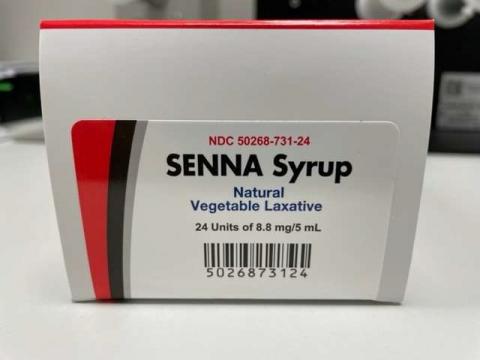
The product is used as a natural vegetable laxative for the relief of occasional constipation and is packaged into 5 mL unit-dose cups. The product is distributed into cases of 20 cartons packaged with 24 units each, NDC: 50268-731-24. The affected Senna Syrup 8.8mg/5mL lot is AM1115S with expiration date of 01/2023. The product can be identified by the label below. Product was distributed to AvKare (Wholesaler) who may have further distributed this to clinics, hospitals, and healthcare providers.

Outer carton labeling (see images below)

Unit-Dose Cups (see image below)

Lohxa LLC is notifying its distributors and customers by letter and is arranging for return of all recalled products. Consumers/distributors/retailers that have product which is being recalled should stop using the product and return it to place of purchase.

Consumers with questions regarding this recall can contact Lohxa LLC by 800-641-5564 or by email to info@lohxa.com Monday-Friday from 9am-5pm EST. Consumers should contact their physician or healthcare provider if they have experienced any problems that may be related to taking or using this drug product.

Adverse reactions or quality problems experienced with the use of this product may be reported to the FDA’s MedWatch Adverse Event Reporting program either online, by regular mail or by fax.

  • Complete and submit the report Online
  • Regular Mail or Fax: Download form or call 1- 800-332-1088 to request a reporting form, then complete and return to the address on the pre-addressed form, or submit by fax to 1-800-FDA-0178

This recall is being conducted with the knowledge of the U.S. Food and Drug Administration.


Company Contact Information

Consumers:
Lohxa LLC
 800-641-5564
 info@lohxa.com

Australia – Saputo Dairy Australia Pty Ltd Butter and Spreadable Butter Blend Products – Microbial Contamination

FSANZ

Product information

Saputo Dairy Australia Pty Ltd is conducting a recall of various butter and spreadable butter blend products. The products have been available for sale nationally at various outlets including Woolworths, Coles, ALDI, independent supermarkets and Costco.

Problem

The recall is due to a potential microbial contamination.

Food safety hazard

Food products with a microbial contamination may cause illness if consumed.

Country of origin

Australia

What to do​

Consumers should not eat these products. Any consumers concerned about their health​ should seek medical advice. Consumers should return the products to the place of purchase for a full refund.

For further information please contact:

Saputo Dairy Australia customer service team

1800 032 479

Related links: