Category Archives: Microbiological Risk Assessment

RASFF Alert – Animal Feed – Enterobacteriaceae -Sheep Meal

RASFF

Enterobacteriaceae in sheep meal from New Zealand in Belgium

Research – High Occurrence of Shiga Toxin-Producing Escherichia coli in Raw Meat-Based Diets for Companion Animals—A Public Health Issue

MDPI

Feeding pets raw meat-based diets (RMBDs) is becoming increasingly popular but comes with a risk of pathogenic bacteria, including Shiga toxin-producing Escherichia coli (STEC). In humans, STEC may cause gastrointestinal illnesses, including diarrhea, hemorrhagic colitis (HC), and the hemolytic uremic syndrome (HUS). The aim of this study was to evaluate commercially available RMBDs with regard to the occurrence of STEC. Of 59 RMBD samples, 59% tested positive by real-time PCR for the presence of Shiga toxin genes stx1 and/or stx2. STECs were recovered from 41% of the 59 samples, and strains were subjected to serotyping and virulence gene profiling, using whole genome sequencing (WGS)-based methods. Of 28 strains, 29% carried stx2a or stx2d, which are linked to STEC with high pathogenic potential. Twenty different serotypes were identified, including STEC O26:H11, O91:H10, O91:H14, O145:H28, O146:H21, and O146:H28, which are within the most common non-O157 serogroups associated with human STEC-related illnesses worldwide. Considering the low infectious dose and potential severity of disease manifestations, the high occurrence of STEC in RMBDs poses an important health risk for persons handling raw pet food and persons with close contact to pets fed on RMBDs, and is of concern in the field of public health. View Full-Text

Research – Yersinia enterocolitica Outbreak Associated with Pasteurized Milk

Mary Ann Liebert

In July 2019, we investigated a cluster of Yersinia enterocolitica cases affecting a youth summer camp and nearby community in northeastern Pennsylvania. After initial telephone interviews with camp owners and community members, we identified pasteurized milk from a small dairy conducting on-site pasteurization, Dairy A, as a shared exposure. We conducted site visits at the camp and Dairy A where we collected milk and other samples. Samples were cultured for Y. enterocolitica. Clinical and nonclinical isolates were compared using molecular subtyping. We performed case finding, conducted telephone interviews for community cases, and conducted a cohort study among adult camp staff by administering an online questionnaire. In total, we identified 109 Y. enterocolitica cases. Consumption of Dairy A milk was known for 37 (34%); of these, Dairy A milk was consumed by 31 (84%). Dairy A had shipped 214 gallons of pasteurized milk in 5 weekly shipments to the camp by mid-July. Dairy A milk was the only shared exposure identified between the camp and community. Y. enterocolitica was isolated from Dairy A unpasteurized milk samples. Five clinical isolates from camp members, two clinical isolates from community members, and nine isolates from unpasteurized milk were indistinguishable by whole-genome sequencing. The risk for yersinosis among camp staff who drank Dairy A milk was 5.3 times the risk for those who did not (95% confidence interval: 1.6–17.3). Because Dairy A only sold pasteurized milk, pasteurized milk was considered the outbreak source. We recommend governmental agencies and small dairies conducting on-site pasteurization collaborate to develop outbreak prevention strategies.

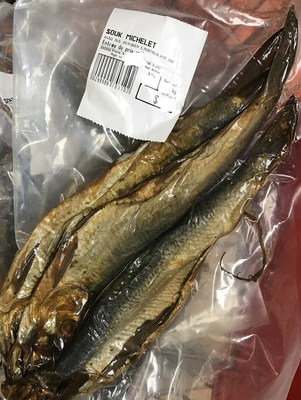
Canada – Notice not to consume smoked fish packaged and sold by Souk Michelet

MAPAQ

WARNING TO THE POPULATION

QUEBEC, July 20. 2021 / CNW Telbec / – The Ministry of Agriculture, Fisheries and Food (MAPAQ), in collaboration with the Food Inspection Department of the City of Montreal and the company Souk Michelet, located at 6450 , rue Beaubien Est, in Montreal, is warning the public not to consume the product indicated in the table below, because it has not been prepared and packaged in such a way as to ensure its safety.

Product name

Format

Targeted lot

“Souk Michelet, smoked fish”

Variable

Units sold until July 19, 2021

The product that is the subject of this warning was offered for sale until July 19, 2021 inclusive, and only at the establishment designated above. It was packaged in transparent bags, under vacuum, and sold refrigerated. The product label includes the words “Souk Michelet”.

The operator is voluntarily recalling the product in question. He agreed with the MAPAQ and the Food Inspection Department of the City of Montreal to disseminate this warning as a precautionary measure. People who have this product in their possession are advised not to consume it. They must either return it to the establishment where they bought it or throw it away. Even if the affected product does not show any signs of spoilage or a suspicious odor, consuming it may represent a health risk. It should be noted that no case of illness associated with the consumption of this food has been reported to MAPAQ so far.

Additional information

The Ministry publishes various information documents concerning food safety. Those interested can consult them in the “Food consumption” section of the MAPAQ website: www.mapaq.gouv.qc.ca/consommation . They also have the option of registering online, by visiting www.mapaq.gouv.qc.ca/rappelsaliments , to receive, by email, the food recall releases published by the Department. Finally, it is possible to follow “MAPAQaliments” on Twitter at the following address: www.twitter.com/MAPAQaliments .

Smoked fish (CNW Group / Ministry of Agriculture, Fisheries and Food) This link will open in a new window.

Smoked fish (CNW Group / Ministry of Agriculture, Fisheries and Food) This link will open in a new window.

Risk  classification : class 1

Item number:  4372

Research – FAO and the Republic of Korea join forces to reduce foodborne antimicrobial resistance

FAO

The Food and Agriculture Organization of the United Nations (FAO) and the Republic of Korea, through its Ministry of Food and Drug Safety (MFDS), today signed a new Framework Arrangement which establishes overarching terms and conditions that will govern the cooperation through voluntary contributions and facilitate future negotiations between MFDS and FAO.

The Arrangement focuses on food safety and standard setting, and contains a Contribution Arrangement which will help to simplify the implementation of individual projects.

The Republic of Korea will provide $10 million to help implement and monitor Codex Alimentarius international food standards, with the goal of containing and reducing foodborne antimicrobial resistance (AMR). AMR not only poses a major threat to human and animal health, but also has serious implications for food safety, food security and the economic wellbeing of millions of farming households.

The first project under the Arrangement will be implemented by the Joint FAO/WHO Centre on CODEX Food Standards and Zoonotic Diseases the FAO Division on Food Systems and Food Safety, and will focus on implementing Codex standards to support containment and reduction of foodborne AMR in six countries: Cambodia, Mongolia, Pakistan, Nepal, Bolivia and Colombia.

Signing on behalf of FAO, Deputy Director-General, Beth Bechdol, praised the Republic of Korea’s continuous interest and effort to increase cooperation with FAO and its deep commitment for the development of international food standards and to the Codex Alimentarius. “The COVID-19 pandemic has shown us how important it is to boost international food safety standards to ensure our food keeps travelling safely across borders, safeguarding food and nutritional security. We must transform our agri-food systems to make them more resilient and inclusive if we are to ensure a better food future for all.”

Since joining FAO as a recipient country in 1949, the Republic of Korea has transformed into a major G-20 economy and a dedicated FAO resource partner. The country is a long-standing Member and strong supporter of the Codex Alimentarius Commission, which sets international and regional standards, guidelines and codes of practice. The broad scope of Codex, which covers areas such as contaminants, nutrition, food hygiene, additives, antimicrobial resistance and pesticide and veterinary drug residues, makes it an essential tool to achieve food security and end hunger.

Jinseok Kim, Vice Minister of the MFDS welcomed the new Arrangement as a way to streamline and enhance the long-lasting cooperation between FAO and the Republic of Korea, and, in the years to come, as a basis for both parties to increase interventions within their joint areas of interest.

“Without global collaboration, we cannot overcome the difficulties due to the pandemic and I believe this is why we are here today: to work together,” Vice Minister Kim affirmed. “It is our responsibility to support other countries, and the most effective way to do this is through FAO, the key player in food safety in the UN.  It is essential to continue to move forward, and as of today Korea would like to play a leading role in world food safety.”

The Republic of Korea currently hosts the Codex ad hoc Intergovernmental Task Force on Antimicrobial Resistance (TFAMR), which is charged with developing science-based guidance on the management of foodborne antimicrobial resistance. The TFAMR is expected to complete its work in 2021.

In addition to hosting the TFAMR and supporting international standard development, the Republic of Korea leads by example in its own efforts to minimize and contain AMR in the food chain, and has expressed a desire to assist other countries in addressing AMR, by supporting the transition from standard-setting to the implementation of Codex guidance, with the collaboration and support of FAO.

Research Australia – Campylobacter, Salmonella at record highs in Australia

Food Safety News

Record levels of Campylobacter and Salmonella have been recorded in Australia, according to the annual surveillance report of notifiable diseases for 2016.

The data comes from a study published in the most recent edition of the Communicable Diseases Intelligence journal that also found E. coli, Listeria and Cryptosporidium infections had risen.

The role of disease surveillance includes identifying national trends, providing guidance for policy development and resource allocation and informing the response to outbreaks, according to the researchers.

In 2016, gastrointestinal diseases made up 15 percent of total reports for communicable diseases. Notified cases increased by 10 percent to 49,885 in 2016 compared to 2015.

Germany – Legionnaires’ disease sickens five, kills 2 in Heilbronn

Outbreak News Today

CDC legionella

In Heilbronn District, in northern Baden-Württemberg, Germany, it is reported that five men and women have contracted Legionnaires’ disease and two have died.

The patients came from Obersulm, Ellhofen, Weinsberg and Löwenstein, health officials announced. Most of them are middle-aged and older men. The two deceased men had a previous illness and were 49 and 81 years old.

Health authorities are feverishly looking for the source of the contamination.

Experts from the Heilbronn health department are not assuming that contaminated drinking water is the cause of the infections. The sick lived in different places, there are several water suppliers. “The surrounding sewage treatment plants were also sampled,” said a spokeswoman for the dpa office. “We assume that the cause can be found in an evaporative cooling system.” The health department fears that there may be more cases.

Switzerland – Seismo Info 07/2021 – Food Safety Information

Click to access Seismo_Info_Aktuell_EN.pdf

Research – Microbiological Quality of Nuts, Dried and Candied Fruits, Including the Prevalence of Cronobacter spp.

MDPI

Cronobacter genus bacteria are food-borne pathogens. Foods contaminated with Cronobacter spp. may pose a risk to infants or immunocompromised adults. The aim of this study was to determine the microbiological quality of nuts, seeds and dried fruits with special emphasis on the occurrence of Cronobacter spp. Analyses were carried out on 64 samples of commercial nuts (20 samples), dried fruits (24), candied fruits (8), seeds (4), and mixes of seeds, dried fruits and nuts (8). The samples were tested for the total plate count of bacteria (TPC), counts of yeasts and molds, and the occurrence of Cronobacter spp. Cronobacter isolates were identified and differentiated by PCR-RFLP (Polymerase Chain Reaction – Restriction Fragments Length Polymorphism) and RAPD-PCR (Random Amplified Polymorphic DNA by PCR) analysis. TPC, and yeasts and molds were not detected in 0.1 g of 23.4%, 89.1%, and 32.8% of the analyzed samples. In the remaining samples, TPC were in the range of 1.2–5.3 log CFU g−1. The presence/absence of Cronobacter species was detected in 12 (18.8%) samples of: nuts (10 samples), and mixes (2 samples). The 12 strains of Cronobacter spp. included: C. sakazakii (3 strains), C. malonaticus (5), and C. turicensis (4). The results of this study contribute to the determination of the presence and species identification of Cronobacter spp. in products of plant origin intended for direct consumption. View Full-Text

Italy – INDOPACIFIC SHELLED SHRIMP CODE INDIVIDUALLY FROZEN (Metapenaeus Affinis) – Incorrect Shelf Life

Salute

Brand : IMPORTED BY DI BATTISTA FOOD SRL – VIA COLLE DELLA FONTE 45 66030 FRISA (CH)

Name : INDOPACIFIC SHELLED SHRIMP CODE INDIVIDUALLY FROZEN (Metapenaeus Affinis)

Reason for reporting : Recall due to microbiological risk

Publication date : 16 July 2021

Click to access C_17_PubblicazioneRichiami_1254_azione_itemAzione0_files_itemFiles0_fileAzione.pdf