Category Archives: Microbiological Risk Assessment

Research – Understanding and predicting food safety risks posed by wild birds

Centre For Produce Safety

Summary

Click to access SHARIAT_%20FINAL.pdf

Co-existence of fresh produce with animal agriculture has come under increased scrutiny, given multiple recent outbreaks where pathogen strains on produce have been linked to livestock. An important consideration in this co-existence is understanding how pathogens are vectored from animals and their environments to fresh produce. This proposal centers on understanding the risks posed by wild birds and how their fecal pathogen content is influenced by nearby animal agriculture. Previous studies examining wild birds have been focused in the western US, where ‘cattle is king’ in terms of animal agriculture. The southeast has a $4 billion fresh produce and nut industry and, while also having beef and dairy cattle, in this region, ‘poultry is king.’ Campylobacter and Salmonella are the top bacterial causes of foodborne illness in the US, are frequently isolated from food animals, and have been linked to outbreaks in fresh produce. This study will examine the role of poultry and cattle in influencing the pathogens deposited onto fresh produce by wild birds. Mapping and modeling technologies will be implemented to develop risk profiles resulting from links between integrated/proximal animal agriculture and wild bird feces containing viable pathogens that are deposited on produce foliage. High-resolution molecular tools will be used to generate pathogen population profiles and, alongside genomic analyses, will be used to attribute pathogen source to zoonotic reservoirs associated with animal agriculture.

Technical Abstract

There is abundant evidence that wildlife often carries potential foodborne pathogenic bacteria. Indeed, wildlife sources have been associated with several outbreaks, leading to calls to remove natural habitats from farms to discourage wildlife visits. Thus, it was surprising that a recent study found that the likelihood of produce contamination actually increased, rather than decreased, in leafy greens fields where natural habitats had been removed (31). Consistent with this, we found that wild bird feces collected from broccoli were more likely to carry Campylobacter when those fields were surrounded by intensified livestock and crop production, rather than more-natural habitats (52). Pathogens were associated with invasive starlings and house sparrows, known to frequent feedlots and other high-density livestock areas, but also with many native birds (e.g., American robins) that also are associated with pastures and cropping fields. Altogether, work to-date suggests three interacting links between wild bird-associated food safety problems: (i) intensive livestock production that provides a pathogen reservoir, (ii) heavily farmed landscapes that support large numbers of invasive birds, and (iii) simple on-farm habitats that draw livestock-associated birds to a particular field. However, thus far these links have been drawn from circumstantial, rather than direct, evidence of pathogen movement. This limits the ability of fresh produce growers to definitively assess food safety risks associated based on local and regional land-use patterns, or to manipulate on-farm habitats to mediate these risks.

Fortunately, recent advances in pathogen tracking, using fine-scale genetic differences in pathogen genomes, is providing a means to directly separate different animal agriculture, wildlife, and environmental pathogen sources. For example, Salmonella Typhimurium isolates have been attributed to different zoonotic sources based on their genome sequences (59). PI Shariat has been a leader in using next-generation sequencing approaches to assess pathogen populations, having developed CRISPR-SeroSeq as a tool to produce high-resolution population profiles of Salmonella serotypes. Here, we propose to definitively establish links between livestock/poultry pathogen reservoirs and pathogens in bird feces on produce foliage growing in the field. We will also examine how likely pathogens in bird feces are to move from deposition points to surrounding produce and plants. We propose two primary research objectives focusing on bird fecal samples collected directly from the fields of our cooperating growers: In Obj. 1 we will assess the risk posed by wild bird feces on fresh produce plants and the influence of proximal animal agriculture on pathogen presence in wild bird feces. In Obj. 2, we will determine the diversity, not just the dominant species or serotype, of Campylobacter and Salmonella in bird feces and perform fine-scale tracking and source attribution using whole genome sequencing. Both of these research objectives will be directly paired with outreach products/strategies that move our findings directly to the hands of growers, processors, and others in the industry that critically need this information. Altogether, we seek to provide produce growers with the science-based knowledge and tools to assess the risk that wild birds pose to food safety on their farms, based on farm-specific local and landscape farming practices.

Research – Investigating the Campylobacter enteritis winter peak in Germany, 2018/2019

Nature.com

Campylobacter kswfoodworld

Surveillance of notified Campylobacter enteritis in Germany revealed a recurrent annual increase of cases with disease onset several days after the Christmas and New Year holidays (“winter peak”). We suspected that handling and consumption of chicken meat during fondue and raclette grill meals on the holidays were associated with winter peak Campylobacter infections. The hypothesis was investigated in a case–control study with a case-case design where notified Campylobacter enteritis cases served as case-patients as well as control-patients, depending on their date of disease onset (case-patients: 25/12/2018 to 08/01/2019; control-patients: any other date between 30/11/2018 and 28/02/2019). The study was conducted as an online survey from 21/01/2019 to 18/03/2019. Adjusted odds ratios (aOR) were determined in single-variable logistic regression analyses adjusted for age group and sex. We analysed 182 data sets from case-patients and 260 from control-patients and found associations of Campylobacter infections after the holidays with meat fondue (aOR 2.2; 95% confidence interval (CI) 1.2–3.8) and raclette grill meals with meat (aOR 1.5; 95% CI 1.0–2.4) consumed on the holidays. The associations were stronger when chicken meat was served at these meals (fondue with chicken meat: aOR 2.7; 95% CI 1.4–5.5; raclette grill meal with chicken meat: aOR 2.3; 95% CI 1.3–4.1). The results confirmed our initial hypothesis. To prevent Campylobacter winter peak cases in the future, consumers should be made more aware of the risks of a Campylobacter infection when handling raw meat, in particular chicken, during fondue or raclette grill meals on the holidays.

RASFF Alert- Animal Feed – Salmonella – Raw Petfood

RASFF

Salmonella Typhimurium in raw petfood from the Netherlands in Belgium

Denmark – Denmark searches for source of new E. coli outbreak (EIEC)

Food Safety News

Denmark is investigating an increase in the number of registered cases of a type of E. coli reported in the past month.

Enteroinvasive E. coli (EIEC) is usually associated with travel diarrhea but the patients in the current outbreak have not been abroad, which suggests a common food may have made people sick, according to the Statens Serum Institut (SSI).

Between Nov. 23 and Dec. 16, 63 infected people with EIEC or ipaH-positive were registered at the Statens Serum Institut and 18 of them have been hospitalized.

EIEC was isolated from 22 patients and the remaining 41 are PCR positive for the invasion plasmid antigen H (ipaH) gene, which is specific to Shigella species and EIEC.

Patients live all over the country, and there are 43 women and 20 men sick. They are aged from 1 to 91 years old with a median age of 53.

Hovedstaden has the most cases with 23, Sjælland has 19, Midtjylland has 14 and seven live in Syddanmark.

The Statens Serum Institut, Danish Veterinary and Food Administration (Fødevarestyrelsen) and DTU Food Institute are trying to find the source of infection.

USA – FDA Core Outbreak Table – 5 Active Outbreaks

FDA

Date
Posted
Reference
#
Pathogen
Product(s)
Linked to
Illnesses

(if any)
12/20/2021 1039 Listeria
monocytogenes
Packaged Salad
12/15/2021 1048 Listeria
monocytogenes
Packaged Salad
11/24/2021 1044 Salmonella Javiana Not Yet
Identified
11/17/2021 1043 E. coli
O157:H7
Spinach

USA – Outbreak Investigation of Listeria monocytogenes: Dole Packaged Salad (December 2021)

FDA

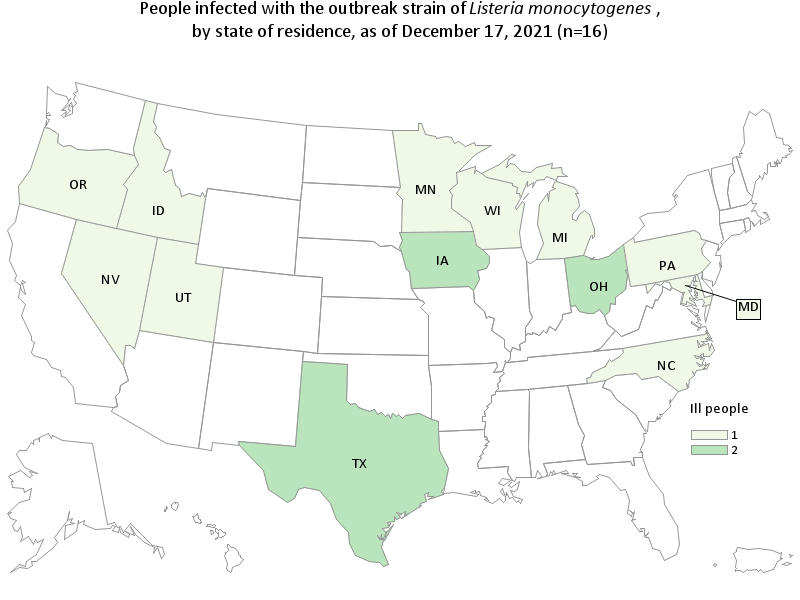
The FDA, along with CDC and state and local partners, is investigating a multistate outbreak of Listeria monocytogenes infections potentially linked to Dole packaged leafy greens. According to the CDC, as of December 22, 2021, 16 people infected with the outbreak strain of Listeria monocytogenes have been reported from 13 states. Illnesses started on dates ranging from August 16, 2014 to October 17, 2021 (one case occurred in 2014 and the remaining cases occurred between 2018 and 2021).

CDC investigated this outbreak in 2019 and 2020 but was unable to gather enough data to identify the source in the past. CDC reopened the investigation in November 2021 when four new illnesses were reported since the end of August.

In October 2021, as a part of routine retail sampling, the Georgia Department of Agriculture collected a product sample of prepackaged salad mix from a grocery store for testing. The sample tested positive for Listeria monocytogenes. In response to the sample results, Dole initiated a recall of packaged garden salads in October 2021. These products are now past their “Best if Used By” dates. The positive sample was later sent for whole genome sequencing (WGS) analysis; and in December 2021, WGS analysis was completed. The results show that the Listeria monocytogenes in the product sample was a match to the outbreak strain. FDA is conducting an inspection at the facility that produced the product that tested positive for Listeria monocytogenes.

The Michigan Department of Agriculture and Rural Development also recently initiated retail sampling of Dole products in their state as part of this investigation. One product containing lettuce from the Dole facility in Yuma, AZ, tested positive for Listeria monocytogenes. WGS analysis showed that the Listeria monocytogenes in the product sample is also a match to the outbreak strain.

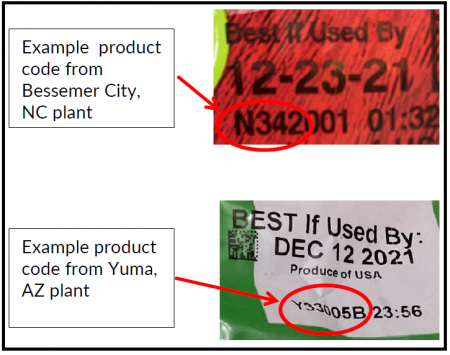
In response to the sample analyses and the ongoing outbreak investigation, Dole has agreed to voluntarily suspend operations at both the Bessemer City, NC, facility and Yuma, AZ, facility and has voluntarily recalled all products and brands from those facilities. Those products have production lot codes beginning with either the letter “N” or “Y” in the upper right-hand corner of the package and Best if Used By dates from November 30, 2021 to January 8, 2022.

This recall does not include whole head packaged lettuce. A full list of recalled products is available on FDA’s website.

This investigation is ongoing, and additional information will be provided as it becomes available.

Recommendation

Consumers, restaurants, and retailers, should not eat, sell, or serve recalled Dole packaged salads. A full list of recalled products is available on FDA’s website.

FDA recommends that anyone who received recalled products use extra vigilance in cleaning and sanitizing any surfaces and containers that may have come in contact with these products to reduce the risk of cross-contamination. Listeria can survive at refrigeration temperatures and can easily spread to other foods and surfaces.

Recall Information

In response to the sample analyses and the ongoing outbreak investigation, Dole has agreed to voluntarily suspend operations at both the Bessemer City, NC, facility and Yuma, AZ, facility and has voluntarily recalled all products and brands from those facilities. Those products have production lot codes beginning with either the letter “N” or “Y” in the upper right-hand corner of the package and Best if Used By dates from November 30, 2021 to January 8, 2022.

This recall does not include whole head packaged lettuce.

The following images are of example labels from recalled products highlighting where to find product codes. View a full list of recalled products

Outbreak Investigation of Listeria monocytogenes from Dole Packaged Salad - Sample Product Codes (December 22, 2021)

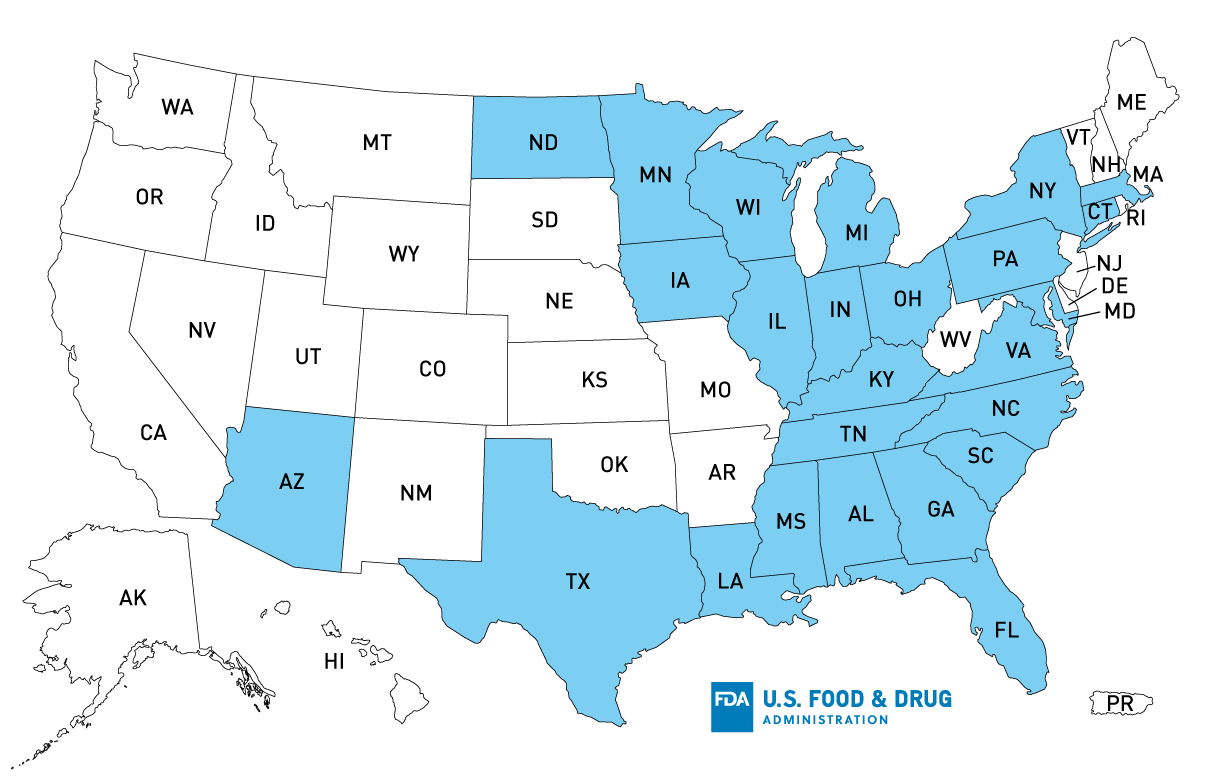
Map of U.S. Distribution of Recalled Packaged Salad

Outbreak Investigation of Listeria monocytogenes from Dole Packaged Salad - Map of U.S. Distribution of Recalled Packaged Salas (December 22, 2021)

Case Count Map Provided by CDC

Outbreak Investigation of Listeria monocytogenes from Dole Packaged Salad - CDC Case Count Map (December 22, 2021)

Case Counts

Total Illnesses: 16
Hospitalizations: 12
Deaths: 2
Last Illness Onset: October 17, 2021
States with Cases: IA, ID, MD, MI, MN, NC, NV, OH, OR, PA, TX, UT, WI
Product Distribution*: AL, AZ, CT, FL, GA, IA, IL, IN, KY, LA, MA, MD, MI, MN, MS, NC, ND, NY, OH, PA, SC, TN, TX, VA, WI

*Distribution has been confirmed for states listed, but product could have been distributed further, reaching additional states

USA – FDA Warning Letters – The Famous Lartigue Seafood

FDA

The United States Food and Drug Administration (FDA) inspected your seafood processing facility located at 100 Plantation Pointe, Fairhope, AL 36532 on October 19, 20 and 25, 2021. Our inspection found you have serious violations of the Seafood Hazard Regulations, Part 123 (21 CFR Part 123(g), failure of a seafood processor to have and implement a HACCP plan that complies with this section or otherwise operate in accordance with requirements of Part 123, renders the fish or fishery products adulterated within the meaning of section 402(a)(4) of the Federal Food, Drug, and Cosmetic Act (the Act), 21 U.S.C. § 342 (a)(4). Accordingly, your seafood products are adulterated because they have been prepared, packed, or held under insanitary conditions whereby they may have been rendered injurious to health. You may find the Act, the seafood HACCP regulation and the 4th Edition of the Fish and Fishery Products Hazards and Controls Guidance (the Hazards Guide) through links on FDA’s home page at www.fda.gov.External Link Disclaimer

FDA’s inspection resulted in the issuance of a FORM FDA 483, Inspectional Observations, listing deviations found during our inspection. We received your response, via email on October 25, 2021. After reviewing the inspectional findings and your response to the observations listed in the FORM FDA483, we are issuing this letter to advise you of FDA’s concerns and provide detailed information describing the findings at your facility.

Your significant violations were as follows:

1. You must conduct or have conducted for you a hazard analysis for each kind of fish and fishery product that you produce to determine whether there are food safety hazards that are reasonably likely to occur, and you must have and implement a written HACCP plan to control any food safety hazards that are reasonably likely to occur, to comply with 21 CFR 123.6(a), and (b). However, you do not have a HACCP Plan for fresh sushi-grade salmon to control the parasite and environmental hazards.

In your response sent on October 25, 2021 you state a HACCP plan will be devised once you complete a seafood HACCP certification course. However, you did not provide documentation of enrollment into a seafood HACCP course. Additionally, no timeline was provided for completion of your HACCP plan.

2. You must maintain sanitation control records that, at a minimum, document monitoring and corrections set out in 21 CFR 123.11(b), to comply with 21 CFR 123.11(c). Specifically, you do not have sanitation control records that document the monitoring of the following key areas of sanitation:

a. Condition and cleanliness of food contact surfaces, such as tables and utensils.
b. Prevention of cross-contamination from insanitary objects.
c. Maintenance of hand washing, hand sanitizing, and toilet facilities.
d. Protection of food, food packaging material, and food contact surfaces from adulteration.
e. Proper labeling, storage and use of toxic compounds.
f. Control of employee health conditions.

In your response sent on October 25, 2021 you state that you monitor sanitation controls utilizing daily and monthly logs. However, no supporting documentation was provided.

3. To comply with 21 CFR 123.10, you must have an individual who has successfully completed training in the application of HACCP principles to fish and fishery product processing that is at least equivalent to that received under a standardized curriculum recognized as adequate by the U.S. Food and Drug Administration or who may otherwise be qualified through job experience to perform the following functions: (1) the development of the HACCP plan, as required by 21 CFR 123.6(b); (2) the reassessment and modification of the HACCP plan in accordance with the corrective action procedures specified in 21 CFR 123.7(c)(5); (3) the reassessment and modification of the HACCP plan in accordance with the verification activities specified in 21 CFR 123.8(a)(1);(4) the reassessment and modification of the hazard analysis in accordance with the verification activities specified in 21 CFR 123.8(c); and (5) perform the record review required by 21 CFR 123.8(a)(3).

In your response sent on October 25, 2021 you state that you will be attending an online seafood HACCP certification course; however, no documentation of enrollment into the course was provided.

You should respond in writing within fifteen (15) working days from your receipt of this letter. Your response should outline the specific actions you are taking to correct these violations. Your response should include documentation reflecting the corrections you made, such as a copy of your HACCP plan. You should also provide five (5) consecutive days of completed monitoring records to demonstrate implementation of your HACCP plan.

Research – What you need to know during a Listeria Outbreak –

Food Poison Journal

There is a video to watch in the link above.

Ingested by mouth, Listeria is among the most virulent foodborne pathogens, with up to 20% of clinical infections resulting in death. These bacteria primarily cause severe illness and death in persons with immature or compromised immune systems.

Except for the transmission of mother to fetus, human-to-human transmission of Listeria is not known to occur. Infection is caused almost exclusively by the ingestion of the bacteria, most often through the consumption of contaminated food.

Adults can get listeriosis by eating food contaminated with Listeria, but babies can be born with listeriosis if their mothers eat contaminated food during pregnancy. The mode of transmission of Listeria to the fetus is either transplacental via the maternal blood stream or ascending from a colonized genital tract. Infections during pregnancy can cause premature delivery, miscarriage, stillbirth, or serious health problems for the newborn.

Listeria is a common presence in nature, found widely in such places as water, soil, infected animals, human and animal feces, raw and treated sewage, leafy vegetables, effluent from poultry and meat processing facilities, decaying corn and soybeans, improperly fermented silage, and raw (unpasteurized) milk.

Foods commonly identified as sources of Listeria infection include improperly pasteurized fluid milk, cheeses (particularly soft-ripened varieties, such as traditional Mexican cheeses, Camembert and ricotta), ice cream, raw vegetables, fermented raw-meat sausages, raw and cooked poultry, and cooked, ready-to-eat (RTE) sliced meats—often referred to as “deli meats,) smoked finfish, smoked shellfish and packaged fruits and vegetables.

Cruise ship outbreak: More than 100 sickened on recent Viking Sea voyage – Cause Unknown

Outbreak News Today

The Centers for Disease Control Prevention Vessel Sanitation Program (CDC-VSP) reported that 118 passengers and crew on a recent voyage of the Viking Cruises, Viking Sea, were sickened with diarrhoea due to a gastrointestinal illness of unknown etiology.

The voyage, which took place November 29–December 13, 2021, resulted in 114 of 640 (17.8%) passengers and 4 of 404 (1.0%) crew members sickened.

In response to the outbreak, Viking Cruises and the crew aboard the ship reported the following actions:

  • Increased cleaning and disinfection procedures according to the ship’s outbreak prevention and response plan.
  • Collected stool specimens from passenger and/or crew gastrointestinal illness cases and sent specimens for testing.
  • Sent daily reports of gastrointestinal illness cases to VSP.

VSP is monitoring the situation and the ship’s outbreak response and sanitation procedures.

Ireland – Irish survey shows gaps in turkey cooking knowledge

Food Safety News

More than three-quarters of Irish people don’t know the correct temperature to cook their turkey, according to a survey.

Among respondents in the Republic of Ireland, 27 percent were concerned about undercooking the turkey and being sure it was safe to eat while 7 percent were worried about overcooking and serving it dry.

The survey was commissioned by safefood with Empathy Research. It was done online in November across a nationally representative sample of 1,036 adults over the age of 18.

Past safefood research has found people are unsure when asked what temperature turkey should be cooked to, with responses ranging from 30 to 260 degrees C (86 to 500 degrees F). The safe cooking temperature for all poultry products is 165 degrees F, according to the U.S. Department of Agriculture.

Whether thawing frozen turkey or storing thawed turkey, it should be kept on the bottom shelf of the refrigerator so any drips won’t land on other food and spread germs. Rinsing turkey or chicken should not be done as it only spreads bacteria around the kitchen. Proper cooking will destroy bacteria and other pathogens.