Category Archives: Microbiological Risk Assessment

Research – Unraveling the Antimicrobial Effectiveness of Coridothymus capitatus Hydrolate against Listeria monocytogenes in Environmental Conditions Encountered in Foods: An In Vitro Study

MDPI

The increased resistance of bacteria to antimicrobials, as well as the growing interest in innovative and sustainable alternatives to traditional food additives, are driving research towards the use of natural food preservatives. Among these, hydrolates (HYs) have gained attention as “mild” alternatives to conventional antimicrobial compounds. In this study, the response of L. monocytogenes ATCC 7644 exposed to increasing concentrations of Coridothymus capitatus HY (CHY) for 1 h at 37 °C was evaluated by means of Phenotype Microarray, modelling the kinetic data obtained by inoculating control and treated cells into GEN III microplates, after CHY removal. The results revealed differences concerning the growth dynamics in environmental conditions commonly encountered in food processing environments (different carbon sources, pH 6.0, pH 5.0, 1–8% NaCl). More specifically, for treated cells, the lag phase was extended, the growth rate was slowed down and, in most cases, the maximum concentration was diminished, suggesting the persistence of stress even after CHY removal. Confocal Laser Scanner Microscopy evidenced a diffuse aggregation and suffering of the treated cells, as a response to the stress encountered. In conclusion, the treatment with HY caused a stressing effect that persisted after its removal. The results suggest the potential of CHY application to control L. monocytogenes in food environments.

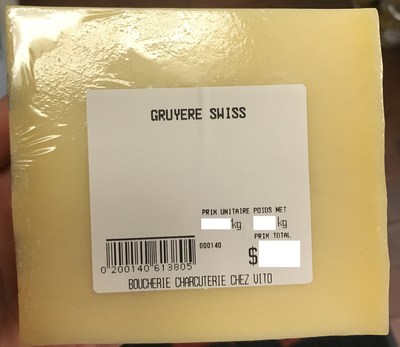
Quebec – Absence of information necessary for the safe consumption of raw milk Gruyère cheese packaged and sold by the Butchery Charcuterie at Vito

MAPAQ

QUEBEC CITY , April 27, 2022 /CNW Telbec/ – The Ministry of Agriculture, Fisheries and Food (MAPAQ), in collaboration with the Food Inspection Division of the City of Montreal and the Boucherie Charcuterie at Vito located at 5180, rue Saint-Urbain in Montreal, advises people considered vulnerable (pregnant women, people with weakened immune systems, children and the elderly) not to consume the product indicated in the table below. below, because it does not include the mention “made of raw milk” which is required.

Product name

Format

Affected batch

“GRUYERE SWISS”

Variable

Units sold until April 27, 2022

The product that is the subject of this warning was offered for sale until April 27, 2022 inclusive, only at the establishment designated above. It was wrapped in clear plastic wrap and sold chilled. The product label included the words “Boucherie Charcuterie chez Vito”.

The retailer is voluntarily recalling the products in question. It has agreed with MAPAQ and the Food Inspection Division of the City of Montreal to issue this warning as a precautionary measure. In addition, persons deemed vulnerable (designated above) who have this product in their possession are advised not to consume it. They should return it to the establishment where they bought it, use it in a cooked dish that will be cooked until it reaches a safe cooking temperature of 74°C or throw it away. However, no case of disease associated with the consumption of this food has been reported to MAPAQ to date.

Additional information

The Ministry publishes various information documents concerning food safety. Interested persons can consult them in the “Food Consumption” section of the MAPAQ website: www.mapaq.gouv.qc.ca/consommation  . They also have the possibility of registering online by visiting www.mapaq.gouv.qc.ca/rappelsfoods  to receive, by e-mail, the food recall press releases published by the Ministry. Finally, it is possible to follow “MAPAQfoods” on Twitter at the following address: www.twitter.com/MAPAQfoods  .

Gruyère Swiss (CNW Group/Ministry of Agriculture, Fisheries and Food) 

Hazard Classification: Class 1
Reference Number: 4540

Source:
Media relations
Direction des communications
Ministry of Agriculture, Fisheries
and Food
Tel. : 418 380-2100, extension 3512

Research – Shiga toxin-producing Escherichia coli (STEC) data: 2019

UKSHA

Main points for 2019

The main points of the 2019 report are:

1. A total of 539 confirmed cases of Shiga toxin-producing Echerichia coli (STEC) O157 were reported in England and Wales in 2019.

2. The lowest incidence of STEC O157 was in the East Midlands region (0.56 per 100,000 population) and the highest in the Yorkshire and Humber region (1.51 per 100,000 population).

3. Children aged 1 to 4 years had the highest incidence of infection (3.28 per 100,000 population, CI 95% 2.63–4.04).

4. Nearly one-third of confirmed STEC O157 cases in England were hospitalised and 3% were reported to have developed haemolytic ureamic syndrome (HUS).

5. In England and Wales, detection of non-O157 STEC increased in line with the growing number of NHS labs implementing gastrointestinal (GI) diagnostics using polymerase chain reaction (PCR); in 2019, 768 culture-positive non-O157 STEC cases (655 in England, 113 in Wales) were reported.

6. A further 347 specimens in England and 66 in Wales were positive for Shiga toxins (stx) genes on PCR at the Gastrointestinal Bacteria Reference Unit (GBRU) but an organism was not cultured.

7. The most commonly isolated non-O157 STEC serogroup was STEC O26 (England: n=109/655, 17% and Wales: n=28/113, 25%).

8. Five outbreaks of STEC involving 65 cases in England were investigated in 2019.

Cases of STEC in England and Wales in 2019

In 2019, 1,720 confirmed cases of STEC were reported in England and Wales; these comprised 539 culture-confirmed cases of STEC serogroup O157 (515 cases in England and 24 in Wales) and 768 cases (655 in England, 113 in Wales) where a serogroup other than O157 was isolated (non-O157). For a further 413 cases, samples were confirmed as STEC by testing positive by PCR for stx genes, but STEC was not cultured (347 in England, 66 in Wales).

Five confirmed cases were infected with multiple serogroups:

  • O157 and O26
  • O26 and O103
  • O76 and O113
  • O91 and O128ab
  • O146 and O91

There were 13 probable cases with serological evidence of STEC infection, with antibodies detected to O157 lipopolysaccharides in 11 cases (England: 10, Wales: 1), for O111 lipopolysaccharides in one case, and for O26 lipopolysaccharides in another case.

The crude incidence rate of confirmed STEC O157 in England and Wales was 0.91 per 100,000 cases (95% CI 0.83–0.99), continuing the downward trend observed since 2015 (Figure 1). It is the lowest number of cases reported annually since 1996, when testing began in England for STEC O157 on all faecal specimens from patients with suspected gastrointestinal infection (7).

Non-O157 STEC cases in England and Wales
Historically, cases of non-O157 STEC have been under ascertained, with 89 cases of STEC non-O157 reported between 2009 and 2013, prior to PCR being implemented.

Following the increase in recent years in frontline laboratories using PCR, there has been a significant increase in the detection of non-O157 STEC in England. It is not possible to estimate a denominator for incidence calculations for non-O157 STEC because details of contract arrangements for referral of samples from primary care and catchment areas of each diagnostic laboratory using PCR are not known.

In 2019, of 5,760 samples received at GBRU for STEC testing, 1,002 non-O157 STEC cases were confirmed in England. Of the 1,002 non-O157 cases, 655 culture positive cases of 72 different serogroups were confirmed. For 21 isolates, a serotype could not be identified as the genes encoding the somatic O antigen did not match any known sequence in the database. Specimens for a further 347 cases in England were positive for stx genes on PCR at GBRU but an organism was not cultured (PCR positive-culture negative).

In Wales, 113 non-O157 cases of 40 different serotypes were confirmed and a further 66 were PCR positive-culture negative. The most common non-O157 serogroups isolated in 2019 were O26 (28/113, 25%), O146 (15/113, 13%), O128ab (10/113, 9%) and O91 (8/113, 7%) followed by O111 (4/113, 4%), O113 (4/113, 4%) and O156 (4/113, 4%).

USA – CDC issues Health Alert: Investigation of Illness Complaints After Consuming Lucky Charms Cereal

Food Poison Journal

During April 2022, there has been an increase in complaints of gastrointestinal illness (GI) attributed to eating Lucky Charms cereal reported primarily to a crowdsourcing website. Some complaints of illness have also been reported to the U.S. Food and Drug Administration (FDA), state, and local health departments. There are very little data on the clinical presentation of these complaints, e.g., symptom profiles, incubation periods, and illness durations, as well as a lack of laboratory testing of clinical specimens. The scarcity of data and lack of a consistent clinical presentation are making it difficult to ascertain if any of these illnesses are linked to the suspected cereal.

The Centers for Disease Control and Prevention (CDC) is coordinating with state and federal partners to characterize the clinical presentations and epidemiology of recent illness reports. CDC is also collaborating with state and federal partners to evaluate data collected from ill people to determine if an outbreak of GI illnesses is occurring and its potential link to Lucky Charms cereal.

USA – Publisher’s Platform: Hey Chicken Little, the sky will not fall if Salmonella is deemed an adulterant

LEX

If Salmonella is deemed an adulterant – at least those that sicken and kill us – the sky will not fall – history as a guide.

On Jan. 19, 2020, we filed a petition with USDA’s Food Safety and Inspection Service (FSIS), on behalf of Rick Schiller, Steven Romes, the Porter family, Food & Water Watch, Consumer Federation of America, and Consumer Reports. 20-01-marler-011920 The petition asked FSIS to declare the following Salmonella “outbreak serotypes” as per se contaminants (adulterants) in meat and poultry products:

Salmonella Agona, Anatum, Berta, Blockely, Braenderup, Derby, Dublin, Enteritidis, Hadar, Heidelberg, I 4,[5],12:i:-, Infantis, Javiana, Litchfield, Mbandaka, Mississippi, Montevideo, Muenchen, Newport, Oranienburg, Panama, Poona, Reading, Saintpaul, Sandiego, Schwarzengrund, Senftenberg, Stanley, Thompson, Typhi, and Typhimurium.

I said at the time, reducing salmonellosis from meat and poultry “demands bold action” beyond that yet taken by FSIS. Salmonella is a leading cause of foodborne illness in the United States, causing 1.35 million illnesses, 26,500 hospitalizations, 130 outbreaks, and 420 deaths each year.

Presently, government regulators are somewhat silent with what they intend to do.  The poultry industry, as expected, sees any additional regulation as unnecessary, burdensome and costly.

Read More at the link above.

Germany -Officials admit failures in German Listeria outbreak

Food Safety News

Officials in a German district have apologized for mistakes made as part of an investigation into a Listeria outbreak in which one person died.

Four people were infected between October 2021 and January this year but the person died with, not because of, listeriosis. Contaminated cucumbers from one company have been linked to the illnesses.

Thomas Will, Groß-Gerau district administrator and Walter Astheimer, district health officer, said in the past two and a half years, there have been significant gaps in food controls and this had been a big mistake with hygiene deficiencies overlooked.

“We deeply regret that food contaminated with Listeria could come into circulation and several people fell ill because a company in Gernsheim was not properly checked for two years,” they said.

The company should have been checked more often but inspections were running behind because of the COVID-19 pandemic and a lack of staff resources.

USA – Alabama warms of E. coli and Rotavirus cases in children

Food Poison Journal

The Alabama Department of Public Health (ADPH) is investigating four cases of E. coli O157:H7 and two cases of Rotavirus in younger children in Northeastern Alabama. ADPH regularly investigates clusters and outbreaks of communicable diseases as required by Notifiable Disease Rules in Alabama.

In 2021, ADPH investigated 113 cases of E. coli, shiga toxin-producing illness (includes O157:H7). People of any age can become infected with this germ, but very young children and the elderly are more likely to develop severe illness and kidney problems than others.

Research – Observational Study of the Impact of a Food Safety Intervention on Consumer Poultry Washing

Journal of Food Protection

This study was conducted to test the effectiveness of a consumer poultry washing educational intervention that included video observation of meal preparation with participants who self-reported washing poultry. Treatment group participants received three e-mail messages containing information that the U.S. Department of Agriculture has used on social media sites (video and infographics) related to poultry preparation, including advising against washing chicken. Participants were observed cooking chicken thighs (inoculated with traceable nonpathogenic Escherichia coli strain DH5α) and preparing a salad to determine whether they washed the chicken and the extent of cross-contamination to the salad and areas of the kitchen. After meal preparation, participants responded to an interview about food handling behaviors, including questions about the intervention for treatment group participants. Three hundred people participated in the study (158 control, 142 treatment). The intervention effectively encouraged participants not to wash chicken before cooking; 93% of treatment group participants but only 39% of control group participants did not wash the chicken (P < 0.0001). The high levels of E. coli DH5α detected in the sink and on the salad lettuce suggest that microbes transferred to the sink from the chicken, packaging, or contaminated hands are a larger cause for concern than is splashing contaminated chicken fluids onto the counter. Among chicken washers, 26 and 30% of the lettuce from the prepared salad was contaminated for the control and treatment groups, respectively. For nonwashers, 31 and 15% of the lettuce was contaminated for the control and treatment groups, respectively. Hand-facilitated cross-contamination is suspected to be a factor in explaining this resulting lettuce cross-contamination. This study demonstrates the need to change the frame of “don’t wash your poultry” messaging to instead focus on preventing contamination of sinks and continuing to emphasize the importance of hand washing and cleaning and sanitizing surfaces.

HIGHLIGHTS
  • The intervention was effective for convincing participants to not wash chicken before cooking.
  • High levels of the bacterial tracer were detected in the sink and on the salad lettuce.
  • Messaging should focus on hand washing and cleaning and sanitizing surfaces.

Research – Innovative Antibiofilm Smart Surface against Legionella for Water Systems

MDPI

Legionella pneumophila contamination of water systems is a crucial issue for public health. The pathogen is able to persist in water as free-living planktonic bacteria or to grow within biofilms that adhere to and clog filters and pipes in a water system, reducing its lifespan and, in the case of hospital buildings, increasing the risk of nosocomial infections. The implementation of water management is considered to be the main prevention measure and can be achieved from the optimization of water system architecture, notably introducing new materials and strategies to contrast Legionella biofilm proliferation and so prolong the water system functionality. In this research, we propose a new smart surface against L. pneumophila biofilm formation. This is based on an innovative type of coating consisting of a sulfonated pentablock copolymer (s-PBC, commercially named Nexar™) deposited on top of a polypropylene (PP) coupon in a sandwich filter model. The covering of PP with s-PBC results in a more hydrophilic, acid, and negatively charged surface that induces microbial physiological inhibition thereby preventing adhesion and/or proliferation attempts of L. pneumophila prior to the biofilm formation. The antibiofilm property has been investigated by a Zone of Inhibition test and an in vitro biofilm formation analysis. Filtration tests have been performed as representative of possible applications for s-PBC coating. Results are reported and discussed.

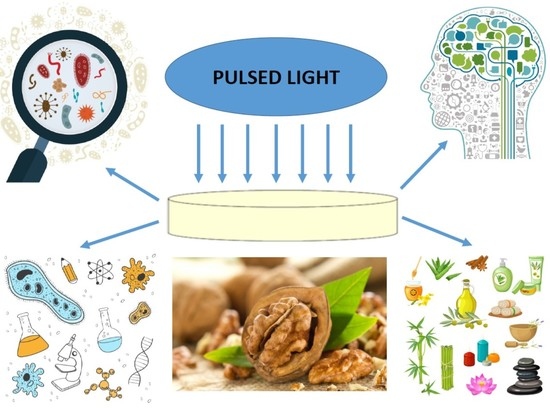
Research – Effect of Pulsed Light on Quality of Shelled Walnuts

MDPI

Shelled walnuts are considered a microbiologically low-risk food but have been linked to some outbreaks, and a treatment aiming to decrease this risk is desirable. Pulsed light (PL) may be an alternative, providing it does not seriously impair their quality. This work assessed the impact of PL on some quality attributes of walnuts. To do this, measurements of rancidity, volatiles, total phenols, antioxidant activity, and descriptive sensory analysis were carried out on untreated and PL (43 J/cm2)-treated kernels. PL had no statistically significant (p > 0.05) effects on TBARS, peroxide value, total phenols, and antioxidant activity but significantly increased the concentration of volatiles related to green/herbaceous odors and decreased compounds related to fruity and citrus odors. The descriptors nut overall, walnut odor and flavor, and aftertaste were given statistically significantly (p < 0.05) higher scores, while descriptors woody odor and sweet received lower scores; 16 other traits such as all those related to color, texture, and rancidity were unaffected. No significant (p > 0.05) effects on total phenols and antioxidant activity in general were observed during the course of PL treatment. It can be concluded that PL technology may be used in shelled walnuts with only mild effects on their quality; a storage study must be carried out in order to determine the effect of PL treatment on its shelf-life. View Full-Text