Category Archives: microbial contamination

USA – TECHNICAL REPORT:FDA REPORT ON THE OCCURRENCE OF FOODBORNE ILLNESS RISK FACTORS IN RETAIL FOOD STORE DELI DEPARTMENTS2015-2016MAY 2021

FDA

This report includes the background, design, and results of data collection on the occurrence of foodborne illness risk factors in the United States in retail food store deli departments (hereafter referred to as delis) during 2015-2016. It is a baseline report representing the first data collection period of the FDA’s current 10-year study on trends in the occurrence of foodborne illness risk factors and food safety behaviors/practices in food service facilities. Data from the 2015-2016 collection will be used as a baseline to assess trends in the occurrence of risk factors in future data collections. Of the foodborne illness risk factors investigated in this study, inadequate cooking was best controlled. The two most commonly occurring out-of-compliance risk factors were improper holding time/temperature and poor personal hygiene. Food Safety Management Systems (FSMS) were the strongest predictor of the compliance status of data items. Establishments with well-developed FSMS had significantly fewer out-of-compliance food safety behaviors/practices than did those with “less developed” food safety management systems. Neither the presence of a Certified Food Protection Manager (CFPM) nor the multiple-unit status of establishments were significant predictors of having out-of-compliance data items when all factors studied were taken into account. These findings suggest that well-developed and documented FSMS are a useful tool in reducing the occurrence of foodborne illness risk factors.
Research -Epidemiological investigation of recurrent outbreaks of haemolytic uraemic syndrome caused by Shiga toxin-producing Escherichia coli serotype O55:H7 in England, 2014–2018

Cambridge Org

Recurrent outbreaks of haemolytic uraemic syndrome (HUS) caused by Shiga toxin-producing Escherichia coli (STEC) serotype O55:H7 occurred in England between 2014 and 2018. We reviewed the epidemiological evidence to identify potential source(s) and transmission routes of the pathogen, and to assess the on-going risk to public health. Over the 5-year period, there were 43 confirmed and three probable cases of STEC O55:H7. The median age of cases was 4 years old (range 6 months to 69 years old) and over half of all cases were female (28/46, 61%). There were 36/46 (78.3%) symptomatic cases, and over half of all cases developed HUS (25/46, 54%), including two fatal cases. No common food or environmental exposures were identified, although the majority of cases lived in rural or semi-rural environments and reported contact with both wild and domestic animals. This investigation informed policy on the clinical and public health management of HUS caused by STEC other than serotype O157:H7 (non-O157 STEC) in England, including comprehensive testing of all household contacts and household pets and more widespread use of polymerase chain reaction assays for the rapid diagnosis of STEC-HUS.

Research – Ecological niche adaptation of Salmonella Typhimurium U288 is associated with altered pathogenicity and reduced zoonotic potential

Nature.com

The emergence of new bacterial pathogens is a continuing challenge for agriculture and food safety. Salmonella Typhimurium is a major cause of foodborne illness worldwide, with pigs a major zoonotic reservoir. Two phylogenetically distinct variants, U288 and ST34, emerged in UK pigs around the same time but present different risk to food safety. Here we show using genomic epidemiology that ST34 accounts for over half of all S. Typhimurium infections in people while U288 less than 2%. That the U288 clade evolved in the recent past by acquiring AMR genes, indels in the virulence plasmid pU288-1, and accumulation of loss-of-function polymorphisms in coding sequences. U288 replicates more slowly and is more sensitive to desiccation than ST34 isolates and exhibited distinct pathogenicity in the murine model of colitis and in pigs. U288 infection was more disseminated in the lymph nodes while ST34 were recovered in greater numbers in the intestinal contents. These data are consistent with the evolution of S. Typhimurium U288 adaptation to pigs that may determine their reduced zoonotic potential.

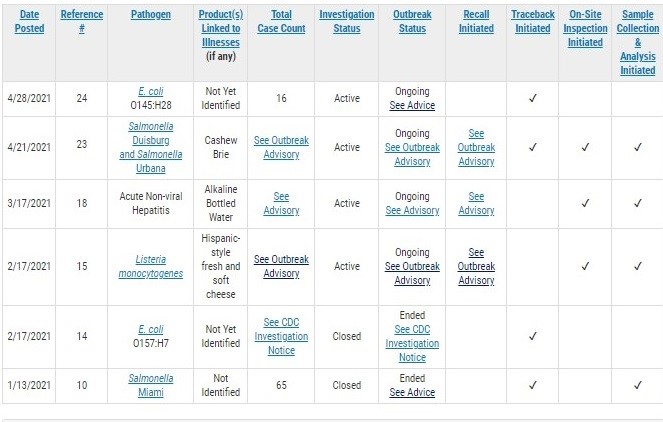
USA – FDA Core Investigation Table

FDA

0a


Kenya – Kenya can’t regulate its way out of aflatoxin menace

Standard Media

Enforcement of food safety regulations is necessary but insufficient to solve this problem. Aflatoxin contamination must be addressed at its root, during production and on-farm storage.

Research by International Food Policy Research Institute and others points to some solutions including education, incentivising farmers and removing the middleman. Educating farmers about how to prevent aflatoxin leads to better practices, which can also improve the quality of grain.

Kenya must also make aflatoxin prevention technologies affordable. Most farmers dry their maize on old woven sisal bags, through which mold spores can permeate. Upgrading to impermeable tarps or drying sheets is a highly cost-effective approach to aflatoxin control, but still costs farmers more than used bags. The new KEBS standard for tarps used in agriculture, which is expected to increase the availability of lower-cost tarps, is an important step forward.

USA – San Francisco’s House of Prime Rib Voluntarily Closes for Food Borne Illness Investigation

CBS

SAN FRANCISCO (CBS SF) — The Department of Public Health in San Francisco on Thursday confirmed that the House of Prime Rib has voluntarily shut down for an investigation into complaints of alleged food borne illness at the popular restaurant.

The city’s Department of Public Health issued a release Thursday stating it “is aware of ongoing online complaints and alleged food borne illness in relation to the House of Prime Rib on 1906 Van Ness Avenue.”

“The owner agreed to voluntarily close to the public for 24 hours starting today (5/13) so DPH health inspectors can ensure meal preparation and food handling process is being done safely and to code,” the statement read.

The restaurant had been serving take out meals for much of the COVID-19 pandemic, but in March resumed dinner service at the restaurant.

Armenia – Armenia reports gastrointestinal outbreak, Hundreds sickened

Outbreak News Today

The Armenian Ministry of Health reports an outbreak of intestinal infections in the country’s Sisian community.

To date, the ministry has recorded 370 cases with diagnoses that are characteristic of intestinal infections and 7 of the 370 patients are currently undergoing treatment at a hospital.

The Ministry of Health said that the patients are in serious condition, while other residents are receiving outpatient treatment.

Outbreak News Interviews Podcast

Sample from water and from patients have been taken for microbial testing to include enteropathogenic intestinal bacteria, Yersinia enterocolitis and Campylobacter, as well as Norovirus and Adenovirus.

RASFF Alert – Animal Feed – Salmonella – Fish Meal

RASFF

Salmonella spp. in fish meal from Mauritania in Spain

Research – Case–Control Study of Risk Factors for Acquired Hepatitis E Virus Infections in Blood Donors, United Kingdom, 2018–2019

CDC

Hepatitis E virus (HEV) is the most common cause of acute viral hepatitis in England. Substantial yearly increases of autochthonous infections were observed during 2003–2016 and again during 2017–2019. Previous studies associated acute HEV cases with consumption of processed pork products, we investigated risk factors for autochthonous HEV infections in the blood donor population in England. Study participants were 117 HEV RNA–positive blood donors and 564 HEV RNA–negative blood donors. No persons with positive results were vegetarian; 97.4% of persons with positive results reported eating pork products. Consuming bacon (OR 3.0, 95% CI 1.7–5.5; p<0.0001), cured pork meats (OR 3.5, 95% CI 2.2–5.4; p<0.0001), and pigs’ liver (OR 2.9, 95% CI 1.0–8.3; p = 0.04) were significantly associated with HEV infection. Our findings confirm previous links to pork products and suggest that appropriate animal husbandry is essential to reduce the risk for HEV infection.

Research – ANSES sets value to protect people from emerging toxin in shellfish

Food Safety News

A French agency has proposed a guideline value to protect consumers of shellfish from a group of marine biotoxins.

The French Agency for Food, Environmental and Occupational Health and Safety (ANSES) said brevetoxins (BTX) were first detected in mussels in Corsica in 2018. If ingested by humans, these toxins can cause neurological, gastrointestinal or cardiovascular symptoms.

After this finding a few years ago, ANSES was asked by the Directorate General for Food (DGAL) and Directorate General for Health (DGS) to propose a guideline value to protect the health of people who eat shellfish. The agency has published an opinion and report on the subject in French.

Based on reports of food poisoning in other countries, ANSES has set a guideline value to protect consumers of products such as oysters and mussels. This value is 180 µg/kg of shellfish flesh, expressed in BTX-3 equivalents, with BTX-3 being the form of brevetoxin used as the reference.