Category Archives: microbial contamination

Research – Unveiling Fresh-Cut Lettuce Processing in Argentine Industries: Evaluating Salmonella Levels Using Predictive Microbiology Models

MDPI

Abstract

A survey was performed to gather information on the processing steps, conditions, and practices employed by industries processing ready-to-eat (RTE) leafy vegetables in Argentina. A total of seven industries participated in the survey. A cluster analysis of the data obtained was performed to identify homogeneous groups among the participating industries. The data collected were used as inputs of two predictive microbiology models to estimate Salmonella concentrations after chlorine washing, during storage and distribution of final products, and to rank the different practices according to the final estimated Salmonella levels. Six different clusters were identified by evaluating the parameters, methods, and controls applied in each processing step, evidencing a great variability among industries. The disinfectant agent applied by all participating industries was sodium hypochlorite, though concentrations and application times differed among industries from 50 to 200 ppm for 30 to 110 s. Simulations using predictive models indicated that the reductions in Salmonella in RTE leafy vegetables would vary in the range of 1.70–2.95 log CFU/g during chlorine-washing depending on chlorine concentrations applied, washing times, and vegetable cutting size, which varied from 9 to 16 cm2 among industries. Moreover, Salmonella would be able to grow in RTE leafy vegetables during storage and distribution, achieving levels of up to 2 log CFU/g, considering the storage and transportation temperatures and times reported by the industries, which vary from 4 to 14 °C and from 18 to 30 h. These results could be used to prioritize risk-based sampling programs by Food Official Control or determine more adequate process parameters to mitigate Salmonella in RTE leafy vegetables. Additionally, the information gathered in this study is useful for microbiological risk assessments.
New Zealand – Do not collect or eat shellfish from areas where shellfish biotoxin warnings have been issued – Hawke Bay – PSP

MPI

Hawke Bay

Reason for alert Paralytic Shellfish Poisoning (PSP)

Date warning issued Media release: 1 November 2023
Affected area Hawke Bay: Cape Kidnappers to Mohaka River.
Shellfish affected Mussels, oysters, tuatua, pipi, toheroa, cockles, scallops, catseyes, kina (sea urchin) and all other bivalve shellfish.

Note, cooking shellfish does not remove the toxin.

Pāua, crab and crayfish may still be eaten if the gut has been completely removed prior to cooking, as toxins accumulate in the gut. If the gut is not removed its contents could contaminate the meat during the cooking process.

Symptoms Symptoms typically appear between 10 minutes and 3 hours after ingestion and may include:

  • numbness and a tingling (prickly feeling) around the mouth, face, and extremities (hands and feet)
  • difficulty swallowing or breathing
  • dizziness
  • headache
  • nausea
  • vomiting
  • diarrhoea
  • paralysis and respiratory failure and in severe cases, death.
Other information Paralytic shellfish toxins have been detected in shellfish at levels over the safe limit of 0.8mg/kg set by New Zealand Food Safety. Ongoing testing will continue and any changes will be communicated accordingly.

Research – UK retailers report Campylobacter in chicken data for 2023

Food Safety News

Supermarkets in the United Kingdom have reported mixed Campylobacter in chicken results for the first two quarters of 2023.

The Food Standards Agency (FSA) maximum target level is up to 7 percent of birds with more than 1,000 colony-forming units per gram (CFU/g) of Campylobacter.

Data from the retailers covers the first half of 2023 on high findings of Campylobacter in fresh, shop-bought, UK-produced chickens.

Results at Morrisons, Asda, and Sainsbury’s went up while Marks and Spencer recorded lower levels. The percentage of positives varied by quarter at Waitrose and Lidl and stayed the same for Co-op.

Campylobacter is the most common cause of bacterial food poisoning in the UK, and the dose needed to make people sick can be as low as a few hundred cells.

Tesco has stopped publishing data as it has changed how it monitors the pathogen in chicken, so findings are not comparable with other retailers. Aldi has not updated its related webpage or provided the figures when asked to do so by Food Safety News.

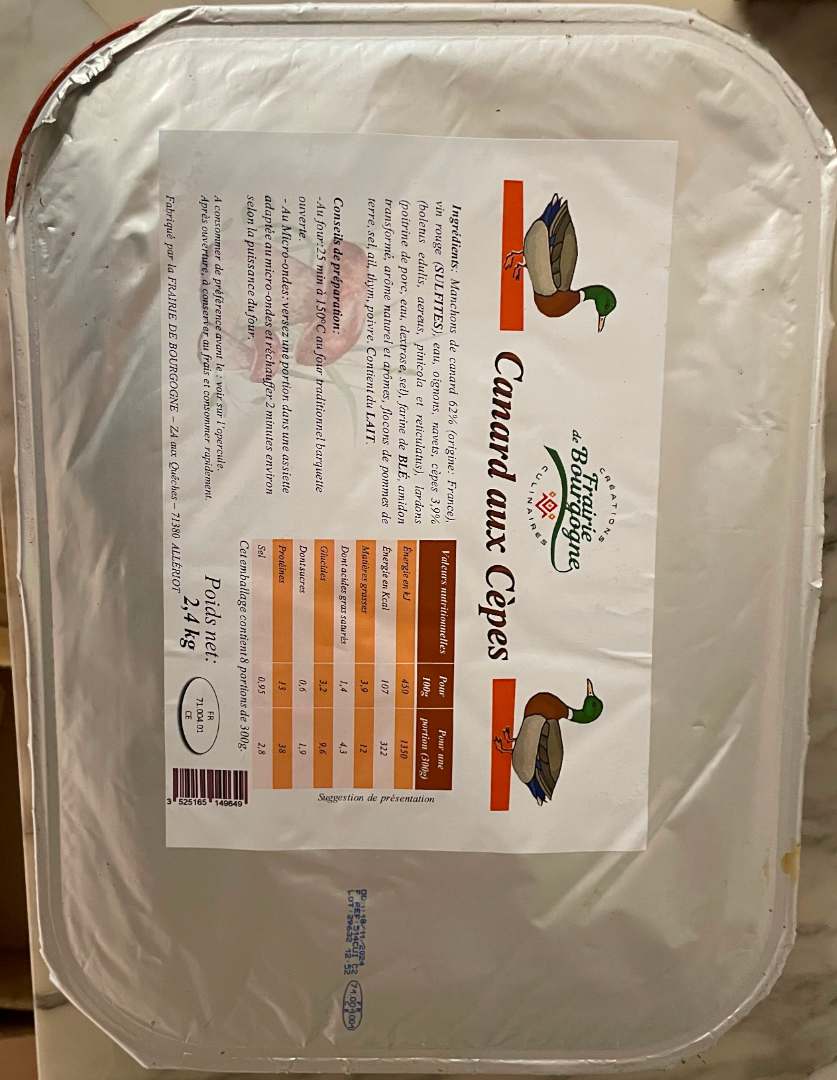
France – Duck with porcini mushrooms 2.4kg – Risk of Microbiological Growth

Gov france

  • Product category Food
  • Product subcategory Meats
  • Product brand name The Frairie de Bourgogne
  • Model names or references 514CUI.PLT: Duck with porcini mushrooms, 2.4kg platter
  • Product identification
    GTIN Batch Date
    3525165149649 Lot 29632 Minimum durability date 11/18/2024
  • Packaging Sealed aluminum tray
  • Start/end date of marketing From 01/12/2022 to 27/10/2023
  • Storage temperature Product to be stored at room temperature
  • Health mark FR 71.004.001 CE
  • Geographical sales area Regions: Burgundy-Franche-Comté
  • Distributors Dijon salted meats, Terrine du Morvan, Frairie de Bourgogne

EU – Multi-country outbreak of Salmonella Enteritidis in chicken meat and chicken meat products

EFSA

Between January and October 2023, 14 EU/EEA countries, the UK and the US reported 335 cases related to this outbreak.

Chicken meat and chicken meat products (kebab) are the likely source of a multi-country outbreak caused by three types of Salmonella Enteritidis, according to EFSA and ECDC’s latest Rapid Outbreak Assessment.

Bacteria similar to those causing the outbreak have been detected in samples of chicken meat and chicken kebab. While food traceability data points to producers located in Poland (7 producers) and Austria (1 producer), no microbiological evidence of a contamination at their facilities has been found.

Scientists expect that new cases are likely to occur in this multi-country outbreak as the source has not yet been identified. EFSA and ECDC experts recommend further investigations to identify the potential locations within the chicken meat production chain where the contamination may have occurred.

Research – Haemolytic uraemic syndrome in children England, Wales, Northern Ireland, and Ireland: A prospective cohort study

Cambridge Org

Abstract

Haemolytic uraemic syndrome (HUS) caused by infection with Shiga toxin-producing Escherichia coli (STEC) is a relatively rare but potentially fatal multisystem syndrome clinically characterised by acute kidney injury. This study aimed to provide robust estimates of paediatric HUS incidence in England, Wales, Northern Ireland, and the Republic of Ireland by using data linkage and case reconciliation with existing surveillance systems, and to describe the characteristics of the condition. Between 2011 and 2014, 288 HUS patients were included in the study, of which 256 (89.5%) were diagnosed as typical HUS. The crude incidence of paediatric typical HUS was 0.78 per 100,000 person-years, although this varied by country, age, gender, and ethnicity. The majority of typical HUS cases were 1 to 4 years old (53.7%) and female (54.0%). Clinical symptoms included diarrhoea (96.5%) and/or bloody diarrhoea (71.9%), abdominal pain (68.4%), and fever (41.4%). Where STEC was isolated (59.3%), 92.8% of strains were STEC O157 and 7.2% were STEC O26. Comparison of the HUS case ascertainment to existing STEC surveillance data indicated an additional 166 HUS cases were captured during this study, highlighting the limitations of the current surveillance system for STEC for monitoring the clinical burden of STEC and capturing HUS cases.

Research – Role of Bacillus cereus biofilm formation behavior in virulence and pathogenic characteristics

Wiley Online

Abstract

This study aimed to examine the potential link between Bacillus cereus biofilm formation, virulence, and pathogenicity. The biofilm formation abilities of nine B. cereus strains isolated from food and two reference strains (ATCC 10876 and ATCC 25621) were measured using a crystal violet assay. Among the tested strains, three strains (GIHE 617-5, GIHE 86-09, and GIHE 728-17) and both reference strains were capable of biofilm formation. A positive correlation was obtained for higher cell surface hydrophobicity and increased biofilm formation. In contrast, HPLC analysis for elevated autoinducer-2 (Al-2) production revealed a negative impact on biofilm formation. PCR data indicated that all tested strains were capable of producing common B. cereus enterotoxins, including Hbl—A, C, and D, CytK, Nhe—B and C, EntFM, and BceT, but were negative for production of the emetic toxin cereulide and the pore-forming toxin Hly II. Meanwhile, RT-PCR data revealed a close correlation between high biofilm formation and the upregulation of several tested virulence genes for selected strains. However, elevated upregulation of virulence genes was not consistent in all of the higher biofilm-forming strains. Cytotoxicity analysis revealed higher virulence characteristics compared to those of low biofilm-forming strains.

Research Dry-surface foodborne pathogens under scrutiny at Purdue

Purdue Edu

Maintaining sanitary conditions without using water presents special challenges

WEST LAFAYETTE, Ind. – During 2021 and 2022, national news reported on four infants being hospitalized and two dying after consuming infant formula tainted with Cronobacter sakazakii. The reports sparked the prolonged shutdown of a production plant that produced large quantities of the formula, leading to a monthslong nationwide shortage of infant formula.

The incident motivated Purdue University’s Haley Oliver to launch a project to improve the safety of low-moisture food-processing facilities. Oliver, a professor of food science, will collaborate with Old Dominion University’s Rishi Drolia on the project, which will target the C. sakazakii pathogen.

“It was a massive-scale food safety challenge that led to a food security challenge,” Oliver said.

USA – Outbreak Investigation of Listeria: Ice Cream (August 2023)

FDA

Product 

  • The Ice Cream House has voluntarily recalled all dairy and non-dairy products with the Ice Cream House logo. Recalled products include dairy and non-dairy (parve):
  • Real Kosher Ice Cream has voluntarily recalled all flavors of Soft Serve On The Go 8-oz ice cream cups 

Additional recall information is available on the recall notices above.

Stores Affected

  • Ice Cream House products: Recalled products with the Ice Cream House brand were sold at the Ice Cream House storefront in Brooklyn, NY and at retail supermarkets in NJ, NY, OH.
  • Real Kosher Ice Cream Soft Serve On The Go cups: Recalled products were sold to multiple retailers in CA, CO, CT, DC, DE, FL, IL, MA, MD, MI, MN, NC, NH, NJ, NY, OH, OR, PA, VA, WV.

Status

Ended

Recommendation

  • This outbreak appears to be over; however, consumers should check their freezers for recalled ice cream and non-dairy [parve] frozen dessert products and should throw the recalled product away. Options to return recalled product can be found in the recall notice from Real Kosher Ice Cream and Ice Cream House.
  • Consumers, restaurants, and retailers who purchased or received any recalled ice cream products should follow FDA’s safe handling and cleaning advice  and use extra vigilance in cleaning and sanitizing any surfaces and containers that may have come in contact with these products to reduce the risk of cross-contamination. Listeria can survive temperatures at or below freezing and can easily spread to other foods and surfaces.
  • Since the recall, the company started placing a label that includes a lot code on their products. If consumers have products in their freezers without a lot code, they should be thrown out.

Recommendation for At-Risk Groups:

  • Listeria is most likely to sicken pregnant people and newborns, adults aged 65 or older, and people with weakened immune systems. Other people can be infected with Listeria, but they rarely become seriously ill.
  • Pregnant people typically experience only fever, fatigue, and muscle aches. However, Listeria infection during pregnancy can lead to miscarriage, stillbirth, premature delivery, or life-threatening infection of the newborn.
  • Call your healthcare provider right away if you have symptoms of a Listeria infection.

Current Update

October 26, 2023

The FDA and CDC, in collaboration with state and local partners, investigated an outbreak of Listeria monocytogenes infections linked to recalled dairy and non-dairy products with the Ice Cream House logo sold at Ice Cream House and Real Kosher Ice Cream.

FDA and state partners collected several samples at the Ice Cream House facility located in Brooklyn, NY. WGS analysis confirmed that the strain of Listeria monocytogenes found in these samples matches the outbreak strain. As of October 26, 2023, CDC announced that the outbreak is over. CDC reports a total of two illnesses in two states. The last illness onset was in May 2023.

Since the recall, the company has taken corrective actions and is now back in operation. The company started placing a label that includes a lot code on their products. FDA’s investigation is complete.

Research- Three clusters of Salmonella Enteritidis ST11 infections linked to chicken meat and chicken meat products

EFSA

Abstract

From 1 January–24 October 2023, 335 laboratory-confirmed Salmonella Enteritidis ST11 cases belonging to three distinct microbiological clusters have been reported in 14 EU/EEA countries, the United Kingdom and the United States, affecting all age groups. Most interviewed cases reported consumption of chicken meat, including chicken kebabs. Nine cases in three countries were hospitalised and one case in Austria died, highlighting the potential for severe and fatal infections from this outbreak. Following the food exposure information and the national investigations in 2023, the food safety authorities in Austria, Denmark and Italy investigated 10 food products (six contaminated by Salmonella Enteritidis ST11 cluster 1 and/or cluster 2), seven final producers in Poland and one in Austria. Traceability information revealed that three Salmonella-contaminated kebabs shared a number of Polish food business operators. The trading link of the suspected kebab suggests one or more common source(s)/point(s) of contamination in Austria, Denmark, and Italy. Following the collection of genomic information, the cluster analysis revealed the presence of the outbreak strains in the food chain in multiple European countries. Most positive foods sampled in 2022–2023 with shared epidemiological data originated from Poland. Given the information collected, contaminated chicken kebab and chicken meat are the plausible vehicles of the human infections reported in these three clusters. In the absence of conclusive microbiological evidence and comprehensive traceability, the role of the identified final producers, their meat suppliers, and the possible involvement of other food business operators as sources of the infections could not be confirmed or excluded. Further investigations are needed to identify the root cause of the contamination and the source of infections, which is crucial for prompt implementation of targeted effective control and corrective measures. As the source(s) have not been identified, new cases are likely to occur in this prolonged multi-country outbreak.