Category Archives: Hygiene

Australia – Norovirus and Gastroenteritis Advice

Australian GovernmentNorwalk_Caspid

Guidelines for the public health management of gastroenteritis outbreaks due to
norovirus or suspected viral agents in Australia

Better Health Channel

Gastroenteritis (gastro) is an illness triggered by the infection and inflammation of the digestive system. Symptoms include abdominal cramps, diarrhoea and vomiting. Some of the causes include viruses, bacteria, bacterial toxins, parasites, particular chemicals and some drugs. The main complication of gastroenteritis is dehydration, but this can be prevented if the fluid lost in vomit and diarrhoea is replaced.

Research – Olive Powder Combatting E.coli in Hamburgers

FeedStuffs FoodLink

The potential of olive powder to keep foods safe to eat is getting a fresh look from Albany chemist Mendel Friedman and colleagues at the University of Arizona-Tucson.

An olive processing co-product, olive powder was one of about two dozen plant extracts, spices, and herbs that the team evaluated for their potential to combat Escherichia coli O157:H7 and to retard formation of heterocyclic amines during cooking of hamburger patties.

E. coli O157:H7 is a leading cause of food sickness in the U.S. and is blamed for more than 73,000 cases of illness annually. In recent years, many E. coli outbreaks have been traced back to ground beef and have led to the introduction of stringent new food safety rules designed to reduce the occurrence of this microbe, and six of its relatives, in meats, poultry, and other foods.

The ability of olive extracts to kill foodborne pathogens has been reported in earlier studies conducted at Albany, Tucson, and elsewhere. However, the E. coli and amines study, reported in a 2012 issue of the Journal of Agricultural and Food Chemistry, may be the first to show olive powder’s performance in concurrently suppressing three targets of concern — two major amines and a pervasive E. coli.

USA – Cyclospora Outbreak

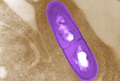
Livewell Nebraska220px-Cyclospora_cayetanensis_stained

Fourteen more cases of cyclospora infection were reported Friday to Nebraska and Iowa public health officials, adding to the 12 that had come in over the past several days.

Officials still are trying to determine the source of the Cyclospora cayetanensis parasite, which causes an intestinal infection called cyclosporiasis. They’re telling physicians to be aware of the illness and to test specifically for the parasite

The new Nebraska cases appear to be from the eastern part of the state, as did the earlier cases, according to a spokeswoman for the Nebraska Department of Health and Human Services. Most of the new Iowa cases were from central and eastern Iowa, said Dr. Patricia Quinlisk, medical director of the Iowa Department of Public Health. One case, she said, involved an Iowan who was tested in Omaha.

Cyclospora is spread by people ingesting food or water that is contaminated with feces. People living or traveling in tropical or subtropical regions of the world may be at increased risk for infection because cyclosporiasis is found in those areas. Foodborne outbreaks of the illness in the U.S. have been linked to various types of imported fresh produce, such as raspberries, basil, snow peas and mesclun lettuce.

People need to wash all fresh produce, health officials said.

The symptoms of cyclospora infection can last for weeks in otherwise healthy people. They include fatigue, lack of appetite, nausea, abdominal cramping and a low-grade fever.

People with compromised immune symptoms will have more severe and longer-lasting symptoms

What is cyclospora?

Cyclospora cayetanensis is a parasite made of one cell, too small to be seen without a microscope. This parasite causes an intestinal infection called cyclosporiasis.

How is cyclospora spread?

Cyclospora is spread by people ingesting something, such as food or water, that is contaminated with feces. Cyclospora needs days to weeks after being passed in a bowel movement to become infectious for another person. Therefore, it is unlikely that cyclospora is passed directly from one person to another.

Who is at risk for cyclospora infection?

People living or traveling in tropical or subtropical regions of the world may be at increased risk for infection because cyclosporiasis is found in some countries in the zones. In the United States, food-borne outbreaks of cyclosporiasis have been linked to various types of imported fresh produce.

What should I do if I think I might be infected with cyclospora?

See your health care provider.

Source: Centers for Disease Control and Prevention


USA – Listeria Outbreak in Cheese Updates

Food Poisoning Bulletin

The Minnesota Department of Health has released information about the multistate Listeria outbreak linked to recalled Crave Brothers soft cheeses. Two people in Minnesota have been sickened in this outbreak. Both were older adults who became ill in early June; one of them has died.

Food Poisoning Bulletin

Two Illinois restaurants served the Crave Brothers soft French cheeses that have been linked to a multistate Listeria outbreak. Girl & The Goat in Chicago, and the Hilton Hotel in Chicago sold the recalled cheese. Anyone who ate Les Frères, Petit Frère, or Petit Frère with Truffles at those restaurants may be at risk for developing listeriosis, a serious disease.

Food Poisoning Bulletin

To date, two Minnesota residents have contracted Listeria food poisoning (listeriosis) after eating Les Freres cheese produced by Crave Brothers Farmstead Cheese Company. One of Minnesota victim died. Prompted by this outbreak, Crave Brothers issued a recall of some of its cheese products, including Les Freres (LF225 2/2.5#), Petit Frère (PF88 8/8 oz) and Petit Frère with Truffles (PF88T 8/8 oz), all with a make date of 7-1-13 or earlier.

Food Poisoning Bulletin

A premier Minnesota restaurant, Butcher & The Boar, is the only restaurant in the state named by Crave Brothers Farmstead Cheese Company as a recipient of soft cheese associated with a deadly outbreak of listeriosis. Whole Foods Markets, Lunds, Byerlys, Rainbow, Kowalski’s and other grocery retailers also sold the cheese, as did restaurants in Wisconsin and Illinois. The recalled gourmet cheese has been associated with a Listeria death in Minnesota, a second Minnesota illness and individual cases of listeriosis in Illinois, Indiana and Ohio. All five people were hospitalized and one infection in a pregnant woman resulted in miscarriage.

Food Posioning Bulletin

The Centers for Disease Control and Prevention has joined the investigation by the Minnesota Department of Health into the Listeria outbreak linked to Crave Brothers Farmstead Cheeses. The company recalled three types of its cheeses on July 3, 2013 after an outbreak was announced. At least five people have been sickened in four states; one person in Minnesota has died and a woman has suffered a miscarriage.


RASFF Alerts – Alfatoxin – Ochratoxin- Black Pepper – Nuts – Curry Powder – Figs – Copra

RASFF – Ochratoxin A (35.63 µg/kg – ppb) in black pepper from Indonesia in Poland

RASFF -Aflatoxins (B1 = 11 µg/kg – ppb) in peanuts in shell from Egypt in Slovenia

RASFF -Ochratoxin A (20.6 µg/kg – ppb) in curry powder from India, via the United Kingdom in Germany

RASFF – Aflatoxins (B1 = 23.2; Tot. = 25.4 µg/kg – ppb) in roasted and salted pistachio nuts from the United States in Germany

RASFF – Aflatoxins (B1 = 27.8; Tot. = 28.7 µg/kg – ppb) in peanut kernels from the United States, via the Netherlands in Germany

RASFF – Ochratoxin A (41.58 mg/kg – ppm) in black pepper from Indonesia in Poland

RASFF – Aflatoxins (B1 = 14; Tot. = 36 µg/kg – ppb) in dried figs from Turkey in the Netherlands

RASFF – Aflatoxins (B1 = 23 µg/kg – ppb) in groundnut kernels from China in the Netherlands

RASFF – Aflatoxins (Tot. = 13.1 / B1 = 12.9; Tot. = 57 µg/kg – ppb) in shelled almonds from the United States in Spain

RASFF – Aflatoxins (B1 = 72 / B1 = 79.3 / B1 = 32.3 / B1 = 105.9 µg/kg – ppb) in maize from Ukraine in Italy

RASFF – Aflatoxins (B1 = 28 µg/kg – ppb) in copra expeller from Indonesia, via Germany in Belgium

RASFF – Aflatoxins (B1 = 36.5 µg/kg – ppb) in copra expeller from Indonesia in Belgium

RASFF Alerts – Salmonella – Poultry – Maltodextrin – Eggs – Beef – Rocket – Dog Chews

RASFF – Salmonella Brandenburg (presence /25g) and Salmonella enterica (presence /25g) in chicken meat from Brazil in Sweden

RASFF – Foodborne outbreak (Salmonella spp.) caused by eggs from Spain in France

RASFF – Salmonella Dublin (presence /25g) in frozen beef trimmings from Ireland in Sweden

RASFF -Salmonella in frozen spiced boneless skinless turkey half breasts from Brazil in the UK

RASFF – Salmonella in frozen spiced boneless skinless turkey half breasts from Brazil in the UK

RASFF – Salmonella spp. (presence /25g) in wild rocket sandwich from Italy, via the United Kingdom in Ireland

RASFF – Salmonella enteritidis (presence /25g) in frozen hens from Poland, with raw material from the Czech Republic in Poland

RASFF – Salmonella spp. (presence /25g) in maltodextrin from France in Belgium

RASFF – Salmonella in frozen poultry meat from Brazil in Spain

RASFF – Salmonella Heidelberg (presence /25g) in frozen chicken from Brazil in Spain

RASFF -Salmonella spp. (O:4,5 /25g) in dog chew from India in Germany

RASFF – Salmonella Give (presence /25g) in processed animal proteins (porc) from the Netherlands in Belgium

RASFF – Salmonella spp. (presence /25g) in dog chews from India in Germany


USA – Cheese – Listeria monocytogenes – Death and Miscarriage

Listeria BlogEurofins Food Testing UK

Les Freres cheese is distributed by Crave Brothers Farmstead Classics, a Wisconsin producer.  Crave Brothers cheese is sold at some of the Midwest restaurants, including Girl and the Goat in Chicago, Wild Rice in Bayfield, Wisconsin, and Butcher and the Boar in Minneapolis. In the Twin Cities, it is also sold at grocery stores such as Lunds, Byerly’s and Kowalski’s.  The products were distributed nationwide through retail and foodservice outlets as well as by mail orders.

According to the Minnesota Department of Health (MDH), two older adults in Minnesota got sick in early June after eating the cheese, and one later died.

The outbreak has sickened at least four others in three states, according to the Food and Drug Administration (FDA).  In addition to Minnesota, the other states involved are Illinois, Indiana and Ohio.  One of the cases was a pregnant woman who suffered a miscarriage.

All of those sickened were infected with the same strain of listeriosis, the FDA said.

Europe – Report into Listeria Prevalence in RTE Foods

EFSAefsa

The first part of EFSA’s analysis of an EU-wide baseline survey on Listeria monocytogenes published today provides valuable insights  into the presence of this bacteria in certain ready-to-eat foods (fish, cold  meats and soft cheeses[1]). The proportion of food samples exceeding the legal  food safety limit was low. However, given the popularity of these foods and the  severe implications that Listeria infections (listeriosis) can have on human  health, overall vigilance regarding the possible presence of the bacteria in  food is warranted. To prevent listeriosis,  EU legislation lays down specific rules for  food business operators including the need to follow  good manufacturing practices, appropriate food  hygiene programmes, and effective temperature control throughout the food chain.  Experts highlighted the importance of these  measures as well as proper storage of these foods in the home, keeping  refrigerator temperatures low.

EFSA Report Link

UK – FSA – Curry Leaves Reminder – Salmonella

FSAfood_standards_agency_logo

The Food Standards Agency is reminding those who eat or use fresh curry leaves in their dishes, to ensure that the leaves are washed thoroughly before use. Cooking provides further assurance that these leaves are safe to eat.

The use of uncooked fresh curry leaves, which were contaminated with several different bacteria including salmonella, was the cause of a food poisoning outbreak which affected more than 400 people at the Street Spice festival in Newcastle. Further information on the recent Newcastle City Council and Public Health England investigation into this incident can be found on the PHE website. See ‘External sites’ links.

UK – FSA Annual Food Incidents Report

FSA food_standards_agency_logo

The Food Standards Agency has today published its latest Annual Report of Food Incidents. The report highlights the wide range of incidents managed by the Food Standards Agency during 2012.

Last year, a total of 1,604 food and environmental contamination incidents in the UK were reported to and investigated by the FSA. This figure was 110 down on 2011 but higher than in many previous years. The three largest contributors to these incidents were microbiological contamination (20%), environmental contamination (15%) and natural chemical contamination (13%).

One of the valuable roles played by the report is providing insight into why certain types of incident have increased. For example, FSA investigations show a recent rise in a certain type of salmonella was mostly the result of paan leaves imported from Bangladesh. Similarly, the number of allergen-related incidents appears to have risen by more than half since 2010. Statistics suggest, however, that legislative changes relating to gluten may have been a major contributory factor.

The report also shows a rise in the number of whistleblowers who contacted the FSA during the year. A total of 81 cases originated from whistleblowers during 2012 – up from 54 the previous year.

Catherine Brown, Chief Executive of the Food Standards Agency, said: ‘We hope that this annual report encourages food businesses and consumers to notify us promptly of incidents and of any other potentially-useful intelligence they have. This will enable us to act swiftly to protect the public and the food industry and, in so doing, increase public confidence in food safety.’

The data released today does not include the incidents of horsemeat contamination that came to light in the first half of 2013, as these occurred outside of the scope of the report. All incidents notified to the FSA are reviewed, and in the case of horsemeat the FSA has commissioned an additional independent external review of how it responded. This is due to report shortly.

Catherine Brown said: ‘Although the horsemeat incident occurred outside the scope of this report, I would like to highlight the resolve with which the FSA responded. Working closely with other Government departments and the food industry, the Agency ensured that 6,000 tests of frozen products were carried out within three weeks – far more than any other EU member state. The UK was also the first country to submit a dossier to Europol and the first country to make arrests.

‘By responding so quickly, we were able to reassure the public that more than 99% of the tests undertaken in the UK contained no horse DNA at the level of 1% or above, and that there was no threat to public health.’