Category Archives: foodborne outbreak

Argentina -More than 50 sick in Argentinian city due to Salmonella

Food Safety News

An emergency committee to control the sale of food has been created in a city in northwest Argentina after a spike in Salmonella cases in early 2020.

There have been 51 confirmed cases of Salmonella in Salta so far this year. At least five people have been hospitalized but recovered after treatment.

The committee will be responsible for controlling food sold on public roads at street stalls and at commercial premises. It includes experts from the National University of Salta (UNSA) and Catholic University of Salta (Ucasal).

Officials hope by increasing controls they can bring the rise in infections under control and minimize the risk to the public.

France -Collective food-borne infections suspected of being linked to the consumption of raw shellfish, epidemiological report as of January 8, 2020

Sante Publique France

Cases of TIAC suspected of being linked to the consumption of raw shellfish in mainland France have been reported since December 2019.

A collective food poisoning (TIAC) ​​is defined by the appearance of at least 2 cases of illness with a similar symptomatology, generally gastrointestinal, the cause of which can be related to the same food or meal. Any person (doctor, manager of collective catering establishments, consumer, etc.) who is aware of an episode that may be a TIAC, must declare this suspicion of TIAC to the administration (Regional Health Agency (ARS) and / or the Departmental Directorate (for social cohesion) and for the protection of populations (DD (CS) PP). This declaration involves local information from the other structure (ARS or DD (CS) PP).

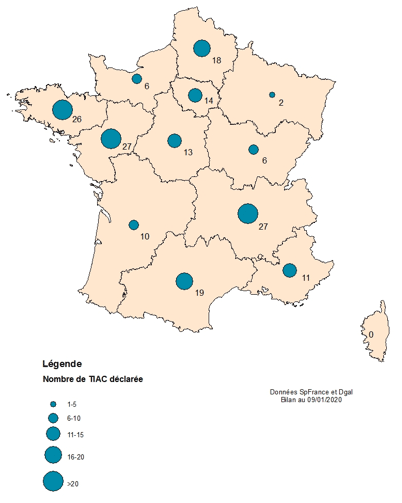
Since the beginning of December 2019, 179 compulsory declarations (DO) of collective food poisoning (TIAC) ​​suspected of being linked to the consumption of raw shellfish, mainly oysters, have been sent to Santé publique France. The reports come from the majority of regions in mainland France (see Figure 1).

Figure 1 – Number of TIAC suspected of being linked to the consumption of raw shellfish, by reporting region. Metropolitan France, December 1, 2019 – January 8, 2020.
Figure 1 - Number of TIAC suspected of being linked to the consumption of raw shellfish, by reporting region.  Metropolitan France, December 1, 2019 - January 8, 2020.

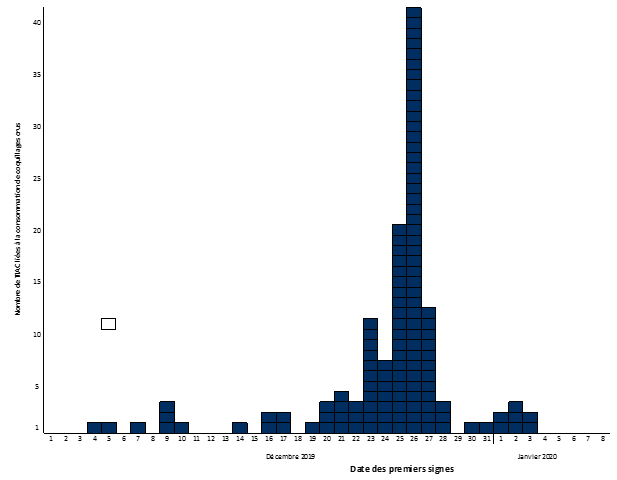
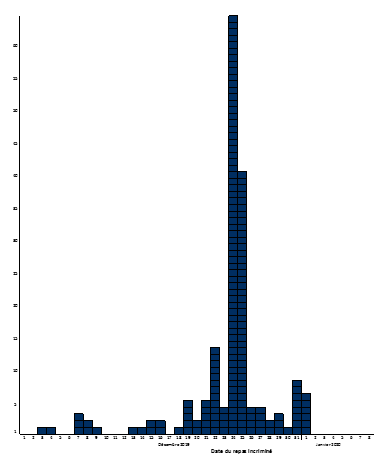
The vast majority (138/179, 77%) of these TIAC occurred from December 23 (Figures 2 and 3). A peak of patients is observed around December 25-27 (Figure 2). The offending meals are grouped around December 24-25 (Figure 3).

A total of 1,033 people were sick, of whom 21 (2%) were hospitalized. Most of them are people over the age of 15. Of the 595 patients with age information, 19 (3.1%) were children under the age of 15. The symptoms, mainly diarrhea and vomiting, as well as the incubation times, are compatible with infections with norovirus or other enteric viruses. Stool tests performed to date by the National Reference Center for Gastroenteritis Viruses have confirmed the presence of norovirus and other enteric viruses.

Figure 2 – Number of TIAC suspected of being linked to the consumption of raw shellfish by date of first signs of patients (information available for 125/179 TIAC). December 1, 2019 – January 8, 2020.
Figure 2 - Number of TIAC suspected of being linked to the consumption of raw shellfish by date of first signs of patients (information available for 125/179 TIAC).  December 1, 2019 - January 8, 2020.
Figure 3 – Number of TIAC suspected of being linked to the consumption of raw shellfish by date of the offending meal (information available for 176/179 TIAC). December 1, 2019 – January 8, 2020.
Figure 3 - Number of TIAC suspected of being linked to the consumption of raw shellfish by date of the offending meal (information available for 176/179 TIAC).  December 1, 2019 - January 8, 2020.

The number of TIAC suspected of being linked to the consumption of raw shellfish is significantly higher than in previous years. Each year between 25 and 120 TIAC suspected of being linked to the consumption of shellfish are reported to Public Health France, of which between 4 and 30 occurred during the December-January periods.

Following reports from TIAC suspected of being linked to the consumption of raw shellfish, the Directorate General for Food (DGAL) in conjunction with the Departmental Directorates in charge of protecting populations (DD (CS) PP) is carrying out an investigation traceability in order to trace back to the production area for suspected shellfish and confirmation analyzes are carried out on the areas concerned. To date, several areas have been closed due to contamination by noroviruses. Zone closings can be viewed on this site:
http://www.atlas-sanitaire-coquillages.fr/ (“Statutes” section)

RASFF Alert – Foodborne Outbreak – Salmonella – Eggs

RASFF-Logo

RASFF – foodborne outbreak suspected to be caused by Salmonella enterica ser. Enteritidis in organic eggs from Italy in France


RASFF Alert – Foodborne Outbreak – Shigella – Fresh Sugar Snap Peas

RASFF-Logo

RASFF – foodborne outbreak suspected to be caused by Shigella sonnei in fresh sugar snap peas from Kenya, via the Netherlands in Norway

RASFF Alerts – Norovirus – Foodborne Outbreak – Live Oysters –

RASFF-Logo

RASFF – foodborne outbreak suspected to be caused by live oysters (Crassostrea gigas) from France

RASFF – foodborne outbreak suspected to be caused by live oysters (Crassostrea gigas) from France

RASFF – foodborne outbreak caused by live oysters from France, via the Netherlands in Sweden

RASFF – norovirus in live mussels from France in Switzerland

RASFF – norovirus in live bouchot mussels from France in the Netherlands

RASFF – norovirus in oysters from France in the Netherlands

RASFF – withdrawal of bivalve molluscs harvested in France because of possible contamination with norovirus in Luxembourg

Australia – Australian Salmonella outbreak grows; bush fires threaten food safety

Food Safety News

kswfoodworld Salmonella

Image CDC

Nearly 90 people are part of a Salmonella outbreak across Australia after eating a particular brand of frozen microwave meals.

A total of 84 people in New South Wales (NSW), Queensland, South Australia, Western Australia and the Australian Capital Territory (ACT) reported eating Core Powerfoods products before becoming sick.

The number of people ill in the Salmonella Weltevreden outbreak previously stood at 46.

Core Ingredients issued a recall in October. Products were available for sale at IGAs and Coles stores nationally, independent retailers in NSW, ACT, Queensland, Victoria, South Australia, Western Australia and the Northern Territory and some Woolworths metro stores in Victoria.

USA – FiveStar Gourmet Foods Voluntary Recalls Fresh Snack Products Due to Possible Health Risk

FDA

MiniMeal2Go-AvocadoToast 6.75oz. top label

FiveStar Gourmet Foods takes issues of food safety seriously and in an abundance of caution is voluntarily recalling two fresh produce snack products, MiniMeal2Go-ProteinPack 8.25oz and MiniMeal2Go- AvocadoToast 6.75oz. due to the notification from Almark Foods of Gainesville, GA that Almark Foods may have supplied single-serve prepackaged Hard Boiled Eggs contaminated with Listeria monocytogenes and its association with a current foodborne illness investigation.

No other FiveStar items are involved with this voluntary recall. There are no reported illnesses to date related to the FiveStar Gourmet Foods products.

MiniMeal2Go-ProteinPack 8.25oz top label


USA – Cyclospora Number One Multistate Food Poisoning Outbreak For 2019

Food Poisoning Bulletin cardcyclosporasme

Cyclospora is the number one multistate food poisoning outbreak for 2019, with more than 2400 people sick. This wasn’t an individual outbreak, but many individual cases and several outbreaks linked to a venue or product. The overall number of domestically acquired cases is higher than those from 2017 and 2018.

hese are the outbreaks of cyclosporiasis linked to a venue or food:

  • An outbreak associated with workplace cafeterias in Virginia that sickened at least 39 people.
  • A large cyclospora outbreak at Cooper’s Hawk Winery in the Jacksonville, Florida area sickened at least 132 people in 11 states.
  • An outbreak in Minnesota sickened 35 people and was associated with three restaurants located in different areas of the state.
  • Cyclosporiasis illnesses in New York City in July sickened more than 90 people.
  • Boston Cyclospora outbreak, also in July, sickened more than 100 people.
  • A cyclospora outbreak linked to Siga Logistics de RL de CV basil imported from Mexico sickened more than 240 people. this was the largest individual outbreak in the overall case count.

RASFF Alert – Foodborne Outbreak -Salmonella – Walnuts

RASFF-Logo

RASFF – foodborne outbreak suspected to be caused by Salmonella in walnuts from Austria in Germany


USA – Salmonella Outbreak at Doug Sauls’ Bar-B-Que & Seafood in NC

Food Poisoning Bulletin

There was a Salmonella outbreak at Doug Sauls’ Bar-B-Que & Seafood in Nash County, North Carolina at the end of November 2019 that sickened almost a dozen people, according to the Nash County Health Department. The restaurant, located at 813 Western Avenue in Nashville, North Carolina is re-opening after being closed on November 22, 2019 by public health officials.