Category Archives: Foodborne Illness

USA – Investigation Update on the Arcadia – Norovirus

CDC

Cruise Line: P&O Cruises

Cruise ShipArcadia

Voyage Dates: December 29, 2022–January 3, 2023

Number of passengers who reported being ill during the voyage out of total number of passengers onboard: 84 of 1,986 (4.23%)

Number of crew who reported being ill during the voyage out of total number of crew onboard: 10 of 818 (1.22%)

Predominant symptoms: vomiting and diarrhea

Causative agent: norovirus

Actions: In response to the outbreak, P&O Cruises and the crew aboard the ship reported the following actions:

  • Increased cleaning and disinfection procedures according to the ship’s outbreak prevention and response plan
  • Collected stool specimens from passenger and/or crew gastrointestinal illness cases
  • Notified embarking guests of the situation onboard and encouraged illness reporting and good hand hygiene.

VSP is monitoring the ship’s outbreak response and sanitation procedures for the current voyage.

Note: The gastrointestinal illness cases reported are totals for the entire voyage and do not represent the number of active (symptomatic) gastrointestinal cases at any given port of call or at disembarkation.

Learn how passengers can protect themselves with these tips for healthy cruising.

Research – Two Outbreaks of Foodborne Gastrointestinal Infection Linked to Consumption of Imported Melons, United Kingdom, March to August 2021 – Salmonella – STEC E.coli

Science Direct

Abstract

The aim of this study was to describe two foodborne outbreaks caused by contaminated imported melon and make recommendations for future practice. Between March and July 2021, there was an outbreak of 113 cases of Salmonella Braenderup in the UK (62% female, median age 61 years, 33% hospitalized). Analytical epidemiological studies identified Galia melons as the vehicle of infection (OR 671.9, 95% CI 39.0–58,074.0, p < 0.001). Subsequently, the outbreak strain was isolated from two samples of Galia melon imported from Latin America. In July and August 2021, there was an outbreak of 17 cases of Shiga toxin-producing Escherichia coli (STEC) O157:H7 in the UK (53% female, median age 21 years, 35% were hospitalized). Review of the STEC surveillance questionnaire data, followed by the analysis of responses from a modified hypothesis-generating questionnaire, implicated eating precut watermelon from retailer B sourced from Europe as the vehicle of infection. Outbreaks of gastrointestinal pathogens caused by contaminated food of nonanimal origin are a global public health concern. Given the difficulty in removing pathogens from the flesh of ready-to-eat fruit and vegetables, public health interventions should target all steps of the food chain prior to consumption, from cultivation on the farm to processing/packing and distribution.

India – 100 people suffer food poisoning after baptism ceremony in Kerala; case filed, probe underway

India Today

Over 100 people suffered food poisoning after consuming food served at a baptism ceremony in Kerala last Thursday. Police have registered a case and are conducting further investigations.


Australia – At Least 70 Contract Salmonella Following Conference at the Crown Plaza Terrigal Pacific Hotel

Food Poisoning News

A hotel on the New South Wales Central Coast suffered from a severe food poisoning outbreak of Salmonella after approximately 70 out of 230 people who attended a two-day conference at the Crown Plaza Terrigal Pacific hotel on November 30th fell ill. A total of 27 out of the 70 illnesses have now been confirmed by medical professionals as cases of Salmonella.

The NSW Food Authority are currently investigating the cause of this outbreak and urges, “anyone who felt unwell or had concerns after the conference should seek medical care, get in touch with their local public health unit, or contact conference organizers, the Aboriginal Languages Trust.”

Authorities are continuing to investigate food that may have been contaminated at the conference, and for the time being, the hotel’s kitchen has voluntarily closed, though “it is required to do [so] under the Food Act of 2003.”

USA – Outbreak Investigation of Salmonella: Sprouts (December 2022)

FDA

The U.S. Food and Drug Administration (FDA), along with the Centers for Disease Control and Prevention (CDC) and state and local partners, is investigating a multistate outbreak of Salmonella Typhimurium infections. FDA’s traceback investigation is ongoing but has identified Sun Sprouts brand alfalfa sprouts grown by CW Sprouts Inc., doing business as (DBA) SunSprout Enterprises of Fremont, NE as a likely source of illnesses in this outbreak.

Based on the epidemiologic information provided by the CDC along with interviews conducted by state and local public health officials, the individuals identified in this outbreak reported consuming alfalfa sprouts prior to their illness onset, either at local restaurants or in their homes after purchasing from local grocery stores. Preliminary traceback evidence indicates that the restaurants and grocery stores identified in this outbreak received alfalfa sprouts from SunSprout Enterprises. Additionally, two of the individuals identified in this outbreak confirmed they had purchased Sun Sprouts brand alfalfa sprouts from their local grocery store. Whole Genome Sequencing (WGS) conducted on clinical samples collected from ill individuals identified 15 isolates that matched the outbreak strain: OK (1), NE (8), and SD (6). WGS for additional clinical isolates are still pending sequencing.

On December 29, 2022, SunSprout Enterprises initiated a voluntary recall of two lots (# 4211 and 5211) of raw alfalfa sprouts due to potential contamination with Salmonella. On the same day, SunSprout Enterprises expanded their voluntary recall to include two additional lots (# 3212, and 4212) of raw alfalfa sprouts. The raw alfalfa sprouts for all recalled lots (#4211, 5211, 3212, and 4212) are packaged in 4-ounce clamshells and 2.5 lb packages with best sold by dates between 12/10/2022 and 1/7/2023.

The investigation is ongoing to determine the source of contamination and whether additional products are linked to illnesses. FDA will update this advisory should additional consumer safety information become available.

Recommendation

Advice for consumers, restaurants, and retailers: Consumers, restaurants, and retailers should not eat, sell, or serve recalled Sun Sprouts brand alfalfa sprouts.

Consumers, restaurants, and retailers should check their refrigerators for recalled Sun Sprouts brand alfalfa sprouts with best by dates between 12/10/2022 and 1/7/2023. If you purchased or used recalled alfalfa sprouts, you should use extra vigilance in cleaning and sanitizing any surfaces that may have come in contact with these products, to reduce the risk of cross contamination.

If you or someone in your household ate Sun Sprouts alfalfa sprouts and have symptoms of salmonellosis, please contact your healthcare provider.

Suppliers and Distributors: Suppliers, distributors and others in the supply chain should not use, ship or sell recalled alfalfa sprouts grown by SunSprout Enterprises. If there has been potential cross-contamination or mixing of recalled alfalfa sprouts with products from other sources, suppliers and distributors should not use any comingled and potentially cross-contaminated product and should use extra vigilance in cleaning any surfaces and storage areas that may have come into contact with recalled alfalfa sprouts.

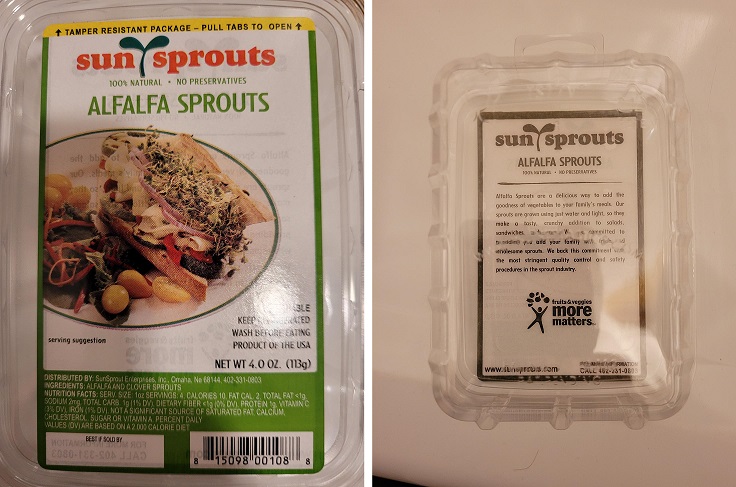
Product Images

Recalled products include raw alfalfa sprouts sold in 4-ounce clamshells and 2.5 Ib packages, with best by dates between 12/10/2022 and 1/7/2023.

Outbreak Investigation of Salmonella from Sprouts (December 2022) - Product Image

Case Count Map Provided by CDC

Outbreak Investigation of Salmonella from Sprouts (December 2022) - CDC Distribution Map as of 12/30/2022

Case Counts

Total Illnesses: 15
Hospitalizations: 2
Deaths: 0
Last illness onset: 12/13/2022
States with Cases: NE, OK, SD

USA – FDA Warning Letter Big Olaf Creamery LLC dba Big Olaf – Listeria monocytogenes

FDA

The United States Food and Drug Administration (FDA) inspected your ready-to-eat (RTE) ice cream manufacturing facility, located at 2001 Cattlemen Rd Unit 123, Sarasota, Florida, from July 19 to September 01, 2022. The inspection was initiated as part of a joint investigation with the Florida Department of Health (FL DOH) and Florida Department of Agriculture & Consumer Services (FDACS) of a multistate outbreak of Listeria monocytogenes (L. monocytogenes) infections linked to ice cream supplied by your facility. According to the Centers for Disease Control and Prevention (CDC), 28 ill people from 11 states were infected with the outbreak strain of L. monocytogenes. On July 13, 2022, your firm recalled all ice cream products, lots, and expiration dates of Big Olaf brand ice cream through June 30, 2022, because they had the potential of being contaminated with L. monocytogenes. CDC and FDA have determined, based upon the epidemiological data and Whole Genome Sequencing (WGS) matches between clinical and FDACS environmental and finished product samples that ice cream manufactured at this facility was the source of this multistate L. monocytogenes outbreak.

During the inspection of your facility, FDA found serious violations of the Current Good Manufacturing Practice, Hazard Analysis, and Risk-Based Preventative Controls for Human Food regulation (CGMP & PC rule), Title 21, Code of Federal Regulations, Part 117 (21 CFR Part 117).

FDA – Core Outbreak Table Updates – Investigations of Foodborne Illness Outbreaks

FDA

What’s New

  • A multistate outbreak of Salmonella Typhimurium (reference #1137) has been added to the table. The Nebraska Department of Health and Human Services and the Nebraska Department of Agriculture issued an advisory regarding illnesses in their state. Preliminary information gathered by state partners indicates that patients consumed alfalfa sprouts prior to becoming ill. FDA’s investigation is underway to confirm the product causing illnesses and additional information will be provided when it becomes available.

Singapore – Lifting of suspension of Rasel Catering Singapore after Food Poisoning Outbreak

SFA

The Singapore Food Agency (SFA) has lifted the suspension of Rasel Catering Singapore Pte Ltd located at 253 Pandan Loop Singapore 128432 today. As the licensee has implemented the required measures as stipulated by SFA, operations can be resumed.

The Ministry of Health (MOH) and SFA received reports of gastroenteritis involving 345 persons after consuming food prepared by Rasel Catering Singapore Pte Ltd between 8 and 16 November 2022. None were hospitalised. To protect consumers from further public health risks, the food business operations of Rasel Catering Singapore Pte Ltd was suspended by SFA from 18 November to 29 December 2022.

Austrian firm in financial difficulty following a deadly Listeria outbreak

Food Safety News

A company in Austria that was linked to a deadly Listeria outbreak earlier this year is in financial trouble.

AKV, an association to protect creditor rights recognized by Austrian authorities, deals with insolvency cases in courts.

It reported that Käserei Gloggnitz can no longer meet its payment obligations. Insolvency proceedings have been opened by the regional court in Wiener Neustadt. A hearing is planned for early February 2023.

The reasons for the insolvency position are unknown, according to AKV. So the impact of the Listeria monocytogenes incident on the company is unclear.

As part of the proceedings, it will have to be checked whether the dairy producer will be continued and restructured or if existing assets will be inventoried and valued.

Research – Study Confirms that Raw Milk Is Linked to Foodborne Illness

Food Poisoning Bulletin

A new study has confirmed that raw milk is linked to foodborne illness. During the time period of 2013 to 2018, 75 outbreaks that caused 675 illnesses were linked to unpasteurized milk. Of these illnesses, almost half were among children and teenagers aged o to 19 years. Given that the consumption of raw milk is low in this country, with only about 1 to 2% of the adult population buying it, these numbers are shocking. The study points out that almost 80% of those outbreaks occurred in states where the sale of raw milk is allowed.