
RASFF – shigatoxin-producing Escherichia coli (stx1+ stx2+ /25g) and too high counts of coliforms (>150000 /g) and of Escherichia coli (>150000 /g) in black pepper cheese from Italy in Germany

RASFF – shigatoxin-producing Escherichia coli (stx1+ stx2+ /25g) and too high counts of coliforms (>150000 /g) and of Escherichia coli (>150000 /g) in black pepper cheese from Italy in Germany
Fromagerie Alpine is recalling all batches of the below Saint-Marcellin unpasteurised cheeses due to the possible presence of Shiga toxin-producing Escherichia coli (STEC) O26. Point-of-sale recall notices will be displayed in retailers that sold the affected batches advising consumers not to eat the affected cheese.
Shiga toxin-producing Escherichia coli (STEC), also known as Verocytotoxigenic E. coli (VTEC), are a specific group of E. coli. While most E. coli are harmless and live in the intestines of healthy humans, STEC produce a powerful toxin which can cause severe illness. Symptoms include abdominal cramps and diarrhoea which is sometimes bloody. Usually there is little or no fever, and patients recover within 5 to 10 days. In some people however, particularly children under 5 years of age and the elderly, the infection can cause a complication called haemolytic uraemic syndrome (HUS), in which the red blood cells are destroyed and the kidneys can stop working properly. The time between the initial infection and the first symptoms appearing is typically between 3 and 4 days but can range between 1 and 8 days.
.jpg "Implicated Cheeses")

Tesco is recalling all batches of Tesco Finest St Félicien Du Dauphiné unpasteurised cheese, due to the possible presence of Shiga toxin-producing Eschericia coli. Point-of-sale recall notices will be displayed in Tesco stores advising consumers not to eat the affected cheese.
Shiga toxin-producing Escherichia coli (STEC), also known as Verocytotoxigenic E. coli (VTEC), are a specific group of E. coli. While most E. coli are harmless and live in the intestines of healthy humans, STEC produce a powerful toxin which can cause severe illness. Symptoms include abdominal cramps and diarrhoea which is sometimes bloody. Usually there is little or no fever, and patients recover within 5 to 10 days. In some people however, particularly children under 5 years of age and the elderly, the infection can cause a complication called haemolytic uraemic syndrome (HUS), in which the red blood cells are destroyed and the kidneys can stop working properly. The time between the initial infection and the first symptoms appearing is typically between 3 and 4 days but can range between 1 and 8 days.

| Pack size | 180g |
| Lot number | All lot numbers from 032 to 116 |
| Use by | All date codes |
| Pack size | 80g |
| Lot number | All lot numbers from 032 to 116 |
| Use by | All date codes between 8 March 2019 and 16 June 2019 |
No other Fromagerie Alpine products are known to be affected.
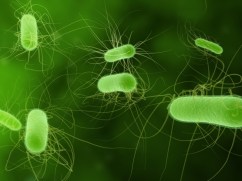
Image CDC
Canada is one of a number of countries that has received raw milk cheese linked to an outbreak of E. coli O26 in France.
French authorities reported 13 cases of hemolytic uremic syndrome (HUS) in young children since March 21. HUS is a severe complication of E. coli infection that causes kidney failure and can occur a week or more after the onset of diarrhea.
Two types of French cheese have been recalled in Germany over fears they could be contaminated with E.coli O26, just a few days after a similar scare in France, the German food safety authority announced on Tuesday.
French cheesemaker, Fromagerie Alpine, has been asked to recall its cheeses Saint-Felicien and Saint-Marcellin, sold in Germany under the name “Xavier David, tradition of good cheese, Alpine”, the authority said.
The decision was a precaution over concerns the brands could have been contaminated with the bacteria E.coli type 026, commonly found in the intestines of humans, livestock and other animals.
Ottawa, April 29, 2019 – La Fromagerie Hamel is recalling Le Pic brand “Saint-Félicien” cheese from the marketplace due to possible E. coli O26 contamination. Consumers should not consume the recalled product described below.
| Brand Name | Common Name | Size | Code(s) on Product | UPC |
|---|---|---|---|---|
| Le Pic | Saint-Félicien | 180 g | All codes up to and including April 29, 2019 | 0 20060641300 0 |
Public Health investigated an outbreak of Shiga toxin-producing E. coli (STEC) associated with I Love Sushi and Café Mario at Nintendo of America campus in Redmond. Café Mario is operated by Sodexo and is not open to the public. I Love Sushi is a food establishment that operates out of Café Mario once a week.
This outbreak appears to be over. After a thorough investigation, we do not have enough evidence to connect I Love Sushi to this outbreak.. No single food item prepared by Café Mario has been identified as the source of the illnesses. Everyone who reported illness has recovered.
As of this week, a total of 156 people infected with the outbreak strain of E. coli O103 have been reported from 10 states – Minnesota, Illinois, Indiana, Ohio, Kentucky, Tennessee, Virginia, Mississippi, Georgia and Florida.
To date there have been two recalls. Link between two producers of meat and the recalls remain unclear (How are the two connected? Presumably a common supplier?) except that both recalls were prompted by positive E. coli O103 tests on “Unopened, intact, packages of ground beef collected as part of the ongoing investigation tested positive for E. coli O103 at an FSIS laboratory.”
It is likely that more recalls will happen as FSIS, CDC and state health authorities continue their efforts to find the source.
What we know is that illnesses began March 1 and it is now almost May 1 – why did it take so long to figure out that 177 people with E. coli O103 were linked to ground beef? Why do we do not yet know the original source of the contamination? Why is the public not being told the location where known illnesses occurred? Finally, are more people going to get sick?
Posted in E.coli, E.coli O103, food bourne outbreak, Food Hygiene, Food Illness, Food Inspections, Food Micro Blog, Food Microbiology, Food Microbiology Blog, Food Poisoning, food recall, Food Safety, Food Safety Alert, Food Testing, Food Toxin, foodborne outbreak, foodbourne outbreak, outbreak, STEC, Uncategorized
Grant Park Packing of Franklin, Illinois is recalling about 53,200 pounds of North Star Imports raw ground beef products that may be contaminated with E. coli O103. The USDA notice states that “Further testing is ongoing to determine if the recalled ground beef products are related to the E. coli O103 outbreak.” That outbreak has sickened at least 156 people in 10 states.
RASFF – aflatoxins (B1 = 5 µg/kg – ppb) in blanched groundnuts from the United States in the Netherlands
RASFF – aflatoxins (B1 = 4.1 µg/kg – ppb) in groundnuts from the United States in the Netherlands
RASFF – aflatoxins (B1 = 5 µg/kg – ppb) in groundnut kernels from Argentina in the Netherlands
RASFF – aflatoxins (B1 = 7.3; Tot. = 8.3 µg/kg – ppb) in blanched groundnuts from the United States in the Netherlands
RASFF – aflatoxins (B1 = 34; Tot. = 38 µg/kg – ppb) in pistachio kernels from Iran in France
RASFF – aflatoxins (B1 = 38; Tot. = 51 µg/kg – ppb) in organic hazelnut kernels from Azerbaijan in Germany
RASFF – aflatoxins (B1 = 29; Tot. = 32 µg/kg – ppb) in dried figs from Turkey in France
RASFF – aflatoxins (B1 = 17.8 µg/kg – ppb) in shelled almonds from the United States in Spain
RASFF – aflatoxins (B1 = 29; Tot. = 32 µg/kg – ppb) in shelled pistachios from Turkey in France
RASFF – aflatoxins (B1 = 20; Tot. = 26 µg/kg – ppb) in roasted organic pistachios in shell from Turkey in France
RASFF – aflatoxins (B1 = 8.9; Tot. = 35.2 µg/kg – ppb) in hazelnut kernels from Georgia in Bulgaria
RASFF – aflatoxins (B1 = 55.4; Tot. = 70.4 µg/kg – ppb) in peanuts with shell from Egypt in Germany
RASFF – aflatoxins (B1 = 10.9 µg/kg – ppb) in hazelnut kernels from Azerbaijan in Bulgaria
RASFF – aflatoxins (B1 = 7; Tot. = 8.1 µg/kg – ppb) in peanut kernels from China in Bulgaria


 FoodWorld