Category Archives: Food Poisoning

New Zealand -Marine biotoxin in shellfish for Waihi Beach in the Waikato/Bay of Plenty region

MPI

The Ministry for Primary Industries (MPI) today issued a public health warning advising the public not to collect or consume shellfish harvested from the southern end of Pauanui Beach down to the northern tip of Mount Maunganui, including the Tauranga Harbour.

Routine tests on shellfish samples taken from this region have shown levels of paralytic shellfish poisoning (PSP) toxins above the safe limit of 0.8 mg/kg set by MPI. Anyone eating shellfish from this area is potentially at risk of illness. Please help keep your whānau safe over the Christmas break and avoid collecting shellfish from the affected area.

Due to currents and prevailing winds going in the opposite direction, the presence of toxic shellfish are not believed to be related to the recent eruption of White Island.

Map showing the affected area

Hong Kong – CFS announces food safety report for October

CFS

The Centre for Food Safety (CFS) of the Food and Environmental Hygiene Department today (November 29) released the findings of its food safety report for the last month. The results of about 16,400 food samples tested were satisfactory except for 21 samples and they were announced earlier. The overall satisfactory rate was 99.9 per cent.

A CFS spokesman said about 1,800 food samples were collected for microbiological tests, some 5,500 samples were taken for chemical tests and the remaining 9,100 (including about 8,400 taken from food imported from Japan) were collected to test radiation levels.

The microbiological tests covered pathogens and hygiene indicators, while the chemical tests included pesticides, preservatives, metallic contaminants, colouring matters, veterinary drug residues and others.

The samples comprised about 4,200 samples of vegetables and fruit and their products; 1,100 samples of cereals, grains and their products; 1,300 samples of meat and poultry and their products; 1,200 samples of milk, milk products and frozen confections; 2,000 samples of aquatic and related products; and 6,600 samples of other food commodities (including beverages, bakery products and snacks).

The 21 unsatisfactory samples comprised eight frozen confection samples detected with counts of hygiene indicator organisms exceeding the legal limits; three crab samples, one vegetable sample and one rice sample detected with excessive cadmium; two silver cod samples detected with mercury exceeding the legal limit; a fresh beef sample found to contain sulphur dioxide; a pickled green mustard sample detected with excessive preservative; a roast drumstick sample found to contain excessive Bacillus cereus; a vegetable sample detected with excessive pesticide residue; a nutmeg powder sample contaminated with aflatoxins; and a chilled chicken sample found to contain veterinary drug residue.

The CFS has taken follow-up action on the unsatisfactory samples, including informing the vendors concerned of the test results, instructing them to stop selling the affected food items and tracing the sources of the food items in question.

Since the Pesticide Residues in Food Regulation (Cap 132CM) came into effect on August 1, 2014, as of October 31 this year, the CFS has taken over 189,500 food samples at import, wholesale and retail levels for testing for pesticide residues. The overall unsatisfactory rate is less than 0.2 per cent.

The spokesman added that excessive pesticide residues in food may arise from the trade not observing Good Agricultural Practice, e.g. using excessive pesticides and/or not allowing sufficient time for pesticides to decompose before harvesting. The maximum residue limit (MRL) of pesticide residues in food is not a safety indicator. It is the maximum concentration of pesticide residues to be permitted in a food commodity under Good Agricultural Practice when applying pesticides. In this connection, consumption of food with pesticide residues higher than the MRL will not necessarily lead to any adverse health effects.

The spokesman reminded the food trade to ensure that food for sale is fit for human consumption and meets legal requirements. Consumers should patronise reliable shops when buying food and maintain a balanced diet to minimise food risks.

Information – Food Net Fast – CDC Tool

FoodNet Fast

FoodNet Fast Logo


FoodNet Fast provides online access to information reported to the Foodborne Diseases Active Surveillance Network (FoodNet). FoodNet’s surveillance area includes about 15% of the U.S. population.

You can use FoodNet Fast tools to search data and see results displayed on interactive graphs and charts.

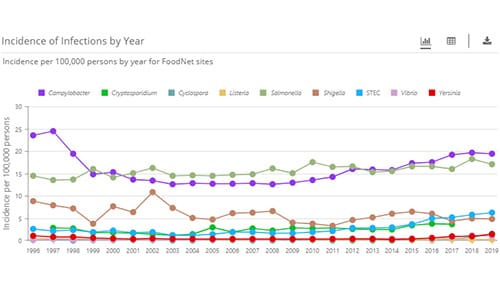
  • Pathogen Surveillance Tool: See how rates of illness have changed in FoodNet’s surveillance area since 1996 for nine pathogens transmitted commonly through food: CampylobacterCryptosporidium *Cyclospora, Listeria, Salmonella, Shiga toxin-producing Escherichia coli (STEC), Shigella, Vibrio, and Yersinia.
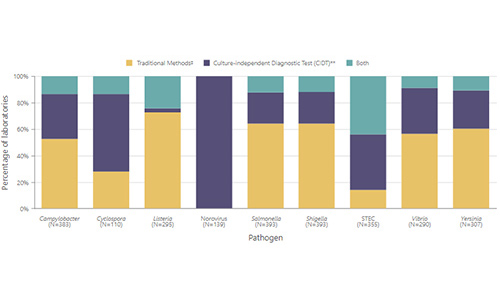
  • Diagnostic Laboratory Practices Tool: Find out how diagnostic testing practices in FoodNet’s surveillance area have changed over time for 10 pathogens: CampylobacterCryptosporidium *CyclosporaListerianorovirusSalmonella, STEC, ShigellaVibrio, and Yersinia.
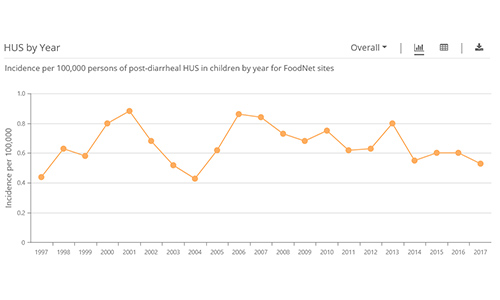
  • Hemolytic Uremic Syndrome (HUS) Surveillance Tool: HUS is a life-threatening condition, most often triggered by STEC infection. See how rates of pediatric HUS and STEC infection have changed in FoodNet’s surveillance area since 1997.

As of January 1, 2018, FoodNet no longer conducts active surveillance for Cryptosporidium.

Background Information

Start exploring FoodNet Fast now – or click the boxes below for more information.

Pathogen Surveillance Tool FAQ

Graphic chart of Pathogen Surveillance Tool FAQ

Laboratory Practices Tool FAQ

Graphic chart of Laboratory Practices Tool FAQ

HUS Surveillance Tool FAQ

Graphic chart of Laboratory Practices Tool FAQ

Canary Islands – Ciguatera outbreak reported in the Canary Islands

Outbreak News Today File:Gambierdiscus toxicus NOAA.png

Health officials with the Government of the Canary Islands have reported a possible outbreak of ciguatera after finding six cases of food poisoning after consuming black medregal (amberjack) in La Victoria de Acentejo, according to a El Dia report (computer translated).

Ciguatera is not unknown in the Canary Island reporting several cases annually and some 20 outbreaks in the past decade.

More than 400 species of fish, including barracuda, black grouper, blackfin snapper, cubera snapper, dog snapper, greater amberjack, hogfish, horse-eye jack, king mackerel, and yellowfin grouper have been implicated in this food borne illness that’s relatively common in several areas of the world.

This toxin is the result of the accumulation of marine algae and the toxins they produce passing up the food chain. These marine algae hang on to dead coral and seaweed. They are then eaten by herbivore fish which are subsequently eaten by predatory reef fish which concentrates the toxin in its tissue. People get this food borne toxin from eating these contaminated larger fish. The reef fishes are more likely to get contaminated during storms and other turbulence.


Information – Handling Flour Safely: What You Need to Know

FDA

Flour is a raw food. It may not look like a raw food, but it usually is, just like fresh tomatoes or carrots. The grains from which flour is ground are grown in fields and, like all foods grown outdoors, they may be exposed to a variety of harmful bacteria like Salmonella and pathogenic Escherichia coli (E. coli).

5 Important Things to Know About Flour

  1. Flours most commonly used in home baking and cooking are made directly from raw grains.
  2. Processing raw grains into flour does not kill harmful bacteria.
  3. Many foods made with flour also contain raw eggs, which may contain harmful bacteria.
  4. Cooking is the only way to be sure that foods made with flour and raw eggs are safe.
  5. Never eat or taste raw flour, dough, or batter.

OUTBREAK

Since 2009 there have been several outbreaks of foodborne illness involving raw flour or raw flour-containing products like cake mixes and cookie dough. These have resulted in 168 known illnesses and 20 hospitalizations.

Dos and Don’ts of Handling Flour

Check out this list of DO’s and DON’Ts to help keep you and your family safe when handling raw flour.

  • DO follow package directions on baking mixes and other flour containing products for correct cooking temperatures and specified times.
  • DO keep all raw foods, like flour and eggs, separate from ready-to eat foods. Remember, flour is a powder and spreads easily.
  • DO refrigerate cookie and pastry dough according to package directions. Use a refrigerator thermometer to be sure your refrigerator is at a safe 40°F.
  • DO clean up carefully after working with flour or raw dough and eggs:
    • Wash hands thoroughly with soap and running water, and,
    • Wash utensils, bowls, baking pans and cutting boards, and countertops with warm, soapy water.
  • DO NOT eat or allow children to eat or play with raw dough products made with any brand of flour or baking mix before cooking.
  • DO NOT keep recalled flour. Throw it away.
  • DO NOT let children use raw dough for crafts or play clay.
  • DO NOT use products that contain raw flour, like cake mix to make milkshakes.
  • DO NOT use raw cookie dough in ice cream (the cookie dough in ice cream sold in stores has been treated to kill harmful bacteria).

USA – Ohio Romaine Outbreak Sickens 12 with E. coli O157:H7 Infections

Food Poisoning Bulletin

The Ohio romaine outbreak has sickened 12 people with E. coli O157:H7 infections, making it the state with the second most illnesses after Wisconsin, with 33 cases as of December 9, 2019. Overall, at least 102 people are sick across the country, with 58 hospitalized and 10 who have developed hemolytic uremic syndrome (HUS), a type of kidney failure.

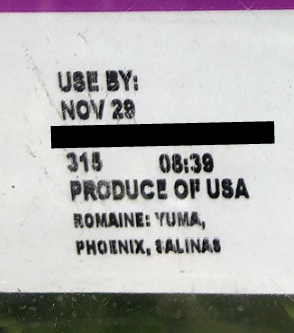
Most romaine products, including baby romaine, chopped romaine, organic romaine, hearts of romaine, romaine in salad wraps, salad bowl kits, sandwiches, packages of precut lettuce, and salad mixes that contain romaine, may be marked with the growing region. This is a voluntary policy put into place after last year’s two romaine E. coli O157:H7 HUS outbreaks. If the label says “Salinas” anywhere, or if the package is unmarked, don’t eat the romaine.

The CDC and FDA have stated that there is one grower associated with all three E. coli O157:H7 romaine outbreaks that are ongoing, but that grower has not been named. Officials have inspected three farms in the Salinas region, but has not named those.

UK – Scotland -FSS issues festive food poisoning warning

HPS

17 December 2019

Article: 53/5007

Food Standards Scotland (FSS) is reminding people to reduce the risk of food poisoning over the festive period by ensuring they follow good food safety practices.

Results from the latest FSS Food in Scotland Consumer Tracking Survey reveal that almost three-quarters of Scots (72%) completely fill their fridge at least some of the time, but only 12% always remember to check the temperature when it’s full. This is an essential measure, as a fridge temperature between zero and five degrees centigrade will help slow the growth of food poisoning bacteria, whilst overfilling can raise the fridge temperature.

FSS has created a downloadable food safety checklist which serves as a reminder when carrying out the different stages of preparing, cooking and eating Christmas dinner, as well as storing leftovers.

Source: FSS, 13 December 2019

Russia -Salmonella sickens dozens in Khanty-Mansiysk, Russia

Outbreak News Today

Salmonella was laboratory confirmed in 35 of 73 pupils of Wonderland kindergarten in Khanty-Mansiysk who were infected with acute intestinal infection, city administrators report.

The Tass news service reports, “As of December 13, 73 cases were registered, four children were hospitalized in the children’s infectious ward of the district clinical hospital, and 35 children were laboratory confirmed with Salmonellosis group D,” Rimir Gimalov, the head of the public health department of the city administration, said in a statement.

According to local authorities, all necessary anti-epidemic measures are being carried out in the kindergarten. The institution was closed for quarantine.

USA -Statement on new findings and current status of the romaine lettuce E. coli O157:H7 outbreak investigation

FDA

Today, the U.S. Food and Drug Administration is providing an update on our investigation of an outbreak of E. coli O157:H7 illnesses linked to romaine lettuce. The FDA takes our responsibility of protecting the public from unsafe food very seriously and is committed to providing the public with more information as it becomes available.

Outbreaks Reported

Early on, based on test results provided by the Maryland Department of Health, our investigation pointed to farms in Salinas, California, as potential sources of contaminated romaine lettuce based on the initial, limited number of reported illnesses. The FDA, in partnership with the California Department of Public Health and the California Department of Food and Agriculture, rapidly mobilized in November to concurrently deploy inspection teams to the farms identified through the initial traceback investigation. The on-site investigations at these farms included collecting a wide-variety of samples for lab testing, including water, soil, soil amendments, scat and swab samples. While the majority of these samples tested negative for the outbreak strain, final results are pending and the Wisconsin Department of Health Services recently reported that it had isolated E. coli O157:H7 from a particular bag of pre-washed, chopped romaine lettuce.

The FDA has also been tracking two additional and separate outbreaks of E. coli O157:H7.

Earlier this week, the FDA, U.S. Centers for Disease Control and Prevention (CDC), and the Canadian Food Inspection Agency announced an outbreak linked to Fresh Express Sunflower Crisp Chopped Salad Kits. To date, the CDC reported eight confirmed cases in the U.S. across three states associated with this cluster of illnesses.The Public Health Agency of CanadaExternal Link Disclaimer also reports 24 cases in six Canadian provinces.

Concurrently, the FDA has been working with health officials in Washington State regarding an outbreak of E. coli O157:H7 associated with romaine consumption at a local restaurant chain. Washington State officials reported 10 confirmed and three probable cases in this outbreak with all reports of exposure in early to mid-November.

It should be noted; these are currently being considered as three separate outbreaks caused by three different strains of E. coli O157:H7.

USA -Investigation of E. coli O157:H7 Outbreak Linked to Romaine from Salinas, California, November 2019

FDA

December 12, 2019

Case Counts

Total Illnesses: 102
Hospitalizations: 58
Deaths: 0
Last illness onset: November 18, 2019
States with Cases:  AZ (3), CA (4), CO (6), FL (1), IA (1), ID (3), IL (1), MD (4), MI (1), MN (3), MT (1), NE (1), NJ (7), NC (1), NM (2), OH (12), OR (1), PA (8), SD (1), TX (4), VA (4), WA (2), WI (31)

Recommendation

FDA, CDC, and state health authorities are investigating an outbreak of illnesses caused by E. coli O157:H7 in the United States. Epidemiologic, laboratory, and traceback evidence indicates that romaine lettuce from the Salinas, California growing region is a likely source of this outbreak. According to CDC, there have been 102 cases reported in 23 states.  The latest date that one of these patients reports becoming ill was on November 18, 2019.

Romaine from Salinas, California Label Enjoy By December 2, 2019


Romaine from Salinas, California Label Use By November 29, 2019

Consumers: Consumers should not eat romaine lettuce harvested from Salinas, California. Additionally, consumers should not eat products identified in the recall announced by the USDA on November 21, 2019.

Romaine lettuce may be voluntarily labeled with a harvest region. If this voluntary label indicates that the romaine lettuce was grown in “Salinas” (whether alone or with the name of another location) do not eat it. Throw it away or return it to the place of purchase.  If romaine lettuce does not have information about harvest region or does not indicate that it has been grown indoors (i.e., hydroponically- and greenhouse-grown), throw it away or return it to the place of purchase. Consumers ordering salad containing romaine at a restaurant or at a salad bar should ask the staff whether the romaine came from Salinas.  If it did, or they do not know, do not eat it.

At this time, romaine lettuce that was harvested outside of the Salinas region has not been implicated in this outbreak investigation. Hydroponically- and greenhouse-grown romaine, which is voluntarily labeled as “indoor grown,” from any region does not appear to be related to the current outbreak. There is no recommendation for consumers to avoid using romaine harvested from these other sources.

Restaurants and Retailers: Restaurants and retailers should not serve or sell romaine harvested from Salinas, California.  If you do not know the source of your romaine lettuce, and if you cannot obtain that information from your supplier, you should not serve, nor sell it.

Suppliers and Distributors: Suppliers, distributors and others in the supply chain should not ship or sell romaine harvested in Salinas, California. If the source of the romaine lettuce is unknown, you should not ship, nor sell the product.

For Restaurants, Retailers, Suppliers and Distributors: Currently, the FDA does not have enough traceback information to identify the specific source of the contamination that would allow us to request a targeted recall from specific growers.

FDA requested that industry voluntarily withdraw romaine grown in Salinas from the market and is requesting that industry withhold distribution of Salinas romaine for the remainder of the growing season in Salinas. Without more specific traceback information, this was the most efficient way to ensure that contaminated romaine was off the market.

At this time, romaine lettuce that was harvested outside of the Salinas region has not been implicated in this outbreak investigation. Hydroponically- and greenhouse-grown romaine, which is voluntarily labeled as “indoor grown,” from any region does not appear to be related to the current outbreak. There is no recommendation for consumers or retailers to avoid using romaine harvested from these other sources.

Update

Based on the information indicating that ill people in Maryland were exposed to romaine lettuce harvested in Salinas, California, FDA, with the assistance of staff from the California Department of Public Health and the California Department of Food and Agriculture, immediately deployed investigators to three farms in the Salinas area that were identified based on the traceback investigation.

FDA continues to actively investigate the cause of this outbreak. Additionally, FDA is investigating two other E. coli outbreaks, each caused by strains that are different from each other and different from the larger outbreak. One of the additional outbreaks, in Washington state, is linked to romaine lettuce, and the other outbreak, with cases in the U.S. and Canada, is linked to Fresh Express Sunflower Crisp Chopped Salad Kits. As part of these investigations, FDA and state partners are conducting traceback investigations to trace romaine exposures to the source.

Currently, the tracebacks on all three outbreaks have identified a common grower in Salinas. FDA, CDC, and California partners are deploying a team to conduct new investigations at several ranches used by this grower as we try to identify the source of the contamination.