Category Archives: Food Pathogen

RASFF Alert – Norovirus – Frozen Seaweed Salad

RASFF-Logo

RASFF – norovirus (GII /25g) in frozen seaweed salad from Taiwan in Italy

RASFF Alerts – Salmonella – Sesame Seeds – Black Pepper – Salted Chicken Fillets – Chilled Smoked Bacon – Ginger

RASFF-Logo

RASFF – Salmonella (in 1 out of 5 samples /25g) in sesame seeds from Sudan in Greece

RASFF – Salmonella (presence /25g) in sesame seeds from Sudan in Greece

RASFF – Salmonella (presence /25g) in black pepper from Brazil in the Netherlands

RASFF – Salmonella enterica ser. Kedougou (presence /25g) in frozen salted chicken fillets from Thailand, via the Netherlands in Finland

RASFF – Salmonella (presence /25g) in sesame seeds from India in Poland

RASFF – Salmonella (presence /25g) in sesame seeds from Sudan in Greece

RASFF – Salmonella (presence /25g) in sesame seeds from Sudan in Greece

RASFF – Salmonella (presence /25g) in frozen salted chicken half breasts from Brazil in the Netherlands

RASFF – Salmonella (presence /25g) in chilled smoked bacon from Belgium in France

RASFF – Salmonella enterica ser. Enteritidis (presence /25g) in frozen chicken fillets from Poland in France

RASFF – Salmonella (presence /25g) in ginger from Italy, with raw material from Nigeria, via Poland in Italy

Canada – The Deli-Shop Pâtés Recalled in Canada For Possible Listeria

Food Poisoning Bulletin

Les Spécialités Prodal (1975) Ltée is recalling certain The Deli-Shop Pâtés from the marketplace for possible Listeria monocytogenes contamination. There have been no reported illnesses conducted with the consumption of these recalled products. The Pâtés were sold in Quebec at the retail level.

The recalled products are all The Deli-Shop brand. They are: Country-style Pâté – Cognac packaged in 150 gram sizes, with UPC number 0 59749 95188 3 and code 2019SE26; Country-style Pâté – Pepper in 150 gram packages, with UPC number 0 59749 95189 0 and code 2019SE26; and Country-style Pâté – Old Fashioned, also sold in 150 gram packages, with UPC number 0 59749 95187 6 and code 2019SE26.

Also recalled is Liver Pâté – Fine Herbs, packaged in 150 gram containers, with UPC number 0 59749 95191 3 and code 2019SE26; Liver Pâté – Garlic, sold in 150 gram containers and with UPC number 0 59749 95190 6 and code 2019SE26; and Liver Pâté – Old Fashioned, packaged in 150 gram containers with UPC number 0 59749 95192 0 and code 2019SE26.

The recalled was triggered by Canadian Food Inspection Agency (CFIA) test results. The CFIA is conducting a food safety investigation, which may lead to the recall of more products. If more products are recalled, they will be listed on the web site. You can see pictures of the recalled product labels at the CFIA web site.

Information -Don’t be too chill about frozen berries, illness

The Columbian

When North Carolina State University microbiologist Benjamin Chapman makes a smoothie, he like many of us uses frozen berries. But first, Chapman microwaves his frozen berries to boiling and then refreezes them again before tossing them into the blender.

Why the extra steps? Chapman wants to be sure that there are no pathogens in the frozen berries that could cause a foodborne illness for him or his family.

“What I am doing may be overkill, but it makes me feel good,” says Chapman, who has been making smoothies this way for the past eight to 10 years, since his children were infants and toddlers. “I don’t have any thoughts that the berries are super high-risk to making us sick. But to me, it is something that is quick and easy to do. It’s my own risk management.”

Nor is he alone in taking extra precautions with frozen berries. In May, the Food and Drug Administration announced that it began sampling frozen berries last fall to look for hepatitis A and norovirus, two of the most common foodborne illnesses. The federal agency said that it plans to test 2,000 samples over the next 18 months from both domestic and imported sources, including food processors, distribution centers, warehouses and retailers, such as grocery stores.


Spain – Four ill in Spain with botulism linked to tuna – Clostridium botulinum

Food Safety News

Four people are part of a foodborne botulism outbreak in Spain after eating DIA brand tuna.

A batch of canned tuna in sunflower oil of the brand DIA has been removed from sale. The Spanish Agency for Food Safety and Nutrition (AESAN) said those who became ill ate a homemade salad that included the tuna. Spanish media reported one of the patients was still in hospital.

The foodborne outbreak was suspected to be caused by the tuna or grated carrots from Spain with distribution including Andorra, according to a Rapid Alert System for Food and Feed (RASFF) notice.

AESAN became aware on Aug. 9, through the Spanish rapid information exchange system (SCIRI), of a notification from health authorities in Castilla y León of a food poisoning outbreak caused by botulinum toxin linked to consumption of canned tuna in a homemade “Russian” salad.

Norway – Norway norovirus outbreaks linked to seaweed salad from China

Food Safety News

More than 100 people have fallen ill in Norway from norovirus likely in a frozen seaweed salad from China.

The first outbreak of norovirus suspected to be linked to the seaweed salad occurred in mid-June and the most recent was at the beginning of August. The implicated product was also shipped to Denmark.

“It is suspected that seaweed from China was the cause of more than 100 cases of gastroenteritis from at least 11 eateries in different areas of Norway. Most of the outbreaks were in June and July this year. Investigations are still ongoing. Norovirus was detected in patients from at least two of these eateries,” Guri Aanderud, senior adviser in the seafood section at the Norwegian Food Safety Authority (Mattilsynet) told Food Safety News.

CDC – Food Safety Education Month

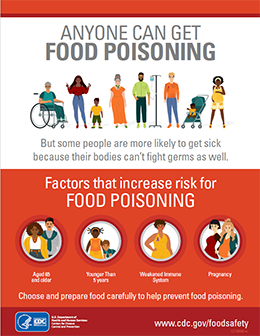
CDC people at risk poster

September is National Food Safety Education Month. Learn how to be a food safety superhero! Take steps to help prevent food poisoning, and show others how to keep food safe.

Every year, an estimated 1 in 6 Americans (or 48 million people) get sick, 128,000 are hospitalized, and 3,000 die from eating contaminated food. Anyone can get sick from a foodborne illness (also called food poisoning). But some groups of people are more likely to get sick and to have a more serious illness. These groups are:

  • Children younger than 5
  • Adults aged 65 and older
  • People with health problems or who take medicines that lower the body’s ability to fight germs and sickness
  • Pregnant women

There are things you can do to protect yourself and your family. As you prepare and handle food, follow these four steps:

  • Clean: Wash your hands, utensils, and surfaces often when you cook.
  • Separate: Raw meat, poultry, seafood, and eggs can spread germs. Separate them from cooked food and fresh produce.
  • Cook: Use a food thermometer to make sure foods are cooked to an internal temperature that kills germs.
  • Chill: Refrigerate perishable foodsexternal icon and leftovers within two hours. Chill within one hour if it’s above 90°F.

Join us in sharing information about the four steps to food safety. Let’s make sure everyone knows how to protect themselves and their loved ones from food poisoning.

Food Safety Education Month Materials

New and Updated Resources

Information on Food Safety

USA – Hepatitis A in Food Worker at Cracker Barrel in Bridgeport, MI

Food Poisoning Bulletin

A food worker at the Cracker Barrel Restaurant and Old County Store at 6450 Dixie Highway in Bridgeport, Michigan has been diagnosed with hepatitis A, according to the Saginaw County Health Department. That person worked there from August 25 through August 28, 2019. Anyone who visited that facility during that time frame may have been exposed to the virus.

Research -The combined effect of high pressure processing and dimethyl dicarbonate to inactivate foodborne pathogens in apple juice

Research Gate

Novel processing technologies can be used to improve both the microbiological safety and quality of food products. The application of high pressure processing (HPP) in combination with dimethyl dicarbonate (DMDC) represents a promising alternative to classical thermal technologies. This research work was undertaken to investigate the combined effect of HPP and DMDC, which was aimed at reaching over 5-log reduction in the reference pathogens Escherichia coli O157:H7, Salmonella enterica, and Listeria monocytogenes inoculated in apple juice. Different strains of each species were tested. The pressure (ranging from 100 to 600 MPa), dwell time (from 26 to 194 s), and DMDC (from 116 to 250 mg/L) were tested based on a central composite rotatable design. The dwell time, in the studied range, did not have a significant effect (p > 0.1) on the pathogens´ reduction. All treatments achieved a greater than 5-log reduction for E. coli O157:H7 and L. monocytogenes. The reductions for S. enterica were also greater than 5-log for almost all tested combinations. The results for S. enterica suggested that it is more resistant to HPP and DMDC compared with E. coli O157:H7 and L. monocytogenes. The findings of this study showed that DMDC at low concentrations can be added to apple juice to reduce the parameters conventionally applied in HPP. The combined use of HPP and DMDC was highly effective under the conditions of this study.

USA -Campylobacter Illness Associated with Bad Farms PA Raw Milk

Food Poison Bulletin


One person is sick with a Campylobacter infection after allegedly drinking raw whole milk from BAD FARMS in Kempton, Pennsylvania, according to news reports. That farm is located in Berks County, Pennsylvania. The milk has been recalled and removed from store shelves.