Category Archives: Food Pathogen

Denmark – Several ill in Danish Salmonella outbreak ate undercooked sausage

Food Safety News

kswfoodworld salmonella

Image CDC


Several people part of a Salmonella outbreak in Denmark tasted or ate raw or undercooked sausage, according to a recently published study.

In November 2018, an outbreak of monophasic Salmonella Typhimurium was detected. It sickened at least 49 people across the country.

A traditional form of raw Danish pork sausage called medister sausage was believed to be the source of illnesses. Product samples were negative for Salmonella and investigations at the production site did not reveal the source of contamination. Medister sausage is often served in the late autumn months and Christmas season. It is a long, thick sausage made from ground pork, seasoned and stuffed into casings.

Due to a control program, Salmonella Enteritidis is all but eliminated in Danish broiler poultry and egg production but Salmonella Typhimurium still exists in pigs and pork.

USA – Outbreak of Salmonella Infections Linked to Ground Beef Final Update

CDC

Final Outbreak Information
Illustration of a clipboard with check marks on it.
  • As of December 30, 2019, this outbreak appears to be over.
  • Thirteen people infected with the outbreak strain of Salmonella Dublin were reported from eight states.
    • Illnesses started on dates ranging from August 8, 2019, to October 22, 2019.
    • Nine hospitalizations were reported, including one death reported from California.
  • Epidemiologic, traceback, and laboratory evidence indicated that contaminated ground beef was the likely source of this outbreak.
  • On November 15, 2019, Central Valley Meat Co. in Hanford, Calif., recalledexternal icon 34,222 pounds of ground beef products that may have been contaminated with Salmonella Dublin.
    • A single, common supplier of ground beef that accounts for all of the illnesses was not identified.

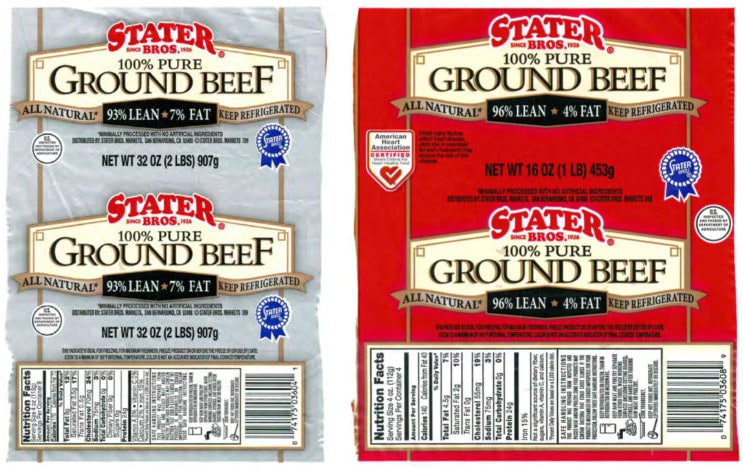
Photo of packaging.

USA -Cheesewich Bacon N Eggs Recalled For Possible Listeria Monocytogenes

Food Poisoning Bulletin

Cheesewich Bacon N Eggs Recalled For Possible Listeria Monocytogenes

The USDA is issuing a public health alert due to illnesses linked to recalled Almark Foods hard boiled eggs. The product in question is Cheesewich Bacon N Eggs that were allegedly made with Almark Foods eggs. At the same time, the notice states, “There have been no confirmed reports of illness due to consumption of the FSIS-regulated products produced containing these eggs.” FSIS regulates products made with meat such as this particular product.

The recalled item is ready to eat Cheesewich Bacon N Eggs sold in 3.6 ounce plastic packages. The product contains separately packaged bacon and hard boiled eggs. The use by dates on this product are 12/27/19, 1/3/20, 1/23/20, 1/30/20, 2/6/20, 2/14/20, 2/19/20, and 2/28/20; and the lot codes are 281191, 302191, 309191, 316191, 323191, 331191, 336191, and 344191. The product has the establishment number “P-45031” inside the USDA mark of inspection.

If you bought this product, do not eat it. Throw it away in a sealed container in a secure garbage can so other people and animals can’t access it, or take it back to the place of purchase for a full refund.

Research – Evaluation of Bactericidal Effects of Phenyllactic Acid on Escherichia coli O157:H7 and Salmonella Typhimurium on Beef Meat

Journal of Food Protection 

ABSTRACT

Bactericidal effects of various concentrations of phenyllactic acid on Shiga toxin–producing Escherichia coli (STEC), including E. coli O157:H7, O26:H11, O103:H2, and O121:H19, and on Salmonella Typhimurium DT104 in pure culture and microplates assays were studied. Beef cuts were surface sprayed with phenyllactic acid or lactic acid for inactivation of E. coli O157:H7 and Salmonella Typhimurium. The 1.5% phenyllactic acid inactivated all inoculated E. coli O157:H7, O26:H11, O103:H2, and O121:H19 and Salmonella Typhimurium DT104 (>6-log reduction) within 1 min of contact at 21°C, whereas 1.5% lactic acid did not result in microbial reduction. Microplate assays (for STEC and Salmonella Typhimurium DT104 at 10 to 100 CFU per well) indicated that concentrations of 0.25% phenyllactic acid or 0.25% lactic acid inhibited the growth of STEC and Salmonella Typhimurium DT104 incubated at 37°C for 24 h. Treatment of beef with 1.5% lactic acid or 1.5% phenyllactic acid reduced E. coli O157:H7 by 0.22 and 0.38 log CFU/cm2, respectively, within 5 min and reduced Salmonella Typhimurium DT104 by 0.12 and 0.86 log CFU/cm2, respectively. When meat treated with 1.5% phenyllactic acid was frozen at −20°C, inactivation of E. coli O157 and Salmonella Typhimurium DT104 was enhanced by 1.06 and 1.46 log CFU/cm2, respectively. Thus, treatment of beef with 1.5% phenyllactic acid significantly reduced the population of E. coli O157:H7 and Salmonella.

HIGHLIGHTS
  • Phenyllactic acid at 1.5% killed STEC and Salmonella (>6-log reduction) within 1 min.

  • The MIC of lactic and phenyllactic acids was 0.25%.

  • The bactericidal effect of phenyllactic acid on beef was enhanced by freezing.

Research -Evaluating Environmental Monitoring Protocols for Listeria spp. and Listeria monocytogenes in Frozen Food Manufacturing Facilities

Journal of Food Protection

ABSTRACT

Food processors face serious challenges due to Listeria monocytogenes contamination. Environmental monitoring is used to control L. monocytogenes from the processing environment. Although frozen foods do not support the growth of L. monocytogenes, the moist and cold conditions in frozen food production environments are favorable for growth of L. monocytogenes. The purpose of the study was to determine the current state of awareness and practices applied across a variety of frozen food facilities related to environmental monitoring for Listeria. A survey tool was created to elicit information on existing environmental monitoring programs within the frozen food industry. The topics included cleaning and sanitizing applications and frequency, microbiological testing, and environmental areas of concern. The survey was reviewed by academic and industry experts with knowledge of microbiology and frozen food processing and was field tested by industry personnel with extensive knowledge of environmental monitoring. The survey was distributed and analyzed electronically via Qualtrics among 150 frozen food contacts. Data were gathered anonymously with a response rate of 31% (n = 46). The survey indicated that facilities are more likely to test for Listeria spp. in environmental monitoring zones 2 to 4 (nonfood contact areas) on a weekly basis. The major areas of concern in facilities for finding Listeria-positive results are floors, walls, and drains. At the time of the survey, few facilities incorporated active raw material and finished product testing for Listeria; instead, programs emphasized the need to identify presence of Listeria in the processing environment and mitigate potential for product contamination. Recognition of environmental monitoring as a key component of a comprehensive food safety plan was evident, along with an industry focus to further improve and develop verification programs to reduce prevalence of L. monocytogenes in frozen food processing environments.

HIGHLIGHTS
  • Environmental monitoring practices vary throughout the frozen food industry.

  • Areas of concern of processing facilities for Listeria are floors, drains, and walls.

  • Listeria spp. sampling is most commonly performed weekly on nonfood contact surfaces.

Research – Evaluating the Risk of Salmonellosis from Dry Roasted Sunflower Seeds

Journal of Food Protection

ABSTRACT

Outbreaks and recalls related to nuts and seeds in the United States have increased recently, and 80% of these recalls are due to Salmonella. The U.S. Food and Drug Administration’s Food Safety Modernization Act requires food manufacturers to implement risk-based preventive controls based on scientific and technical evidence. Data are limited on the inactivation of Salmonella during processing of saltwater brined in-shell sunflower seeds. The goal of this research was to validate the adequacy of roasting in controlling Salmonella during the production of sunflower seeds and to assess the resulting risk. Four Salmonella strains were inoculated onto sunflower seeds and processed to simulate commercial manufacturing. Seeds were tumbled and roasted at 225°F (107.2°C) and 275°F (135°C) for roasting times from 5 to 45 min. Regression models for Salmonella inactivation and water activity change were developed. The inactivation model predicted a 5-log reduction in Salmonella when sunflower seeds were roasted at 135°C for 19.2 min, with a corresponding water activity of ∼0.61. Roasted sunflower seeds are typically not saleable at water activities >0.6 due to quality issues. Saleable water activities (0.03 to 0.04) were only achieved when the sunflower seeds were roasted for 45 min at 135°C, which resulted in a >7-log reduction in Salmonella. A quantitative microbial risk assessment based on literature values, expert opinion, and the above-mentioned models was used to predict risk of salmonellosis from sunflower seeds. The quantitative microbial risk assessment model predicted an arithmetic mean probability of illness of 1.45E−07 per 28-g serving based on roasting at 135°C for 20 min and an arithmetic mean probability of illness of 5.46E−10 per serving based on roasting at 135°C for >45 min (i.e., saleable product process parameters). This study demonstrates that sunflower seeds roasted to saleable parameters should not represent a public health risk from potential presence of Salmonella.

Research – Predictive Model of Listeria monocytogenes Growth in Queso Fresco

Journal of Food Protection

ABSTRACT

Listeria monocytogenes is a hardy psychrotrophic pathogen that has been linked to several cheese-related outbreaks in the United States, including a recent outbreak in which a fresh cheese (queso fresco) was implicated. The purpose of this study was to develop primary, secondary, and tertiary predictive models for the growth of L. monocytogenes in queso fresco and to validate these models using nonisothermal time and temperature profiles. A mixture of five strains of L. monocytogenes was used to inoculate pasteurized whole milk to prepare queso fresco. Ten grams of each fresh cheese sample was vacuum packaged and stored at 4, 10, 15, 20, 25, and 30°C. From samples at each storage temperature, subsamples were removed at various times and diluted in 0.1% peptone water, and bacteria were enumerated on Listeria selective agar. Growth data from each temperature were fitted using the Baranyi model as the primary model and the Ratkowsky model as the secondary model. Models were then validated using nonisothermal conditions. The Baranyi model was fitted to the isothermal growth data with acceptable goodness of fit statistics (R2 = 0.928; root mean square error = 0.317). The Ratkowsky square root model was fitted to the specific growth rates at different temperatures (R2 = 0.975). The tertiary model developed from these models was validated using the growth data with two nonisothermal time and temperature profiles (4 to 20°C for 19 days and 15 to 30°C for 11 days). Data for these two profiles were compared with the model prediction using an acceptable prediction zone analysis; >70% of the growth observations were within the acceptable prediction zone (between −1.0 and 0.5 log CFU/g). The model developed in this study will be useful for estimating the growth of L. monocytogenes in queso fresco. These predictions will help in estimation of the risk of listeriosis from queso fresco under extended storage and temperature abuse conditions.

HIGHLIGHTS
  • Growth of L. monocytogenes was examined in queso fresco at constant temperatures.

  • A positive correlation was found between temperature and growth rate.

  • A tertiary model was developed to predict growth under nonisothermal conditions.

  • The acceptable prediction zone analysis suggests that the tertiary model was acceptable.

USA – Limena, LLC Recalls “Salvadorean String Cheese (Quesillo Cheese)” Because of Possible Health Risk

FDA

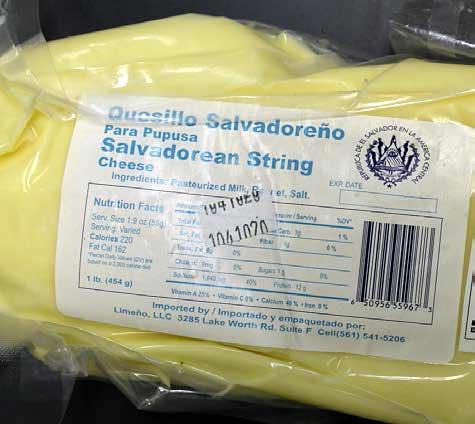
Product image, Salvadorean String Cheese block, Limeno, LLC

Limena, LLC of Palm Springs, FL. is recalling its 1 lb. (16 ounce) blocks of Salvadorean String Cheese (Quesillo Cheese) semi-soft cheese because it has the potential to be contaminated with Listeria monocytogenes, an organism which can cause serious and sometimes fatal infections in young children, frail or elderly people, and others with weakened immune systems.

The recalled “Salvadorean String Cheese (Quesillo Cheese)” was distributed to retail stores and through mail orders.

The product has a blue and white label and comes in a 1 lb. (16 oz.), clear plastic vacuum package marked with lot #1041020 on the top. The Expiration date is blank.

No illnesses have been reported to date in connection with this problem.

The potential for contamination was noted after routine testing by the Florida Department of Agriculture and Consumer Services revealed the presence of Listeria monocytogenes in one sample of 1 lb. (16 ounce) blocks of Salvadorean String Cheese (Quesillo Cheese).

The production of the product has been suspended while FDA and the company continue to investigate the source of the problem.

USA – Outbreak Investigation of Salmonella Javiana Potentially Linked to Tailor Cut Produce Fruit Mix, Winter 2019

FDA

January 2, 2020

Total Illnesses: 96
Hospitalizations: 27
Deaths: 0
Last illness onset: December 10, 2019

Recommendation

FDA, CDC and state and local partners are investigating an outbreak of illnesses caused by Salmonella Javiana. Epidemiologic and traceback evidence indicate that fruit mix with cantaloupe, honeydew, pineapple, and grapes from Tailor Cut Produce of North Brunswick, New Jersey, is a potential source of this outbreak.

The firm recalled the fruit mix, called Fruit Luau, as well as cut honeydew, cut cantaloupe and cut pineapple products on December 7. Food service and institutional food operators should not sell or serve the recalled products.

Tailor Cut Produce reports that their products may be found in restaurants, banquet facilities, hotels, schools, long-term care facilities and institutional food service establishments in Delaware, New Jersey, New York, and Pennsylvania.

Because the recalled products may have been distributed to nursing homes, schools, hospitals and other facilities that cater to vulnerable populations, it is important that these facilities do not sell or serve them. Please consult with your distributor to confirm the source of the fruit mix and cut fruit used in your operation.

Background

As of December 30, 2019, CDC is reporting 96 illnesses confirmed by Whole Genome Sequencing (WGS) in CA, CO, CT, DE, IL, MN, NJ, NY, PA, VA, and WA. Illnesses were reported from states where Tailor Cut Produce distributes, including Pennsylvania, New York City, New Jersey, and Delaware. Ill people from other states reported traveling to these states in the week before their illness started. CDC reports only cases confirmed by WGS, and these numbers may differ from the numbers that states are investigating.

FDA’s inspection at Tailor Cut Produce is ongoing. FDA is currently collecting records to support a traceback investigation and will provide updates as more information becomes available.

Research – Quantifying the Influence of Relative Humidity, Temperature, and Diluent on the Survival and Growth of Enterobacter aerogenes

Journal of Food Protection

ABSTRACT

Survival of bacteria on surfaces plays an important role in the cross-contamination of food. Temperature, relative humidity (RH), surface type, and inoculum diluent can affect bacterial survival. This study was conducted to examine how temperature, RH, and diluent affect the survival of Enterobacter aerogenes on stainless steel, polyvinyl chloride, and ceramic tile. Although surface type had little effect on survival, temperature had a clear effect. E. aerogenes survival was highest at 7°C and 15 and 50% RH on all surfaces. Some diluents allowed growth under high RH conditions. Cell populations in distilled water inoculated onto each surface decreased initially compared with populations in 1% phosphate-buffered saline (PBS) and 0.1% peptone broth. At 15 and 50% RH, cell populations in 1% PBS declined more sharply after 120 h than did those 0.1% peptone, but populations in both diluents had similar declines up to 3 weeks. Cell populations in 0.1% peptone had the greatest growth and reached the highest population density (∼8 log CFU/mL). Cell populations in PBS and distilled water increased by ∼2 log CFU/mL. When cells in 0.1% peptone were inoculated onto stainless steel at 100% RH, populations increased to ∼7 log CFU per coupon, whereas cells in 1% PBS increased to ∼5 log CFU per coupon followed by a decline over 3 weeks. DMFit and GInaFiT software modeled inactivation on surfaces at all conditions other than 100% RH at 21°C. These findings have important implications for experiments in which microorganisms are inoculated onto foods or food contact surfaces because the growth observed may be affected more by the inoculum diluent at high or uncontrolled RH than by the type of inoculated surface.

HIGHLIGHTS
  • Survival of E. aerogenes was quantified at 7°C with 15, 50, and 100% RH and at 21°C with 5 and 50% RH.

  • E. aerogenes survival was higher at 7°C with 15 and 50% RH on all surfaces.

  • Cell populations in 0.1% peptone at 21°C with 100% RH increased to ∼7 log CFU per coupon.

  • Cell populations in 1% PBS at 21°C with 100% RH increased to ∼5 log CFU per coupon.

  • Cell populations in distilled water at 21°C increased by ∼2 log CFU/mL.