KANNUR: Two inmates how now died and 22 others have been hospitalised following food poisoning at a destitute home near Oduvally. The inmates suffered food poisoning apparently after they consumed ghee rice, chicken curry and salad.

KANNUR: Two inmates how now died and 22 others have been hospitalised following food poisoning at a destitute home near Oduvally. The inmates suffered food poisoning apparently after they consumed ghee rice, chicken curry and salad.
More than 650 people have fallen ill in France this past month after eating contaminated raw shellfish.
Since the start of December 2019, Santé publique France has received 123 reports of collective food poisoning suspected to be linked to consumption of raw shellfish, mainly oysters.
The majority, 87 of the 123 alerts, occurred from Dec. 23, 2019, and forward. A peak of illnesses hit from December 25 to 27.
A total of 668 people were sick and 17 needed hospital treatment. Most are more than 15 years old. Of the 415 patients with age information available, 15 were younger than 15.
Much higher than recent years
Symptoms, mainly diarrhea and vomiting, as well as incubation times, are consistent with norovirus or other enteric virus infections. Stool tests have confirmed the presence of these viruses. Symptoms of norovirus appear one to two days after being infected and typically last for two or three days.
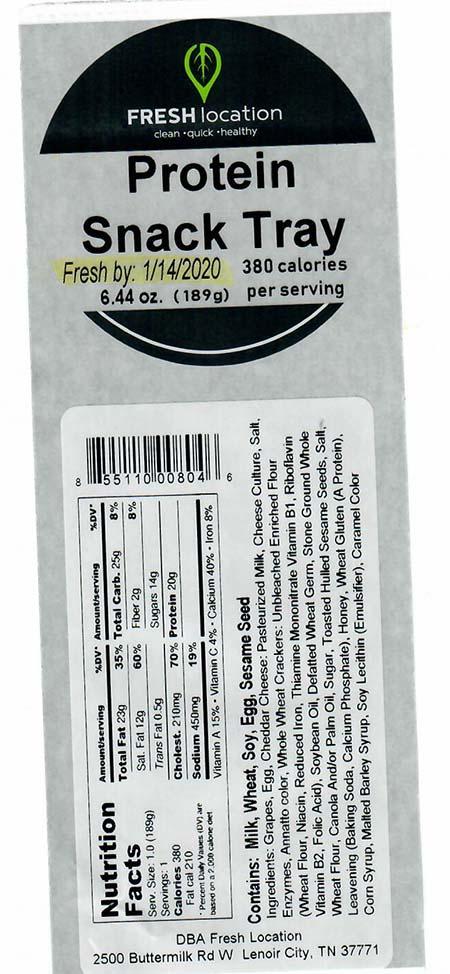
Fresh Location, of Lenoir City, Tennessee is recalling:
Due to possible contamination of Listeria monocytogenes, an organism which can cause serious and sometimes fatal infections in young children, frail or elderly people, and others with weakened immune systems.
Almark Foods which manufactures the Hard-Boiled at the Gainesville facility may be associated with a Listeria monocytogenes outbreak that has been linked to several reported illnesses and one reported death.
Affected product could have been delivered in the following states through convenience stores, micro markets, hospitals, hotels and vending machines: Illinois, Missouri, Tennessee, Georgia, South Carolina, North Carolina, Kentucky, Virginia, Indiana, and Mississippi.
An increasing number of food safety alerts linked to Salmonella in poultry have been issued in Poland, according to the report. This has led to the establishment of official sampling procedures in poultry slaughterhouses. The auditors noted that these systems have been revealing higher rates of Salmonella detection than the companies’ own checking systems.


At least 100 tons of chicken infected with salmonella has reached the Bulgarian market. Some of the meat, imported from Poland, has been seized and so far there are no reporters of consumers infected with salmonella. Poland is the major producer of poultry meat in the European Union. the majority of poultry meat exports are directed to the internal EU market.
This is not the first time that poultry products imported from Poland are contaminated with Salmonella. Salmonella has been detected in 16 tons of poultry imported to the Czech Republic from Poland in April-May 2019.
In 2018 The EU has reported almost 1,500 people sickened by Salmonella linked to Polish eggs in an outbreak that has lasted more than six years and affected 18 countries.

Image CDC
Nearly 90 people are part of a Salmonella outbreak across Australia after eating a particular brand of frozen microwave meals.
A total of 84 people in New South Wales (NSW), Queensland, South Australia, Western Australia and the Australian Capital Territory (ACT) reported eating Core Powerfoods products before becoming sick.
The number of people ill in the Salmonella Weltevreden outbreak previously stood at 46.
Core Ingredients issued a recall in October. Products were available for sale at IGAs and Coles stores nationally, independent retailers in NSW, ACT, Queensland, Victoria, South Australia, Western Australia and the Northern Territory and some Woolworths metro stores in Victoria.
Posted in food bourne outbreak, food contamination, Food Hygiene, Food Illness, Food Inspections, Food Micro Blog, Food Microbiology, Food Microbiology Blog, Food Microbiology Testing, Food Pathogen, Food Safety, Food Safety Alert, Food Testing, foodborne outbreak, foodbourne outbreak, outbreak, Salmonella, Uncategorized
Lipari Foods has issued a voluntary recall of various Premo and Fresh Grab wedge sandwiches due to potential contamination of Listeria monocytogenes.
The product was distributed exclusively by Lipari Foods in Warren, Michigan to food service and retail stores throughout Florida, Illinois, Indiana, Kentucky, Maryland, Michigan, Ohio, Pennsylvania, Tennessee, West Virginia, and Wisconsin.
The affected product can be identified by:
| Brand | Product | Lipari # | Size | Best By Date | Lot # | UPC |
|---|---|---|---|---|---|---|
| Premo | Wedge Ham & Cheese On Wheat | 915509 | 5 oz. | 1/23/2020 | 31201912 | 612510002001 |
| Premo | Wedge Egg Salad On Wheat | 915523 | 5 oz. | 1/23/2020 | 31201912 | 612510002025 |
| Premo | Wedge Chicken Salad On Wheat | 915530 | 5 oz. | 1/20/2020 | 31201912 | 612510002032 |
| Premo | Wedge Tuna Salad On Wheat | 915579 | 5 oz. | 1/23/2020 | 31201912 | 612510002049 |
| Fresh Grab | Wedge Ham/American On Wheat | 252646 | 5 oz. | 1/23/2020 | 31201912 | 612510002001 |
| Fresh Grab | Wedge Egg Salad On Wheat | 252901 | 5 oz. | 1/20/2020, 1/23/2020 | 31201912 | 612510002025 |
| Fresh Grab | Wedge Chicken Salad On Wheat | 253377 | 5 oz. | 1/23/2020 | 31201912 | 612510002032 |
| Fresh Grab | Wedge Tuna Salad On Wheat | 282022 | 5 oz. | 1/23/2020 | 31201912 | 612510002049 |
| Fresh Grab | Wedge Turkey No Cheese On Wheat | 253445 | 5 oz. | 1/23/2020 | 31201912 | 612510002100 |
| Fresh Grab | Wedge Ham/American On White | 253479 | 5 oz. | 1/23/2020 | 31201912 | 612510093962 |
This was brought to our attention by JLM Manufacturing after environmental sampling returned a positive test result for Listeria monocytogenes. No illnesses have been reported to date in relation to these products or recall.
Lipari Foods began shipping this product on December 31, 2019.
Consumers who have purchased these recalled products should not consume them. Consumers should discard the products or return them to the point of purchase. Consumers with questions should call Customer Service at 800- 729-3354, 8:15 am – 4:30 pm, EST, Monday through Friday.

Foodborne botulism is rare but potentially deadly.
The death of an El Paso County, CO, woman who died this past Sept.20 has since been officially blamed on foodborne botulism, the first death of its kind in a decade.
Cardiovascular disease and diabetes contributed to death, according to the autopsy report. Were it not for botulism, however, the 80-year-old woman could still be alive.
The source of the botulism was previously frozen potatoes stored at room temperature for two weeks. After eating the pre-prepared potatoes, the woman developed trouble breathing; her eyes bulged, her speech slowed, and her muscles became weakened.
The woman’s botulism death was the first in El Paso County since 2008.
Austrian officials have linked six Listeria infections to a German meat producer.
Products from Wilke Waldecker Fleisch- und Wurstwaren are suspected to be behind a Listeria outbreak in Germany involving 37 people and three deaths. One infection was recorded in 2014, three in 2016, four in 2017, 21 in 2018 and at least eight in 2019.
Between May 24 and Aug. 8, 2019, six people in Austria contracted an identical Listeria strain identified as Listeria monocytogenes IIa.
Following illnesses in the federal states of Carinthia, Styria, and Vienna the Federal Ministry of Labor, Social Affairs, Health and Consumer Protection (BMASGK) asked the Austrian Agency for Health and Food Safety (AGES) to investigate the outbreak.
Authorities in the Waldeck-Frankenberg district of Germany stopped production at a Wilke facility in Twistetal, Berndorf in October.
Posted in food contamination, food death, Food Hygiene, Food Illness, Food Inspections, Food Micro Blog, Food Microbiology, Food Microbiology Blog, Food Microbiology Testing, Food Pathogen, Food Poisoning Death, food recall, Food Safety, Food Safety Alert, Food Testing, Listeria, Listeria monocytogenes, Uncategorized
Boning of dry‐cured hams involves additional handling which increases the risk of contamination with Listeria monocytogenes. This work studies the ability of E‐beam to eliminate this pathogen from boned dry‐cured ham (BDH). The destruction kinetics of four L. monocytogenes strains (S2, S4‐2, S12‐1, and S7‐2) and L. innocua NCTC 11288 as a surrogate were determined at doses up to 3 kGy. L. innocua and L. monocytogenes S4‐2 were the most radioresistant (D‐value = 0.55 kGy). E‐beam penetration was studied in blocks extracted from BDH and irradiated with 2–6 kGy. The bilateral treatment of 2 kGy allows the required dose (1.32 kGy) to be absorbed in the innermost part of the block to achieve the food safety objective of “zero tolerance” for this microorganism. This listericidal treatment was also confirmed in whole BDH intentionally contaminated with L. innocua. The sensory analysis of irradiated BDH showed off‐odors that were imperceptible after 15 days of storage at 4°C.