Category Archives: Food Microbiology Research

Research – Mechanisms of Salmonella Attachment and Survival on In-Shell Black Peppercorns, Almonds, and Hazelnuts

Frontiers in Microbiology

Salmonella enterica subspecies I (ssp 1) is the leading cause of hospitalizations and deaths due to known bacterial foodborne pathogens in the United States and is frequently implicated in foodborne disease outbreaks associated with spices and nuts. However, the underlying mechanisms of this association have not been fully elucidated. In this study, we evaluated the influence of storage temperature (4 or 25°C), relative humidity (20 or 60%), and food surface characteristics on the attachment and survival of five individual strains representing S. enterica ssp 1 serovars Typhimurium, Montevideo, Braenderup, Mbandaka, and Enteritidis on raw in-shell black peppercorns, almonds, and hazelnuts. We observed a direct correlation between the food surface roughness and S. enterica ssp 1 attachment, and detected significant inter-strain difference in survival on the shell surface under various storage conditions. A combination of low relative humidity (20%) and ambient storage temperature (25°C) resulted in the most significant reduction of S. enterica on shell surfaces (p < 0.05). To identify genes potentially associated with S. enterica attachment and survival on shell surfaces, we inoculated a library of 120,000 random transposon insertion mutants of an S. Enteritidis strain on almond shells, and screened for mutant survival after 1, 3, 7, and 14 days of storage at 20% relative humidity and 25°C. Mutants in 155 S. Enteritidis genes which are involved in carbohydrate metabolic pathways, aerobic and anaerobic respiration, inner membrane transport, and glutamine synthesis displayed significant selection on almond shells (p < 0.05). Findings of this study suggest that various food attributes, environmental factors, and an unexpectedly complex metabolic and regulatory network in S. enterica ssp 1 collectively contribute to the bacterial attachment and survival on low moisture shell surface, providing new data for the future development of knowledge-based intervention strategies.

Research – Edible insects and Toxoplasma gondii : is it something we need to be concerned about?

Journal of Food Protection

Toxoplas

Novel foods such as edible insects and food products based on insects could play an important role in both human and animal nutrition in the future. The identification of dangers associated with insect consumption is fundamental to guarantee consumer safety and adequate regulatory guidelines for operators of the food sector. While former studies have focused on the microbiological contamination of fresh or processed edible insects, so far little information is available about the occurrence of foodborne parasites such as Toxoplasma gondii, whose life cycle makes it a candidate for potential insects’ breeding substrate contamination.  Hence, we investigated the presence of contaminating T. gondii in farmed edible insects to rule out this further hazard for consumers. Four species of insects most commonly used as food for human consumption were analyzed: Mealworm, African migratory locust, House cricket and Silkworms. Samples included live specimens but also minimally (dehydrated) and highly processed edible insects. Traces of T. gondii DNA were detected in samples of dehydrated mealworm. These results highlight the need for implementing good farming and processing practices with particular care paid to safe storage and handling of feed and substrates used for edible insects to reduce the chance of T. gondii entering the human food chain.

Research – Characteristics of Norovirus Food Poisoning Outbreaks in Korea in the 2000s

Journal of Food Protection

Eurofins

Norovirus food poisoning outbreaks in Korea (South) appeared in 2000s and have been increasing since then. We aimed to investigate the epidemiological features of norovirus food poisoning outbreaks in Korea over the past years (2002 ~ 2017), based on official food poisoning statistics and available reports, and to find their association with climate factors. Norovirus was the most common cause of food poisoning among known causative substances in Korea during the study period. More than one-third of the incidents occurred in group meal-service facilities, including school lunch programs. A few of these facilities used groundwater contaminated with noroviruses to wash / cook food, which contributed to outbreaks. Norovirus occurrences showed strong seasonality; cold and relatively dry winter air may help norovirus to flourish. Both norovirus genotypes GI and GII infectious to humans were detected, with GII becoming more prevalent than GI. According to our correlation analysis in connection with climate factors, average temperatures, the highest and lowest temperatures, precipitation, the number of rain days, and humidity showed a significant negative correlation with a monthly norovirus occurrence (p < 0.05). The lowest temperature and average temperature had higher coefficients of correlation, -0.377 and -0.376, respectively. The norovirus outbreaks in Korea showed complex etiological characteristics, although it more prevailed in wintertime, and are now considered as a major public health problem. The use of groundwater in group meal-service settings has a public health impact as well as norovirus concern, therefore groundwater used in food service facilities / business should be treated for safety.

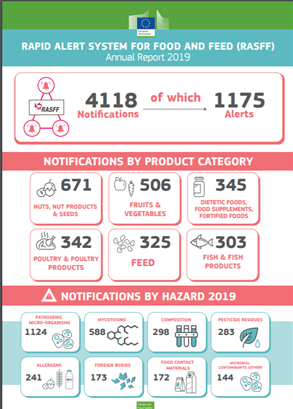
RASFF Alerts – 2019

rasff_annual_report_2019_infograph

00b.jpg

Research – Microbiological Quality of Cooked Chicken: Results of Monitoring in England (2013 to 2017)

Journal of Food Protection

Results from monitoring of the microbiological quality of 2,721 samples of ready-to-eat cooked chicken collected between 2013 to 2017 in England were reviewed: 70% of samples were from retail, catering, or manufacture and 30% were imported and collected at English ports. Samples were tested for a range of bacterial pathogens and indicator organisms. Six samples (<1%) had unsatisfactory levels of pathogens that were potentially injurious to health. Neither Salmonella nor Campylobacter were recovered from any samples. Two samples from catering settings contained either an unsatisfactory level of Bacillus cereus (5 × 10⁶ CFU/g) or an unsatisfactory level of coagulase-positive staphylococci (1.6 × 10⁴ CFU/g). Listeria monocytogenes was recovered from 36 samples (1 at manufacture, 26 at catering, and 9 at retail) and in 4 samples, unsatisfactory levels (≥102 CFU/g) were detected (3 samples collected at catering and 1 sample at retail). For L. monocytogenes, there were no significant differences between the rates of contamination for the samples collected from ports, manufacture, retail supermarkets, and other retailers (P = 0.288). There were no differences between the rates of contamination for other potential pathogens detected between samples from different settings. The prevalence of hygiene indicators (Escherichia coli, Enterobacteriaceae, and aerobic colony counts) at import was significantly lower than in samples collected from manufacturers, retail, or catering (P < 0.01). Samples collected from catering gave poorer results than those from all other settings. Regardless of the stage in the food chain, samples from Thailand and from other non–European Union countries were of significantly better microbiological quality with respect to indicator organisms than those from the United Kingdom or from other European Union countries (P = <0.001).

HIGHLIGHTS
  • Routine microbiological monitoring of 2,721 samples was reviewed.
  • Six samples (<1%) were unsatisfactory due to the levels of bacterial pathogens.
  • Hygiene indicator bacteria were significantly higher in samples from catering.
  • Port samples had significantly lower levels of hygiene indicators.

Iceland – Listeria guidelines for companies producing ready-to-eat foods

MAST

The Food Administration has published new guidelines for the analysis of Listeria monocytogenes (listeria) in ready-to-eat foods .

Companies that produce “ready-to-eat food” need to submit a sampling plan based on the manufacturer’s risk assessment for listeria. The risk assessment is an assessment of how likely listeria is to enter the food and then what the growth conditions of the bacterium are during the shelf life of the product. The information should be used by companies to classify the food they produce under the correct food safety criteria in terms of listeria. They are roughly divided into three main risk categories and several sub-categories.

The guidelines are intended to assist food companies in classifying their products according to the correct food safety criteria, estimating the frequency and number of samples and how to react if listeria is detected in products or processing environments.

Related material

USA – Marler Clark, The Nation’s Food Safety Law Firm, relaunches www.about-listeria.com – www.about-HUS.com – www.about-ecoli.com

Food Poison Journal

With another Listeria outbreak just announced, this one sickening 10 with 1 dead likely linked to deli meat , Marler Clark, The Nation’s Food Safety Law Firm, relaunches www.about-listeria.com.

Food Poison Journal

In the beginning of yet another – in fact two E. coli Outbreaks that have sickened dozens, Marler Clark, The Nation’s Food Safety Law Firm, relaunches www.about-hus.com.

Food Poison Journal

In the beginning of yet another – in fact two E. coli Outbreaks that have sickened dozens, Marler Clark, The Nation’s Food Safety Law Firm, relaunches www.about-ecoli.com.

Europe – Multi-country outbreak of Salmonella Typhimurium and S. Anatum infections linked to Brazil nuts

Click to access salmonella-typhimurium-rapid-outbreak-assessment-october-2020.pdf

Research – Evaluation of Listeria monocytogenes and Staphylococcus aureus survival and growth during cooling of hams cured with natural-source nitrite

Journal of Food Protection

Growing consumer desires for clean label, “natural” products drives more meat processors to cure meat products with natural sources of nitrate or nitrite such as celery juice powder (CJP). One particular challenge for these producers is to identify safe cooling rates in CJP-cured products where extended cooling could allow growth of pathogens. USDA FSIS recently added guidelines for stabilization of meat products cured using naturally occurring nitrites, based on control of Clostridium spp . Currently a gap exists in knowledge associated with safe cooling rates of naturally cured ham that prevent the growth of Listeria monocytogenes and Staphylococcus aureus that are potential post-lethality contaminants. The study aims to investigate the temperature profiles of naturally cured hams of typical sizes during refrigerator cooling and determine the survival behavior of S. aureus and L. monocytogenes on ham during these cooling periods. Whole (14 lbs / 6300 g), half (6 lbs / 2700 g) and quarter hams (3 lbs / 1400 g) were slowly cooked in Alkar Ò 1000 smokehouse until internal temperatures reached a minimum of 140 ° F / 60°C and were immediately transferred into walk-in cooler (38 ° F / 3.3°C). Cooling times for all sizes were within the requirements for cured products but not for uncured products. Worst-case scenarios of post-processing surface contamination were simulated by inoculating small, naturally cured ham samples with S. aureus or L. monocytogenes , which were cooled in controlled processes (130-45 ° F / 54.4-7.2 ° C in 720-900 min). B y the end of cooling, each inoculum had a small decrease of 0.5-0.6 log CFU/g. This study helps small processors identify if recommended concentrations of natural cure agents that prevent growth of Clostridium pathogens may also prevent growth of other pathogens during cooling, which aids small meat processors in production and quality control.

Research – Do as I say or as I do? Food handler’s knowledge on good handling practices and evaluation of hygienic–sanitary conditions in hospital foodservices

Wiley Online

The aim of the study was to evaluate the overall hygienic–sanitary conditions of university hospitals foodservices and assess food safety knowledge and self‐reported practices of food handlers. A self‐administered questionnaire based on sanitary standards for foodservices was given to 123 food handlers from three public hospitals. Microbiological analysis of food handling surfaces and food hygiene inspections were also performed. Food handlers’ self‐reported knowledge and practices reached satisfactory levels (77.2% and 78.1%, respectively), and showed a significant positive intercorrelation (p < .05). Food hygiene inspections in the hospitals foodservices presented a 60.9% average of adequacy and microbiological analysis results showed that 66.7% of the evaluated surfaces presented significant contamination by mesophilic bacteria. The presence of coliforms at 45°C above the safety limit was identified in 47.9% of the surfaces. The results showed a need for motivating hospital food handlers to practice the safe handling knowledge that they have demonstrated in theory.