Category Archives: Food Micro Blog

Scotland – Salmonella in Feeder Mice for Reptiles

HPS

28 September 2021

Article: 55/3908

Food Standards Scotland (FSS) and the Food Standards Agency (FSA) are urging reptile owners who have purchased certain feeder mice for their pets, take extra precautions in order to avoid contracting salmonellosis.

Scientists have again confirmed a link between Salmonella detected in feeder mice distributed across the UK by Monkfield Nutrition, and an outbreak of human cases of Salmonella. Retailers must now legally provide customers buying these feeder mice with an information leaflet about the risks of Salmonella infection, and advise on good practice for handling animal food, and ensuring good hygiene in the home.

The outbreak was first investigated in 2015 and has so far resulted in almost 850 reported human cases, mostly, but not exclusively, in those living in households with one or more pet reptiles. FSS and the FSA advise that the risk to the general public is considered to be very low.

Source: FSS, 20 September 2021

Belgium – Aldi – Mill XXL Sea salt with herbs and Mediterranean sea salt – Salmonella

AFSCA

Recall of Aldi
Products: Mill XXL Sea salt with herbs and Mediterranean sea salt.
Problem: Possible presence of salmonella.


PRODUCT DESCRIPTION

Denomination: Moulin XXL Herb sea salt (seasoned salt)
EAN code: 270 1686 2
Brand: Portland
Type of packaging: mill
Expiration dates: 07/2024
Batch codes: 125350
Points of sale: ALDI

Denomination: Mediterranean sea salt – with herbs
EAN code: 27055939
Brand: Grill time!
Type of packaging: glass mill
Expiration dates: 05/2024
Batch codes: 124351
Points of sale: ALDI

NATURE OF THE PROBLEM

Possible presence of salmonella in the ingredient basil.

ALDI has therefore decided, in consultation with the AFSCA, to withdraw this product from the market and to recall it to consumers.

Other ALDI products are not affected by this product recall.

DESCRIPTION OF THE RISK

Possible symptoms of salmonella poisoning are fever, abdominal cramps and diarrhea within 12 to 48 hours of consuming the contaminated food. The risk of infection is higher in the elderly, children, pregnant women and people with weakened immune systems.

People who have consumed these products and who present this type of symptoms are invited to consult their doctor without delay, notifying him of this consumption.

TIPS FOR CONSUMERS

Please do not consume these products and bring them back to the store.
The returned products will be reimbursed (also without sales receipt).
For any further information, you can contact ALDI via serviceclients@aldi.be .

Denmark – Gas evolution in potato salad – Micro Contamination

DVFA

BY Lantz is recalling organic potato salad with carrots due to gas evolution in the packages, indicating unwanted growth of microorganisms.

Recalled Foods , Published: September 27, 2021

What food:
Organic Potato salad with carrots
Net content: 350g
Best before-dates: 9/29/2021 and 6/10/2021
EAN bar code number: 5710871004605

Sold in:
Irma Shops Zealand

Company withdraws:
BY Lantz, Hovedvagtsgade 8.5, 1103 Copenhagen K

Cause:
The company has found gas evolution in some of the packages, which indicates unwanted growth of microorganisms.

Risk: The
evolution of gas and the possible growth of microorganisms make the product unfit for human consumption. Consumer

Advice:
Consumers are advised to return the product to the store where it was purchased or to discard it.

Research – Antimicrobial resistance, virulence , Antimicrobial resistance, virulence genes, and biofilm formation in Staphylococcus aureus strains isolated from meat and meat products

Wiley Online

Staphylococcus aureus is an important food pathogen that has the ability to form biofilms. This pathogen has been implicated in foodborne outbreaks associated with the consumption of meat and meat products. Since the role of meat products as reservoirs of antimicrobial resistant S. aureus and biofilm formers has not been studied, this research was conducted to assess the incidence, antimicrobial resistance, and presence of biofilm-forming genes in S. aureus bacteria from meat and meat products. For this purpose, 440 samples of meat and meat products were randomly collected from supermarkets of Shahrekord city, Iran. S. aureus isolates were highlighted and identified through biochemical tests. All S. aureus isolates were profiled for susceptibility to 14 antibiotics and the corresponding resistance genes were searched. The quantification of biofilm formation followed by a screening of biofilm formation encoding genes was done. Of the 440 samples collected, 61 were found to contain S. aureus. The incidence of S. aureus among the beef meat (16/61) was the highest followed by its incidence in sausage (10/61) and lunch meat (9/61). At least one isolate of S. aureus carries one of the following resistance gene blaZ, mecA, tet K, linA, tetM, erm A, ermB, and aac A-D. High distribution of icaA, icaB, icaC, icaD, clfB, and clfA, biofilm formation genes and Enterotoxin encoding genes sea, seb, sec, and sed. The ability of biofilm production and the presence of virulence determinants in the genome of S. aureus can contribute to their pathogenicity. This research demonstrated the roles of meat and meat products as reservoirs of biofilm-forming and antimicrobial-resistant strains of S. aureus. This poses a food safety and public health problem. However, further work needs to be done to better understand the implication of icaABCD biofilm forming genes present in S. aureus from meat and meat products in their resistance.

Singapore – Prohibition of the distribution and sale of food prepared by The Peachy Sugarmaker Pte Ltd lifted after meeting required standards

Click to access joint-sfa-moh-media-release—prohibition-of-the-distribution-and-sale-of-food-prepared-by-the-peachy-sugarmaker-pte-ltd-lifted-after-meeting-required-standards.pdf

Sweden – Salmonella Outbreak (Sweden, August 2021-)

Folkhalsomyndigheten

2021-09-24

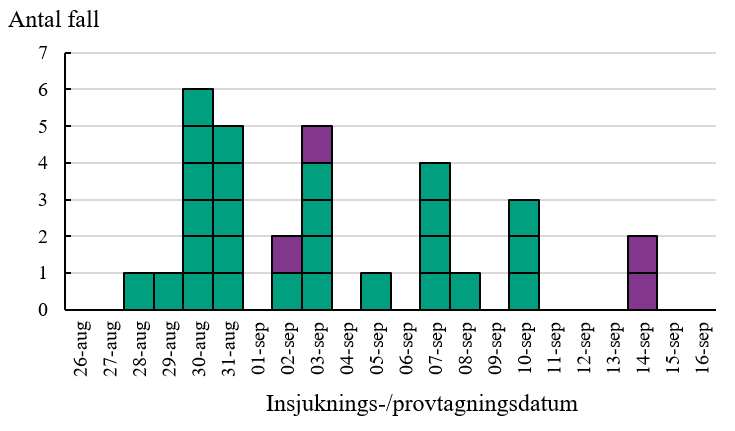
As of August 28, 31 people have been confirmed infected with Salmonella Coeln. Whole genome sequencing (analysis of the bacterium’s genome) has shown that the disease cases carry the same strain of Salmonella Coeln and are thus suspected of having been infected by a common source of infection. The cases, which are aged 0-85 years (median = 28 years), are resident in twelve different regions in Sweden and 18 (58 percent) of the patients are men. Affected infection control units, municipalities and County Administrative Boards, together with the National Food Administration and the Swedish Public Health Agency, are investigating the outbreak to identify the source of infection that is suspected to be a food with a wide distribution in Sweden.

Figure. Disease curve for outbreak cases with Salmonella Coeln (n = 31), 2021-09-24. For cases marked in purple, information on the date of illness is missing and instead the sampling date has been specified.

The bar graph shows that 0-6 people fell ill or were sampled per day between 28 August and 14 September

Sweden – KalasMat recalls portion dish Pokébowl-Chicken due to Listeria monocytogenes

Livsmedelsverket

2021-09-27

The party food in Luleå recalls the portion dish Pokébowl – Chicken (art no. 3532) with the best before date 28-09-21.

The reason is that 1 in 5 subtests have detected Listeria Monocytogenes.
After consultation with the National Food Administration, we have decided to withdraw the above batch as security.

France – Rosary Soubressade – Listeria monocytogenes

Gov france

Identifying information for the recalled product

  • Product category Food
  • Product sub-category Others
  • Product brand name Crisol
  • Names of models or references Soubressade
  • Product identification
    Lot Dated
    2121476014952 Use-by date 04/17/2022
  • Start date / End of marketing Since 09/13/2021
  • Storage temperature Product to be stored in the refrigerator
  • Health mark ES 10.10.371 / PM CE
  • Geographical sales area Whole France
  • Distributors All

Practical information regarding the recall

  • Reason for recall Presence of listeria danger.
  • Risks incurred by the consumer Listeria monocytogenes (causative agent of listeriosis)

Denmark – Gas evolution in tomato ketchup – Lactic Acid Bacteria

DVFA

Scandic Food A / S is recalling REMA1000 Tomato Ketchup, as a few bottles have been found with growth of lactic acid bacteria, which cause gas evolution.

Recalled Foods , Published: September 27, 2021

What foods:
REMA1000 Tomato ketchup
Net content: 1,000 grams
Best before date: 03/25/2022

Sold in:
REMA1000

Company withdraws:
Scandic Food A / S

Reason:
The company has found gas development in some of the products. Gas evolution is due to unwanted growth of lactic acid bacteria.

Risk:
The unwanted growth of lactic acid bacteria and gas evolution make the product unfit for human consumption.

Advice for consumers: The Danish
Veterinary and Food Administration advises consumers to deliver the product back to the store where it was purchased or to discard it.

India – Delhi govt”s food safety dept to start campaign to check buckwheat flour stocks ahead of Navratri – Aflatoxin

Outlook India

New Delhi, Sep 25 (PTI) Delhi government”s Food Safety department will run a campaign ahead of Navrati festival next month to check the stocks of buckwheat flour in the national capital, officials said on Saturday.

Buckwheat flour, popularly known as ”kuttu atta”, if infected with fungus can cause food poisoning owing to development of aflatoxin in it.

Last April, cases of illness due to consumption of spoiled ”kuttu atta” were reported from Delhi”s Kalyanpuri, Trilokpuri and Mehrauli areas, officials said.

“People who consume spoiled ”kuttu atta” may fall ill. So, they should prefer to use packed ”kuttu” four to avoid chances of any fungal infection.,” said Neha Bansal, food safety commissioner of Delhi government.

The loose quantities of these buckwheat flour, if stored in unhygienic condition for long, may develop fungal growth and also get infested with insects. The fungus produces aflatoxin which is harmful for health, she said.

“In view of use of ”kuttu” flour on a large-scale during Navratri. the Food Safety department will conduct special inspection drive ahead of the festival to ensure shopkeepers do not have ”kuttu atta” unfit for consumption,” Bansal said.

The food safety officers in the districts have been asked to visit marketplaces and check samples of buckwheat flour to ensure it is not spoiled. The drive will start soon, said another officer of the department.

”Kuttu” flour is used to cook food by people holding fast on the nine days of Navratri festival. The festival this year will beginning from October 7.

Nearly 500 residents of Kalyanpuri and Trilokpuri in east Delhi had to be admitted to different hospitals in April this year. They had consumed food cooked with ”kuttu” flour after which they had complained of stomachache, vomiting and headache and were treated in hospitals.

Local police had registered a case against a shopkeeper and also arrested him for selling rotten buckwheat flour to the locals in the area.