Category Archives: Food Micro Blog

Research -Listeria monocytogenes Cold Shock Proteins: Small Proteins with A Huge Impact

MDPI

Listeria monocytogenes has evolved an extensive array of mechanisms for coping with stress and adapting to changing environmental conditions, ensuring its virulence phenotype expression. For this reason, L. monocytogenes has been identified as a significant food safety and public health concern. Among these adaptation systems are cold shock proteins (Csps), which facilitate rapid response to stress exposure. L. monocytogenes has three highly conserved csp genes, namely, cspA, cspB, and cspD. Using a series of csp deletion mutants, it has been shown that L. monocytogenes Csps are important for biofilm formation, motility, cold, osmotic, desiccation, and oxidative stress tolerance. Moreover, they are involved in overall virulence by impacting the expression of virulence-associated phenotypes, such as hemolysis and cell invasion. It is postulated that during stress exposure, Csps function to counteract harmful effects of stress, thereby preserving cell functions, such as DNA replication, transcription and translation, ensuring survival and growth of the cell. Interestingly, it seems that Csps might suppress tolerance to some stresses as their removal resulted in increased tolerance to stresses, such as desiccation for some strains. Differences in csp roles among strains from different genetic backgrounds are apparent for desiccation tolerance and biofilm production. Additionally, hierarchical trends for the different Csps and functional redundancies were observed on their influences on stress tolerance and virulence. Overall current data suggest that Csps have a wider role in bacteria physiology than previously assumed. View Full-Text
USA – TECHNICAL REPORT:FDA REPORT ON THE OCCURRENCE OF FOODBORNE ILLNESS RISK FACTORS IN RETAIL FOOD STORE DELI DEPARTMENTS2015-2016MAY 2021

FDA

This report includes the background, design, and results of data collection on the occurrence of foodborne illness risk factors in the United States in retail food store deli departments (hereafter referred to as delis) during 2015-2016. It is a baseline report representing the first data collection period of the FDA’s current 10-year study on trends in the occurrence of foodborne illness risk factors and food safety behaviors/practices in food service facilities. Data from the 2015-2016 collection will be used as a baseline to assess trends in the occurrence of risk factors in future data collections. Of the foodborne illness risk factors investigated in this study, inadequate cooking was best controlled. The two most commonly occurring out-of-compliance risk factors were improper holding time/temperature and poor personal hygiene. Food Safety Management Systems (FSMS) were the strongest predictor of the compliance status of data items. Establishments with well-developed FSMS had significantly fewer out-of-compliance food safety behaviors/practices than did those with “less developed” food safety management systems. Neither the presence of a Certified Food Protection Manager (CFPM) nor the multiple-unit status of establishments were significant predictors of having out-of-compliance data items when all factors studied were taken into account. These findings suggest that well-developed and documented FSMS are a useful tool in reducing the occurrence of foodborne illness risk factors.

Research -Epidemiological investigation of recurrent outbreaks of haemolytic uraemic syndrome caused by Shiga toxin-producing Escherichia coli serotype O55:H7 in England, 2014–2018

Cambridge Org

Recurrent outbreaks of haemolytic uraemic syndrome (HUS) caused by Shiga toxin-producing Escherichia coli (STEC) serotype O55:H7 occurred in England between 2014 and 2018. We reviewed the epidemiological evidence to identify potential source(s) and transmission routes of the pathogen, and to assess the on-going risk to public health. Over the 5-year period, there were 43 confirmed and three probable cases of STEC O55:H7. The median age of cases was 4 years old (range 6 months to 69 years old) and over half of all cases were female (28/46, 61%). There were 36/46 (78.3%) symptomatic cases, and over half of all cases developed HUS (25/46, 54%), including two fatal cases. No common food or environmental exposures were identified, although the majority of cases lived in rural or semi-rural environments and reported contact with both wild and domestic animals. This investigation informed policy on the clinical and public health management of HUS caused by STEC other than serotype O157:H7 (non-O157 STEC) in England, including comprehensive testing of all household contacts and household pets and more widespread use of polymerase chain reaction assays for the rapid diagnosis of STEC-HUS.

Research – Ecological niche adaptation of Salmonella Typhimurium U288 is associated with altered pathogenicity and reduced zoonotic potential

Nature.com

The emergence of new bacterial pathogens is a continuing challenge for agriculture and food safety. Salmonella Typhimurium is a major cause of foodborne illness worldwide, with pigs a major zoonotic reservoir. Two phylogenetically distinct variants, U288 and ST34, emerged in UK pigs around the same time but present different risk to food safety. Here we show using genomic epidemiology that ST34 accounts for over half of all S. Typhimurium infections in people while U288 less than 2%. That the U288 clade evolved in the recent past by acquiring AMR genes, indels in the virulence plasmid pU288-1, and accumulation of loss-of-function polymorphisms in coding sequences. U288 replicates more slowly and is more sensitive to desiccation than ST34 isolates and exhibited distinct pathogenicity in the murine model of colitis and in pigs. U288 infection was more disseminated in the lymph nodes while ST34 were recovered in greater numbers in the intestinal contents. These data are consistent with the evolution of S. Typhimurium U288 adaptation to pigs that may determine their reduced zoonotic potential.

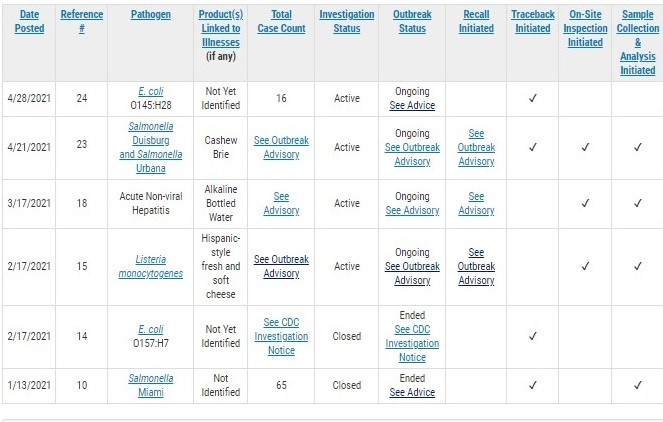
USA – FDA Core Investigation Table

FDA

0a


Research – FDA In Brief: FDA Releases Investigation Report Following 2020 Salmonella Outbreak Linked to Red Onions

FDA

“The FDA has been working with the CDC, state partners and Canadian officials to investigate the largest Salmonella Newport outbreak in over a decade, which was linked to red onions. The FDA, today, released a 2020 Salmonella Outbreak Linked to Red Onions Report that includes an overview of our investigation findings, including factors that potentially contributed to the Salmonella contamination of red onions.

“Our investigation found the outbreak to be linked to whole red onions supplied by Thomson International, Inc., with farms in Bakersfield and Holtville, California. During the investigation, the FDA identified several plausible opportunities for contamination that may have contributed to the outbreak, including potentially contaminated irrigation water, sheep grazing on adjacent land, signs of animal intrusion including scat (fecal droppings) and large flocks of birds that may spread contamination, as well as packing house cleaning and sanitizing practices.

“Eleven of the environmental subsamples tested positive for various types of Salmonella Newport; however, none matched the outbreak strain. Although a conclusive root cause could not be identified, the FDA’s leading hypothesis is that contaminated irrigation water used in a growing field in Holtville, California may have led to contamination of the onions. Considering these findings, the FDA encourages all produce growers to assess risks that may be posed by adjacent and nearby land uses, especially as it relates to the presence of livestock and the interface between farmland, rangeland, irrigation water, and other agricultural areas.

“Safeguarding the U.S. food supply and helping to ensure that our food is not contaminated at any point during its journey along the supply chain is a critical focus of the FDA’s work. Food safety is a shared responsibility that involves food producers, distributors, manufacturers, retailers, and regulators. The FDA is committed to working with these stakeholders to advance the critical work to reduce the potential for contamination events and ensure the continued safety of our food supply.”

Additional Information

  • The U.S. Food and Drug Administration is releasing a report on an investigation conducted in response to an outbreak of Salmonella Newport, which caused more than 1,600 reported illnesses in the U.S. and Canada between June and October 2020.
  • The FDA’s investigation identified Thomson International Inc. of Bakersfield, California, as the likely source of contaminated red onions. Thomson International, Inc. recalled all varieties of onions that could have come in contact with potentially contaminated red onions due to the risk of cross contamination.
  • This was the largest Salmonella outbreak in more than a decade. The FDA recommends that all produce farms assess growing operations to ensure implementation of appropriate science- and risk-based preventive measures, including applicable provisions of the FDA Food Safety Modernization Act (FSMA) Produce Safety Rule and good agricultural practices.

Related Information

UK – FSA shares how it is using data to monitor food risks

Food Safety News

A specialist from the Food Standards Agency (FSA) has revealed how the authority is using data science to identify emerging risks by using a variety of sources and analytics techniques.

The aim is to help develop a picture of the food system, its safety, authenticity, and risks and vulnerabilities, so issues can be better managed.

Speaking at IAFP Europe, Julie Pierce, director of openness, data and digital, said she had to persuade the FSA that putting funds and faith into data was a good idea.

“I started with a narrow question, answered it and then expanded it into other regions and commodities. We started off with the observation on the amount of aflatoxins in figs from Turkey. We noticed a seasonal variation in the number of alerts we were seeing and could determine the weather was impacting on the aflatoxin level,” she said.

“It was a relatively straightforward model that we built but it was relevant to those grappling with the real life issue. It proved to be relatively straightforward to extend the model beyond figs to other commodities like Bolivian Brazil nuts.”

Kenya – Kenya can’t regulate its way out of aflatoxin menace

Standard Media

Enforcement of food safety regulations is necessary but insufficient to solve this problem. Aflatoxin contamination must be addressed at its root, during production and on-farm storage.

Research by International Food Policy Research Institute and others points to some solutions including education, incentivising farmers and removing the middleman. Educating farmers about how to prevent aflatoxin leads to better practices, which can also improve the quality of grain.

Kenya must also make aflatoxin prevention technologies affordable. Most farmers dry their maize on old woven sisal bags, through which mold spores can permeate. Upgrading to impermeable tarps or drying sheets is a highly cost-effective approach to aflatoxin control, but still costs farmers more than used bags. The new KEBS standard for tarps used in agriculture, which is expected to increase the availability of lower-cost tarps, is an important step forward.

USA – E. coli Outbreak likely linked to fresh produce expands to Benton, King, Snohomish and Walla Walla counties – As many as 11 sickened, some with acute kidney failure

Food Poison Journal

The Washington State Department of Health (DOH) is working with local health jurisdictions to respond to a multi-county outbreak of E. coli O157:H7 that may be linked to fresh produce.

The outbreak currently includes six confirmed cases across Benton County (1), King County (3), Snohomish County (1) and Walla Walla County (1). DOH is only reporting confirmed cases infected with bacteria that have been genetically linked, but local health officials may report higher numbers for their counties that include cases still under investigation.

There is one case in the outbreak between ages 0-9, two cases age 10-19, one case age 20-29, one age 30-39, and one case age 70-79. Three cases have been hospitalized and one case developed hemolytic uremic syndrome (HUS). HUS is a serious complication of E. coli O157:H7 infection that can damage the kidneys and other organs. The earliest case in the outbreak started having symptoms March 9, and the most recent case had symptoms starting April 21.

USA – San Francisco’s House of Prime Rib Voluntarily Closes for Food Borne Illness Investigation

CBS

SAN FRANCISCO (CBS SF) — The Department of Public Health in San Francisco on Thursday confirmed that the House of Prime Rib has voluntarily shut down for an investigation into complaints of alleged food borne illness at the popular restaurant.

The city’s Department of Public Health issued a release Thursday stating it “is aware of ongoing online complaints and alleged food borne illness in relation to the House of Prime Rib on 1906 Van Ness Avenue.”

“The owner agreed to voluntarily close to the public for 24 hours starting today (5/13) so DPH health inspectors can ensure meal preparation and food handling process is being done safely and to code,” the statement read.

The restaurant had been serving take out meals for much of the COVID-19 pandemic, but in March resumed dinner service at the restaurant.