Category Archives: Food Illness

USA – Roadhouse 100 Restaurant linked to Hepatitis A problem

Food Poison Journal

According to press reports an employee who handles food at the Roadhouse 100 restaurant on Missouri Highway 100 in the unincorporated community of Gray Summit was diagnosed with hepatitis A, officials with the Missouri Department of Health and Senior Services said Tuesday. Anyone who ate at Roadhouse 100 between June 23 and July 5 is advised to receive the hepatitis A vaccination within 14 days to prevent illness.

The incident is being investigated by the Franklin County Health Department.

USA – Outbreak of E. coli Infections Linked to Flour – Outbreak is Over.

CDC

Recalls and Advice to Consumers, Restaurants, and Retailers
Illustration of a clipboard with check marks on it.
At A Glance


Photo of flour.

Several brands and types of flour were recalled because they may be contaminated with E. coli. Consumers should not use recalled products.

Consumers should not use any of the recalled flour. Throw it out.

  • If you stored flour in another container without the packaging and don’t remember the brand or “use by” date, throw it away.
  • Thoroughly wash the container before using it again.

Eating raw dough can make you sick.

  • Any flour or raw eggs used to make dough or batter might be contaminated with harmful germs.
  • Bake or cook food made with raw dough or batter before eating it. Follow the recipe or instructions on the package. Do not use recalled flour in cooking or baking.
  • Do not taste raw dough or batter. Even tasting a small amount could make you sick.

Clean up thoroughly after baking.

  • Wash any bowls, utensils, and other surfaces that were used when baking with warm water and soap.
  • Wash your hands with water and soap before and after baking.

Contact your healthcare provider if you think you may have become ill from eating raw dough.

Restaurants and other retailers should not use, sell, or serve any of the recalled flour.

  • If you stored flour in another container without the packaging and don’t remember the brand or “use by” date, throw it away.
  • Restaurants and retailers should thoroughly wash flour storage containers before using them again.

Restaurants and other retailers should always be safe with raw dough.

  • Do not give customers raw dough to play with or eat. It is not safe to eat or play with raw dough, whether made from recalled flour or any other flour.
  • Bake or cook food made with raw dough or batter before serving or selling it. Follow the recipe or instructions on the package. Do not use recalled flour in cooking or baking.
  • As of July 11, 2019, this outbreak appears to be over.
  • A total of 21 people infected with the outbreak strain of E. coli O26 were reported from 9 states.
    • Illnesses started on dates ranging from December 11, 2018, to May 21, 2019.
    • Three hospitalizations and no deaths were reported.
  • Epidemiologic and laboratory evidence, supported by product distribution records, indicated flour was the likely source of this outbreak.
  • Several products were recalled because they may be contaminated with E. coli. Those products include 5-lb. bags of Baker’s Corner All Purpose Flour sold at ALDI, some 5-lb. bags of King Arthur Unbleached All-Purpose Flour, certain 5-lb. bags of Pillsbury Best Bread Flour, and several brands of cookie and brownie mix produced by Brand Castle. For more information about these recalls, visit the FDA websiteexternal icon.

RASFF Alert – Foodborne Outbreak suspected (Salmonella spp) – Coppa

RASFF-Logo

RASFF – foodborne outbreak suspected (Salmonella spp) to be caused by coppa from Italy in France

RASFF Alert – Cronobacter sakazakii – Organic Corn and Tapioca Baby Food

RASFF-Logo

RASFF – Cronobacter sakazakii (presence /10g) in organic corn and tapioca baby food from Spain in Italy

USA -Alleged Cyclospora Outbreak at Cooper’s Hawk Winery in Jacksonville, FL

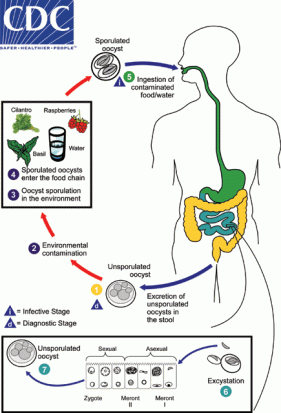
Food Poisoning Bulletin Cyclospora_LifeCycle201

News outlets are reporting that an alleged cyclospora outbreak has occurred after people ate at Cooper’s Hawk Winery & Restaurant, located in the Markets at Town Center near the St. Johns Town Center in Jacksonville, Florida. People who belong to the Exchange Club held a banquet at that venue last month.

Information – Keeping Your Backyard Barbeque Safe

USDA Staph

Millions of Americans celebrate the Fourth of July with favorite foods grilled in secret barbecue sauces and side dishes made from traditional family recipes. But nothing puts a damper on a celebration like foodborne illness.

Even when food safety rules are followed, foodborne bacteria can sometimes sneak into dishes made by hand that require no additional cooking such as potato and egg salads, cream pies, and sandwiches as well as meats. Food poisoning can cause nausea, vomiting, diarrhea, severe abdominal cramps, and mild fever.

One of the most common causes of food poisoning is the bacterium Staphylococcus aureus, which produces a wide range of toxins, including staphylococcal enterotoxin type E—associated with outbreaks in the United States and other countries.

According to the Centers for Disease Control and Prevention, an estimated 1 in 6 Americans—48 million—get sick, 128,000 are hospitalized and 3,000 die of foodborne diseases each year. Of that group, staphylococcal food poisoning causes an estimated 240,000 illnesses, 1,000 hospitalizations, and 6 deaths annually.

A USDA scientist developed a test that specifically detects Staphylococcus aureus in foods. The new test is faster, more sensitive and less expensive than standard tests.

“The current test detects active toxin only 50 percent of the time compared to the test, which detects it 99 percent of the time,” says Reuven Rasooly, a chemist with the USDA’s Agricultural Research Service (ARS). “The new test also detects toxins within 5 hours compared to 48 to 72 hours for other tests.”

In addition, Rasooly said the new test can distinguish between active toxin, which poses a threat to public health, and inactive toxin, which does not. It can be used by food makers to help keep products safer before they’re sold and by public health officials to trace the source of foodborne outbreaks.

The test, which specifically targets Staphylococcus aureus, is not commercially available. ARS has applied for a patent for this technology and plans to use it to develop additional tests that detect other foodborne toxins that make people sick.

For food consumer resources on keeping your Fourth of July celebrations safe, visit USDA’s Food Safety and Inspection Service for a variety of tips.

Research – Tamoxifen May Fight Lethality of Shiga Toxin-Producing E. coli Bacteria

Food Poisoning Bulletin

According to new research from the University of Texas at Austin’s College of Pharmacy the drug tamoxifen may help fight the lethality of Shiga toxin-producing E. coli (STEC) bacteria. That drug is already approved by the FDA for treatment of diseases such as breast cancer.

USA – Cavi Papayas From Agroson’s Linked to Salmonella Uganda Outbreak

Food Poisoning Bulletin


Cavi papayas from Agroson’s LLC are now linked to the Salmonella Uganda outbreak that was just announced by the CDC. Now 71 people in 8 states are sick. Twenty-seven people have been hospitalized because they are so ill.

Of 45 people who have provided information to investigators, 60% have been hospitalized. This is three times the hospitalization rate in a typical Salmonella outbreak. This particular strain of Salmonella Uganda is resistant to several antibiotics, which may explain the hospitalizations.

USA – FDA Investigates Contaminated Pig Ear Pet Treats Connected to Human Salmonella Infections

FDA

Fast Facts

  • The U.S. Food and Drug Administration, together with the Centers for Disease Control and Prevention (CDC) and State partners, is investigating a suspected link between pig ear treats and human cases of salmonellosis.
  • CDC reports that there are 45 cases of human infection with Salmonella enterica serotype I 4,[5],12:i:- in 13 states. Twelve people have been hospitalized.
  • Pig ear treat samples collected from bulk bins in retail locations by the Michigan Department of Agriculture and Rural Development (MDARD) tested positive for several strains of Salmonella, but not the specific strain connected to this outbreak.
  • On July 3, Pet Supplies Plus issued an advisory  to consumers that the firm is recalling bulk pig ear products supplied to all locations by several different vendors. Bulk pig ears were distributed to Pet Supplies Plus stores in AL, AR, CA, CO, CT, DE, FL, GA, IA, IL, IN, KS, KY, MA, MD, MI, MN, MO, NC, NE, NH, NJ, NY, OH, OK, PA, RI, SC, TN, TX, VA, WI and WV. Bulk pig ears were stocked in open bins. Prepackaged branded pig ears are not included in the PSP pig ear recall.
  • CDC and FDA are working with state boards of health to determine if there are any cases of human or animal illness linked to the strains of Salmonella found in the tested treats.
  • FDA is also working with impacted firms to remove these pig ears from the marketplace and identify other places where they may have been distributed.
  • FDA is issuing this alert so that consumers can choose whether to remove pig ear treats from their homes or take steps to potentially prevent Salmonella infection.
  • Salmonella can affect both human and animal health. People with symptoms of Salmonella infection should consult their healthcare providers. Consult a veterinarian if your pet has symptoms of Salmonella infection.
  • This is an ongoing investigation and FDA will provide the public with new information as it becomes available.

USA – Hepatitis A identified in Ugly Grouper employee, Vaccines offered today and tomorrow

Outbreak News Today

Manatee County health officials announced Wednesday of a hepatitis A case in a food service worker at the Ugly Grouper restaurant located at 5704 Marina Drive  in Holmes Beach.

The Manatee County Health Department (CHD) advises if you frequented this restaurant prior to June 22 and have not previously been vaccinated for Hepatitis A, you should consider being vaccinated at your local county health department or primary care physician’s office.