Category Archives: Food Illness

France – More than 1,000 sick in France from contaminated raw shellfish

Food Safety News

The number of people in France who have become ill after eating contaminated raw shellfish has jumped to more than 1,000. The outbreak has spurred international recalls.

A total of 1,033 people have been sickened and 21 needed hospital treatment, according to Santé publique France. A previous update listed the number of illnesses at 668.

Sweden, Italy and the Netherlands have all also reported outbreaks linked to live oysters from France. Products have been recalled due to a risk of norovirus contamination in Luxembourg, Switzerland, Hong Kong and Singapore.

Mats Lindblad, a communicable disease coordinator at Livsmedelsverket (National Food Agency of Sweden), said 31 people are sick in the country.

USA -Unlicensed Yolo restaurant fined over $100K after allegedly poisoning UC Davis students

sacbee

An unlicensed restaurant that served college students through a Chinese app has been ordered to pay more than $100,000 after its food reportedly caused several people to fall ill.

The Yolo County District Attorney’s Office settled with Xin Jiang, owner of Anna’s Kitchen, for $106,997 in total costs and penalties on Dec. 18, according to a news release distributed Monday afternoon. Jiang will owe an additional $90,000 if he’s found operating a retail food operation without a valid county permit again.

Anna’s Kitchen targeted University of California, Davis students from China through the immensely popular Chinese app WeChat. It became the subject of a Yolo County Environmental Health Division investigation after multiple complaints from students who became sick after eating food from Anna’s Kitchen, according to the release.

The investigation found Jiang delivered hundreds of meals that weren’t kept at county-mandated hot or cold temperatures, putting customers at risk for food-borne illnesses.

Viet Nam -101 hospitalized during school trip with food poisoning

VN Express

101 secondary school students and teachers from Tay Ninh Province traveling to neighboring HCMC were hospitalized with food poisoning on Sunday.

After picked up at 5:30 a.m., students of Chu Van An Secondary School, upon traveling to Dam Sen amusement park in HCMC, received a box of chicken sticky rice provided by the hosting travel agency.

At around 9:30 a.m., 71 students started to experience nausea, and were immediately sent to the emergency room at HCMC’s Children’s Hospital 1.

At noon, another 30 cases, including both students and teachers, were sent to HCMC’s District 11 Hospital, with similar symptoms.

In the late afternoon, 22 cases at District 11’s Hospital were released home, while the rest, including one teacher, remained.

HCMC’s health department has collected the food sample to determine the cause of the accident.

Food poisoning occurs

USA -Yosemite National Park Stomach Illness Outbreak Sickens Visitors

Food Poisoning Bulletin

Federal health officials say a Yosemite National Park stomach illness outbreak has sickened at least a dozen people, according to the San Francisco Chronicle. An investigation has been launched after the reports of illness began, and inspections are being conducted at the service facilities.

The illness or origin of the outbreak have not been identified. Those sickened are recovering or have already recovered. There is no information about this outbreak on Yosemite’s web site.

Hong Kong – Import and sale of shellfishes harvested in production areas 35.11 and 35.06 in France suspended

CFS

Issue Date 10.1.2020
Source of Information Centre for Food Safety
Food Product Shellfishes
Product Name and Description Shellfishes harvested in production areas 35.11 and 35.06 in France
Reason For Issuing Alert
  • The CFS received a notification from the Rapid Alert System for Food and Feed (RASFF) of the European Commission that shellfishes harvested in the abovementioned areas which were suspected to be contaminated with norovirus were under recall.
  • The CFS immediately followed up with major local importers and retailers. Preliminary investigation found that a local importer had imported not ready-to-eat mussels from the abovementioned areas into Hong Kong which were on sale in its supermarkets.
Action Taken by the Centre for Food Safety
  • For the sake of prudence, the CFS has immediately suspended the import into and sale within Hong Kong of all shellfishes harvested in the two areas concerned.
  • The importer concerned had already voluntarily stopped sale and removed from shelves of the affected product for the sake of prudence.
  • The CFS is tracing the distribution of the affected product.
  • The CFS has informed the French authorities of the import suspension and will also notify the local trade.
  • The CFS will continue to follow up on the incident and take appropriate action to safeguard food safety and public health.
Advice to the Trade Stop using or selling the affected product harvested in the abovementioned areas concerned immediately.
Advice to Consumers
  • One may be infected by norovirus or other pathogenic microorganism if consuming undercooked shellfish which is contaminated. So, shellfish should be thoroughly cooked before consumption.
  • Young children, elderly people, pregnant women and others with weakened immune systems should pay special attention when consuming shellfish.
Further Information The CFS press release

France -Collective food-borne infections suspected of being linked to the consumption of raw shellfish, epidemiological report as of January 8, 2020

Sante Publique France

Cases of TIAC suspected of being linked to the consumption of raw shellfish in mainland France have been reported since December 2019.

A collective food poisoning (TIAC) ​​is defined by the appearance of at least 2 cases of illness with a similar symptomatology, generally gastrointestinal, the cause of which can be related to the same food or meal. Any person (doctor, manager of collective catering establishments, consumer, etc.) who is aware of an episode that may be a TIAC, must declare this suspicion of TIAC to the administration (Regional Health Agency (ARS) and / or the Departmental Directorate (for social cohesion) and for the protection of populations (DD (CS) PP). This declaration involves local information from the other structure (ARS or DD (CS) PP).

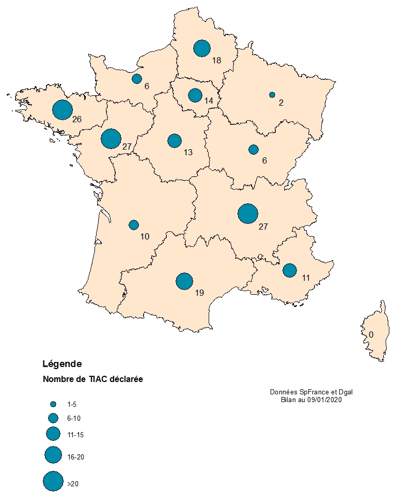
Since the beginning of December 2019, 179 compulsory declarations (DO) of collective food poisoning (TIAC) ​​suspected of being linked to the consumption of raw shellfish, mainly oysters, have been sent to Santé publique France. The reports come from the majority of regions in mainland France (see Figure 1).

Figure 1 – Number of TIAC suspected of being linked to the consumption of raw shellfish, by reporting region. Metropolitan France, December 1, 2019 – January 8, 2020.
Figure 1 - Number of TIAC suspected of being linked to the consumption of raw shellfish, by reporting region.  Metropolitan France, December 1, 2019 - January 8, 2020.

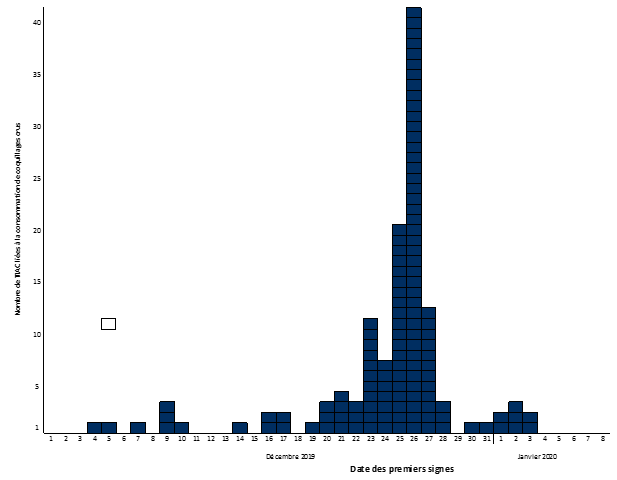
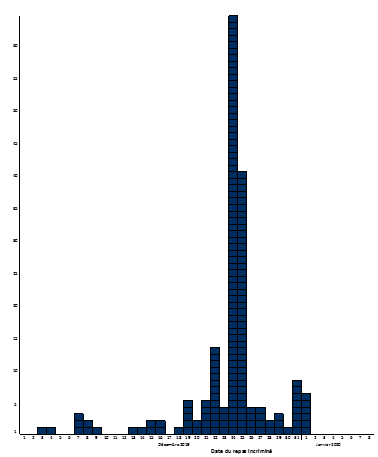
The vast majority (138/179, 77%) of these TIAC occurred from December 23 (Figures 2 and 3). A peak of patients is observed around December 25-27 (Figure 2). The offending meals are grouped around December 24-25 (Figure 3).

A total of 1,033 people were sick, of whom 21 (2%) were hospitalized. Most of them are people over the age of 15. Of the 595 patients with age information, 19 (3.1%) were children under the age of 15. The symptoms, mainly diarrhea and vomiting, as well as the incubation times, are compatible with infections with norovirus or other enteric viruses. Stool tests performed to date by the National Reference Center for Gastroenteritis Viruses have confirmed the presence of norovirus and other enteric viruses.

Figure 2 – Number of TIAC suspected of being linked to the consumption of raw shellfish by date of first signs of patients (information available for 125/179 TIAC). December 1, 2019 – January 8, 2020.
Figure 2 - Number of TIAC suspected of being linked to the consumption of raw shellfish by date of first signs of patients (information available for 125/179 TIAC).  December 1, 2019 - January 8, 2020.
Figure 3 – Number of TIAC suspected of being linked to the consumption of raw shellfish by date of the offending meal (information available for 176/179 TIAC). December 1, 2019 – January 8, 2020.
Figure 3 - Number of TIAC suspected of being linked to the consumption of raw shellfish by date of the offending meal (information available for 176/179 TIAC).  December 1, 2019 - January 8, 2020.

The number of TIAC suspected of being linked to the consumption of raw shellfish is significantly higher than in previous years. Each year between 25 and 120 TIAC suspected of being linked to the consumption of shellfish are reported to Public Health France, of which between 4 and 30 occurred during the December-January periods.

Following reports from TIAC suspected of being linked to the consumption of raw shellfish, the Directorate General for Food (DGAL) in conjunction with the Departmental Directorates in charge of protecting populations (DD (CS) PP) is carrying out an investigation traceability in order to trace back to the production area for suspected shellfish and confirmation analyzes are carried out on the areas concerned. To date, several areas have been closed due to contamination by noroviruses. Zone closings can be viewed on this site:
http://www.atlas-sanitaire-coquillages.fr/ (“Statutes” section)

USA – Seven Seattle Evergreen Restaurants Associated with E. coli Outbreak

Food Poisoning Bulletin 

There are now seven Seattle Evergreen Restaurants associated with an E. coli O157:H7 outbreak that has sickened 15 people, an increase of two more patients since the last update posted in December 2019. The outbreak appears to be over, according to the Seattle King County Health Department, but the investigation is ongoing. Three people were hospitalized because they were so sick.

The seven Seattle Evergreen restaurants named by the health department include Evergreen locations at:

  • Pioneer Square (106 1st Avenue S, Seattle)
  • University District (4609 Village Ter NE, Seattle)
  • Downtown (823 3rd Avenue, Seattle)
  • Chinatown-International District (504 5th Ave South, Seattle)
  • Sammamish Highlands (600 228th Avenue NE, Sammamish)
  • Seattle-Tacoma International Airport (17801 International Blvd, Seattle)
  • 2nd and Pike Street (1430 2nd Ave, Seattle)

Cruise Ship – Norovirus – What you need to know.

Cruise Critic

With cruise ship “outbreaks” regularly appearing in the news, awareness of Norovirus — an extremely common and highly contagious virus that causes gastroenteritis — has been significantly raised.
But before you reconsider that long-awaited cruise vacation because of gloom-and-doom reports on television and in your daily paper, know these facts:

  • Norovirus is not a “cruise ship” virus, nor does it limit itself to sea-going vessels.
  • Norovirus spreads swiftly wherever there are many people in a small area, including nursing homes, restaurants, hotels, dormitories … and cruise ships.
  • The common cold is the only illness more common, and the Centers for Disease Control and Prevention in Atlanta estimates that there are more than 20 million cases of Norovirus annually.
  • Norovirus is associated with cruise travel simply because health officials are required to track illnesses on ships (and are not at hotels and resorts); therefore, outbreaks are found and reported more quickly at sea than on land.

Here’s everything you need to know about Norovirus — and how to avoid getting sick on your next cruise vacation. See the link above.

Singapore -SFA recalls live mussels from France due to presence of Norovirus

CNA


SINGAPORE: The Singapore Food Agency (SFA) said on Saturday (Jan 11) that it has directed food specialist Classic Fine Foods to recall the Bouchot live mussels from France.

In a media release, SFA said that the European Commission Rapid Alert System for Food and Feed has issued a recall for the live mussels from Baie Du Mont-Saint-Michel Aop in France “due to the presence of a norovirus”.

Information USA – What Are the Symptoms of Common Foodborne Pathogens?

CDC

Burden of Foodborne Illness: Findings

CDC estimates that each year roughly 1 in 6 Americans (or 48 million people) gets sick, 128,000 are hospitalized, and 3,000 die of foodborne diseases.


These estimates provide the most accurate estimates yet of which known foodborne pathogens (bacteria, viruses, and parasites) are causing the most illnesses in the United States, and how many foodborne illnesses are caused by unspecified agents. The estimates also show that much work remains to be done—specifically in focusing efforts on the top known pathogens and identifying the additional causes of foodborne illness and death.

CDC provides estimates for two major groups of foodborne illnesses

Known foodborne pathogens — 31 pathogens known to cause foodborne illness. Many of these pathogens are tracked by public health systems that track diseases and outbreaks. Read the report >

Unspecified agents — Agents with insufficient data to estimate agent-specific burden; known agents not yet identified as causing foodborne illness; microbes, chemicals, or other substances known to be in food whose ability to cause illness is unproven; and agents not yet identified. Because you can’t “track” what isn’t yet identified, estimates for this group of agents started with the health effects or symptoms that they are most likely to cause, such as acute gastroenteritis. Read the report >


Total number of foodborne illnesses each year

CDC estimated the number of illnesses, hospitalizations, and deaths caused by both known and unspecified agents. CDC then estimated what proportion of each were foodborne. The first table below provides estimates for domestically acquired foodborne illnesses, and the second table provides estimates for domestically acquired illnesses caused by all transmission routes (foodborne, waterborne, person-to-person contact, animal contact, environmental contamination, and others).

Estimated annual number of domestically acquired, foodborne illnesses, hospitalizations, and deaths due to 31 pathogens and the unspecified agents transmitted through food, United States
Foodborne agents Estimated annual number of illnesses Estimated annual number of hospitalizations Estimated annual number of deaths
Number (90% credible interval) % Number (90% credible interval) % Number (90% credible interval) %
31 known pathogens 9.4 million
(6.6–12.7 million)
20 55,961
(39,534–75,741)
44 1,351
(712–2,268)
44
Unspecified agents 38.4 million
(19.8–61.2 million)
80 71,878
(9,924–157,340)
56 1,686
(369–3,338)
56
Total 47.8 million
(28.7–71.1 million)
100 127,839
(62,529–215,562)
100 3,037
(1,492–4,983)
100
Estimated annual number of illnesses, hospitalizations, and deaths due to 31 pathogens and the unspecified agents, United States
Foodborne agents Estimated annual number of illnesses Estimated annual number of hospitalizations Estimated annual number of deaths
Number (90% credible interval) % Number (90% credible interval) % Number (90% credible interval) %
31 known pathogens 37.2 million
(28.4–47.6 million)
21 228,744
(188,326–275,601)
47 2,612
(1,723–3,819)
42
Unspecified agents 141.8 million 79 258,033 53 3,574 58
Total 179 million 100 486,777 100 6,186 100


Pathogens causing the most foodborne illnesses, hospitalizations, and deaths each year

Top five pathogens contributing to domestically acquired foodborne illnesses
Pathogen Estimated number of illnesses 90% credible interval %
Norovirus 5,461,731 3,227,078–8,309,480 58
Salmonella, nontyphoidal 1,027,561 644,786–1,679,667 11
Clostridium perfringens 965,958 192,316–2,483,309 10
Campylobacter spp. 845,024 337,031–1,611,083 9
Staphylococcus aureus 241,148 72,341–529,417 3
Subtotal 91

 Top of Page

Top five pathogens contributing to domestically acquired foodborne illnesses resulting in hospitalization
Pathogen Estimated number of hospitalizations 90% credible interval %
Salmonella, nontyphoidal 19,336 8,545–37,490 35
Norovirus 14,663 8,097–23,323 26
Campylobacter spp. 8,463 4,300–15,227 15
Toxoplasma gondii 4,428 2,634–6,674 8
E. coli (STEC) O157 2,138 549–4,614 4
Subtotal 88
Top five pathogens contributing to domestically acquired foodborne illnesses resulting in death
Pathogen Estimated number of deaths 90% credible interval %
Salmonella, nontyphoidal 378 0–1,011 28
Toxoplasma gondii 327 200–482 24
Listeria monocytogenes 255 0–733 19
Norovirus 149 84–237 11
Campylobacter spp. 76 0–332 6
Subtotal 88