A troublesome Cyclospora outbreak continues to grow in North America with 37 confirmed cases in Canada added to 206 in the midwest United States. Cyclospora is a coccidian parasite that causes diarrheal disease in humans called cyclosporiasis.
The update today involves an outbreak of Cyclospora infections traced to Fresh Express bagged garden salad products containing lettuce, carrots, and red cabbage.
As of July 8 there are 37 confirmed cases of Cyclospora illness linked to this outbreak in three Canadian provinces: Ontario (26), Quebec (10) and Newfoundland and Labrador (1). Canadians became sick between mid-May and mid-June. One Canadian has been hospitalized. No deaths have been reported. Individuals who became ill are between 21 and 70 years of age. The majority of cases, 76 percent, are female.
Almost 40 people are part of a Salmonella outbreak traced to eggs from the United Kingdom.
A spokesman for Public Health England told Food Safety News that it does not hold information on the date of onset of illness for all the patients.
“There have been 38 reported cases linked to this incident through analysis of whole genome sequencing data. Cases range in age from 6 months to 85 years; 19 are female and 19 are male. We are aware of two cases having been hospitalized,” the spokesman said.
A notification on the Rapid Alert System for Food and Feed (RASFF) portal from early July shows that eggs contaminated with Salmonella Enteritidis were subjected to physical or chemical treatment in the Netherlands, which was a commercial decision by the producer.
Authorities in Finland are investigating a Listeria outbreak that has affected eight people.
All patients have been hospitalized but no deaths have been recorded. The age range of those sick is 60 to 93 years old, five are female and they live in different parts of the country.
Ruska Rimhanen-Finne, a veterinary epidemiologist at the National Institute for Health and Welfare (THL), said all illnesses occurred within a month in May and June.
The Public Health Agency of Canada (PHAC) is collaborating with provincial public health partners, the Canadian Food Inspection Agency (CFIA) and Health Canada to investigate an outbreak of Cyclospora infections occurring in three provinces. The outbreak appears to be ongoing, as recent illnesses continue to be reported to PHAC.
Based on the investigation findings to date, exposure to certain Fresh Express brand salad products containing iceberg lettuce, carrots and red cabbage, has been identified as a likely source of the outbreak. Some of the individuals who became sick reported having eaten Fresh Express brand salad products containing these ingredients before their illnesses occurred. The source of illness for the remaining individuals continues to be under investigation. The investigation is ongoing and this public health notice will be updated as the investigation evolves.
On June 28, 2020, the CFIA issued a food recall warning for certain Fresh Express brand salad products containing iceberg lettuce, carrots and red cabbage that were distributed nationally in Canada. The recalled salad products begin with lot code “Z177” or a lower number and have best before dates up to and including 20JUL08 – 20JUL14. For more information on the recalled product, please consult the CFIA’s website.
Canadians are advised not to eat the recalled products. Retailers and food service establishments are advised not to sell or serve the recalled products, or any items that may have been prepared or produced using these products.
The CFIA is continuing its food safety investigation, which may lead to the recall of other products. If additional products are recalled, the CFIA will notify the public through updated food recall warnings.
The U.S. Centers for Disease Control and Prevention and the U.S. Food and Drug Administration are also investigating a multi-state outbreak of Cyclospora infections that has been linked to bagged salad mixes containing iceberg lettuce, carrots, and red cabbage produced by Fresh Express.
Investigation summary
As of July 8, 2020, there are 37 confirmed cases of Cyclospora illness linked to this outbreak in three provinces: Ontario (26), Quebec (10) and Newfoundland and Labrador (1). Individuals became sick between mid-May and mid-June 2020. One individual has been hospitalized. No deaths have been reported. Individuals who became ill are between 21 and 70 years of age. The majority of cases (76%) are female.
Some of the individuals who became sick reported having eaten certain Fresh Express brand salad products containing iceberg lettuce, red cabbage and carrots before their illnesses occurred. The source of illness for the remaining individuals continues to be under investigation.
Cyclospora infections occur each summer in Canada. PHAC is working with provincial partners to determine if other recent cases of Cyclospora infection are linked to this outbreak.
It is possible that more recent illnesses may be reported in the outbreak because of the period between when a person becomes ill and when the illness is reported to public health officials. For this outbreak, the illness reporting period is between two and four weeks.
Epidemiological information
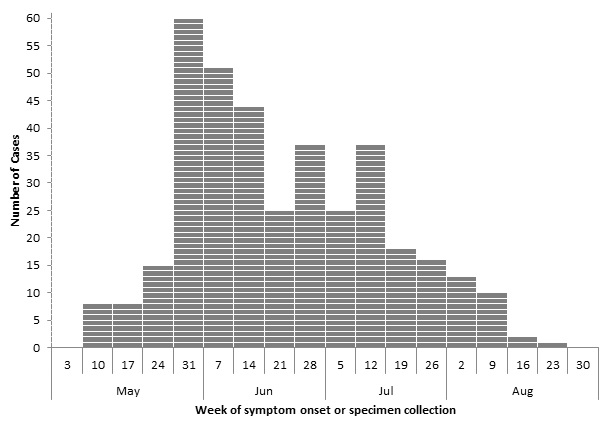
Figure 1 below is an epidemiological curve for this outbreak. Outbreak investigators use this information to show when illnesses begin, when they peak, and when they trail off. It can take several weeks from the time a person becomes ill to when the illness is reported and testing confirms a link to the outbreak. Data are available for 37 cases.
Figure 1: Number of people infected with Cyclospora
There has been a Taco Bell hepatitis A exposure at the restaurant on Erie Boulevard in Rome, New York. That employee worked while infectious, according to a press release by the Oneida County Health Department.
More than 50 Syrian families at the Al-Rayyan camp in the country’s northern city of Idlib have been poisoned by packaged meals distributed by an aid organisation working in the area.
Local media quoted the camp director, Abdo Al-Ali, as saying that the victims had included “women and children”, adding that they were receiving medical treatment at the hospitals in the area.
In May, dozens of Syrian families were reported to have been poisoned after eating breakfast distributed by an organisation in a refugee camp located in Idlib’s countryside of Deir Hassan. Others were also poisoned in June after eating takeaway meals from a restaurant in the city.
Idlib is the last opposition stronghold in Syria where millions now live after fleeing from their homes in the war-torn country.
Salmonella Dublin (S. Dublin) issues tend to garner more headlines today in the dairy industry than in beef, but it’s still an issue in the latter, says Jackson McReynolds.
The first reported incidence of S. Dublin in beef that McReynolds says he found recorded in literature was in California in 2014, though veterinarians have told him they identified cases of it as early as the 1960s.
A previous version of this press release issued on June 19, 2020 stated that product bearing the facility code “S5417” and that code is incorrect. The only product bearing the product code “S5424” is subject to recall and it was made at a facility in Streamwood, IL.
In cooperation with the Fresh Express recall of bagged salads potentially linked to an outbreak of Cyclospora infections in the Midwest. Jewel-Osco is voluntarily recalling bagged Signature Farms Garden Salad, net wt. 12 oz., sold in its stores in Illinois, Indiana, and Iowa.
The recalled Signature Farms Garden Salad, UPC code of 21130 98135, was sold in 12-ounce bags in the Produce section. The recalled products have BEST IF USED BY dates of May 16 through July 4 (5-16-20 through 7-04-20). The BEST IF USED BY date and the product code are printed on the top right corner of the front of the package. The affected product with the product code is subject to recall.
Cyclospora cayetanensis is a microscopic parasite of humans. This parasite, when it contaminates food or water and is then ingested, can cause an intestinal illness called cyclosporiasis. Most people infected with Cyclospora develop diarrhea. Other common symptoms include loss of appetite, weight loss, stomach cramps/pain, bloating, increased gas, nausea, and fatigue. Vomiting, body aches, headache, fever, and other flu-like symptoms may be noted. Some people who are infected with Cyclospora do not have any symptoms. If not treated, the illness may last from a few days to a month or longer. Symptoms may seem to go away and then return one or more times.
Consumers are asked to check their refrigerators for the recalled product. Consumers who have purchased the product are asked to discard or return it to the place of purchase for a refund. Customers who have questions about the recall can contact Jewel-Osco at 1-877-723-3929.
SAITAMA – More than 3,400 elementary and junior high school students and teachers have contracted food poisoning at 15 schools near Tokyo due to school lunches, local authorities said Thursday.
Students started to complain of food poisoning symptoms such as diarrhea and abdominal pain on June 26 after they ate school lunches including fried chicken and seaweed salad at their schools in Yashio, Saitama Prefecture.
Concluding that the food poisoning was caused by school lunches supplied by lunch deliverer Tobu Kyushoku Center, the prefectural government ordered the company to suspend use of its kitchens for three days.
As the number of students suffering food poisoning increased, 377 students were absent from schools on Monday, though none of them were in serious condition.
E. coli bacteria was detected in the feces of some patients by a local health center.