Category Archives: Food Hygiene

RASFF Alerts – Salmonella – Sesame Seeds – Whitish Sesame Seeds -Turkey Carcasses -Chicken Fillets –

RASFF-Logo

RASFF -Salmonella enterica ser. Ank (presence in 1 out of 5 samples /25g) in sesame seeds from Sudan in Greece

RASFF-Salmonella enterica ser. Kisii (presence /25g), Salmonella enterica ser. Millesi (presence /25g) and Salmonella enterica ser. Munchen (presence /25g) in whitish sesame seeds from Sudan in Greece

RASFF-Salmonella enterica ser. Kentucky (presence /25g) and Salmonella enterica ser. Mbandaka (presence /25g) in sesame seeds from Sudan in Greece

RASFF-Salmonella enterica ser. Typhimurium (presence /25g) in chilled turkey carcasses from Poland in Belgium

RASFF-Salmonella enterica ser. Senftenberg (in 2 out of 5 samples /25g) in whitish sesame seeds from Sudan in Greece

RASFF-Salmonella enterica ser. Ruiru (in 1 out of 5 samples /25g) in whitish sesame seeds from Sudan in Greece

RASFF-Salmonella enterica ser. Enteritidis (presence /25g) and Salmonella enterica ser. Infantis (presence /25g) in chilled chicken fillets from Poland in Italy

RASFF-Salmonella (presence /25g) in sesame seeds from Sudan in Greece

RASFF-Salmonella enterica ser. Vleuten (presence /25g) in sesame seeds from Sudan in Greece

RASFF-Salmonella enterica ser. Senftenberg (in 1 out of 5 samples /25g) in whitish sesame seeds from Sudan in Greece

RASFF-Salmonella (in 1 out of 5 samples /25g) in sesame seeds from Nigeria in Poland


USA- Oasis of the Seas: 277 sickened on cruise, voyage cut short – Norovirus?

Outbreak News Today

Health officials are reporting some 277 passengers and crew onboard Royal Caribbean’s vessel, Oasis of the Seas, have fell ill with vomiting being the predominant symptom.

According to the Center for Disease Control and Prevention (CDC), 266 of 6,285 (4.23%) passengers and 11 of 2,169 (0.51%) crew were sickened.

While media reports state the cause of the outbreak as Norovirus, CDC officials report the causative agent as being “unknown” as of Jan. 10.

The ship left left Port Canaveral on a seven-day Western Caribbean cruise on Sunday. The ship will return to Port Canaveral on Saturday, one day ahead of schedule.

RASFF Alerts – Aflatoxin – Peanuts – Almond Kernels – Almonds

RASFF-Logo

RASFF – aflatoxins (B1 = 13,3; Tot. = 14,7 µg/kg – ppb) in peanuts from China in Spain

RASFF-aflatoxins (B1 = 23.9; Tot. = 26.2 µg/kg – ppb) in peanuts in shell from Egypt in Germany

RASFF-aflatoxins (B1 = 15.7; Tot. = 24 µg/kg – ppb) in almond kernels from Australia, via Vietnam in Spain

RASFF-aflatoxins (Tot. = 24 µg/kg – ppb) in almond kernel from Australia, manufactured in Vietnam in Spain

RASFF -aflatoxins (B1 = >24; Tot. = >24 µg/kg – ppb) in almond kernels from Australia, manufactured in Vietnam in Spain

RASFF-aflatoxins (B1 = >24; Tot. = >24 µg/kg – ppb) in almond kernels from Australia, manufactured in Vietnam in Spain

RASFF-aflatoxins (B1 = 22.8 µg/kg – ppb) in almonds from Australia, manufactured in Vietnam in Spain

RASFF-aflatoxins (B1 = 22.7; Tot. = >24 µg/kg – ppb) in almonds from Australia, manufactured in Vietnam in Spain

RASFF-aflatoxins (B1 = 17.2; Tot. = 21.7 µg/kg – ppb) in almonds from Australia, manufactured in Vietnam in Spain

RASFF-aflatoxins (B1 = 24; Tot. = 24 µg/kg – ppb) in almonds from Vietnam in Spain

RASFF-aflatoxins (B1 = >24; Tot. = >24 µg/kg – ppb) in almonds from Vietnam in Spain


RASFF Alert – Ochratoxin A -Raisins

RASFF-Logo

RASFF-ochratoxin A (66.5 µg/kg – ppb) in raisins from Uzbekistan, via Slovakia in the Czech Republic

RASFF Alert- Listeria monocytogenes – Butter

RASFF-Logo

RASFF-Listeria monocytogenes (presence /25g) in butter from Ireland in Ireland

Bengal – Bengal food poisoning scare: Primary school students hospitalised after eating mid-day meal

Times Now News

30 students of a primary school in Burdwan district of West Bengal were hospitalized after consuming mid-day meals. The showed symptoms of nausea, vomiting and mild fever and are now recovering in a government hospital.

Australia – Recall: Raw Apricot Kernels

NSW Food Authority

The NSW Food Authority advises:

Tamex Import Export has recalled the above product from Fred’s one stop, Nevros Supermarket, Middle East Supermarket, BM Fruit Market, and Fairfield Forum Market in NSW.

Product details:

  • Raw Apricot Kernels, 400g, plastic bag
  • Best Before 27.03.2019

Problem: The recall is due to biotoxin (hydrocyanic acid) contamination.

Food safety hazard: Food products containing hydrocyanic acid may cause illness if consumed.

Country of origin: Turkey

What to do: Consumers should not eat this product. Any consumers concerned about their health should seek medical advice and should return the product to the place of purchase for a full refund.

For more information on this recall, contact Tamex Import Export on 02 9832 3656​

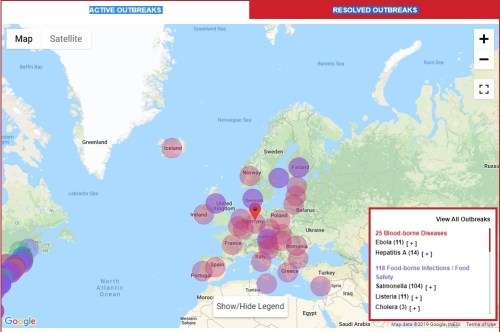
Information – The Contagion® Outbreak Monitor

Contagion Live

I came across this which is quite an interesting tool for looking at outbreaks.

cm


The Contagion® Outbreak Monitor provides details on the number of confirmed cases, deaths, and recent website articles on infectious disease outbreaks.
Use the Contagion® Outbreak Monitor to learn about infectious disease outbreaks in your geographical region and manipulate the map to find out the latest information on global outbreaks. Click on “Trends” to learn more about trends in the number of cases and deaths.

Norway – 13 sick: Some had eaten rakfish: — more affected by mysterious listeria outbreaks in eastern Norway

BArfblog

News Beezer reports that shortly before Christmas, the Norwegian Institute of Public Health announced that there had been six reports of a new outbreak of Listeriosis. Today it was known that this number has increased significantly and that the affected area is also larger than previously known. So far, five patients have detected bacteria with a similar DNA profile.

Research – Listeria monocytogenes risk associated with chicken at slaughter and biocontrol with three new bacteriophages

Wiley Online

Abstract

The aim of this study was to isolate Listeria monocytogenes from chicken neck skins and lytic bacteriophages from poultry slaughterhouse wastewaters, and following the characterization of the isolates, biocontrol of L. monocytogenes was investigated on chicken drumsticks with the isolated phages. L. monocytogenes prevalence was detected 12.3% in the chicken samples and the dominant serotype was determined as 1/2a (92.5%). Expression levels of major virulence genes were revealed by real‐time RT‐PCR. Ten different DNA profiles were detected by ERIC‐PCR fingerprinting. According to the MIC results, LM‐P75 was defined as MDR by showing resistance to antibiotics in six different groups. Besides, five lytic listeriophages were isolated from wastewaters and treated with Cla1 and Sac1. Taking EoP, TEM, in vitro, and in vivo analyses results into consideration, three bacteriophages were used for the biocontrol assay. The application of the bacteriophages on drumsticks achieved a reduction up to 3.3 log CFU/ml in L. monocytogenes count in 3 hr of incubation at 4°C.

Practical applications

Our results showed that in spite of the developments in hygiene practices during slaughtering, chicken meat is still a potential source for L. monocytogenes. On the other hand, the phage cocktail that used in this study can be an effective tool to reduce L. monocytogenes in chicken carcasses at final wash or at cooling step in poultry slaughtering process, as well as in decontamination of chicken meat parts.